
Table of Contents
- Why Monocrystalline Panels Are Better Suited to Most Solar Lights
- Why the Solar Panel Matters So Much in a Solar Light
- What Is a Monocrystalline Solar Panel?
- What Is a Polycrystalline Solar Panel?
- The Third Option You'll Find on Cheap Solar Lights: Amorphous Silicon
- Monocrystalline vs. Polycrystalline: Side-by-Side Comparison
- Head-to-Head: How the Two Panel Types Compare for Solar Lighting
- Beyond Mono vs. Poly: What Really Determines Solar Light Performance
- How to Tell Which Panel a Solar Light Has
- Getting the Most From Either Panel Type
- Conclusion
- FAQs
Pick up any two solar garden lights in a store and they may look almost identical: similar housing, similar LED, similar price tag. Turn them over, though, and you'll often find two very different solar panels on top. One is a uniform, deep black square. The other is a shimmering, speckled blue. That small panel is the single most important factor in how bright your light shines, how long it runs each night, and how many seasons it lasts before it gives up.
Most comparisons of monocrystalline and polycrystalline panels are written for rooftop systems that span hundreds of square feet. Solar lights are a completely different engineering problem. The panel might be smaller than a coaster, it sits at ground level among plants and mulch, and it has to fill a battery every single day with no help from the grid. In that setting, the differences between the two technologies are magnified rather than diluted.
This guide explains how each panel type works, compares them on every metric that matters for outdoor lighting, and shows you how to choose the right one for pathways, spotlights, wall lights, and security lighting in different US climates.
Why Monocrystalline Panels Are Better Suited to Most Solar Lights
For the vast majority of solar lights, monocrystalline panels are the better choice. They convert more sunlight into electricity per square inch. They charge more effectively on cloudy and winter days, lose less output in summer heat, and degrade more slowly over time. Because solar lights have so little room for a panel, that efficiency advantage translates directly into brighter output and longer runtime.
Polycrystalline panels still have a place. They can make sense for low-output decorative lights in sunny locations, for fixtures with plenty of room for a larger panel, and for buyers whose main priority is the lowest upfront price. They are not a bad technology. They are simply less suited to the tight space and demanding conditions of most solar lighting.
That said, the panel type is only part of the story. A well-built polycrystalline light with a durable surface and a properly matched battery will outperform a poorly made monocrystalline light. We'll cover what to look for beyond the label later in this guide.
Why the Solar Panel Matters So Much in a Solar Light
To understand why panel choice matters, it helps to look at how a solar light operates as a system. Among the main parts of a garden light, a solar model adds four components that work together: the photovoltaic panel, a rechargeable battery, a charge controller, and a light sensor.
During the day, a solar light’s panel converts sunlight into direct current. A charge controller regulates the flow of electricity to the battery, which stores the energy for use after dark. In a solar pathway light, for example, a sensor detects the fading daylight and switches on the LED, which draws power from the battery to illuminate the path.
The key insight is this: the panel is the only source of energy the light will ever have. Every lumen the LED produces at night must first be harvested by the panel during the day. If the panel underperforms, the battery never fills, the light dims early, and the battery itself suffers from chronic undercharging.
Unlike a rooftop system, a solar light cannot simply add more panels to compensate. The panel size is fixed by the fixture's design, often somewhere between 10 and 150 square centimeters for garden stake and pathway lights. That makes power density, meaning how much electricity a panel generates per unit of area, the defining metric for solar lighting. This is exactly where the two technologies differ most.
What Is a Monocrystalline Solar Panel?
Monocrystalline cells are cut from a single, continuous crystal of silicon. Manufacturers grow this crystal by slowly drawing a seed crystal out of a bath of molten, high-purity silicon. This produces a cylindrical ingot with a perfectly uniform atomic structure. The ingot is then sliced into thin wafers, which are treated, fitted with electrical contacts, and assembled into cells.
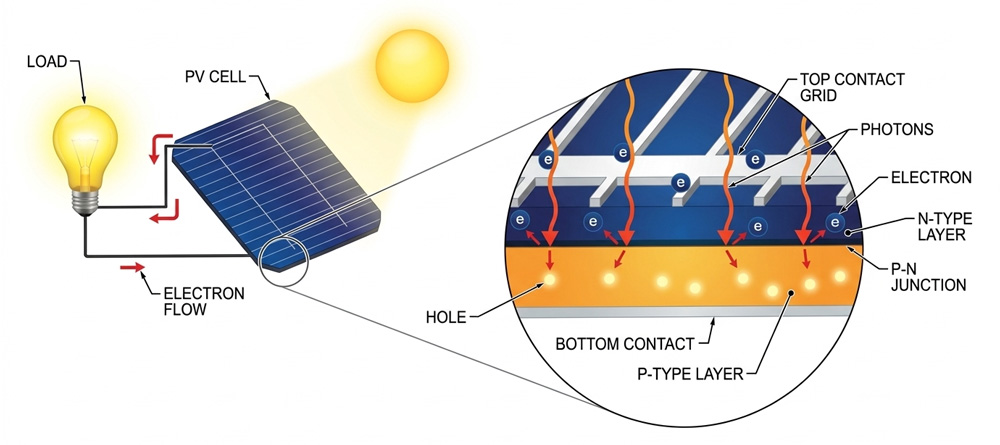
Operating principle of a monocrystalline silicon solar cell, illustrating photon absorption, electron–hole pair generation, charge carrier separation across the PN junction, and electric current generation through an external circuit.
Because the entire wafer has one unbroken crystal lattice, electrons freed by sunlight can move through the material with minimal resistance. There are no internal boundaries to trap or scatter them. This is the fundamental reason monocrystalline cells achieve higher efficiency.
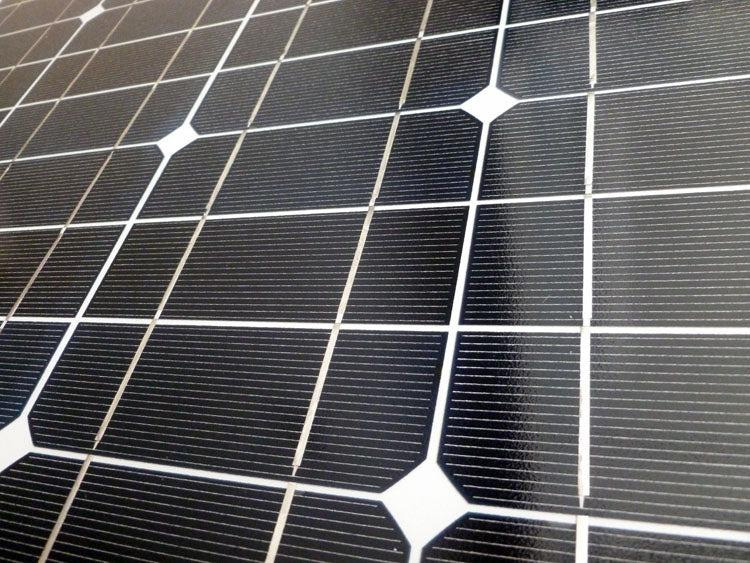
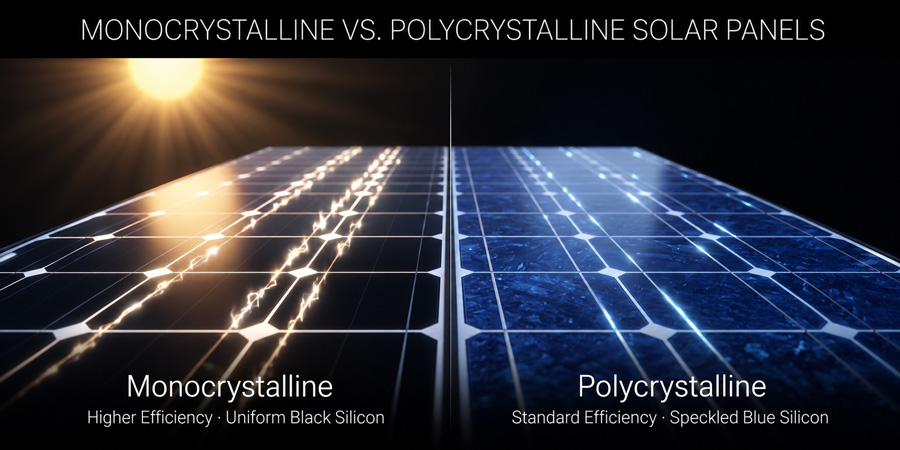
How to recognize them: Monocrystalline cells have a uniform black or very dark color. On larger panels the cells often have clipped corners, a leftover from the round ingot shape. On the small panels used in solar lights, you'll typically see a smooth, even black surface. Fine silver contact lines may run across it.
Typical cell efficiency: Roughly 18% to 23% for the cell grades commonly used in quality solar lights. Advanced cell architectures can push higher.
What Is a Polycrystalline Solar Panel?
Polycrystalline cells, sometimes called multicrystalline, are made by melting silicon fragments together and letting the material cool in a square mold. Instead of forming one uniform crystal, the silicon solidifies into many small crystals with random orientations. The resulting block is sliced into square wafers.
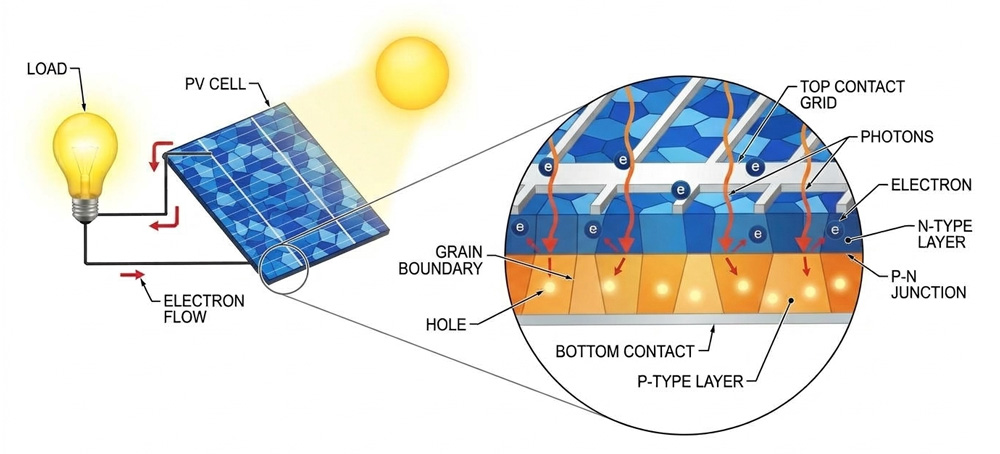
Operating principle of a polycrystalline silicon solar cell, illustrating photon absorption, electron–hole pair generation, charge carrier separation at the p–n junction, the presence of grain boundaries, and electron transport through the external circuit to generate electrical power.
The boundaries where these crystals meet act as obstacles for electrons. Some of the energy freed by sunlight is lost at these grain boundaries before it can be collected as usable current. This is why polycrystalline cells are less efficient than monocrystalline cells made from the same base material.
The upside is that the manufacturing process is simpler, wastes less silicon, and historically cost less. That made polycrystalline panels the default choice for budget solar products for many years.
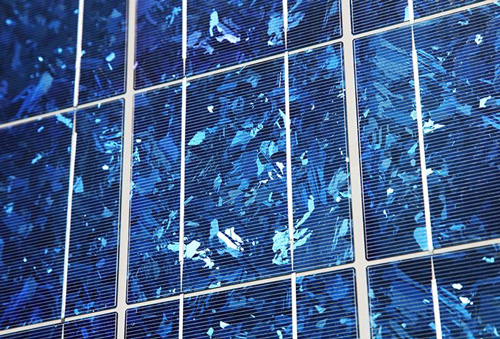
How to recognize them: Polycrystalline cells have a blue color with a visible, shimmering texture. It looks almost like a mosaic or crushed ice, created by the many individual crystals reflecting light at slightly different angles.
Typical cell efficiency: Roughly 15% to 18%.
The Third Option You'll Find on Cheap Solar Lights: Amorphous Silicon
Many competitor guides skip this, but anyone buying solar lights should know about it. The least expensive solar lights often use neither monocrystalline nor polycrystalline cells. Instead, they use amorphous silicon, a thin-film technology where a very thin layer of non-crystalline silicon is deposited onto glass or another base.
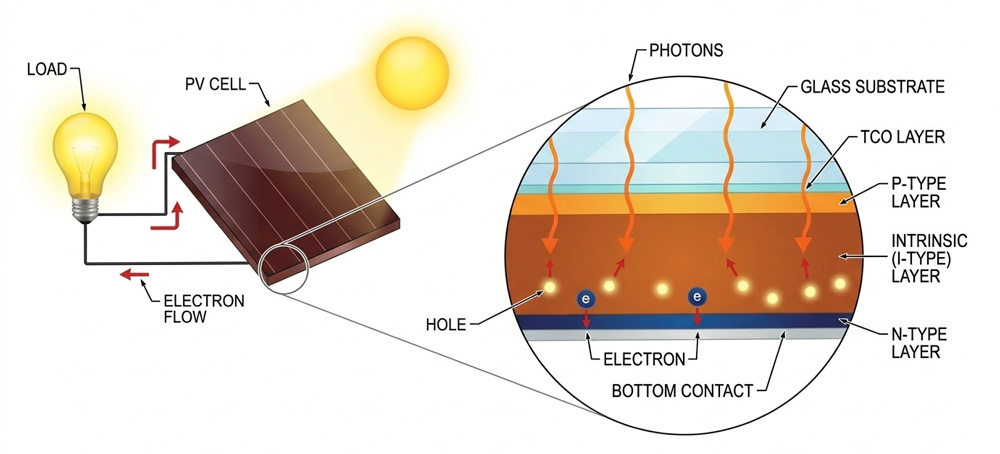
Operating principle of an amorphous silicon solar cell, illustrating photon absorption, electron–hole pair generation within the intrinsic (i-type) layer, charge carrier separation across the p–i–n junction, and electrical current generation through the external circuit.
Amorphous panels typically appear as a uniform reddish-brown or dark gray surface with fine horizontal stripes. They are cheap to produce and perform reasonably under very weak light. That's why they are common on calculators. However, their outdoor efficiency is low, usually around 6% to 10%. They also lose a noticeable portion of their output during their first months of sun exposure.
For a solar light that needs to fill a battery every day, amorphous panels are generally the weakest option. If a solar light seems unusually inexpensive and its panel looks brownish with thin stripes, that is likely what you're looking at.
Monocrystalline vs. Polycrystalline: Side-by-Side Comparison
| Factor | Monocrystalline | Polycrystalline |
|---|---|---|
| Silicon structure | Single continuous crystal | Many fused crystal fragments |
| Typical cell efficiency | ~18%–23% | ~15%–18% |
| Panel area needed for 2 W* | ~100 cm² | ~125 cm² |
| Low-light / cloudy performance | Better | Fair |
| Temperature coefficient | About −0.30% to −0.40% per °C | About −0.40% to −0.50% per °C |
| Typical annual degradation | ~0.25%–0.5% | ~0.5%–1% |
| Appearance | Uniform black | Speckled blue |
| Upfront cost | Slightly higher | Slightly lower |
| Best suited to | Compact, high-output, all-season lights | Low-output decorative lights in sunny spots |
*Approximate figures at standard test conditions (1,000 W/m² of sunlight). Real-world output depends on the panel's surface coating, lamination quality, and installation conditions.
Head-to-Head: How the Two Panel Types Compare for Solar Lighting
1. Conversion Efficiency and Power Density
Efficiency describes what percentage of incoming sunlight a panel converts into electricity. For solar lights, it matters because it determines how much energy fits into a fixed panel size.
Fraunhofer ISE found that the monocrystalline modules it tested reached a median efficiency of about 20% in 2022, while the polycrystalline modules in the same study had leveled off near 17% (Kräling et al., 2022).
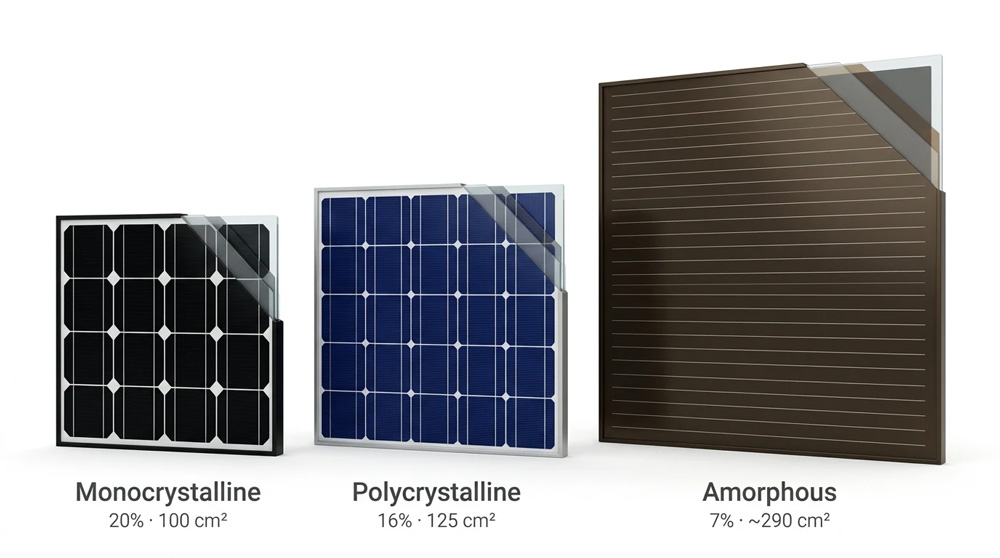
Here's a simple example. Under full sun, roughly 1,000 watts of solar energy reach each square meter of ground. A panel that is 20% efficient produces about 200 watts per square meter. That works out to about 2 watts from a 10 × 10 cm panel. A 16% efficient polycrystalline panel needs about 125 cm² to produce the same 2 watts. An amorphous panel at 7% would need nearly 290 cm².
Now apply that to a light's daily energy budget. Suppose a solar light gets the equivalent of four hours of full sun per day. After real-world charging and conversion losses of around 25%, a 2-watt panel delivers about 6 watt-hours to the battery. That's enough to run a 0.5-watt LED for 10 to 12 hours. Shrink the panel's output by 20% and the same light may cut out around 2 a.m. instead of running until dawn.
Verdict: Monocrystalline wins clearly. In a product where panel space is the main limit, higher power density means either a brighter light, a longer runtime, or a more compact fixture.
2. Low-Light, Cloudy, and Winter Performance
Solar lights rarely enjoy perfect conditions. Overcast skies, morning haze, short winter days, and low sun angles all reduce the energy reaching the panel.
Monocrystalline cells generally respond better in diffuse light. Their pure structure makes better use of the limited photons available. Polycrystalline panels still produce power under clouds, but their already lower output falls further, and the gap matters more when the daily energy budget is tight.
On a heavily overcast day, a panel might receive only 10% to 25% of its usual sunlight. Whether solar lights charge on a cloudy day at all depends heavily on panel efficiency. A stronger panel can still put meaningful energy into the battery. A weaker one may produce almost nothing.
Winter adds a second problem: fewer daylight hours combined with a low sun angle. Across northern US states, December can deliver less than half the usable solar energy of June. Whether solar powered lights work in the winter in your area often comes down to having an efficient monocrystalline panel paired with an adequate battery.
Verdict: Monocrystalline wins, and the advantage grows the further north you live.
3. Performance in Partial Shade
Garden lights are often placed among shrubs, under trees, or beside fences, where shadows move across the panel through the day. Both panel types suffer under shade, because shading even one cell in a series can limit the current of the whole string.
In a field test of series-connected crystalline silicon modules, the percentage of power lost could far exceed the percentage of the surface in shadow (Deline, 2009).
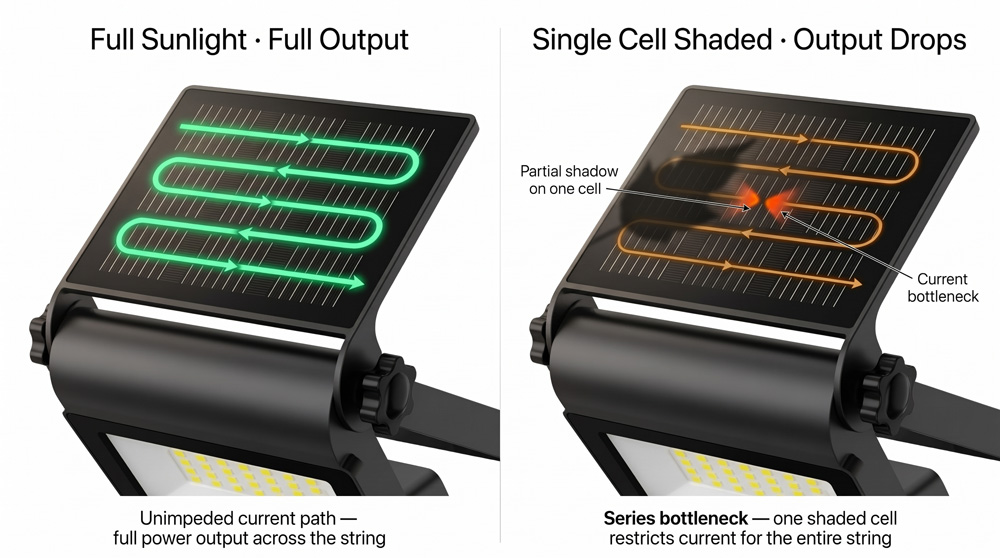
Although solar lights can still charge in partial shade, both panel types produce less electricity when shadows fall across their cells. Moving the panel to a spot that stays sunny longer usually improves daily charging more than switching panel types. If a fixture gets direct sun only in the morning, a monocrystalline panel will typically generate more electricity during those hours than a polycrystalline panel of the same size, leaving more energy available to power the light after dusk.
Verdict: Slight edge to monocrystalline, but placement is the bigger factor.
4. Heat Performance and Temperature Coefficient
This is counterintuitive: solar panels produce less power as they get hotter. Efficiency ratings are measured at a cell temperature of 25°C (77°F). A dark panel on a summer afternoon can easily reach 60°C to 70°C, especially a small light sitting on hot pavement or dark mulch.
The temperature coefficient tells you how much output a panel loses for each degree above 25°C. Monocrystalline panels typically lose about 0.30% to 0.40% per °C. Polycrystalline panels typically lose 0.40% to 0.50% per °C. At a panel temperature of 65°C, that means:
- A monocrystalline panel loses roughly 12% to 16% of its rated output.
- A polycrystalline panel loses roughly 16% to 20%.
In places with long, hot summers, including parts of Arizona, Texas, Florida, and Southern California, two panels with the same rated wattage can deliver different amounts of energy. The panel that loses less power as it heats up can supply more electricity on sunny afternoons. If temperatures regularly rise above the fixture’s recommended operating range, the battery can also lose capacity faster, leaving less energy available after dark.
Verdict: Monocrystalline wins, particularly in the South and Southwest.
5. Lifespan and Degradation
All silicon panels slowly lose output over time. Monocrystalline panels typically degrade at around 0.25% to 0.5% per year. Polycrystalline panels typically degrade at around 0.5% to 1% per year.
Over the five to ten years of a solar light's realistic service life, the cell degradation itself is modest for both types. In practice, the small panels on solar lights rarely fail because of the silicon. They fail because the protective surface yellows, cracks, or lets in moisture, or because the battery wears out. That's why lamination quality, covered below, matters so much.
Some solar lights have removable panels, so if an aging panel no longer produces enough power to keep the battery charged, replacing it can extend the life of the fixture. When replacing the solar panel on a garden light, for example, choose one that matches the original panel’s rated voltage and fits the existing mount.
Verdict: Monocrystalline has a modest edge on cell longevity, but construction quality decides real-world lifespan.
6. Appearance and Design Integration
Solar lights are decorative objects as much as functional ones. A monocrystalline panel's uniform black finish blends easily with black, bronze, dark gray, and charcoal fixture housings, which are the dominant finishes in modern outdoor lighting. It looks cleaner and more deliberate, especially on minimalist wall lights and spotlights.
Polycrystalline panels' blue, speckled appearance is more visible and can look out of place on dark, architectural fixtures. Some people like the shimmering, "technical" look on rustic or decorative garden lights. Overall, though, the market has moved toward black panels for aesthetic reasons as well as performance.
Verdict: Monocrystalline for most modern designs, though appearance is ultimately a matter of taste.
7. Cost: Upfront Price vs. Cost Per Year of Service
Polycrystalline panels were long the budget option, and they can still lower the price of entry-level solar lights. However, as global manufacturing has shifted heavily toward monocrystalline technology, the price gap has narrowed a lot. For small panels used in lighting, it's often a minor part of the fixture's total cost.
A more useful way to think about value is cost per year of reliable service. Consider a light that costs a little more but runs all night year-round and lasts five years. That typically costs less per year than a cheaper light that dims by midnight and needs replacing after two seasons. It also produces less waste.
Verdict: Polycrystalline wins on sticker price; monocrystalline usually wins on long-term value.
8. Environmental Footprint
Both panel types are made from silicon, and both offset their manufacturing energy over their working life. Monocrystalline production uses more energy per wafer and creates more silicon waste during slicing. Polycrystalline production is less energy-intensive per wafer but yields a less efficient product.
Because monocrystalline panels generate more energy per unit of material and tend to stay in service longer, their lifetime footprint is broadly comparable or better. Whether you’re choosing a solar security light for a driveway or eco-friendly outdoor lights for a garden path, look for an efficient panel and a fixture built to last.
Verdict: Roughly even per panel; durable, efficient lights are the greener choice overall.
Beyond Mono vs. Poly: What Really Determines Solar Light Performance
A crystalline label on the box tells you part of the story. These factors often make a bigger difference to how a solar light performs in your yard.
Panel Surface and Lamination
The silicon cell is fragile, so it is sealed under a protective layer. On solar lights, that layer varies enormously in quality:
- Epoxy resin: Common on the cheapest lights. It yellows and clouds under UV exposure, sometimes within a single season, which steadily blocks sunlight from reaching the cell.
- PET film: A clear plastic laminate that's an improvement over epoxy, but it can yellow and delaminate after a few years of intense sun.
- ETFE film: A highly UV-resistant fluoropolymer with excellent light transmission and self-cleaning properties. It stays clear for many years and is a mark of a better-quality light.
- Tempered glass: The most durable option, with strong resistance to scratches, hail, and UV. It's common on larger solar spotlights and wall lights.
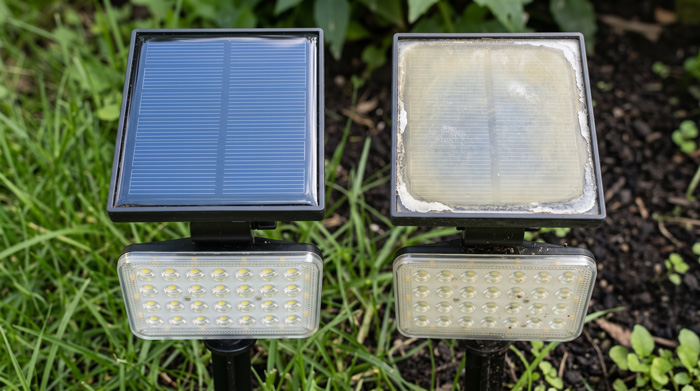
The spotlight on the left has a clear solar panel cover, while the yellowing and haze on the right can limit how much sunlight reaches the cells.
A premium monocrystalline cell under cheap epoxy can underperform a polycrystalline cell under ETFE within two years. When comparing products, the surface material deserves as much attention as the cell type.
Panel-to-Battery Matching
A strong panel is wasted if the battery is too small to store its output. Likewise, a large battery is useless if the panel can never fill it. Well-designed solar lights size the panel so it can fully recharge the battery within a normal day, with some reserve for cloudy weather.
Battery chemistry matters as well. Lithium iron phosphate (LiFePO4) handles more charge cycles and higher temperatures than older nickel-based batteries.
Sealing and Weather Protection
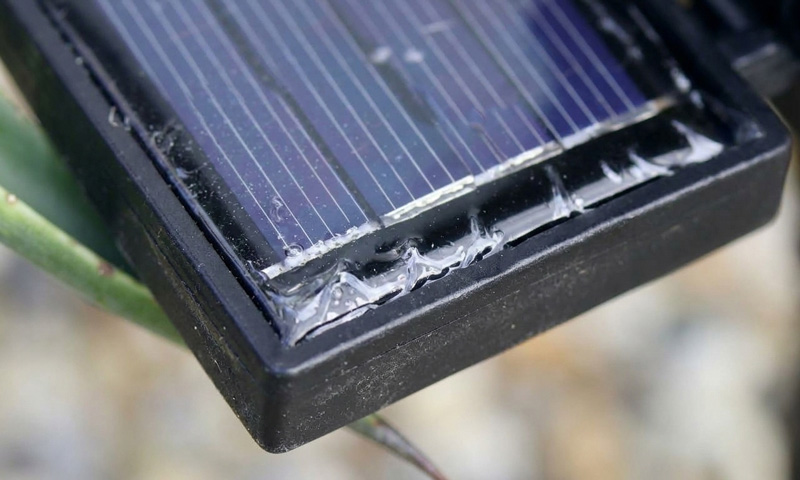
The sealant around the solar panel perimeter helps secure the joint between the panel and the light housing.
Moisture can seep in around the edges of a poorly sealed solar panel and corrode the electrical contacts beneath it. For outdoor lights exposed to rain or sprinklers, an IP65 rating means the enclosure is dust-tight and resists water jets from any direction.
Whether the panel is monocrystalline or polycrystalline, an undersized battery can run out of charge before dawn. Over time, a yellowing panel cover lets less sunlight reach the cells, while a cracked seal leaves the wiring vulnerable to moisture. Either problem can shorten the life of a solar light even when the cells themselves still work.
How to Tell Which Panel a Solar Light Has
Product listings don't always state the panel type clearly. You can usually identify it yourself in a few seconds:
- Check the color. Uniform black or very dark gray usually means monocrystalline. Blue usually means polycrystalline. Reddish-brown or dark brownish-gray points to amorphous thin-film.
- Look at the texture. Monocrystalline looks smooth and even. Polycrystalline shows a speckled, mosaic-like pattern that changes as you tilt it. Amorphous often shows thin, evenly spaced horizontal stripes.
- Inspect the surface. A glossy, thick, slightly domed surface is often epoxy. A thin film with a subtle texture may be PET or ETFE. A hard, cool-to-the-touch surface is likely glass.
- Read the specifications. Reputable products list the panel type, rated wattage, and voltage. Vague descriptions such as "high-efficiency solar panel" with no numbers deserve skepticism.
Getting the Most From Either Panel Type
Whichever panel your lights use, these practices make a measurable difference:
- Choose a spot with several hours of sun. Solar lights charge best in direct sunlight. Check the spot in both the morning and afternoon, since a tree or fence may shade the panel for part of the day.
- Angle the panel toward the south. In the US, a south-facing panel collects the most energy. Tilting adjustable panels more steeply in winter helps capture the lower sun.
- Keep the panel surface clean. Dust, pollen, and bird droppings can block sunlight from reaching the cells. When cleaning a solar light’s panel, rinse off loose grit first, then use a soft, damp cloth to gently wipe away residue without scratching the protective surface.
- Clear snow and fallen leaves. A covered panel produces essentially nothing.
- Give new lights a full first charge. Let new lights charge in full sun for a day or two with the switch off so the battery starts fully charged.
Conclusion
When it comes to monocrystalline vs. polycrystalline solar panels for solar lights, the comparison is more one-sided than it is for rooftop systems. Solar lights work with very little panel area, face shade, heat, clouds, and short winter days, and must fill a battery every day without help. Monocrystalline panels handle all of these challenges better. They offer higher power density, stronger low-light performance, better heat tolerance, slower degradation, and a cleaner look.
Polycrystalline panels remain a reasonable budget option for low-output decorative lights in consistently sunny locations. For anything that needs to reliably light a path, highlight a feature, or provide security, monocrystalline is worth the modest extra cost.
Remember to look beyond the cell type. A durable panel surface, a properly matched battery, and solid weather sealing determine how a solar light performs not just this season but for years to come.
FAQs
Does a higher-wattage solar panel make solar lights brighter?
Not directly. The light's brightness is set by the LED and its driver circuit. The panel's job is to keep the battery charged. A higher-wattage panel helps the light reach its full rated brightness more consistently and run for its full duration, especially after cloudy days, but it won't push the LED beyond its design output.
What do PERC, half-cut, and TOPCon mean on solar light panels?
These are advanced monocrystalline cell technologies. PERC (Passivated Emitter and Rear Cell) adds a reflective layer to the back of the cell, so light that passes through gets a second chance to be absorbed. This improves efficiency and low-light performance. Half-cut cells are standard cells cut in half to reduce internal resistance and limit losses from partial shading. TOPCon (Tunnel Oxide Passivated Contact) is a newer, higher-efficiency design that has become a mainstream standard in larger solar modules. On solar lights, seeing any of these terms is generally a sign of a higher-grade monocrystalline panel.
Can monocrystalline solar lights charge under indoor or artificial light?
Yes, but charging is limited under ordinary indoor lighting. Both monocrystalline and polycrystalline panels can generate electricity from artificial light, though a typical household lamp delivers far less energy to the cells than direct sunlight. Even after a full day under a lamp, a solar light is unlikely to gain enough charge to run through the night.
How can I tell whether my solar light's panel or its battery is failing?
When troubleshooting a solar light that won’t charge, start with a clean panel and a full day of direct sun. With the switch on, cover the panel or the separate light sensor to simulate dusk. If the LED starts bright but fades within an hour or two, the battery may be losing capacity. If it barely lights at all, check the panel cover for yellowing, cloudiness, or cracks that could reduce charging. If the panel can be disconnected, you can also measure its voltage in direct sun with a multimeter. A reading well below its rated open-circuit voltage points to a possible panel or wiring fault.
How long does a solar light with a monocrystalline panel need to fully charge?
For many solar lights with monocrystalline panels, six to eight hours of direct sunlight is a reasonable estimate for a full charge. The panel’s wattage, the battery’s capacity, and how much energy the light used overnight all affect how long a solar light takes to recharge. A polycrystalline or amorphous panel of the same size may need longer to recharge the same battery. On short or cloudy days, any of these lights may reach dusk with only a partial charge.
