

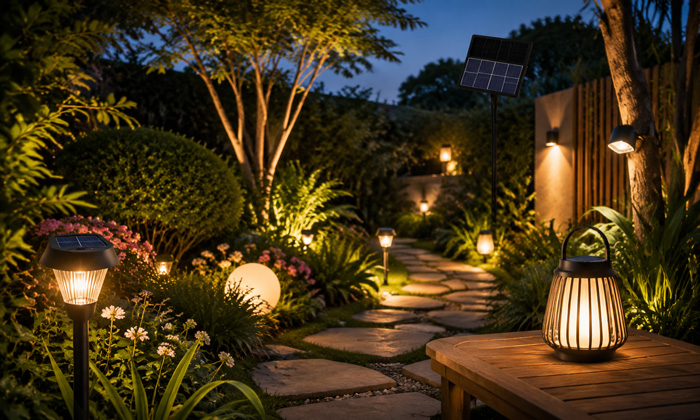
Best Eco-Friendly Garden Lighting Options
1. Solar-Powered LED Path Lights
2. Motion-Sensor LED Lights
3. Low-Voltage LED Landscape Lights
4. Solar LED String Lights
5. Shielded Warm-White Fixtures
How to Choose the Right Eco-Friendly Outdoor Lights
Which Option Is Best?
FAQs
Eco-friendly outdoor lighting should do more than reduce electricity use. The best garden lights also minimize light pollution, operate only when needed, withstand outdoor conditions, and provide enough illumination without overpowering the landscape.
For most gardens, the strongest options are solar-powered LED lights, motion-sensor fixtures, low-voltage LED spotlights, warm-colored pathway lights, and energy-efficient string lights.
Best Eco-Friendly Garden Lighting Options
|
Lighting Type |
Best For |
Main Environmental Benefit |
What to Check |
|---|---|---|---|
|
Solar LED path lights |
Paths, borders and flower beds |
Uses renewable solar energy and requires no wiring |
Replaceable battery, durable solar panel and weather resistance |
|
Motion-sensor LED lights |
Entrances, gates and security areas |
Operates only when movement is detected |
Adjustable sensitivity, timer and detection range |
|
Low-voltage LED spotlights |
Trees, walls and garden features |
Uses less energy than traditional landscape lighting |
Directional beam, transformer efficiency and brightness |
|
Solar string lights |
Pergolas, patios and decorative areas |
Combines low-energy LEDs with solar charging |
Cable durability, charging time and lighting duration |
|
Shielded warm LED fixtures |
Walkways and seating areas |
Reduces glare, wasted upward light and excessive brightness |
Full shielding and a color temperature of 2700K or lower |
1. Solar-Powered LED Path Lights
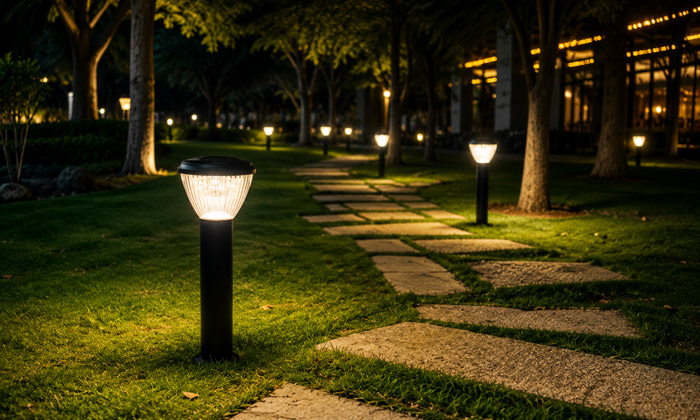
Solar LED path lights are often the best choice for gardens that receive several hours of direct sunlight each day. Their built-in panels charge during daylight and power the lights after sunset, eliminating the need for underground wiring or grid electricity.
They work especially well along pathways, lawn edges, driveways and planting beds. However, product quality varies considerably. A good solar light should have an efficient panel, a weather-resistant housing and a rechargeable battery that can be replaced instead of requiring the entire fixture to be discarded.
Avoid extremely cheap models with sealed batteries and fragile plastic components. A longer-lasting fixture is usually more sustainable than a disposable product, even when both are solar powered.
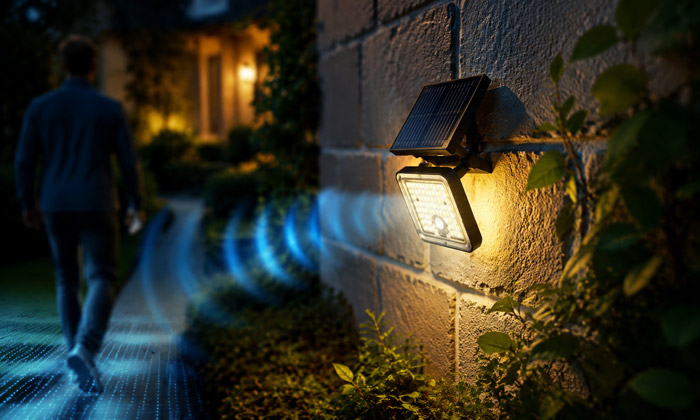
Motion-sensor lights are ideal for gates, entrances, sheds, steps and other areas that do not need continuous illumination. They switch on only when activity is detected, reducing unnecessary energy consumption and limiting nighttime light exposure.
The U.S. Department of Energy recommends lighting controls such as motion detectors because they allow exterior lighting to respond to real-time activity rather than remaining at full brightness throughout the night.
Choose a fixture with adjustable sensitivity, brightness and operating duration. This prevents the light from being activated repeatedly by small animals, moving branches or distant pedestrians.
3. Low-Voltage LED Landscape Lights
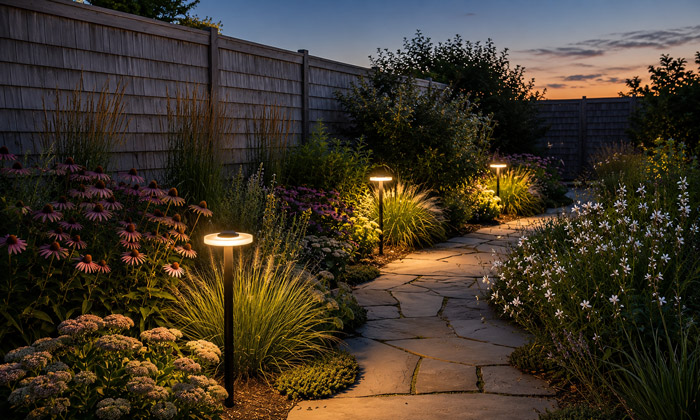
Low-voltage LED systems are suitable for larger gardens or spaces that need reliable lighting throughout the year. They can illuminate trees, sculptures, walls, water features and architectural details more consistently than solar fixtures.
LED products are considerably more efficient than traditional incandescent bulbs. ENERGY STAR states that LED lighting can produce light up to 90% more efficiently than incandescent lighting, making LEDs a practical foundation for energy-conscious garden design.
For the best results, use narrow, directional beams and aim them downward. Lighting a specific plant or pathway requires less power than flooding an entire garden with bright, unfocused light.
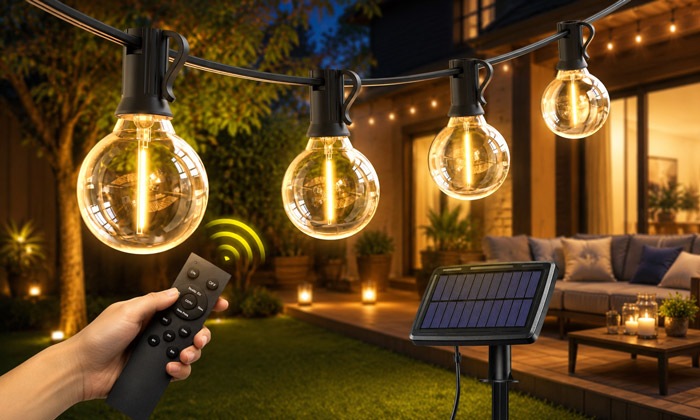
Solar string lights provide gentle decorative lighting for pergolas, fences, patios, balconies and outdoor dining areas. Because they use small LEDs, they need relatively little energy and can operate effectively with a compact solar panel.
Select warm white lights rather than cool white or blue-toned products. Warm lighting creates a more comfortable atmosphere and is less disruptive to the nighttime environment.
Look for models with automatic dusk operation, multiple brightness settings and a manual off switch. Decorative lighting should not remain illuminated after the garden is no longer being used.
5. Shielded Warm-White Fixtures
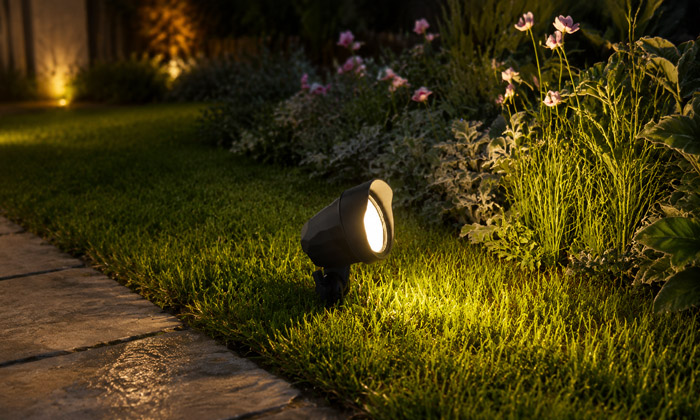
An outdoor light is not truly eco-friendly simply because it uses an efficient bulb. Poorly directed lighting can waste energy by sending light into the sky, neighboring properties or areas that do not need illumination.
DarkSky recommends outdoor lighting that is useful, targeted, low-level, controlled and warm-colored. It also advises using timers or motion sensors so lights are dimmed or switched off when they are unnecessary.
For garden fixtures, choose a warm or amber color temperature of 2700K or lower whenever possible. DarkSky specifically recommends this range for more night-friendly residential lighting.
Fully shielded fixtures are particularly effective because they direct light toward the ground instead of allowing it to shine upward or outward.
How to Choose the Right Eco-Friendly Outdoor Lights
Start by deciding which areas genuinely need illumination. Paths and steps may need low-level safety lighting, while entrances may benefit from motion-activated fixtures. Trees, walls and decorative features usually need only a small number of carefully positioned spotlights.
Brightness should be kept as low as practical. More lumens do not automatically create a better garden. Excessive brightness produces glare, wastes energy and can make nearby darker areas more difficult to see.
Durability is equally important. Choose fixtures made from corrosion-resistant metal or high-quality weather-resistant materials. Replaceable bulbs, batteries and components can extend the product’s useful life and reduce waste.
Controls should also be treated as an essential feature. Timers, dusk sensors, dimmers and motion detectors prevent lights from operating unnecessarily. ENERGY STAR notes that smart lighting controls can help reduce energy use by switching lights off automatically and managing their operation more efficiently.
For sunny gardens and simple pathway lighting, solar LED lights are usually the most convenient choice. For entrances and security areas, motion-sensor LEDs offer better reliability while avoiding continuous energy use.
Low-voltage LEDs are the best option for permanent landscape lighting or gardens with limited sunlight. Solar string lights are suitable for decoration, while shielded warm-white fixtures provide the most responsible solution for frequently used seating and walking areas.
In many gardens, the best approach is a combination: solar lights for pathways, motion sensors near entrances and a small number of low-voltage LEDs for important landscape features. Keeping every fixture warm, targeted and controlled creates a garden that is attractive, functional and genuinely eco-friendly.
What IP rating is best for outdoor garden lights?
Garden lights should have a minimum rating of IP44 for sheltered locations.
Fixtures exposed to heavy rain, sprinklers, or soil moisture should generally be rated IP65 or higher. Lights installed near ponds or fountains may require IP67 or IP68 protection.
How far apart should garden pathway lights be placed?
Pathway lights are commonly positioned about 6 to 8 feet apart. The correct spacing depends on beam width, fixture height, and surrounding obstacles.
Staggering lights on opposite sides of a path can create balanced illumination without producing an overly bright, runway-like appearance.
Can outdoor lighting affect plant growth?
Artificial light at night can interfere with plant processes such as flowering, dormancy, and seasonal growth.
Fixtures should be directed away from sensitive plants and switched off when the garden is not in use. Lower-intensity lighting helps reduce prolonged exposure.
See also: What Impact Do Garden Lights Have on Plants and Animals?
How should old garden lights and batteries be recycled?
Outdoor fixtures, rechargeable batteries, solar panels, and LED components should not be placed in ordinary household waste when local recycling services are available.
Batteries should be removed and taken to an approved collection point, while electronic fixtures can be processed through an e-waste recycling program.
How often should eco-friendly garden lights be maintained?
Garden lights should be inspected every few months.
Clean solar panels and lenses, remove leaves and soil, check cables and seals, and reposition fixtures affected by plant growth. Regular maintenance improves charging performance, prevents moisture damage, and extends the useful life of the lighting system.
