

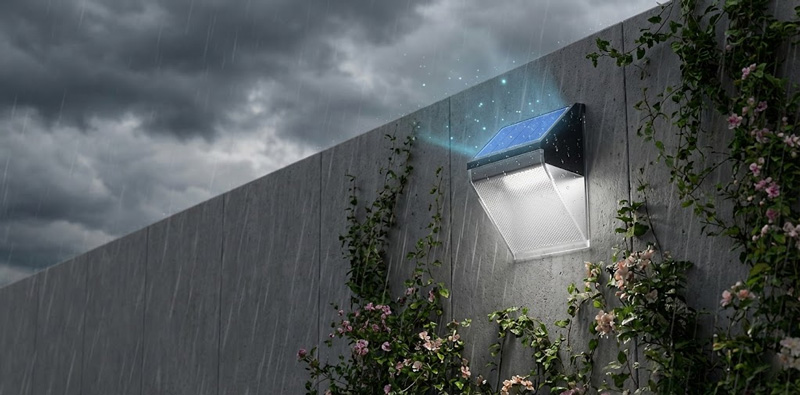
How Charging Works When the Sun Isn’t Out
What to Expect From Solar Garden Lights on Cloudy Days
Key Factors That Determine Whether They’ll Charge Well
“Bright But Cloudy” Can Still Work
Practical Tips to Improve Charging in Cloudy Weather
When Cloudy Days Won’t Be Enough
FAQs
Yes, it is possible to charge with solar lights on a cloudy day, although it would take a longer time to charge, causing the energy capacity of the battery to be less compared to charging it in the sunlight. In the event that the sun is cloudy, it is less likely that it would block the entire light, since there is diffused lighting in a cloudy sky, which can be converted into electricity.
Still, whether or not your lights charge sufficiently for an entire night's duration will be contingent on a host of factors, namely cloud density, quality of your solar panel, health of your battery, prevailing temperatures, and how long your light needs charging. Such considerations will be particularly important for garden lights that use small solar panels and batteries, which aren’t made for stockpiling a lot of power, only for being functional, space-saving, and easy to use.
How Charging Works When the Sun Isn’t Out
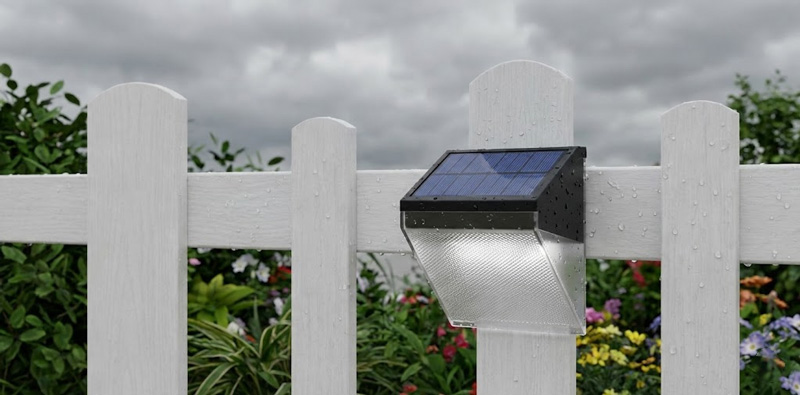
Figure 1. Model: LM-SL-904.
Solar lighting systems consist of photovoltaic cells that convert light into electrical energy. In situations where there is direct sunlight, the intensity of the sunlight is high; this leads to the battery of the lighting device being charged instantly. In situations where there are clouds, the intensity of the sunlight becomes diffused due to the scattering of the sunlight by the atmosphere.
- The faucet opens in full sunlight with the water turned high—fast fill.
- During heavy cloud, the faucet turn is decreased to slow filling.
- In stormy darkness, the faucet may be nearly off—that is, little to no fill.
Thus, the consequence of this particular requirement is that the true question would actually become, “How cloudy is ‘cloudy’?”
What to Expect From Solar Garden Lights on Cloudy Days
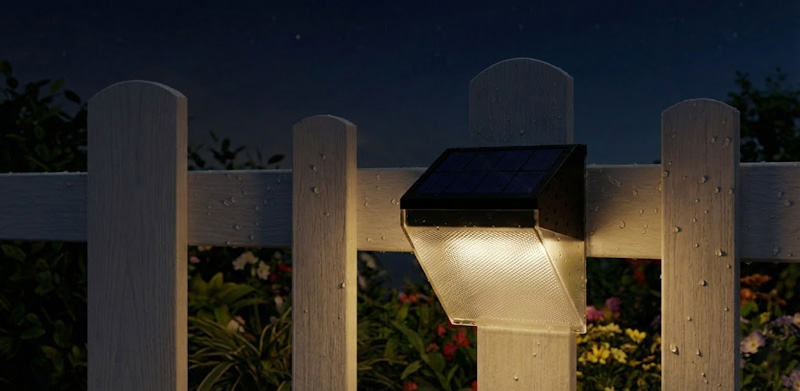
Since solar garden lights are small, often decorative, they demonstrate the effects of cloudy conditions more obviously than bigger solar units might.
What you might see on an actual cloudy day:
- Reduced night operating time (say 2–5 hours as compared to 6-10)
- Dimmed brightness, particularly in the latter part of the night
- Lights which turn on and then quickly fade
- Some units do not power on if the battery level is low
If the lights have had some cloudy nights, the battery may not have had the chance to fully recover between nights, effectively reducing its ability day by day.
Key Factors That Determine Whether They’ll Charge Well
Clouds matter, but they are just part of it. Such elements make the largest impact:
-
Thickness and type of clouds
Indeed, Thin clouds might still make charging possible; thick storm clouds may inhibit charging severely. -
Number of Hours of Daylight Available
More daylight can help make up for lower light intensity. Cloudy and short winter days may be a challenge together as a combination. -
Panel cleanliness
A Dust, pollen, or water spots may reduce the efficiency of charging. A quick wipe may help better than people think. -
Shading from trees or buildings
Having the sky cloudy and the area shaded lends an additional blow. Even partial shade can be detrimental. -
Battery age and capacity
For a battery A recharging battery has a finite lifetime. As batteries age, the charging time slows down, storing less energy, and the performance in cloudy conditions is further affected
-
Lighting mode & Power consumption
Some solar lights come with ‘bright’ settings, motion sensors, or colored options that consume more energy compared to basic pathway lights.
“Bright But Cloudy” Can Still Work
But here’s a surprising twist: some days when it’s cloudy, the brightness level is high enough to charge your lights. Just because it’s cloudy and your sky conditions aren’t good doesn’t mean it’s not bright outside, and your lights will likely get enough charges for a good evening’s power supply.
However, if the sky is sufficiently dark that you need light indoors, then solar charging is likely to be limited.
Practical Tips to Improve Charging in Cloudy Weather
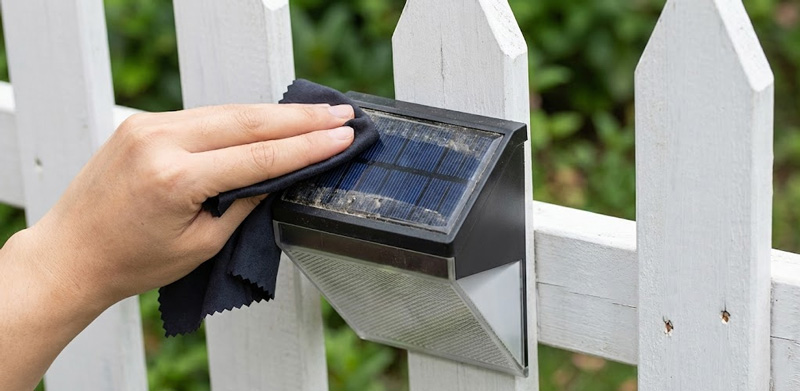
If you have solar garden lights and wish for even more improvement, the following are the generally regarded upgrades worth the costs:
-
Position lights where they get the most open sky
Move them away from fences, hedges, or tree canopies that interfere with daylight. -
Clean the panel on regular bases.
Use a soft cloth with a little water, not abrasive materials that scratch the surface.
-
Angle or tilt if possible the panel
Some fixtures allow adjusting the solar head. The better angle improves capturing more diffuse light. -
Use better-quality lights
Look for larger panels, improvements in batteries, and trusted water-resistance ratings. When considering cloudy environments, the quality of the panel is what counts. -
Replace old rechargeable batteries
A number of solar lights utilize AA/AAA batteries that are NiMH cells. Brand new batteries are effective at improving their performance. -
Care should be avoided near night ambient lighting
Bright porch lighting can interfere with the dusk sensor, resulting in intermittent or turned-off solar lighting.
When Cloudy Days Won’t Be Enough
Solar lights may have some difficulties charging if:
- Clouds are very thick, or it rains continuously.
- Most of the day, the lights are in shade
- The battery is near end-of-life
- You' ve had several overcast days in a row with limited recovery time
For these, solar garden lights may still "charge", but not enough to create meaningful night time lighting.
FAQs
Can solar garden lights be charged through windows or under porch roofs?
This is not optimal.
Standard glass, double glazing, and coated windows reduce and reflect sunlight, lowering the amount of energy reaching the solar panel.
Panels installed under porch roofs also lose direct access to the sky.
For reliable performance, solar panels should be installed outdoors with a clear, unobstructed view of the sky.
Will solar lights charge if it is bright outside?
There may be limited charging in bright shade, but efficiency is greatly reduced.
Photovoltaic panels require direct sunlight or strong diffuse daylight to charge effectively.
If a panel is installed in heavy shade, such as under dense trees or against walls, the stored energy is often insufficient for nighttime operation.
How long should solar lights be charged before their first use?
For initial setup, it is recommended to allow solar lights to charge for one to two full days.
This is especially important if the lights have been stored for a long period before installation.
The initial charging period helps the rechargeable battery reach stable operating capacity.
Do extreme temperatures affect charging and battery performance?
Yes.
High temperatures can accelerate battery degradation, while low temperatures reduce available capacity and operating voltage.
This can make the light appear dimmer or cause it to shut off earlier than expected.
Large temperature swings are a common contributor to early solar lighting system failure.
Why do solar lights sometimes turn off early even after a sunny day?
Common causes include moisture intrusion, a battery with high internal resistance, or a dirty or degraded solar panel surface.
Faulty charge-control circuitry or malfunctioning light sensors can also trigger premature shutdown.
In many cases, the issue is related to aging components rather than the amount of sunlight received.