

How Solar Panels Generate Electricity
Sunlight vs. Artificial Light
Can LED Lights Charge Solar Panels?
Can Fluorescent or Incandescent Lights Charge Solar Panels?
Why Artificial Light Charging Is Usually Inefficient
Situations Where Artificial Light Charging Makes Sense
The Role of Light Spectrum
Distance and Angle Matter
Can Artificial Light Fully Charge a Solar Battery?
FAQs
Solar panels are often associated with bright sunlight, clear skies, rooftops, and large outdoor solar farms. Because they are designed to convert light into electricity, many people naturally wonder whether solar panels can also be charged by artificial light. The simple answer is yes: solar panels can generate electricity from artificial light. However, the more important answer is that they usually do so much less efficiently than they do under direct sunlight. While it is technically possible to charge solar panels using lamps, LED bulbs, fluorescent lights, or other indoor lighting sources, the amount of electricity produced is generally small and often impractical for large-scale energy needs.
To understand why, it is helpful to look at how solar panels work, what kind of light they need, and why sunlight is so much more powerful than most artificial light sources.
How Solar Panels Generate Electricity
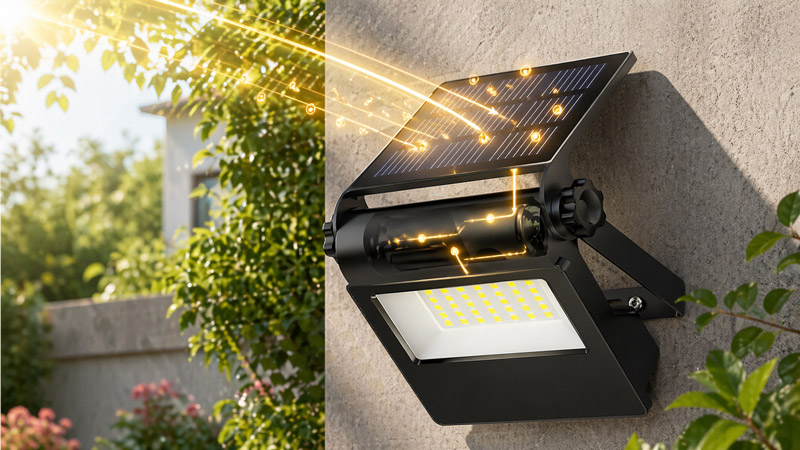
Solar panels are made of photovoltaic cells, often called PV cells. These cells are typically made from semiconductor materials such as silicon. When light hits the surface of a photovoltaic cell, photons from the light transfer energy to electrons in the semiconductor. This process causes electrons to move, creating an electric current. That current can then be used immediately, stored in a battery, or sent into an electrical system.
The important point is that solar panels do not necessarily require sunlight specifically. They require light. Any source of light that contains photons with enough energy can potentially produce electricity in a solar cell. This includes sunlight, artificial light, and even some specialized light sources used in laboratories.
However, not all light is equal. The amount of electricity a solar panel can generate depends on several factors: the intensity of the light, the spectrum of the light, the distance between the light source and the panel, the angle at which the light hits the panel, and the efficiency of the solar cell itself.

Sunlight is extremely powerful compared with ordinary indoor lighting. On a clear day, direct sunlight can deliver around 1,000 watts of power per square meter at the Earth’s surface. This is why solar panels are rated under standard test conditions that simulate bright sunlight. A 100-watt solar panel, for example, is expected to produce close to 100 watts only under strong, direct sunlight and ideal conditions.
Artificial indoor light is usually far weaker. A typical household bulb may seem bright to human eyes, but it produces much less usable energy for a solar panel than sunlight does. Human vision is highly sensitive, so a room can look well-lit even when the actual energy available to a solar panel is low. A solar panel placed under a desk lamp might produce some electricity, but the output may be only a tiny fraction of what the same panel would generate outdoors.
This difference explains why artificial light can charge solar panels in theory but is often inefficient in practice. The panel is not refusing to work; it simply is not receiving enough energy.
Can LED Lights Charge Solar Panels?
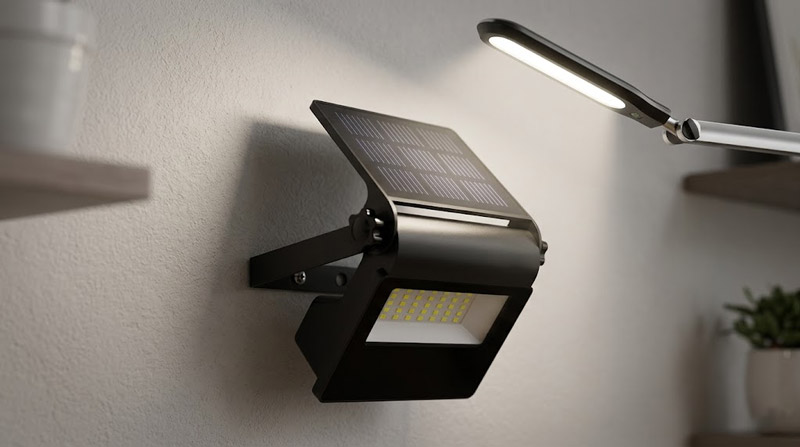
LED lights can charge solar panels, but usually at a low rate. LEDs are energy-efficient because they convert electricity into visible light with relatively little waste heat. That makes them excellent for lighting rooms, but it does not automatically make them excellent for charging solar panels.
A solar panel under an LED bulb may generate electricity if the light is close enough and bright enough. Small solar-powered devices, such as calculators, watches, garden lights, and indoor sensors, may be able to run or recharge under artificial lighting. In fact, some indoor photovoltaic cells are specifically designed to work well with LED lighting.
However, using LED lights to charge a standard outdoor solar panel is usually not practical. The reason is simple: you must use electricity to power the LED light, and then the solar panel converts only part of that light back into electricity. Energy is lost at every step. If the LED is powered by the grid, using it to charge a solar panel is normally less efficient than charging a battery directly from the electrical outlet.
See also: How to Charge Solar Lights Without Sun
Can Fluorescent or Incandescent Lights Charge Solar Panels?
Fluorescent lights can also produce electricity in solar panels. Some older indoor solar devices were designed to operate under fluorescent office lighting. Fluorescent bulbs emit a spectrum that can be usable for photovoltaic cells, especially those optimized for indoor environments.
Incandescent bulbs can charge solar panels too, but they are very inefficient for this purpose. Incandescent bulbs produce a lot of heat and relatively less visible light compared with LEDs. Much of their energy is emitted as infrared radiation, which many solar cells do not convert efficiently. As a result, using incandescent light to charge a solar panel wastes a large amount of electricity.
In both cases, the panel can respond to the light, but the energy return is usually poor.
Why Artificial Light Charging Is Usually Inefficient
The biggest issue with artificial light is energy conversion loss. Imagine you plug a lamp into a wall outlet. The electricity from the outlet powers the lamp. The lamp converts that electricity into light. The solar panel then receives only a portion of that light, because light spreads in many directions and not all of it lands on the panel. The panel then converts only a portion of the received light back into electricity.
At every stage, energy is lost. The lamp is not 100 percent efficient. The light does not all hit the solar panel. The solar panel is not 100 percent efficient either. Therefore, using artificial light to charge a solar panel is generally a losing process from an energy-efficiency perspective.
This does not mean it is impossible. It means it rarely makes sense when the goal is to produce useful power. If you already have access to electricity to power a lamp, it is usually better to use that electricity directly to charge a battery or device.
Situations Where Artificial Light Charging Makes Sense
Although artificial light is inefficient for charging large solar panels, there are situations where it can be useful.
One common example is small electronics. Solar calculators are designed to operate under both sunlight and indoor lighting. They require very little power, so even weak artificial light can be enough. Some wireless sensors, remote controls, keyboards, and low-power Internet of Things devices can also use indoor photovoltaic cells to extend battery life or eliminate the need for batteries.
Another example is emergency or experimental use. If a small solar-powered device needs a tiny amount of charge and no sunlight is available, placing it near a bright lamp may help. This could be useful for testing whether a panel or device is functioning.
Artificial light charging is also useful in controlled laboratory environments. Researchers may use artificial light sources to test solar cells under repeatable conditions. These lights are designed to simulate sunlight or specific parts of the light spectrum. In that context, artificial light is not being used because it is the most efficient energy source, but because it allows precise measurement and comparison.
Indoor solar technology is another growing area. Some photovoltaic materials are being developed specifically for low-light indoor environments. These cells may not produce much power, but they can be useful for small devices that consume very little energy.
The spectrum of light matters because solar cells respond differently to different wavelengths. Sunlight contains a broad range of wavelengths, including ultraviolet, visible, and infrared light. Standard silicon solar panels are designed to capture a useful portion of this spectrum.
Artificial lights often have narrower or uneven spectra. An LED bulb, for example, may produce strong light in certain visible wavelengths but very little ultraviolet or infrared. A fluorescent bulb has a different spectral profile. An incandescent bulb emits a lot of infrared energy, much of which may not be efficiently converted by typical solar panels.
This means two lights that appear equally bright to the human eye may not produce the same amount of electricity from a solar panel. Brightness as perceived by humans is not the same as photovoltaic usefulness. A solar panel “sees” light differently than the human eye does.
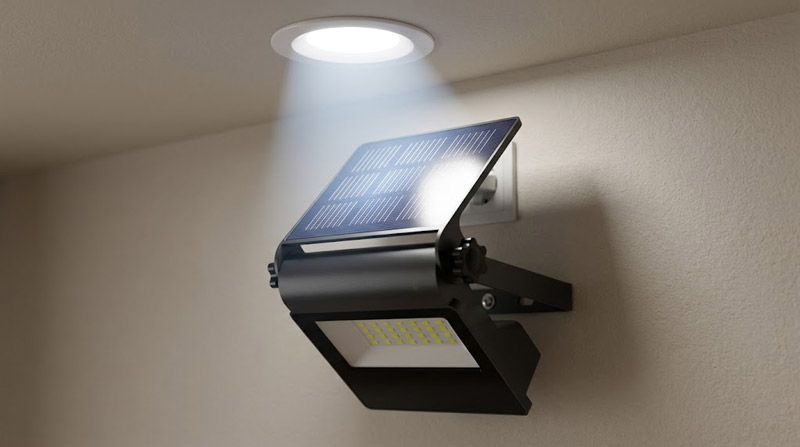
When charging a solar panel with artificial light, distance is extremely important. Light intensity decreases rapidly as the light source moves farther away from the panel. A panel placed directly under a bright lamp will produce more electricity than one placed several feet away.
The angle also matters. Solar panels work best when light strikes them directly. If the light hits the panel at a shallow angle, less energy is absorbed. This is true for both sunlight and artificial light.
However, placing a lamp very close to a solar panel can create another problem: heat. Excessive heat can reduce solar panel efficiency and may damage small devices. This is especially true with incandescent or halogen bulbs, which can become very hot.
Can Artificial Light Fully Charge a Solar Battery?
In principle, artificial light can charge a solar battery if the solar panel produces enough voltage and current for the charging system. In practice, this is usually slow unless the battery is very small or the artificial light source is very powerful.
For example, a small solar garden light might slowly charge under a bright indoor lamp, but it may take far longer than it would in direct sunlight. A large solar battery system designed for a home would be completely impractical to charge with household lighting. The amount of light required would be enormous, and the electricity used to power the lights would far exceed the energy recovered through the solar panels.
Therefore, artificial light is best viewed as a low-power or testing solution, not as a realistic replacement for sunlight.
Do solar panels need direct sunlight to work properly?
Solar panels do not always need direct sunlight to generate electricity, but direct sunlight produces the highest output. They can still work on cloudy days, in shaded areas, or near windows, but the power generation drops significantly because the light intensity is lower.
For best performance, solar panels should be placed where they receive strong, unobstructed sunlight for several hours per day.
Can artificial light damage solar panels?
Artificial light will not normally damage solar panels. Standard LED, fluorescent, and household bulbs are generally safe for photovoltaic cells.
However, very hot lamps, such as halogen or high-wattage incandescent bulbs, may create excessive heat if placed too close to the panel. Since heat can reduce efficiency and potentially harm nearby plastic components or wiring, artificial lights should be kept at a safe distance.
What type of artificial light works best for solar panels?
High-intensity LED lights are usually the best artificial light option for solar panels because they are efficient, stable, and produce less heat than incandescent or halogen lamps.
Full-spectrum LEDs may perform better than ordinary indoor bulbs because their light output is closer to natural sunlight. However, even powerful LEDs cannot usually match the energy density of direct sunlight.
How long does it take to charge a solar panel with indoor light?
Charging time depends on the size of the solar panel, the brightness of the light, the distance from the light source, and the capacity of the battery being charged.
Under normal indoor lighting, charging can take many times longer than outdoor sunlight. A small solar device may gain a usable charge after several hours under a bright lamp, but a larger solar battery could take an impractically long time.
Can grow lights charge solar panels?
Yes, grow lights can charge solar panels because they emit strong light designed to support plant growth. Full-spectrum grow lights may perform better than standard household bulbs because they cover a wider range of wavelengths.
However, using grow lights to charge solar panels is usually inefficient because the electricity used to power the grow light is greater than the electricity recovered from the panel.
