
Start With the Feature You Want to Highlight
Choose the Right Fixture Type
Get the Brightness Right
Pay Close Attention to Beam Angle
Select a Suitable Color Temperature
Consider CRI as Well as Color Temperature
Check the IP Rating Before Installing Outdoors
Choose Fixture Materials That Can Handle the Environment
Position the Lights to Create Depth and Texture
Control Glare and Unwanted Light Spill
Low-Voltage or Line-Voltage Lighting?
Choose LED Fixtures Based on Performance, Not Just Wattage
Add Useful Lighting Controls
Match the Lighting to the Style of the House
Test the Lighting After Dark
Exterior Accent Lighting Selection Table
Keep the Entire Lighting Design Balanced
FAQs
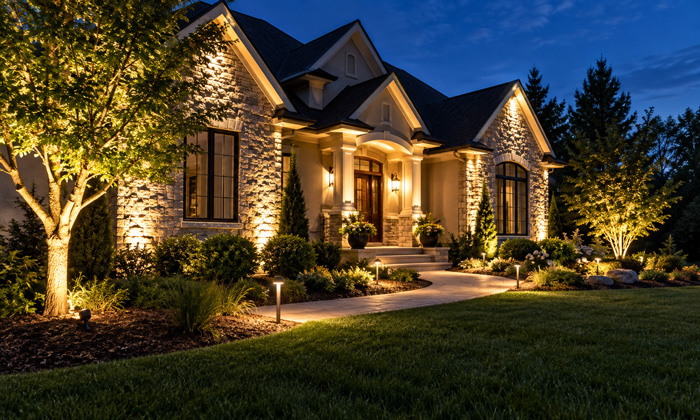
Exterior accent lighting can make a house look more attractive, dimensional, and welcoming after dark. Unlike general outdoor lighting, which is mainly intended to provide visibility, accent lighting draws attention to selected architectural or landscape features. It can emphasize stone walls, columns, trees, entrance areas, textured surfaces, and other details that give a property its character.
Choosing the best exterior accent lighting is not simply a matter of finding a fixture that looks good. The fixture type, brightness, beam angle, color temperature, weather resistance, mounting position, and overall lighting plan all affect the final result. A successful design creates contrast and visual interest without producing excessive brightness or glare.
Start With the Feature You Want to Highlight
The most important question is what you actually want the lighting to emphasize. Different parts of a house require different lighting techniques, so choosing fixtures before identifying the target often leads to poor results.
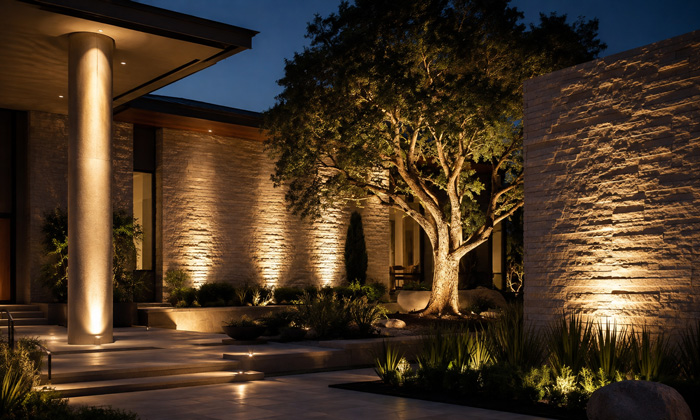
For example, a tall architectural column usually benefits from a narrow, controlled beam that follows its vertical shape. A broad stone façade requires a wider distribution of light. Trees may be illuminated from below to emphasize their trunks and canopies, while textured walls can be lit from close range to create stronger shadows and reveal surface detail.
Instead of illuminating every exterior feature, identify the areas that contribute most to the appearance of the property. These may include:
- Columns, arches, stonework, brick walls, or distinctive façade details
- Mature trees, ornamental plants, sculptures, fountains, or garden walls
- Entrances, patios, pergolas, decks, or other important outdoor living areas
- House numbers or selected decorative features that should remain visible after dark
Selective lighting generally creates a more sophisticated appearance than uniform brightness across the entire property. Areas of darkness are also important because they provide the contrast that makes illuminated features stand out.
Choose the Right Fixture Type
Exterior accent fixtures are designed to distribute light in different ways. A spotlight produces a concentrated beam, making it suitable for narrow architectural details, trees, sculptures, and other individual focal points. Floodlights distribute light across a wider area and can be useful for large façades or broad landscape features.
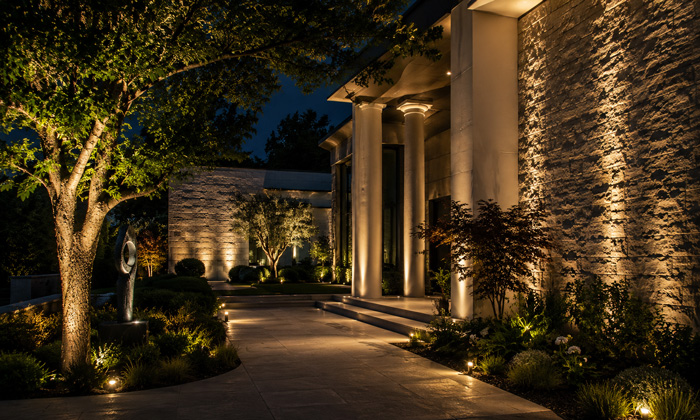
Wall washers are designed to spread relatively even illumination across vertical surfaces. They work especially well on stone, brick, and textured exterior walls. In-ground fixtures can provide discreet uplighting for columns, façades, and trees because most of the fixture remains below the surrounding surface.
The table below compares common fixture types and their typical applications.
| Fixture Type | Best Application | Typical Lighting Effect |
|---|---|---|
| Spotlight | Trees, columns, sculptures | Focused and dramatic |
| Floodlight | Large walls and façades | Broad coverage |
| Wall Washer | Brick, stone, textured walls | Smooth vertical illumination |
| In-Ground Light | Trees, walls, columns | Discreet upward lighting |
| Landscape Uplight | Trees, shrubs, architectural elements | Adds height and depth |
| Downlight | Trees, pergolas, roof structures | Soft downward illumination |
| Step Light | Stairs, decks, retaining walls | Low-level directional light |
| Outdoor Wall Light | Entrances and exterior walls | Decorative and functional |
A single house may use several fixture types. The important point is that each fixture should have a specific purpose rather than being installed simply because there is available space.
Get the Brightness Right
Brightness has a major influence on whether exterior accent lighting looks refined or excessive. More light is not automatically better. Accent lighting relies on controlled contrast, so an extremely bright fixture can actually make architectural details appear flatter.
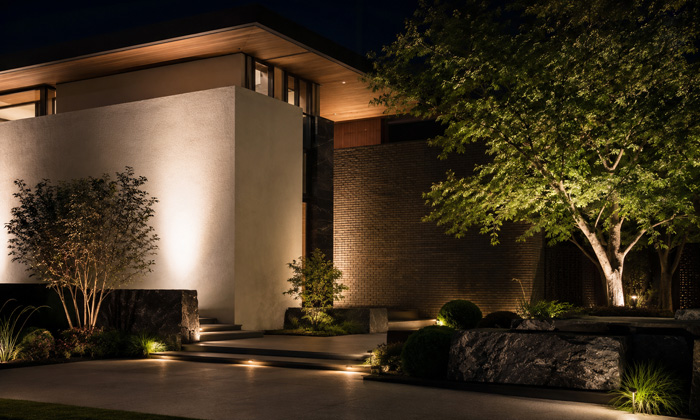
Small decorative objects and plants may need only modest light output, while large trees or broad façades require significantly more. Surface materials also affect perceived brightness. Pale stucco reflects light efficiently, whereas dark brick, dense foliage, and dark natural stone absorb considerably more light.
The following figures can be used as general starting points.
| Application | Approximate LED Output |
|---|---|
| Small plants and decorative features | 50–200 lumens |
| Steps and subtle architectural accents | 50–300 lumens |
| Small trees and columns | 200–500 lumens |
| Medium trees and larger features | 400–800 lumens |
| Large trees and broad façades | 700–1,500+ lumens |
These values should not be treated as fixed requirements. Fixture distance, optics, surface reflectivity, ambient lighting, and beam angle all influence the actual result.
Dimmable fixtures are particularly useful for exterior accent lighting because brightness can be adjusted after installation. This makes it easier to balance one illuminated feature against another instead of trying to calculate the perfect output before the fixtures are installed.
Pay Close Attention to Beam Angle
Beam angle determines how concentrated the light will be. A narrow beam creates a small, intense area of illumination, while a wider beam spreads light across a larger surface.
Narrow beams around 10 to 20 degrees are often suitable for columns, narrow trees, and small architectural features. Beam angles between approximately 20 and 35 degrees work well for medium-sized trees, sculptures, and vertical façade elements. Wider beams between 35 and 60 degrees can cover shrubs, walls, and larger landscape features.
For large surfaces, a beam angle of 60 degrees or more may be appropriate, depending on the distance between the fixture and the target.
| Beam Angle | Typical Use |
|---|---|
| 10°–20° | Narrow columns, tall trees, small details |
| 20°–35° | Sculptures, medium trees, vertical features |
| 35°–60° | Walls, shrubs, broad landscape elements |
| 60°+ | Large walls and general façade illumination |
Mounting distance must also be considered. The farther the fixture is positioned from the target, the wider the illuminated area becomes. For this reason, beam angle and fixture placement should always be evaluated together.
Select a Suitable Color Temperature
Color temperature changes the overall mood of exterior lighting and also affects how building materials appear.
For most houses, 2700K to 3000K is a strong starting range. A 2700K LED produces warm white light with a softer residential appearance. It works especially well with wood, red or brown brick, warm-colored stone, traditional architecture, and landscaped gardens.
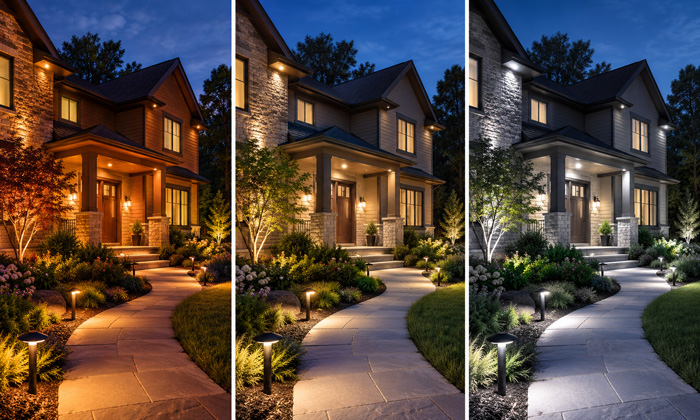
A 3000K source appears slightly cleaner while still retaining warmth. It is highly versatile and works with many contemporary as well as traditional properties.
Cooler temperatures such as 3500K or 4000K can complement gray stone, concrete, metal, and some modern architectural designs. However, excessive cool white lighting can make a residential exterior feel harsh or commercial.
Consistency is generally more important than choosing one exact number. If different sides of the same façade are illuminated with visibly different color temperatures, the exterior can appear disconnected.
Consider CRI as Well as Color Temperature
Color temperature describes whether the light appears warm or cool, but it does not describe how accurately colors are rendered. That is where the Color Rendering Index, or CRI, becomes important.
For residential accent lighting, fixtures with a CRI of at least 80 are preferable. A CRI of 90 or above can provide more natural and vivid color reproduction, which is useful when illuminating high-quality architectural materials or landscaping.
High CRI lighting can make natural stone appear richer, wood tones more accurate, and flowers or ornamental plants more visually appealing. When two fixtures have similar brightness and color temperature, the one with better color rendering may still produce a noticeably better result.
See also: What Are CCT and CRI in Garden Lights?
Check the IP Rating Before Installing Outdoors
Exterior fixtures must withstand environmental conditions that indoor lighting never encounters. Rain, dust, irrigation systems, humidity, temperature changes, and standing water can all affect fixture life.
The IP rating indicates the degree of protection a fixture provides against solid particles and moisture.
| IP Rating | Typical Application |
|---|---|
| IP44 | Covered exterior areas with limited exposure |
| IP54 | Protected outdoor locations |
| IP65 | Exposed outdoor locations subject to rain and dust |
| IP66 | Locations exposed to heavier water |
| IP67 | In-ground and very wet locations |
| IP68 | Specialized applications requiring greater water protection |
For many exposed outdoor applications, IP65 or higher provides a useful starting point. In-ground fixtures normally require greater protection because water can accumulate around the fixture.
However, an IP rating does not compensate for poor installation. Cable joints, connectors, seals, mounting positions, and drainage must also be suitable for the environment.
Choose Fixture Materials That Can Handle the Environment
Exterior fixtures may remain outdoors for years, so material quality matters.
Powder-coated aluminum is widely used because it provides a good balance of cost, weight, appearance, and corrosion resistance when manufactured properly. Brass is a popular option for premium landscape lighting because it is durable and develops a natural patina over time.
Stainless steel works particularly well with contemporary architecture, although the grade and quality of the material are important in demanding environments. Copper is another durable option and is often selected for landscape installations where an aged natural finish is desirable.
Material selection becomes especially important near the coast. Salt exposure can accelerate corrosion, so fixtures, mounting hardware, screws, and other components should be designed for corrosive environments rather than selected on appearance alone.
Position the Lights to Create Depth and Texture
Placement can have as much impact as the fixture itself.
Consider a textured stone wall. When the light is placed close to the surface, the angle emphasizes irregularities and produces stronger shadows. This technique can reveal the texture of stone, brick, or wood. Moving the same fixture farther away creates a softer and more even wash of light.
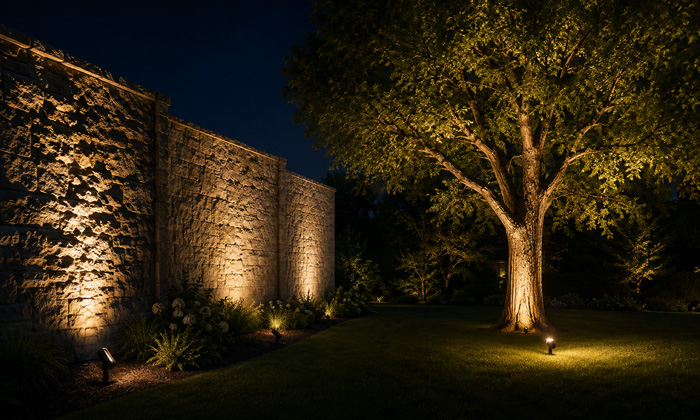
Tree lighting also changes according to fixture position. A light close to the trunk can emphasize vertical structure and bark texture. Moving the fixture farther away can illuminate a greater portion of the canopy.
Good exterior lighting often creates several visual layers. Features close to the viewer may receive subtle illumination, trees or structural elements provide a middle layer, and the façade creates a background. These differences in distance and intensity prevent the scene from looking flat.
Control Glare and Unwanted Light Spill
Even an attractive fixture can produce poor lighting if the source shines directly into people's eyes. Good exterior accent lighting should make the illuminated object noticeable rather than the LED itself.
Several methods can reduce unwanted glare:
- Use fixtures with recessed light sources, shields, louvers, or glare guards.
- Aim beams toward the intended architectural or landscape feature instead of toward windows, seating areas, roads, or neighboring properties.
- Avoid using more light output than the feature actually requires.
- Check important viewing angles from the driveway, street, patio, entrance, and interior windows.
Light spill should also be minimized. A large amount of uncontrolled light extending past the roofline or around the target wastes energy and reduces visual contrast. Precise beam control usually produces a better result than simply installing a more powerful lamp.
Low-Voltage or Line-Voltage Lighting?
Low-voltage systems are common in residential landscape lighting. They use a transformer to reduce the supply voltage before power reaches the fixtures. This approach works particularly well when multiple compact accent fixtures need to be positioned around gardens, walls, and trees.
A low-voltage system still requires proper planning. Transformer capacity, total fixture load, cable length, wire size, connections, and voltage drop must all be considered. A poorly designed system may cause fixtures at the end of a long cable run to perform differently from fixtures closer to the transformer.
Line-voltage fixtures remain useful for some permanent architectural applications, particularly wall-mounted lighting connected directly to the building's electrical system. The appropriate solution depends on the fixture, installation environment, electrical design, and local requirements.
See also: Low Voltage Pathway Lights vs. High Voltage Lighting: Which Is Better for Outdoor Use?
Choose LED Fixtures Based on Performance, Not Just Wattage
LEDs have become the standard choice for most exterior accent lighting because they combine low energy consumption with long operating life and precise optical control.
However, comparing LED fixtures by wattage alone can be misleading. Wattage describes power consumption rather than lighting quality.
When evaluating an exterior LED fixture, consider:
- Actual lumen output and how effectively the fixture directs it
- Beam angle and optical control
- Color temperature and CRI
- Dimming capability and control compatibility
- Fixture construction, outdoor rating, and expected durability
- Replaceability or serviceability where long-term maintenance is important
A lower-wattage fixture with well-designed optics may illuminate a column or tree much more effectively than a higher-wattage product that sends light in the wrong directions.
Add Useful Lighting Controls
Exterior accent lighting rarely needs to operate at full intensity from sunset until sunrise.
Photocells can turn the system on automatically when daylight levels fall. Timers can switch decorative lighting off later in the evening, while astronomical timers can adjust operation according to seasonal sunrise and sunset times.
Smart controls allow different parts of the exterior to function independently. For example, façade lighting can operate on one schedule while garden, pathway, and patio lighting use different settings.
Dimming is also useful because the ideal brightness may change according to the time of night or the activities taking place outdoors.
Good controls make the system more convenient while reducing unnecessary energy use.
Match the Lighting to the Style of the House
Exterior accent lighting should reinforce the architecture rather than compete with it.
Traditional homes often look best with warmer illumination and restrained lighting effects. Brick, timber, natural stone, and classic façade details generally respond well to 2700K or similarly warm light.
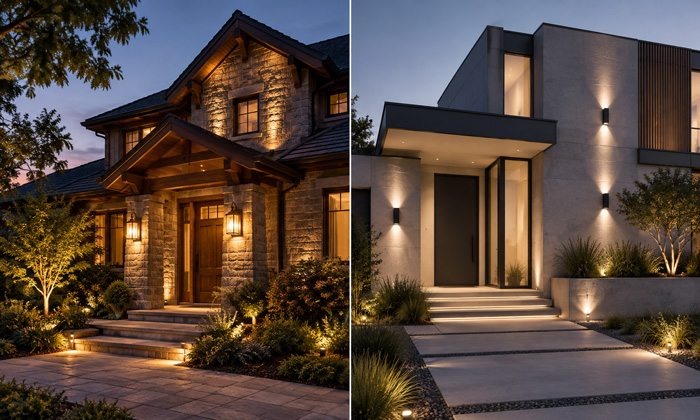
Modern homes may benefit from cleaner beam patterns, concealed fixtures, simple wall lights, and carefully illuminated geometric forms. Slightly more neutral white light can also work well with concrete, gray stone, metal, and minimalist architecture.
Visible fixtures should also be appropriately scaled. A very small wall light can appear insignificant on a large façade, while an oversized fixture may dominate a compact entrance.
For landscape accent lighting, the fixture itself should often remain unobtrusive. The goal is usually to see the lighting effect rather than the hardware creating it.
Test the Lighting After Dark
The final evaluation should always take place at night.
Fixture positions that look correct during daytime installation may create glare, awkward shadows, excessive brightness, or poor beam coverage after sunset. Adjustable fixtures can be temporarily aimed before the final position is fixed.
View the lighting from several important locations, including the street, driveway, main entrance, patio, garden, and windows inside the house. This reveals problems that may not be obvious when standing beside the fixture.
Small changes in angle or position can significantly alter the result. Nighttime adjustment is therefore one of the easiest ways to improve an exterior lighting installation without replacing any equipment.
Exterior Accent Lighting Selection Table
Before choosing a fixture, compare the main specifications and design considerations in one place.
| Factor | What to Look For |
|---|---|
| Purpose | A clearly defined architectural or landscape feature |
| Fixture Type | Appropriate light distribution for the target |
| Brightness | Enough output without excessive illumination |
| Beam Angle | Narrow for focused accents; wide for larger surfaces |
| Color Temperature | Usually 2700K–3000K for residential settings |
| CRI | 80+ recommended; 90+ for higher-quality color rendering |
| IP Rating | Suitable for the exact level of outdoor exposure |
| Fixture Material | Corrosion-resistant and appropriate for the environment |
| Glare Control | Shielded source and precise aiming |
| Energy Efficiency | Efficient LED light source with effective optics |
| Controls | Timer, photocell, dimmer, or smart zoning where useful |
| Installation | Correct wiring, drainage, mounting, and connections |
| Design Consistency | Coordinated brightness, color, and lighting style |
Keep the Entire Lighting Design Balanced
The best exterior accent lighting does not make every feature equally bright. It creates a hierarchy.
A primary tree, entrance, or architectural feature can serve as the dominant focal point. Secondary elements should receive softer illumination so they support rather than compete with it. Some areas can remain intentionally dark to create contrast.
Consistency also matters. Fixtures covering connected parts of the property should generally have compatible color temperatures and similar light quality. Brightness should transition naturally from one area to another rather than changing randomly.
A balanced design therefore depends on both what you illuminate and what you choose not to illuminate.
FAQs
How Much Does Professional Exterior Accent Lighting Cost?
The cost varies according to the number of fixtures, electrical work, landscape conditions, fixture quality, and installation complexity.
Custom architectural lighting and larger properties generally require a higher budget than small residential landscape projects.
Does Exterior Accent Lighting Increase Home Value?
Well-designed exterior lighting can improve nighttime curb appeal and make architectural and landscape features more visually prominent.
While it does not guarantee a specific increase in property value, an attractive and professionally installed lighting system can strengthen a home's overall presentation to potential buyers.
Are Solar-Powered Lights Suitable for Exterior Accent Lighting?
Solar-powered fixtures can work for decorative areas with sufficient direct sunlight, but their brightness and operating time depend heavily on battery capacity, panel efficiency, and weather conditions.
Wired systems are generally more consistent for architectural features that require reliable illumination every night.
How Often Should Exterior Accent Lighting Be Maintained?
Exterior lighting should be inspected periodically for dirt, plant overgrowth, damaged wiring, loose fixtures, moisture intrusion, and changes in fixture alignment.
Cleaning lenses and trimming surrounding vegetation can help maintain consistent light output and beam accuracy.
See also: How to Clean Garden Lights?
Does Exterior Accent Lighting Attract Insects?
Outdoor lighting can attract insects, particularly when shorter-wavelength light is present.
Warmer light sources generally attract fewer insects than cooler or blue-rich lighting, making warm-spectrum LEDs a practical option for patios, entrances, and other frequently used outdoor spaces.
See also: What Impact Do Garden Lights Have on Plants and Animals?
