
Common Spotlight Beam Angles
How Beam Angle Affects Lighting
How to Calculate Spotlight Coverage
Beam Angle vs. Field Angle
How to Choose the Right Beam Angle
FAQs
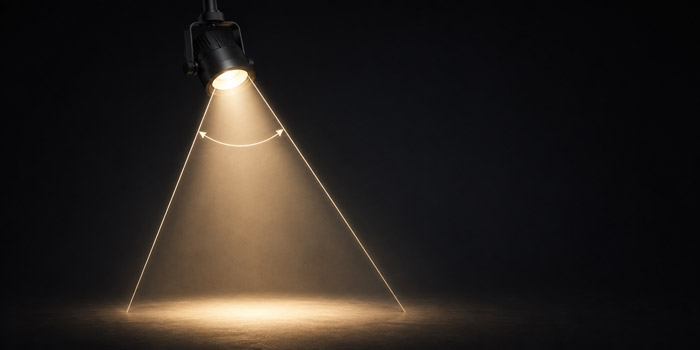
The beam angle of a spotlight is the angle at which light spreads outward from the center of the beam. Measured in degrees, it determines how narrow or wide the illuminated area will be.
A narrow beam angle produces a concentrated, high-intensity spot, while a wide beam angle covers a larger area with softer, less concentrated light. Choosing the correct beam angle is essential for achieving the desired lighting effect.
|
Beam Angle |
Beam Type |
Typical Applications |
|---|---|---|
|
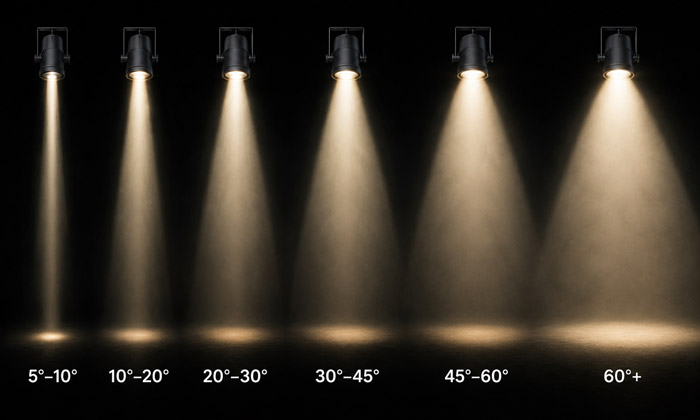
5°–10° |
Very narrow spot |
Long-distance highlighting, statues, towers |
|
10°–20° |
Narrow spot |
Artwork, displays, architectural details |
|
20°–30° |
Standard spot |
Retail products, stages, accent lighting |
|
30°–45° |
Wide spot |
Restaurants, galleries, residential interiors |
|
45°–60° |
Narrow flood |
General area lighting, walls, large objects |
|
Above 60° |
Flood beam |
Broad ambient lighting and open spaces |
How Beam Angle Affects Lighting
A spotlight with a 10-degree beam angle creates a small, focused circle of light. It is suitable for highlighting a specific object or illuminating a target from a long distance.
A 25-degree beam angle provides a balanced spotlight effect. It is commonly used in shops, museums, hotels, theaters, and homes.
A 40-degree beam angle creates a wider and softer light distribution. It is better for illuminating larger objects or areas where smoother coverage is required.
The beam angle also affects light intensity. When two spotlights produce the same number of lumens, the narrower beam usually appears brighter at the center because the light is concentrated over a smaller area.
How to Calculate Spotlight Coverage
The approximate beam diameter can be calculated with the following formula:
Beam diameter = 2 × distance × tan(beam angle ÷ 2)
For example, a spotlight with a 30-degree beam angle installed 3 meters from a surface produces a beam approximately 1.6 meters wide.
This calculation represents the main beam area. Actual coverage may vary because of lens design, reflector quality, installation angle, and light distribution outside the central beam.
Beam angle and field angle are related but not identical.
The beam angle is generally measured between the points where light intensity falls to 50% of the maximum center intensity. The field angle is wider and is commonly measured where intensity falls to 10%.
For practical lighting selection, manufacturers usually list the beam angle because it describes the strongest and most useful part of the light beam.
How to Choose the Right Beam Angle
Choose a narrow beam when the spotlight must emphasize a small object, create a dramatic effect, or project light over a long distance. Choose a wider beam when the target is large, the installation distance is short, or more even coverage is needed.
The ideal beam angle depends on three main factors:
- The size of the object or area
- The distance between the spotlight and the target
- The required brightness and visual effect
For accent lighting, beam angles between 15 and 30 degrees are widely used. For larger displays or general illumination, angles between 30 and 60 degrees are usually more appropriate.
Does dimming a spotlight change its beam angle?
Dimming normally reduces light output without changing the optical beam angle.
However, the illuminated edge may appear less defined at very low brightness because the outer portion of the beam becomes harder to see.
What is the difference between a fixed-beam and zoomable spotlight?
A fixed-beam spotlight has one preset beam angle, while a zoomable spotlight allows the user to adjust the beam from narrow to wide.
Zoomable models provide greater flexibility for exhibitions, stages, retail displays, and changing layouts.
How do lenses and reflectors control spotlight beam angle?
Lenses refract light, while reflectors redirect it forward.
Their shape, size, surface finish, and distance from the LED determine beam width, edge sharpness, uniformity, and the amount of stray light.
Why does a spotlight produce hot spots, halos, or uneven light?
These effects may result from poor optical design, incorrect LED positioning, low-quality lenses, reflector defects, or mismatched components.
High-quality spotlights use optimized optics to create a smoother beam with consistent intensity.
How can spotlight beam performance be verified before installation?
Review the manufacturer’s photometric data, including the IES or LDT file, candela distribution, lux chart, and beam diagram.
Lighting simulation software can then predict beam shape, illuminance, overlap, and glare within the actual project space.
