
In professional landscape and garden lighting design, light is not only a functional tool for visibility and safety, but also a critical design element that shapes atmosphere, depth, and visual perception after dark. Among the many parameters used to specify outdoor luminaires, Correlated Color Temperature (CCT) and Color Rendering Index (CRI) are two of the most important yet frequently misunderstood metrics.
CCT determines whether light appears warm or cool, directly influencing the emotional tone of a garden space. CRI, on the other hand, governs how accurately colors of plants, hardscape materials, and architectural elements are rendered under artificial illumination. For lighting designers, landscape architects, and technical professionals, a precise understanding of both parameters is essential to achieve consistent visual quality, color fidelity, and design intent in outdoor environments.
Correlated Color Temperature (CCT)
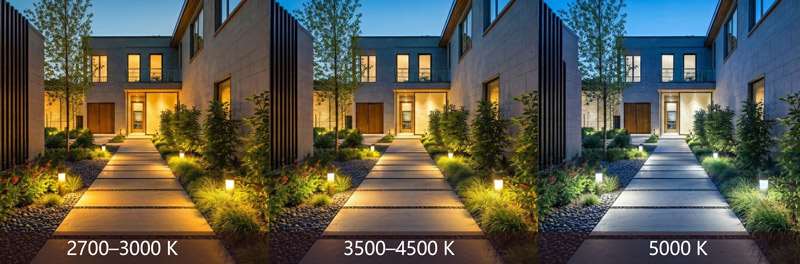
Correlated Color Temperature (CCT) describes the apparent color of a light source and is measured in Kelvin (K). It indicates whether the emitted light appears warm (yellowish), neutral (balanced white), or cool (bluish). The lower the Kelvin value, the warmer the light; the higher the value, the cooler and more blue the light appears.
In garden lighting, CCT is primarily used to control ambiance and spatial perception. Warm white light in the range of 2700–3000 K is commonly associated with comfort, intimacy, and residential character. It closely resembles the glow of traditional incandescent lamps or firelight, making it ideal for patios, pathways, and seating areas where relaxation is the primary goal.
Neutral white light, typically 3500–4500 K, provides a balanced appearance without strong yellow or blue bias. This range is often selected for general landscape illumination, walkways, and areas where accurate color perception and visual clarity are required. Neutral CCTs tend to enhance green foliage and present materials in a more natural, daylight-like manner.
Cool white or daylight CCTs above 5000 K produce a crisp, high-contrast light with a noticeable blue component. In garden applications, this range is usually reserved for specific purposes such as security lighting, moonlighting effects from tall trees, or contemporary landscape designs. While cool light increases perceived brightness, excessive use can make outdoor spaces feel harsh or unnatural.
Impact of CCT on Plant and Material Appearance
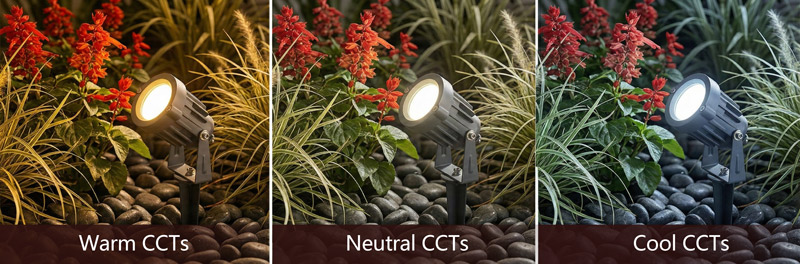
Reference image: Lumetro LM-2802 model
CCT significantly affects how colors are perceived at night:
- Warm CCTs enhance reds, browns, and warm stone textures but may slightly mute deep greens and blues.
- Neutral CCTs provide balanced color reproduction and are particularly effective for mixed planting schemes.
- Cool CCTs intensify greens and cool-toned materials but can desaturate warm-colored flowers or surfaces.
Professional designers often layer multiple CCTs within the same landscape to create depth and visual hierarchy, rather than relying on a single uniform color temperature.
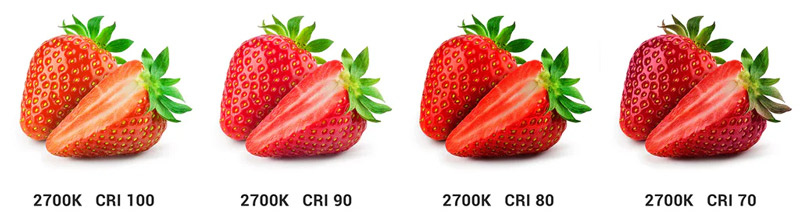
While CCT defines the color tone of light, Color Rendering Index (CRI) measures how accurately that light source reveals the colors of objects compared to a reference source of the same color temperature. CRI is expressed on a scale from 0 to 100, where 100 represents perfect color fidelity similar to natural daylight.
A higher CRI indicates that colors appear more vivid, natural, and differentiated. In contrast, a low CRI light can cause colors to look dull, distorted, or indistinguishable from one another. In garden lighting, this distinction is particularly important because plants, flowers, and natural materials rely heavily on subtle color variation for visual interest.
Why CRI Is Critical in Garden Lighting
High CRI lighting ensures that:
- Flower colors remain rich and identifiable at night
- Foliage shows natural variation rather than appearing flat or gray
- Stone, wood, and architectural finishes retain their true appearance
- Visual comfort is improved through better color discrimination
For professional outdoor lighting projects, a minimum CRI of 80 is generally recommended. For feature lighting, ornamental planting, and color-sensitive areas, CRI 90 or higher is preferred. Although very high CRI LEDs may have slightly lower luminous efficacy, the improvement in color quality typically outweighs the efficiency trade-off in landscape applications.
Comparison of CCT and CRI in Garden Lighting Applications
|
CCT (K) |
Light Appearance |
Typical Use Case |
Effect on Plant and Foliage Appearance |
Typical CRI Requirement |
|---|---|---|---|---|
|
2700–3000 K |
Warm white, amber-toned |
Residential gardens, pathways, patios, ambient lighting |
Enhances warm colors; creates soft, natural glow; slightly reduces green saturation |
CRI ≥ 80 (90+ for feature areas) |
|
3500–4500 K |
Neutral white |
Pathways, lawns, general landscape lighting |
Balanced color reproduction; highlights green foliage and mixed planting |
CRI ≥ 80 |
|
5000–6500 K |
Cool white / daylight |
Security lighting, moonlighting, modern landscapes |
Intensifies greens and cool tones; may wash out warm colors if overused |
CRI ≥ 80 recommended |
Professional Selection Considerations
When specifying garden lighting, CCT and CRI should always be evaluated together and in relation to the specific application:
1. Path Lights
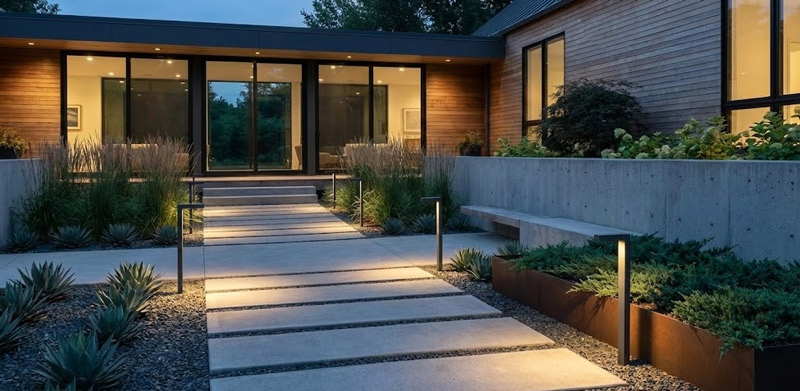
- Typically use warm white (2700–3000 K) for visual comfort and reduced glare
- CRI ≥ 80 ensures natural appearance of surrounding plants and paving
2. Accent and Feature Lighting
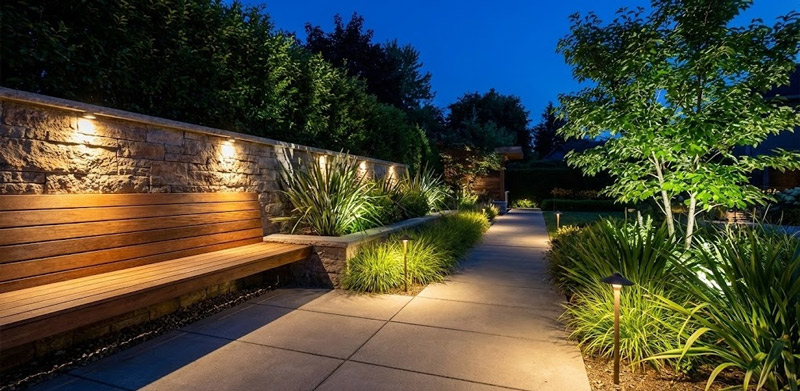
- CCT selected based on the object being highlighted (warm for stone or wood, neutral/cool for greenery)
- High CRI (90+) strongly recommended to preserve color accuracy
3. Tree Uplighting
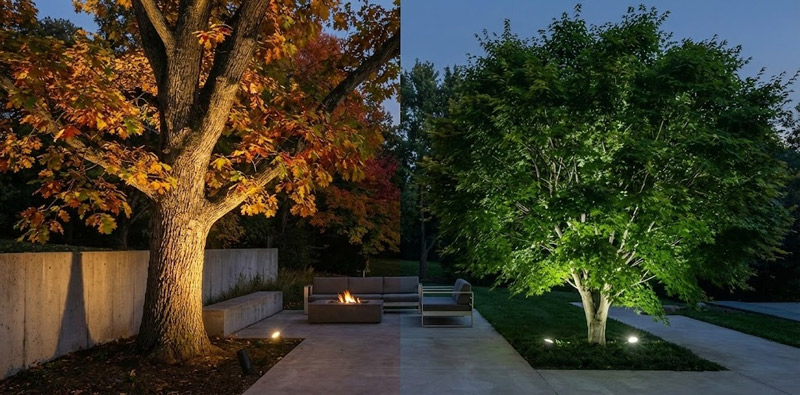
- Warm CCT emphasizes trunk texture and autumn tones
- Neutral or slightly cool CCT enhances dense green canopies or moonlight effects
- CRI ≥ 80 to maintain natural foliage color variation
In professional garden lighting design, CCT defines mood and spatial character, while CRI determines visual quality and color truthfulness. Neither parameter should be selected in isolation. Warm and neutral CCTs between 2700 K and 4000 K form the foundation of most successful landscape lighting schemes, with cooler temperatures applied selectively for contrast or functional needs.
At the same time, prioritizing high CRI luminaires ensures that plants, materials, and architectural elements retain their intended appearance after dark. For designers seeking refined, high-end results, combining layered CCT strategies with CRI values of 80–90+ allows the garden to feel natural, balanced, and visually engaging at night.
Ultimately, the best garden lighting solutions are those where CCT and CRI work together to support both technical performance and aesthetic intent, transforming outdoor spaces into coherent and inviting nighttime environments.
Can CCT and CRI affect the perceived brightness of garden lights?
Yes. While luminous flux (lumens) defines measured brightness, both CCT and CRI significantly influence perceived brightness.
Cooler CCTs (higher Kelvin values) often appear brighter to the human eye at the same lumen level due to a higher scotopic/photopic ratio, especially in low-light outdoor environments.
Higher CRI distributes light across a broader spectrum, making objects appear more vivid but sometimes slightly less “bright” compared to lower-CRI sources at equal wattage.
Professional lighting design must therefore consider perceived brightness, not just lumen output.
Is it acceptable to mix different CRI values within the same garden lighting system?
It is technically possible, but not recommended for visually cohesive designs.
Fixtures with different CRI values can cause inconsistent color appearance across the landscape, even when CCT is identical.
Plants or materials under lower-CRI light may appear dull compared to areas illuminated by higher-CRI fixtures, creating unintended visual imbalance.
Best practice is to maintain consistent CRI levels within the same visual zone, particularly for feature lighting and focal areas.
How do optical lenses and beam angles interact with CCT and CRI performance?
Optical components such as lenses, reflectors, and diffusers can subtly influence spectral distribution and perceived color quality.
Narrow beam angles tend to increase contrast and color saturation, making high CRI more visually apparent, while wide flood optics soften color impact.
Low-quality optical materials may introduce color shift or spectral loss.
For professional garden lighting, high-quality optics are essential to preserve intended CCT and CRI at the illuminated surface.
Does LED aging affect CCT and CRI over time in outdoor environments?
Yes. Over long operating periods, LED light sources may experience gradual color shift due to heat, humidity, and UV exposure.
CCT can drift warmer or cooler depending on phosphor stability, and CRI may decline if spectral balance degrades.
Professional-grade garden luminaires mitigate these effects through advanced thermal management, high-quality LED packages, and robust environmental sealing.
Long-term color stability should be considered when specifying fixtures for permanent outdoor installations.
Are CCT and CRI standards measured the same way for outdoor and indoor lighting?
The measurement standards are the same, but application expectations differ.
Outdoor garden lighting operates at lower illuminance levels and under mesopic or scotopic vision conditions, where human color perception behaves differently than indoors.
As a result, CCT and CRI selections that perform well indoors may not produce the same visual effect outdoors.
Professional outdoor lighting design often favors slightly warmer CCTs and higher CRI values to enhance nighttime color perception.
