
Understanding the IP Rating System
What IP44 Really Means
What IP65 Really Means
The Real Difference in Practical Terms
Why the Difference Is Often Misunderstood
Common Applications for IP44
Common Applications for IP65
IP44 vs IP65 in Lighting Applications
What IP Ratings Do Not Tell You
Installation Quality Matters
Choosing the Right Rating
FAQs
When comparing IP44 and IP65, many people assume the difference is minor because only one digit changes. In reality, the gap is substantial. These two ingress protection ratings are designed for very different environmental demands, and choosing the wrong one can lead to avoidable maintenance problems, shorter product life, performance failures, or unnecessary over-specification.
This matters across a wide range of industries and applications. Lighting manufacturers use IP ratings to classify fixtures for bathrooms, gardens, facades, and industrial sites. Electrical engineers rely on them when specifying enclosures, switches, connectors, and distribution boxes. Facility managers use them to judge whether installed equipment can tolerate dust, splashing water, or direct weather exposure. In each of these cases, understanding the real difference between IP44 and IP65 is not just a technical exercise. It is a practical decision with implications for safety, durability, compliance, and cost.
Understanding the IP Rating System
The term IP stands for Ingress Protection. It is a standardized code used to describe how well an enclosure resists the entry of solid particles and water. The code usually appears in the form IPXY, where the first digit indicates protection against solids and the second digit indicates protection against water.
These two digits should never be treated as decorative labels. They represent tested performance under defined conditions. A higher first digit means better resistance to the intrusion of dust or solid foreign objects. A higher second digit means better protection against water under specific forms of exposure, such as splashes, sprays, or jets.
That is why the comparison between IP44 and IP65 is so important. The difference is not simply “a little more waterproof.” IP65 provides a significantly higher level of protection in both categories.
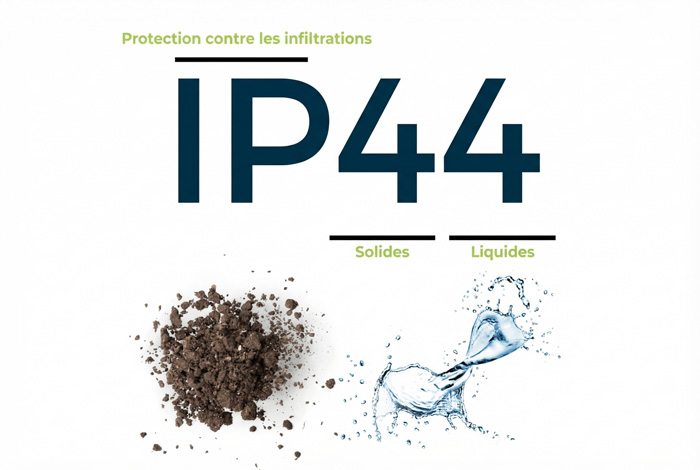
An IP44 rating tells you two things about the enclosure.
First, the digit 4 for solids means the enclosure is protected against solid objects larger than 1.0 mm. In practical terms, this provides a moderate level of protection against accidental contact and against the entry of objects such as wires, screws, or many insects. However, it does not mean the enclosure is sealed against fine dust. Small airborne particles can still enter if conditions allow.
Second, the digit 4 for water means the enclosure is protected against splashing water from any direction. This is suitable for environments where the product may be exposed to incidental moisture, condensation, or water splashes during ordinary use. It performs well in locations where water exposure is present but limited in force and duration.
This makes IP44 a common choice for environments that are humid, occasionally wet, or partially exposed, but not severe. It is often viewed as a moderate protection rating rather than a heavy-duty one.
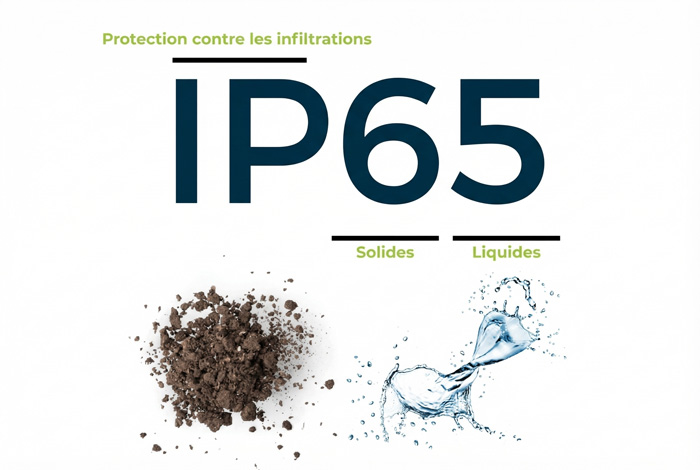
An IP65 rating represents a considerably more robust level of sealing.
The first digit, 6, means the enclosure is dust-tight. This is one of the most important differences. With IP65, dust is not supposed to enter at a harmful level. That makes it much more suitable for outdoor and industrial environments where airborne particles can accumulate over time and compromise performance.
The second digit, 5, means the enclosure is protected against water jets from any direction. This is a major step up from splashing water. Water jets involve more force, more directional impact, and more demanding test conditions. As a result, IP65 is generally considered a strong rating for exposed outdoor installations and technical equipment that may face more aggressive moisture conditions.
However, it is still important to be precise. IP65 does not mean the product is submersible, nor does it mean it can withstand every possible cleaning process or extreme weather condition. It is a high protection rating, but it is not the same as immersion-rated protection such as IP67 or IP68.
The Real Difference in Practical Terms
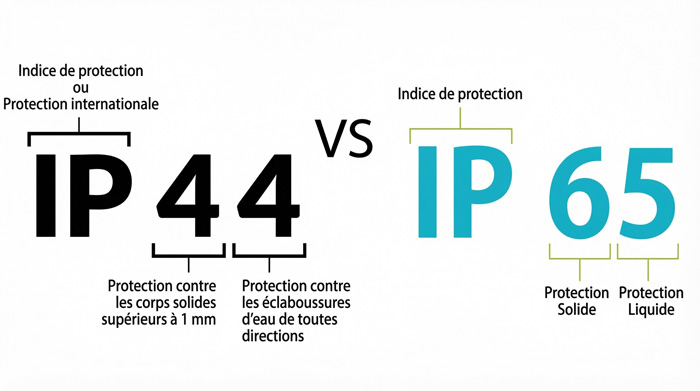
If the comparison is reduced to a simple technical phrase, the difference is this: IP44 protects against small objects and splashing water, while IP65 protects against dust and water jets. But in real-world use, that distinction becomes much more meaningful.
The solids protection difference alone can strongly influence service life. In relatively clean indoor spaces, the lack of dust-tight sealing may not matter much. But in outdoor environments or technical settings with dust, debris, or particles in the air, the difference becomes critical. Fine dust can settle on electrical components, degrade seals, block vents, create contamination, and shorten maintenance intervals. That is where IP65 has a clear advantage.
The water protection difference is equally important. Splashing water is a lower threshold. It assumes incidental exposure, not forceful projection. Water jets are more demanding and better reflect the realities of exposed installations, hose cleaning, wind-driven rain, or environments where water can strike the enclosure more directly.
In other words, IP44 is suitable for moderate moisture exposure, while IP65 is intended for harsher and less predictable conditions.
Why the Difference Is Often Misunderstood
One reason people misunderstand IP ratings is that they rely too heavily on broad labels such as “bathroom safe” or “outdoor suitable.” These descriptions are often too vague to be useful on their own. Not all bathrooms have the same moisture conditions, and not all outdoor installations face the same environmental stress.
A covered porch in a mild climate is very different from an exposed coastal wall. A decorative residential wall light is very different from a factory-mounted junction box. A garden fixture in a sheltered landscape bed experiences different risks from a floodlight mounted on an open commercial building. In each case, the environmental conditions should drive the specification, not just the marketing category.
Another common misunderstanding is the assumption that a higher IP rating always means a better product overall. That is not necessarily true. IP rating only tells you about protection against ingress under specific test conditions. It does not automatically tell you anything about corrosion resistance, UV stability, heat dissipation, mechanical strength, or the long-term quality of seals and gaskets.
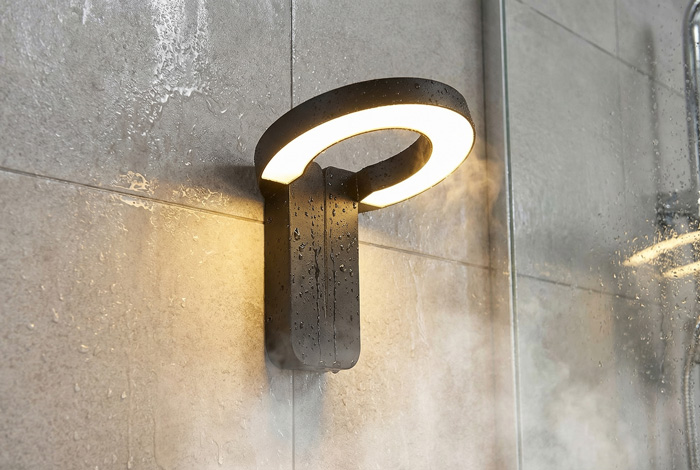
IP44 is widely used where a moderate level of environmental protection is sufficient. It is especially common in residential and light commercial settings where water exposure is possible but controlled.
Typical examples include:
- bathroom lights outside direct spray zones
- vanity fixtures and mirror lights
- covered porch lighting
- sheltered entryway luminaires
- partially protected balconies and canopies
These applications share a common feature: the product may encounter splashes, humidity, or occasional weather contact, but it is not expected to resist dust-heavy conditions or direct water jets on a regular basis.
Because of this balance, IP44 is often attractive in situations where aesthetics, compact design, ventilation, or lower cost also matter.
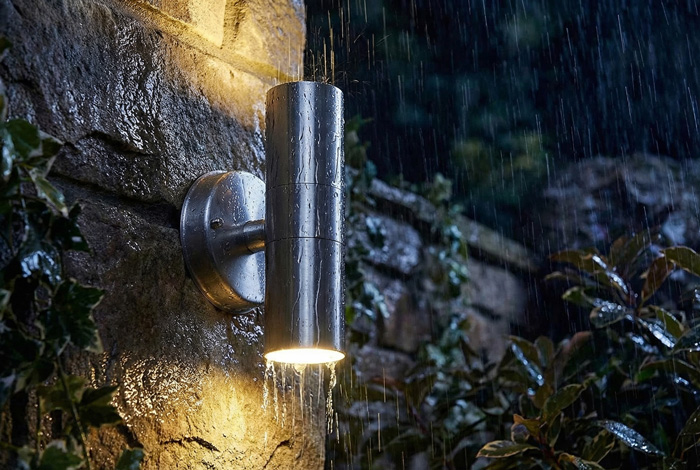
IP65 is more appropriate when the environment is exposed, dusty, operationally demanding, or difficult to maintain. It is frequently chosen for technical and professional installations where stronger sealing is needed to reduce failure risk over time.
Typical applications include:
- exposed outdoor wall lights and floodlights
- landscape and pathway lighting
- industrial control enclosures
- outdoor junction boxes
- warehouse, workshop, and agricultural installations
In these environments, the combination of dust-tight sealing and water-jet resistance makes a meaningful difference. IP65 often serves as a safer baseline for fully exposed exterior equipment and many industrial-use products.
IP44 vs IP65 in Lighting Applications
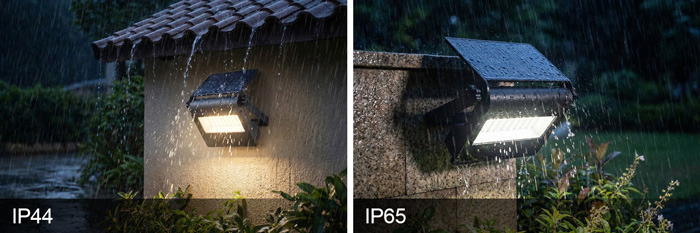
Lighting is one of the most common areas where this comparison appears, and it is also where the wrong assumption is often made. A fixture labeled for “outdoor use” may be technically acceptable in one outdoor location and completely unsuitable in another.
An IP44 luminaire may perform perfectly well under a roofed entrance or on a sheltered wall where it experiences only occasional splashes and limited environmental contamination. In that setting, moving to IP65 may offer little practical advantage beyond added margin.
But once a fixture is mounted in a fully exposed position, the situation changes. Wind-driven rain, irrigation spray, road dust, airborne particles, and seasonal weather shifts all increase the stress on the enclosure. In those cases, IP65 is usually the more appropriate specification. It provides a higher confidence level, particularly where maintenance access is difficult or where reliability expectations are high.
For commercial and architectural lighting, this distinction can have a direct effect on lifecycle cost. A product that is under-protected for its environment may appear less expensive at the point of purchase, but become more costly through premature replacement, service visits, and warranty issues.
What IP Ratings Do Not Tell You
A professional specification should never rely on IP rating alone. This is one of the most important principles in enclosure and fixture selection.
An IP65-rated product can still perform poorly if its materials are not suited to the environment. For example, an enclosure may resist dust and water ingress but still suffer corrosion in a coastal atmosphere or in areas with chemical exposure. Likewise, an outdoor plastic housing may carry a strong IP rating yet degrade under UV exposure if the material is not stable.
The IP code also does not tell you how well a product handles impact, vibration, thermal cycling, or long-term gasket aging. A rating obtained under laboratory conditions does not guarantee identical performance after years of installation, opening, reassembly, and environmental wear.
That is why engineers and specifiers often consider additional factors such as:
- material quality
- corrosion resistance
- UV resistance
- impact protection
- operating temperature range
Without those considerations, the IP number alone can create a false sense of security.
Even the best enclosure can lose its intended protection level if the installation is poorly executed. This is particularly relevant with IP65 products, where the rating depends not only on the main body of the enclosure but also on how it is assembled and connected in the field.
Cable entries, glands, seals, mounting holes, connectors, and maintenance access points all affect the final result. A genuine IP65 enclosure can effectively become a lower-protection system if gaskets are damaged, covers are misaligned, or cable entry hardware is incorrectly selected.
This is why experienced professionals do not just ask whether the product is IP65. They ask whether the installed system will remain IP65 in practice.
The decision between IP44 and IP65 should be based on the real service environment rather than a generic rule. In a moderate, sheltered, and relatively clean setting, IP44 may be entirely appropriate. It is often sufficient for bathroom fixtures outside direct spray zones, covered entrances, and similar semi-protected applications.
By contrast, IP65 is the better choice when dust exclusion matters, when direct weather exposure is likely, or when stronger water resistance is needed. It is especially sensible for exposed outdoor areas, industrial sites, and installations where maintenance is inconvenient or expensive.
A useful way to think about the difference is this: IP44 is suitable for splash-prone environments, while IP65 is suited to exposed and more demanding environments.
What does an IP67 rating mean?
An IP67 rating indicates that the product is dust-tight (protected against solid particles) and can withstand immersion in water up to 1 meter deep for up to 30 minutes.
What is the difference between IP65 and IP68?
IP65 provides water-jet protection, meaning it is protected against water sprayed from any direction with low pressure.
IP68, on the other hand, offers full protection against immersion in water, making it suitable for submersible applications such as underwater lighting or marine equipment.
Can an IP65-rated product be used in extreme temperatures?
IP65 only covers protection against dust and water, but it does not address the ability to withstand extreme temperatures.
For temperature extremes, check the product's technical specifications for additional temperature ratings.
How often should IP65-rated enclosures be maintained?
Although IP65 offers high protection, it is important to regularly check the integrity of seals and clean the product, especially in harsh environments, to maintain long-term performance.
Is IP protection necessary for indoor lighting?
For most indoor environments, an IP44 rating may suffice. However, areas prone to high humidity or water splashes (e.g., kitchens and bathrooms) often benefit from higher-rated enclosures like IP65 for enhanced durability.
