
Start With Carol Stream’s Residential Lighting Requirements
Plan Outdoor Lighting Around How You Use the Property
Compare Low-Voltage, Solar, and Line-Voltage Lighting
Choose Fixtures for Light Quality and Outdoor Exposure
Control Glare and Operating Hours
Understand the Cost of Carol Stream Outdoor Lighting
Maintain the System Through the Seasons
FAQs
Outdoor lighting should make your home easier to approach, your yard more comfortable to use, and your landscaping attractive after sunset. For homeowners in Carol Stream, Illinois, a successful system also needs to suit winter conditions, respect neighboring properties, and meet local lighting requirements.
The best starting point is a clear plan: illuminate the routes people use, add comfortable lighting where they gather, and highlight a few architectural or landscape features. Choose fixtures and controls around those priorities, then check the results after dark.
Start With Carol Stream’s Residential Lighting Requirements
Local requirements should shape the design before fixtures are purchased.
Carol Stream’s residential lighting provisions address fixture placement, spill light, color temperature, and mounting height. Among the requirements:
- Privately owned lights must be located on the property they illuminate.
- Lighting must be directed to limit spill onto neighboring properties.
- Light at the property line must not exceed 0.1 foot-candles, measured five feet above grade in a plane at any angle of inclination.
- Residential luminaires must have a color temperature below 4,000K.
- House-mounted fixtures may not be installed above the roofline.
- Ordinary yard light poles may not exceed eight feet above established grade; separate provisions apply to recreational lighting.
The ordinance also encourages automatic shut-off controls. Confirm the current requirements and any project-specific conditions with the Village before installation.
The Village lists electrical work among projects requiring permits. Ask Community Development how the rules apply to your proposed installation, particularly if it includes a new circuit, receptacle, or hardwired fixture. If your property belongs to an HOA, check its exterior alteration requirements as well.
Plan Outdoor Lighting Around How You Use the Property
Walk around your home after sunset before deciding how many lights to buy. Follow the route from the driveway to the front door, check side entrances, and sit in the areas where you spend evenings.
Look for three things: places where visibility is inadequate, places where existing lights feel uncomfortable, and features worth highlighting.
Front Doors and Garage Entrances
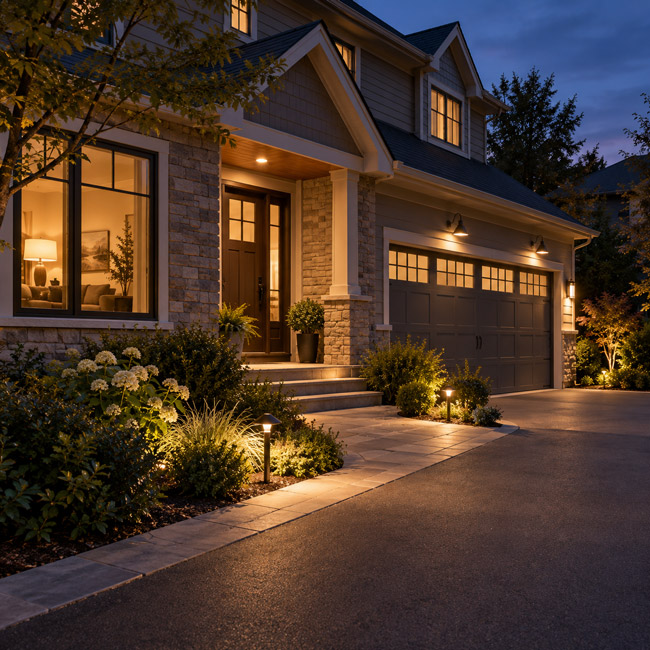
The front entrance needs enough light to identify visitors, find keys, and see the threshold. Position fixtures so the light reaches the landing and door hardware without shining directly into someone’s eyes.
At the garage, consider the transition from driveway to walkway. A bright garage wall does little to help if the path beside it remains difficult to see.
Check the view from indoors, too. An exposed bulb outside a living-room window can become distracting even when the entry itself looks attractive.
Walkways and Garden Paths
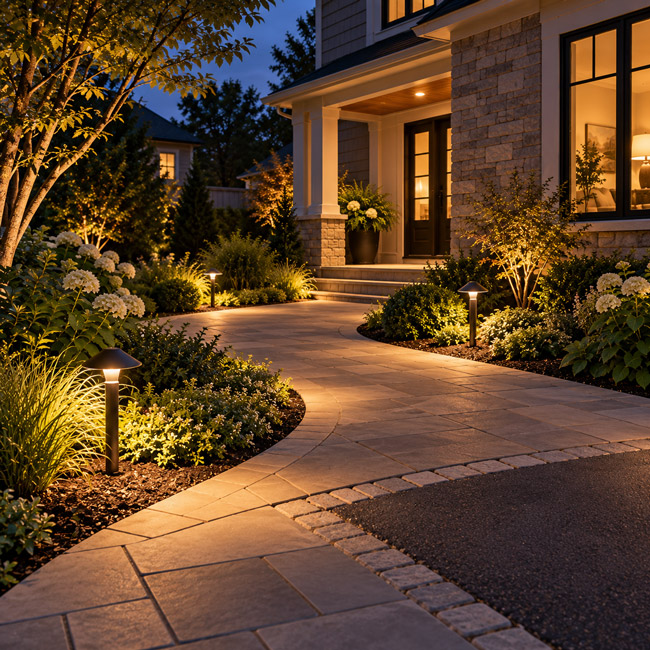
Path lighting should reveal the walking surface, changes in direction, and transitions between paving materials.
Shielded fixtures can direct light downward while keeping the source less visible. Avoid placing lights where lawn equipment, car doors, or snow-clearing tools are likely to strike them.
There is no universal distance that works for every path. Appropriate pathway light spacing depends on fixture height, beam spread, output, and path width. Test the proposed positions after dark and look for both dark gaps and distracting bright spots.
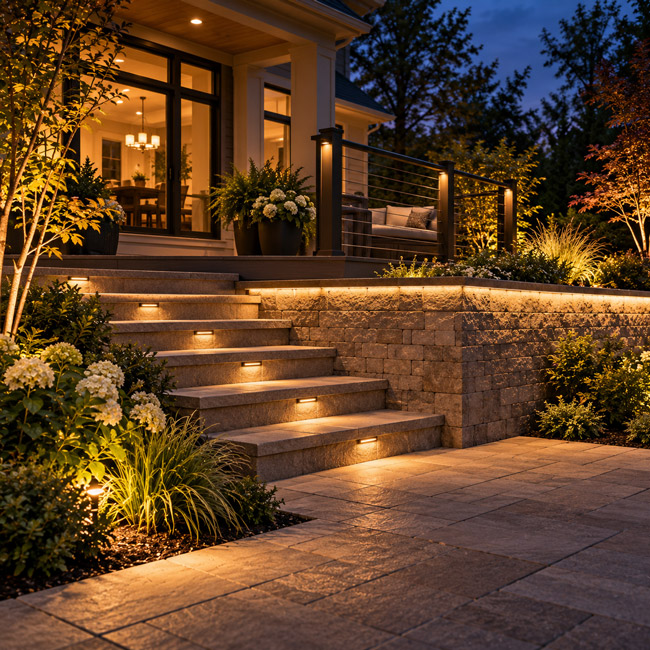
Steps, Decks, and Retaining Walls
Steps need lighting that makes tread edges and elevation changes easy to distinguish. Recessed step lights, shielded rail lights, or under-cap fixtures can provide useful illumination without a bright source at eye level.
Position lights so people can see the stairs from both directions. A fixture that looks comfortable when walking down may produce glare when someone approaches from below.
For retaining walls, concealed lighting beneath a cap can define the edge and illuminate nearby paving.
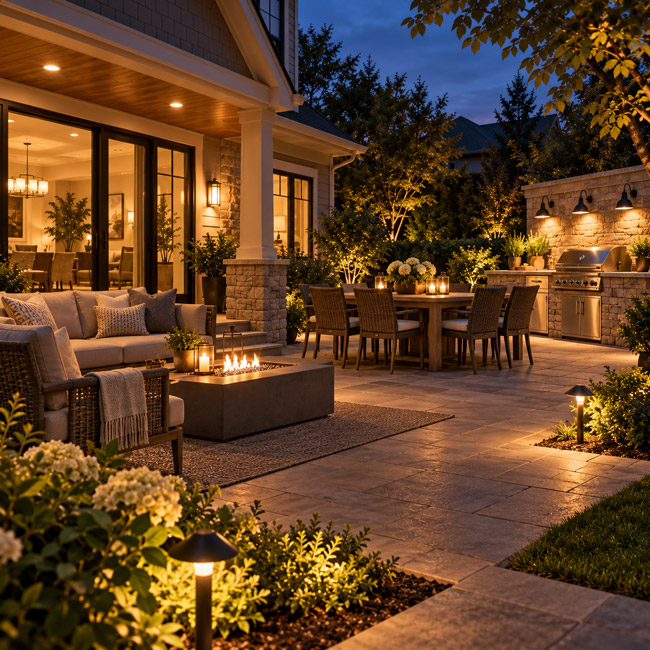
Patios and Outdoor Seating
Patio lighting should support conversation, dining, and movement between the house and yard.
Use separate layers for different activities. Soft ambient lighting can serve a seating area, while a grill or preparation counter may need a more focused source. Keep brighter task lighting independently controlled so it does not dominate the whole patio.
Evaluate the installation while seated. Fixtures hidden from a standing viewpoint may be directly visible from a dining chair.
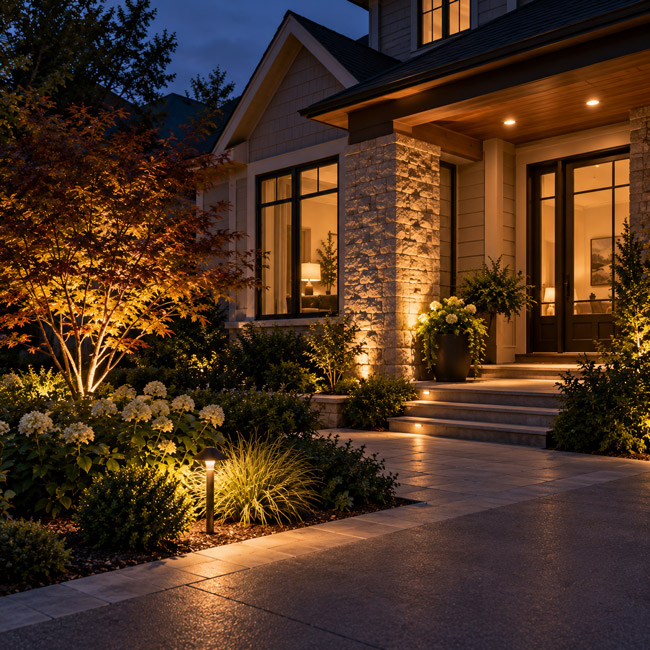
Trees, Planting Beds, and the House Exterior
Choose a few focal points rather than lighting every plant and wall.
An ornamental tree, textured facade, or distinctive entry column can establish the composition. Leave quieter areas between them to preserve depth.
Aim accent lights carefully and avoid sending unnecessary light beyond the feature. Consider how the scene will change when deciduous trees lose their leaves or shrubs grow across a beam.
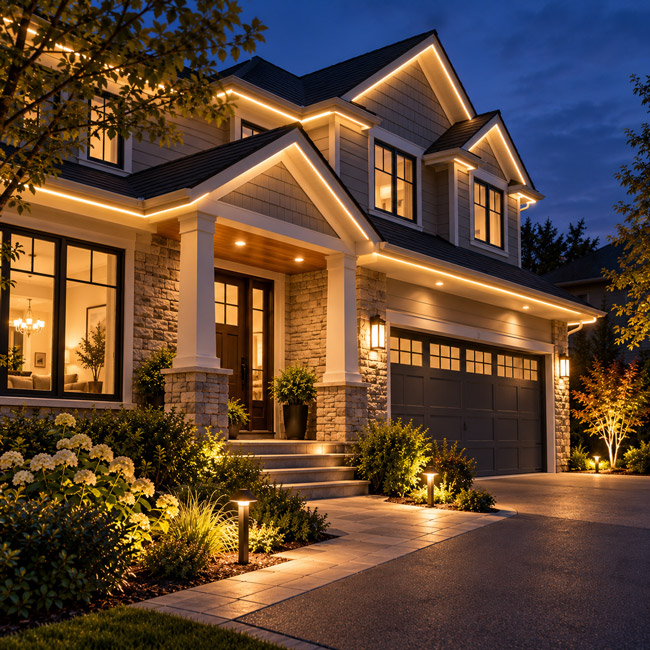
Permanent Roofline Lighting
Permanent roofline lighting can outline architectural features and provide decorative effects throughout the year. However, it serves a different purpose from lighting a stair tread or walkway.
If you include it, judge the system in both daylight and darkness. Check the visibility of tracks and wiring, the appearance of its everyday white-light setting, and access for future servicing. Confirm that the intended operating modes meet applicable local and HOA requirements.
Compare Low-Voltage, Solar, and Line-Voltage Lighting
The right power source depends on the location, expected operating hours, and importance of consistent illumination.
| System | Suitable applications | Main planning consideration |
|---|---|---|
| Low-voltage LED | Paths, planting beds, landscape accents, and many deck applications | Requires a compatible transformer, cable layout, and weather-resistant connections |
| Solar | Decorative accents and locations where running cable is impractical | Runtime depends on solar exposure, battery condition, and the product’s design |
| Line-voltage | Many house-mounted fixtures and dedicated exterior lighting circuits | Requires appropriate electrical installation and project-specific code compliance |
For a permanent residential landscape system, low-voltage LED lighting is often a practical starting point. It supports a coordinated layout and does not depend on that day’s sunshine.
Solar lighting can work well where modest decorative output is sufficient. When comparing solar and low-voltage outdoor lighting, assess the actual site rather than judging only by fixture price. A sunny garden border and a shaded side entrance present very different conditions.
Winter deserves particular attention. Shorter days and a lower sun angle reduce the available solar resource, so evaluate solar fixtures against winter conditions if you expect year-round operation. Essential walking routes should have lighting that reliably meets the required hours of use.
Choose Fixtures for Light Quality and Outdoor Exposure
A fixture’s appearance matters, but its beam, construction, and serviceability determine how well it works over time.
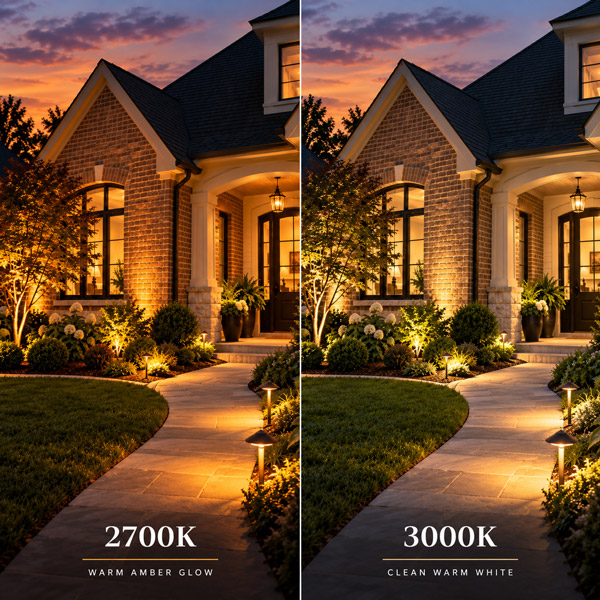
Select a Consistent Color Temperature
For many residential settings, 2700K or 3000K provides a comfortable starting point. The choice between 2700K and 3000K landscape lighting is largely about the appearance you prefer: 2700K looks warmer, while 3000K offers a somewhat crisper warm white.
Test samples against your home’s actual materials. Brick, pale siding, stone, and foliage can look different under the same light.
Keep adjacent areas reasonably consistent unless a deliberate contrast serves the design.
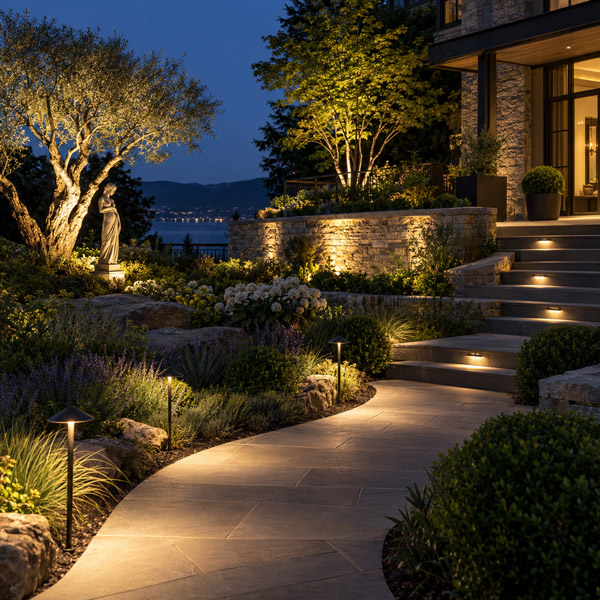
Match the Beam to the Target
Lumens describe light output, but they do not tell you where that light lands.
A narrow beam can emphasize a small feature. A wider beam can cover a broader planting area or wall. Path fixtures need a useful distribution across the ground, while step lights need controlled illumination at the tread.
Ask to see the beam pattern or a nighttime demonstration. Increasing output will not correct a poorly aimed or unsuitable optic.
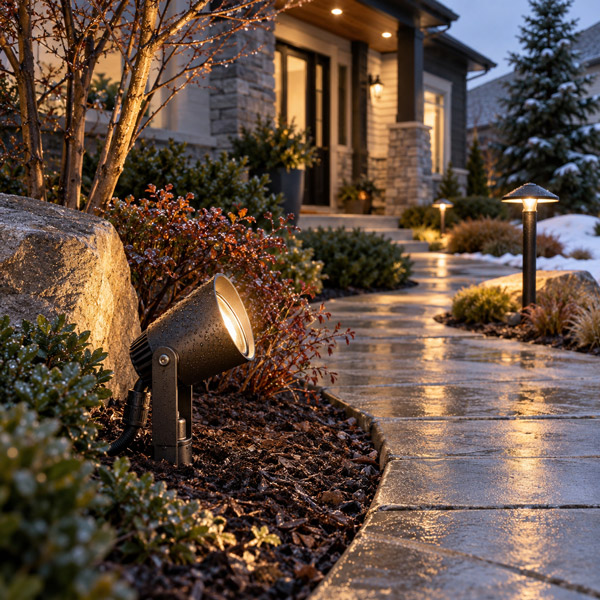
Check the Whole Fixture’s Outdoor Suitability
Review the manufacturer’s installation instructions and specifications for the intended location. Consider:
- Suitability for rain and other direct weather exposure.
- Published operating temperature range.
- Housing finish and corrosion resistance.
- Cable entries, seals, and connector protection.
- Mounting strength and replacement-part availability.
Avoid low points where water collects unless the complete installation is specifically designed for that exposure. An outdoor label alone does not establish suitability for submersion.
For Carol Stream yards, also consider where shoveled snow accumulates and whether winter maintenance equipment can reach the fixture.
Control Glare and Operating Hours
Comfortable lighting depends on controlling brightness, direction, and duration together.
Use shields and careful aiming to keep light on the intended surface. Review the layout from the street, neighboring property boundaries, and windows inside your own home.
Timers, photocells, and motion controls serve different purposes:
- A timer sets operating hours.
- A photocell responds to ambient daylight.
- A motion sensor activates lighting when movement is detected.
Separate frequently used routes from decorative accents where practical. The front approach may need a different schedule from a tree or garden feature.
Understand the Cost of Carol Stream Outdoor Lighting
A useful estimate begins with a defined layout. Fixture count alone cannot explain the price of a complete installation.
The main cost drivers include:
- Fixture construction, optics, and light sources.
- Transformer and control equipment.
- Cable length and routing.
- Connections and mounting hardware.
- Work beneath or around existing hardscape.
- New electrical supply work, where required.
- Installation labor, aiming, and commissioning.
- Warranty coverage and ongoing service.
A compact front-yard project with accessible planting beds differs substantially from a property requiring long cable runs, masonry work, or difficult roof access. Obtain itemized local quotes rather than treating a national average as a Carol Stream price.
Compare equivalent specifications. A lower quote may use different materials, exclude electrical work, or provide less service after installation.
Estimate Electricity Use Separately
Operating cost can be calculated from power consumption and runtime:
Monthly energy use = total input watts ÷ 1,000 × hours per night × days per month
For an illustrative system drawing 80 watts at the outlet and running five hours per night:
80 ÷ 1,000 × 5 × 30 = 12 kWh per month
At an assumed electricity rate of $0.20 per kWh, that would cost approximately $2.40 per month. This is a calculation example, not a quoted local utility rate. Use your own applicable rate and include transformer and controller consumption.
Maintain the System Through the Seasons
Outdoor lighting needs occasional attention as plants grow and weather changes the site.
In spring, inspect for tilted fixtures, damaged mounts, exposed cable, and winter debris. Clean lenses using methods approved by the manufacturer.
During the growing season, check whether foliage blocks beams or covers fixtures. Adjust aiming where necessary without directing light into windows or beyond the intended feature.
Before winter, confirm that fixtures remain clear of snow-clearing routes and that exposed components are secure. Review operating schedules as sunset changes.
Keep fixture model numbers, warranty information, and an installation layout together. These records make future repairs and matching replacements much easier.
FAQs
1. Can I convert an existing halogen landscape lighting system to LED?
Often, but compatibility needs to be checked first. Match the replacement lamp’s base, dimensions, voltage, and AC or DC requirements. Confirm that the existing transformer and any dimming controls support the proposed LED lamps, including any minimum-load requirements.
If the housings, sockets, and cables remain sound, a lamp retrofit may be possible. Corroded fixtures or an unsuitable power supply may make a broader upgrade more sensible.
2. Why do my outdoor LED lights flicker?
Possible causes include a failing lamp or driver, an incompatible dimmer, unstable supply voltage, or a damaged connection. The pattern helps narrow the problem: one flickering fixture suggests a local issue, while several flickering together may point to shared equipment or wiring.
When troubleshooting flickering lights, isolate power before inspecting accessible components. Have a qualified electrician investigate hardwired connections, recurring trips, or signs of overheating.
3. Which outdoor lights attract fewer insects?
Amber and warmer-spectrum lights generally attract fewer insects than sources with more blue or ultraviolet output, although responses vary by species. No light guarantees an insect-free patio.
Choosing outdoor light colors that attract fewer bugs can help, especially when combined with modest brightness and thoughtful placement away from frequently opened doors.
4. Can I replace a solar garden light’s battery with an ordinary AA battery?
Only use the rechargeable battery type and specification approved by the manufacturer. A battery fitting the compartment does not establish compatibility.
Disposable alkaline AA batteries are not substitutes for rechargeable cells in a solar charging circuit. Check the required chemistry, voltage, and capacity before ordering a replacement; different rechargeable battery types are not automatically interchangeable.
5. Are replaceable-bulb fixtures better than integrated LED fixtures?
Neither design is automatically better. Replaceable-bulb fixtures can make routine lamp replacement and future changes easier, provided compatible lamps remain available.
Integrated LED fixtures can offer compact shapes and optics designed around their light source. Their long-term value depends partly on whether the LED module or driver can be serviced. Before buying, ask what must be replaced when the light source fails and whether the warranty covers parts, labor, or both.
