

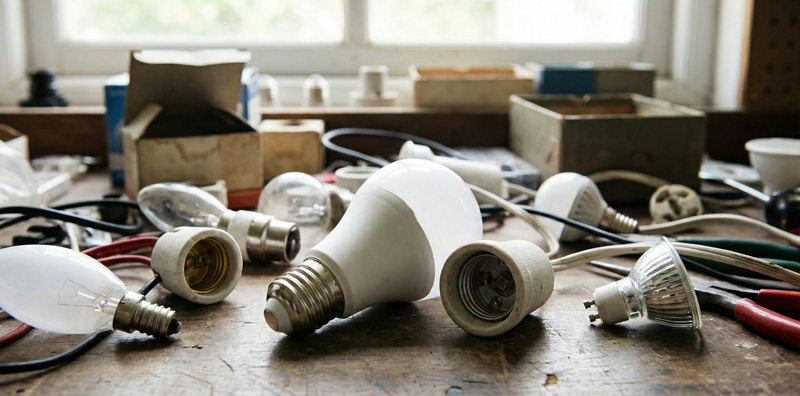
In the world of residential and commercial lighting, the term "universal" is often used loosely. For architects, electrical engineers, and international sourcing agents, however, precision is paramount. The E27 Edison Screw bulb is arguably the most recognizable lighting standard on the planet, but does that make it truly universal?
The short answer is no. While the E27 is the dominant standard in many parts of the world, it faces significant physical and electrical incompatibility issues in North America and select Commonwealth nations.
This article dissects the technical specifications, regional voltage differences, and safety implications that prevent the E27 from being a truly "one-size-fits-all" solution.
The Global Divide: E27 vs. E26
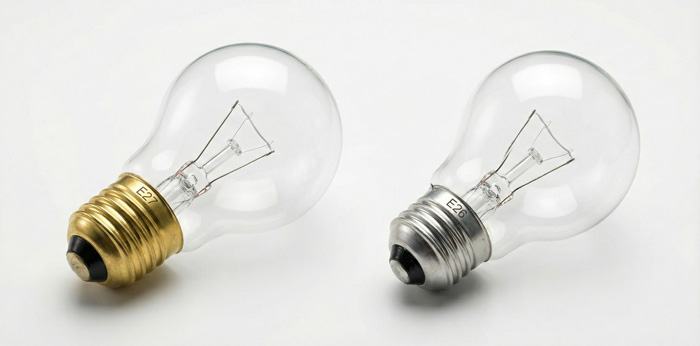
To understand why E27 is not universal, one must first look at its North American counterpart: the E26.
The "E" stands for Edison, and the number refers to the external diameter of the screw base in millimeters.
-
E27 (27mm): The standard for Europe, Asia, Africa, South America, and Australia. It is governed by IEC (International Electrotechnical Commission) standards and is designed for 220–240V systems.
-
E26 (26mm): The standard for the United States, Canada, and Japan. It is governed by ANSI (American National Standards Institute) standards and is designed for 110–120V systems.
The "False Fit" Trap
The most dangerous aspect of these two standards is their physical similarity. Because there is only a 1mm difference in diameter, an E26 bulb will often fit loosely into an E27 socket, and an E27 bulb can sometimes be jammed into an E26 socket.
While they may physically connect, they are not electrically compatible in traditional incandescent applications.
Voltage Incompatibility: The Safety Risk
The primary barrier to universality is voltage, not just physical dimensions.
Scenario A: E26 Bulb in an E27 Socket (North American Bulb in Europe)
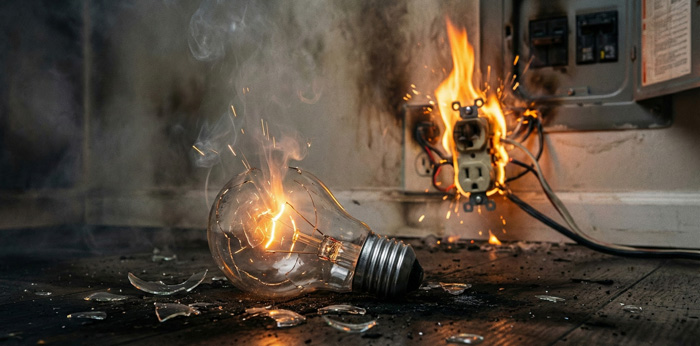
If you screw a standard 120V North American E26 bulb into a 240V European E27 socket, the results are catastrophic. The bulb will instantly receive double its rated voltage.
-
Result: The filament will blow immediately, the glass may shatter, and in severe cases, it can cause an electrical fire or trip the circuit breaker.
Scenario B: E27 Bulb in an E26 Socket (European Bulb in USA)
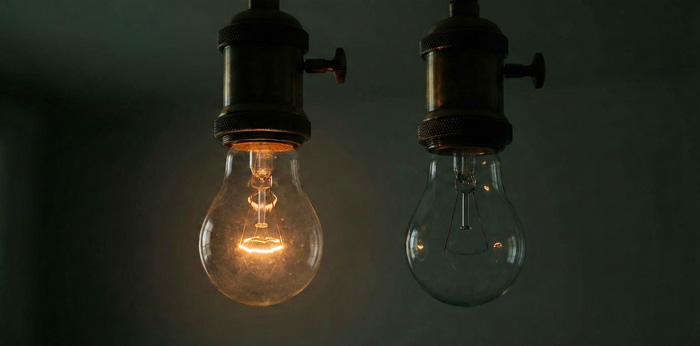
If you place a 240V European E27 bulb into a 120V American socket, the bulb is underpowered.
-
Result: The bulb will emit a very dim, orange glow (roughly 25% of its intended brightness) or fail to ignite entirely.
The Hidden Danger: Base Height
Beyond voltage, there is a subtle mechanical difference. E27 bulbs have a slightly taller insulator (the ceramic or plastic ring between the metal screw and the bottom contact tip) than E26 bulbs. This is designed to provide extra protection against arcing at higher voltages (240V). Using an E26 bulb in a high-voltage E27 socket can theoretically increase the risk of a short circuit or electrical arcing at the base.
The "Universal" Exception: Multi-Voltage LEDs
Advancements in LED technology have created a "loophole" in this non-universality.
Many modern LED drivers are designed with Universal Input Voltage (85V–265V).
-
If you purchase a high-quality E27 LED bulb that is explicitly rated for 85V–265V, it can technically operate safely in both North American (120V) and European (240V) grids.
-
However, the physical fit remains imperfect. An E27 base in an E26 socket may damage the contact points over time due to tight threading, while an E26 base in an E27 socket may be loose, leading to sparking.
Pro Tip: Always check the voltage printing on the base of the bulb. If it says "220V-240V Only," it is strictly for E27 regions.
The Bayonet Factor: UK and Australia
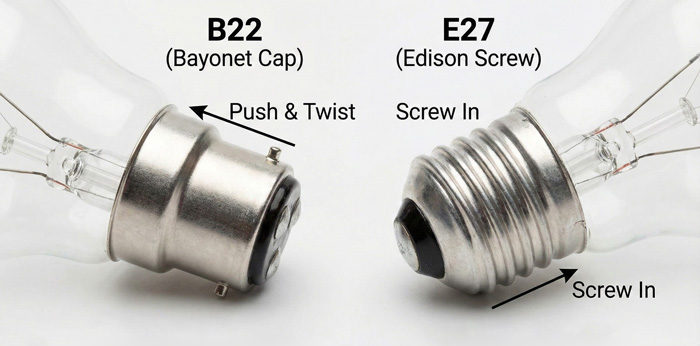
Even within 240V regions where E27 is dominant, it is not the exclusive standard.
-
United Kingdom: While shifting toward E27, the UK historically relies on the B22 (Bayonet Cap). Many older homes and rental properties still exclusively use B22 fittings.
-
Australia: Similar to the UK, Australia uses a mix of B22 and E27. A traveler or importer assuming "Australia = E27" will find themselves wrong 50% of the time.
Summary Table: Global Compatibility
|
Region |
Standard Socket |
Voltage |
Compatible with E27 Bulb? |
|
Europe (UK, DE, FR, IT) |
E27 (Standard) |
220-240V |
Yes |
|
North America (USA, CA) |
E26 |
120V |
No (Voltage hazard) |
|
Japan |
E26 |
100V |
No (Voltage mismatch) |
|
China / Asia |
E27 |
220V |
Yes |
|
Australia / NZ |
E27 & B22 |
230-240V |
Yes (unless fixture is B22) |
Are E27 light bulbs universal? No. They are the standard for roughly 70% of the world's residential lighting voltage systems (220-240V), but they are fundamentally incompatible with the North American market.
For global supply chains and international travelers, the rule of thumb is simple: Match the voltage first, then the base. An E27 bulb is only "universal" if your destination operates on 220-240V.
