
Table of Contents
- What Is the Difference Between a Sconce and a Wall Light?
- Types of Wall Sconces by Light Direction
- Hardwired, Plug-In, and Battery-Powered Sconces
- Where to Place Wall Sconces
- Bathroom mirrors
- Bedrooms and reading corners
- Living and dining rooms
- Hallways and stairs
- Front doors, porches, and exterior walls
- What to Check Before Buying a Wall Sconce
- Dimensions, projection, and backplate
- Light output and glare
- Color temperature and color rendering
- Bulb fit and shade access
- FAQs
A sconce light fixture is a light mounted to a wall that provides ambient, task, or accent lighting. It can cast a soft glow along a hallway, put light at face height beside a bathroom mirror, illuminate a book at the bedside, or brighten the threshold at a front door. Because the wall supports the fixture, a sconce can put light close to where you need it while keeping floors and furniture surfaces clear.
Two sconces of the same size can produce very different results. An opaque shade can direct light onto a specific surface, while an opal glass diffuser can spread it across a wider area. To choose a sconce, start with what you want to illuminate and where people will be when they use the light.
What Is the Difference Between a Sconce and a Wall Light?
Wall light is the broad term for a fixture mounted to a wall. It includes sconces, vanity bars, picture lights, and recessed step lights. Sconce commonly describes a fixture with a visible body, shade, or arm attached to the wall. Product listings often use wall light and wall sconce interchangeably, especially for decorative fixtures.
Historical sconces held candles or torches. Modern sconces range from shallow LED fixtures to adjustable reading lamps and exterior lanterns. The product name gives you a starting point. The fixture drawing tells you how far it projects, where it attaches, and whether an arm or shade will clear nearby objects. Photos of the fixture switched on help show where its light falls.
Types of Wall Sconces by Light Direction
The choice between uplighting and downlighting changes which surfaces receive light and how much of the source you can see. A light aimed toward the ceiling can brighten the upper part of a room. A shielded light aimed downward can illuminate a book, a console, or the ground near a doorway.
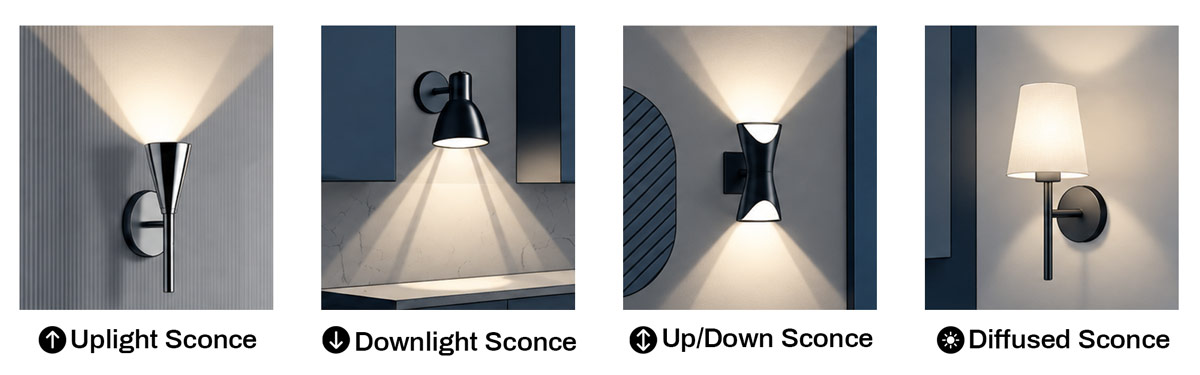
| Light direction | How it lights the space | Where it works well |
|---|---|---|
| Uplight | Sends light up the wall or toward the ceiling, where lighter surfaces can reflect it back into the room. | Living rooms, dining rooms, and hallways with room for the light to spread above the fixture. |
| Downlight | Directs light below the fixture. A deep shade can shield the source from someone looking across the room. | Reading spots, consoles, doorways, and surfaces that need light in a specific area. |
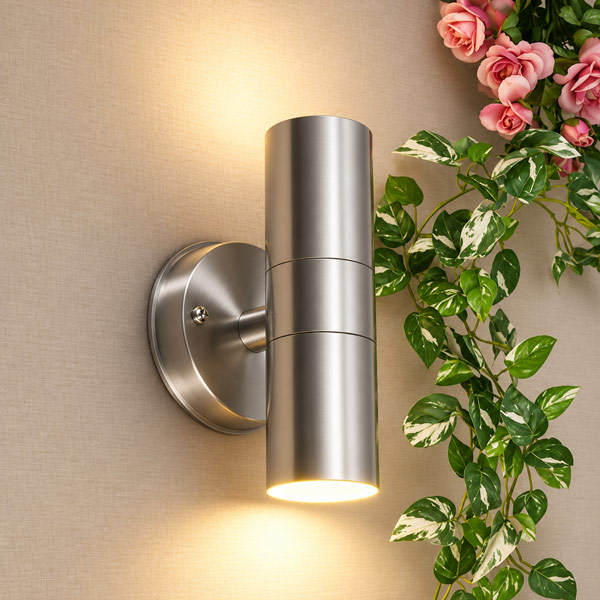
| Up-and-down light | Sends separate beams above and below the fixture, making the wall part of the lighting effect. | Entry walls, columns, and architectural features with enough clear wall area to show both beams. |
| Diffused light | Spreads light through a translucent shade or lens, making the bright source less distinct. | Bathroom mirrors, seating areas, and other locations where people often face the fixture. |
The body of the fixture determines how it fits the wall. A flush-mount sconce sits close to the surface and can suit a narrow passage. A fixed-arm sconce brings the shade forward, which can help the light clear a shelf or a deep mirror frame. A swing-arm sconce lets you move the light toward a book or work surface and fold it back afterward. Measure its reach in both positions.
Style terms such as candle, globe, and lantern describe the fixture’s shape. Check the shade openings and lens material to understand the light. A clear globe makes the bulb visible from several angles. An opal globe spreads light across a larger glowing surface. An opaque metal shade directs most of the light through its openings.
Hardwired, Plug-In, and Battery-Powered Sconces
The power source affects where you can put the fixture, how you operate it, and what you’ll see on the finished wall.
| Power source | Best fit | What to check |
|---|---|---|
| Hardwired | A permanent location with suitable wiring, such as a vanity, hallway, or front entrance. | Confirm the connection point, mounting support, and switch location. For new wiring or a relocated connection, have a qualified electrician assess the installation. |
| Plug-in | A bedroom, reading corner, or other location with a conveniently placed outlet. | Measure the usable cord length and check where the switch sits. The fixture still needs wall mounting that suits its weight and the wall material. |
| Battery-powered or rechargeable | An occasional-use location where an outlet or permanent wiring is difficult to reach. | Check output, runtime at the brightness you plan to use, and how you access the battery or charging port once the fixture is mounted. |
Decide who needs to control the light and from where. Two bedside sconces may be more useful with independent controls, especially when one person reads after the other goes to sleep. A pair along a hallway may work better on a shared switch that can be reached from either end.
Where to Place Wall Sconces
A common starting point for wall sconce mounting height is 60 to 72 inches (152 to 183 cm) from the finished floor to the center of a general-purpose decorative fixture. Use that range to sketch a layout, then adjust for the people, furniture, and surfaces the light will serve.
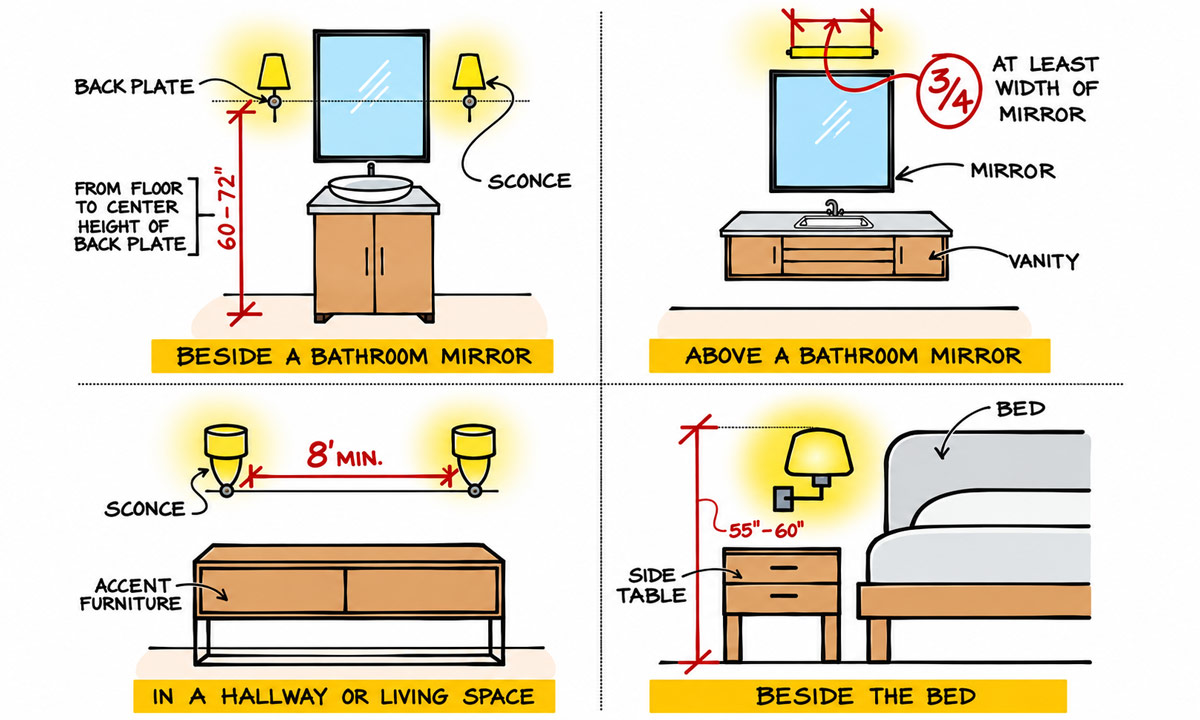
Use these measurements as starting points for wall sconce height and spacing beside bathroom mirrors, in hallways and living rooms, and beside beds, and for sizing a vanity light above a mirror.
Check the mounting drawing before marking the wall. The center of the fixture, the center of its backplate, and the electrical connection can sit at different heights. On a tall or asymmetrical sconce, a few inches of offset can change where the shade lands in relation to a mirror or door casing.
Bathroom mirrors
A pair of diffused sconces beside a mirror can light both sides of the face and soften shadows under the eyes and chin. Start with the luminous portion near the regular users’ eye level. When several people share the bathroom, a taller vertical diffuser can spread light across a wider range of heights.
For guidance on placing sconces vertically beside a mirror to distribute light more evenly, see Hathaway et al. (2023, p. 37).
Hathaway, N., Ang, A., & Suk, J. Y. (2023). Residential lighting: A guide to meeting or exceeding California’s 2022 Building Energy Efficiency Standards. California Lighting Technology Center, University of California, Davis.
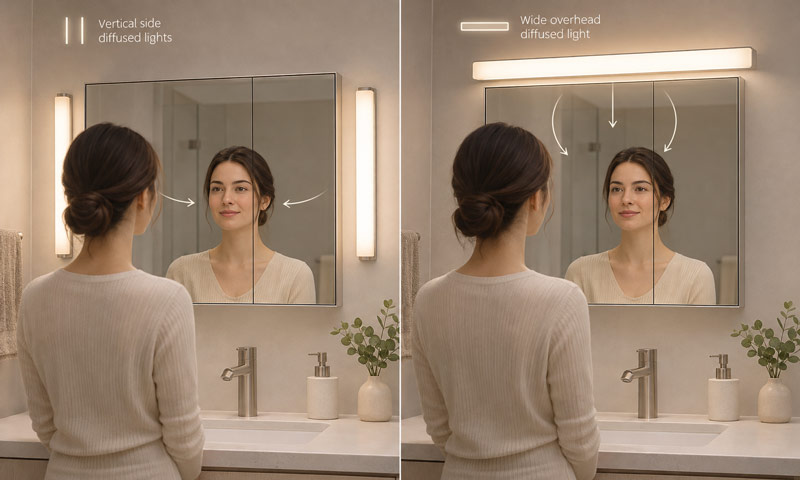
Vertical sconces beside the bathroom mirror light both sides of the face, and a wide, diffused vanity light above the mirror provides soft coverage when side space is limited.
Check that a medicine cabinet door can open fully and that the shade fits beside the mirror frame. Look at the fixture both directly and in the mirror. A visible bulb can produce a second bright spot in the reflection. If the mirror leaves room only above it, a wide, diffused fixture with some forward light can give better facial coverage than a narrow beam aimed at the sink.
Bedrooms and reading corners
Position a bedside sconce with the mattress, headboard, and pillows in place. Sit where you normally read and check that the light reaches the open pages and the switch is within reach. A shielded head or adjustable arm helps keep the source out of the reader’s direct view and limits light on the other side of the bed.
At a reading chair, check the beam with the chair in its usual position. A shade that looks centered above the chair can still leave the book in the reader’s shadow. Moving the source slightly to one side or using an adjustable head gives you more control. Allow space for the arm to swing clear of shelves, curtains, and the back of the chair.
Living and dining rooms
A pair of living room wall sconces can frame a fireplace, console, or piece of art. Check the grouping from the main seating area as well as from the doorway. A clear bulb that looks comfortable when you enter can be distracting at seated eye level. Glossy artwork and television screens can also reflect a bright source across the room.
In a dining room, sconces can illuminate the walls and leave the overhead fixture to light the table. View the proposed fixtures from seats at both ends of the table. A diffuser or deeper shade can make the wall light more comfortable from those angles. If the sconce is meant to pick up a textured finish, look at the wall with the light on. A narrow beam can emphasize joints, ridges, and surface irregularities as clearly as it reveals the texture you chose.
Hallways and stairs
In a narrow hallway, measure projection, the distance from the finished wall to the fixture’s farthest point. Check it against door swings, furniture, and the clear walking path. Include the shade and arm in that measurement.
For a run of fixtures, judge the spacing by how the light reaches the walking surface. A regular rhythm on the wall can still leave dark gaps below. On stairs, look at the first and last treads, landings, and changes in direction. If a decorative sconce leaves those areas in shadow, a shielded step light can put light closer to the walking surface.
Front doors, porches, and exterior walls
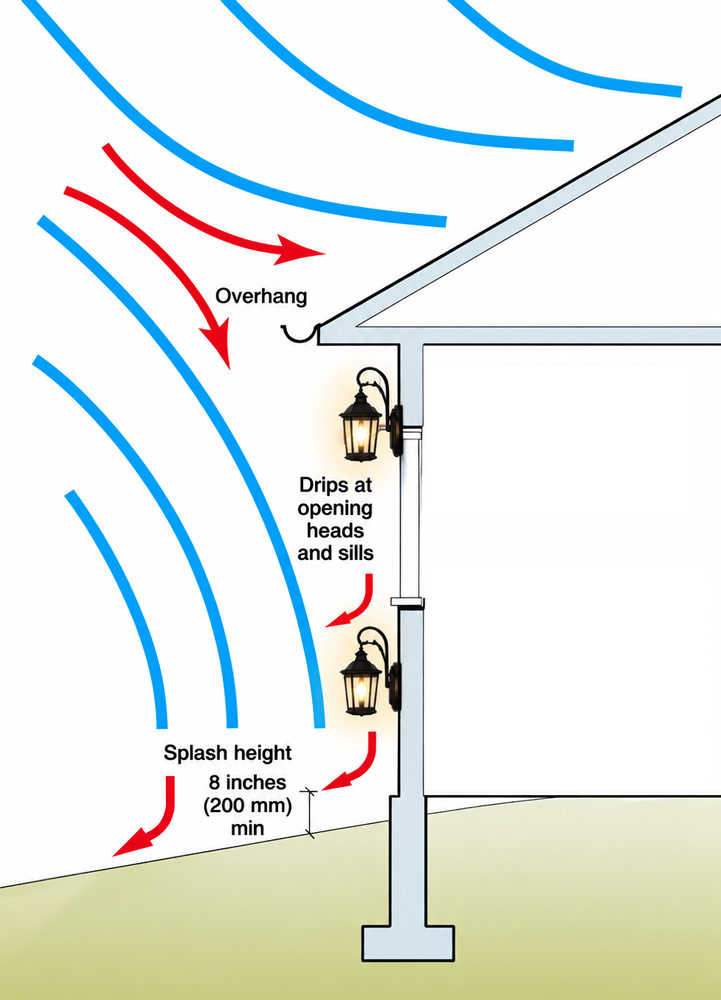
Even beneath a roof overhang, check whether wind-driven rain, runoff, or splashback can reach the mounting spot before choosing a location rating for an outdoor wall sconce.
For front door lighting, check what someone can see while approaching the house, stepping onto the landing, and using the lock. A shielded downward beam can put light on the threshold and keep the bright source out of a visitor’s eyes. On a door with glass or sidelights, check for reflections from inside the house as well.
Choose the location rating based on the fixture’s actual exposure. A damp-location fixture may suit a covered porch protected from direct water. An exposed wall that receives rain, runoff, or sprinkler spray calls for a fixture marked suitable for wet locations. Look at the direction rain reaches the wall during a storm. An overhang can leave part of a porch exposed to wind-driven rain.
“Only luminaires marked ‘SUITABLE FOR WET LOCATIONS’ are intended to be installed in wet locations” (UL LLC, 2016, p. 25).
UL LLC. (2016). Luminaires marking and application guide.
What to Check Before Buying a Wall Sconce
Dimensions, projection, and backplate
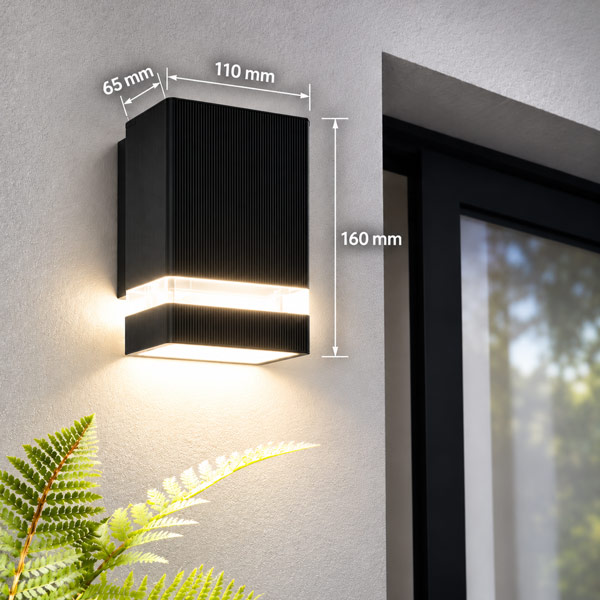
Compare the fixture’s overall width and height with the available wall area. Then check the backplate separately. Its shape and position determine how the fixture sits against trim, tile joints, or siding. When replacing a sconce, measure the existing mounting point and the area the old backplate covered. A smaller backplate can reveal an unfinished patch even when the new fixture fits the space.
Mark the full outline on the wall with painter’s tape. Use a paper or cardboard template to represent the projection if the fixture sits near a door, cabinet, or narrow passage. Check it from the positions where people stand, walk, or sit. A full-size outline can reveal conflicts that are difficult to spot in a product photo.
Light output and glare
Lumens measure light output. Watts measure electrical power. For a fixture with an integrated light source, look for the output of the complete fixture when the specification is available. For a socketed sconce, the bulb’s lumen rating describes the bulb itself. A shade can absorb some of that light or send it in a different direction.
Compare output together with beam direction and shielding. A focused 500-lumen fixture can put more light on a page than a broadly diffused fixture with the same rated output. An exposed bulb at eye level can feel harsh even at modest output. If you can see the source from a bed, sofa, or mirror, look for a diffuser, a recessed light source, or a shade that shields it from that view.
Color temperature and color rendering
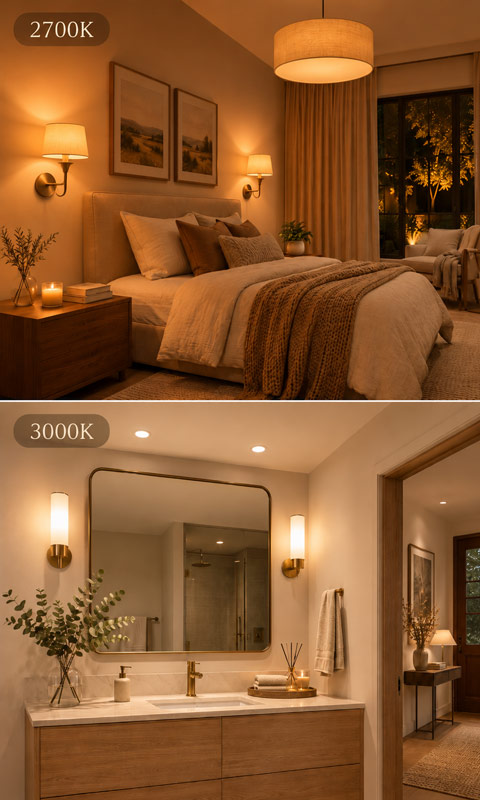
Color temperature, measured in kelvins, describes the appearance of the white light. Around 2700 K gives a warm, soft appearance that works well in many bedrooms and living rooms. 3000 K still looks warm and can suit a bathroom or entry where you prefer a slightly less amber appearance. When several fixtures are visible together, compare their light color before mixing them in the same space.
Color rendering index, or CRI, describes how faithfully a light source renders colors. A CRI of 90 or higher is a useful starting point beside a mirror where you apply makeup or check clothing colors. Color rendering and light direction solve different problems. A high-CRI source can render colors faithfully, and a well-positioned diffuser helps reduce facial shadows.
In the “What about LED light quality?” section, the U.S. Department of Energy (n.d.) states, “CRI of 90 or higher indicates excellent color fidelity; LEDs can also meet this threshold” (para. 3).
U.S. Department of Energy. (n.d.). LED basics.
Bulb fit and shade access
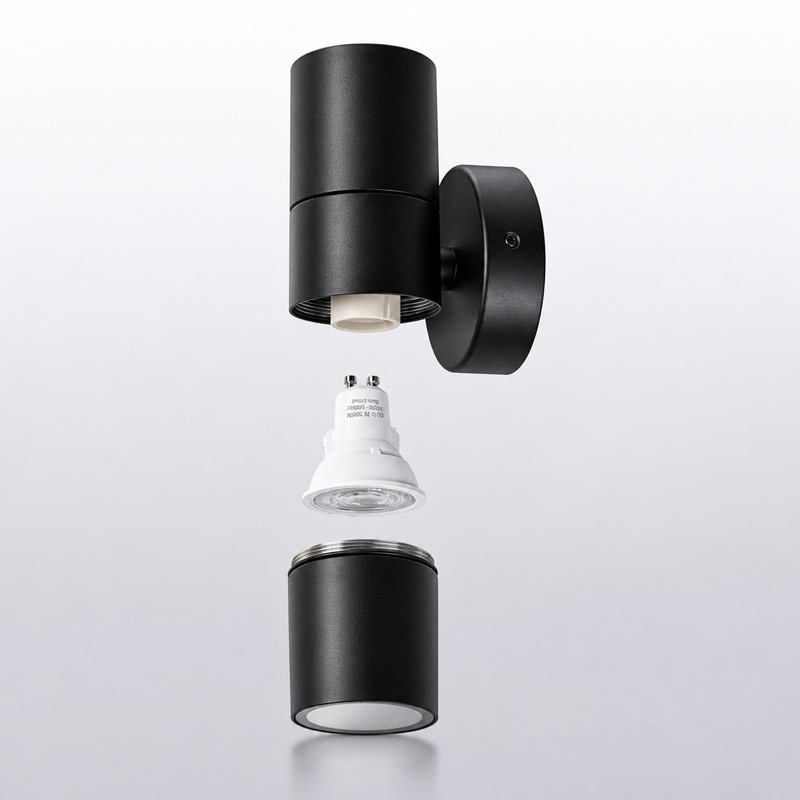
For a sconce with a socket, check the required bulb base, maximum wattage, and available space inside the shade. If the fixture fully encloses the bulb, choose a bulb marked for that use. A bulb can fit the socket and still be too long for the shade or extend far enough to become visible from below.
Check how you’ll reach the bulb or remove the diffuser once the sconce is mounted. A fixture that fits tightly under a shelf may look good on the wall and still leave too little room to open the shade. For outdoor models, follow the mounting orientation and clearance instructions so the fixture can manage water as designed.
FAQs
1. Are wall sconces outdated?
Wall sconces are still used in contemporary interiors. Their appearance depends on details such as the shade profile, arm shape, and finish. If an existing sconce feels dated, identify which detail is responsible. A compatible replacement shade can change the appearance of a sound fixture without changing the wall connection.
2. Can wall sconces be dimmed?
Yes, when the light source and control support the same dimming method. A socketed sconce needs a dimmable bulb and a compatible control. An integrated LED model needs a control that works with its driver. Check dimming compatibility for the exact model, including its minimum dimming level if you want a soft night setting.
3. How do you hide the cord on a plug-in wall sconce?
Use a surface-mounted cover designed for power cords and run it in a straight line from the sconce toward the outlet. A paintable cover in the wall color can make the route less visible. Keep the cord on the wall surface, leave the plug accessible, and allow enough clearance to keep doors or furniture from pinching the cord.
4. Can you replace the LED in an integrated wall sconce?
Some integrated LED fixtures have a replaceable LED module or a serviceable driver. Check the product manual for replacement part numbers and who can perform the service. A driver fault can stop the fixture from working even when the LEDs are intact. If you’re buying a matching pair, check parts availability so you know your options if one fixture fails.
5. Can a damp-rated wall sconce be used inside a shower?
A damp-rated wall light in a shower is an option only where the fixture is protected from spray and the applicable electrical rules permit that installation. Where shower spray can reach the fixture, use a model marked suitable for wet locations. Have a qualified electrician confirm the requirements for the exact mounting position and check that the fixture instructions allow that use.
