

What Makes a Light Fixture Dimmable?
Which Types of Lights Can Be Dimmed?
How to Tell Whether Your Light Fixture Is Dimmable
Can You Make a Non-Dimmable Light Fixture Dimmable?
Are Outdoor and Landscape Light Fixtures Dimmable?
Why Do Dimmable Lights Flicker, Buzz, or Switch Off?
FAQs
No, not all light fixtures are dimmable. Dimming depends on whether the light source, any driver or transformer, and the dimming control are designed to work together. Installing a dimmer switch alone does not make a non-dimmable light compatible with brightness adjustment.
A simple fixture with replaceable bulbs may support dimming after a compatible bulb and dimmer upgrade. An integrated LED fixture needs a driver that supports the intended dimming method. Low-voltage lighting adds another consideration: the power supply must also be suitable for the system.
The most useful question is therefore whether the complete lighting setup supports dimming—and which control it requires.
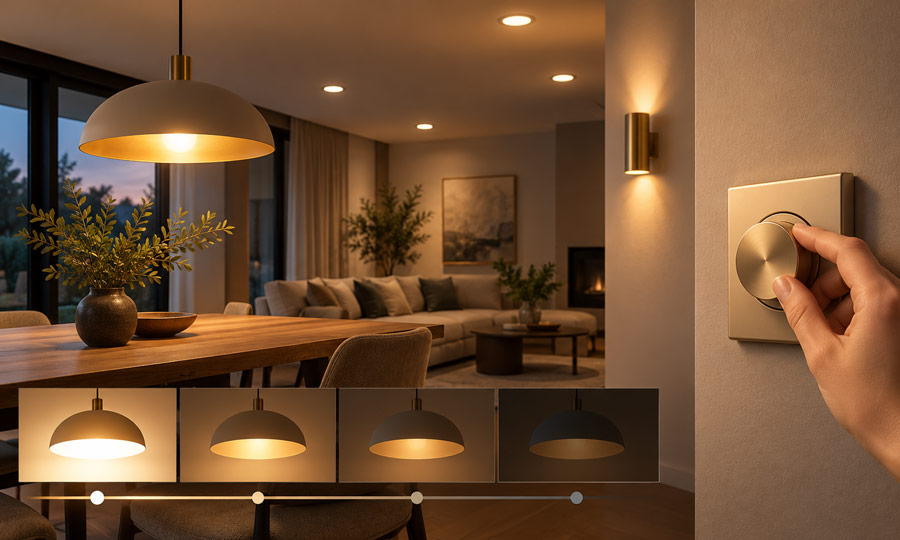
What Makes a Light Fixture Dimmable?
A light fixture can include more than a housing and bulb socket. Depending on its design, it may contain a driver, transformer, ballast, sensor, or built-in controller. These components determine how the fixture responds when brightness is adjusted.
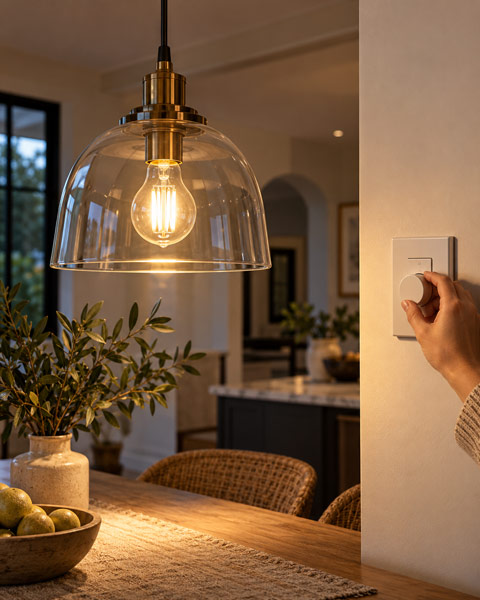
Fixtures with Replaceable Bulbs
In a basic line-voltage fixture without built-in electronics, dimming often depends primarily on the bulb and the dimmer switch.
For example, a pendant with a standard socket may accept a dimmable LED bulb. However, the bulb must still match the fixture’s voltage, base, wattage limit, and enclosure requirements. The dimmer must also be compatible with that exact type of LED load.
If the fixture’s instructions explicitly prohibit dimming, do not assume that changing the bulb overrides the restriction. Confirm the requirements for the exact model.
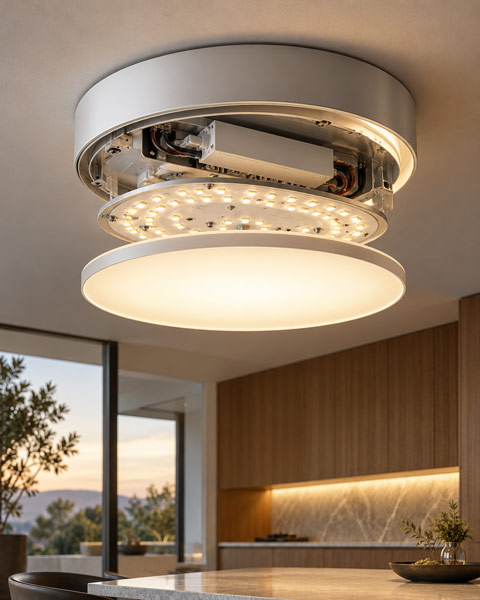
Integrated LED Fixtures
An integrated LED fixture has its LED light source built into the fitting rather than using an ordinary replaceable bulb.
Its driver supplies the electrical conditions the LEDs need. For dimming to work, the driver must accept the selected control method and regulate the LED output accordingly.
Reference: Beebe, A. (2011, February). Navigating the world of LED controls. NEMA electroindustry, 18–19.
Two fixtures can look identical while using different drivers. One may support dimming, while another operates only at a fixed brightness. “Integrated LED” describes the construction; it does not establish dimming capability.
Which Types of Lights Can Be Dimmed?
Use the following comparison as a starting point, then check the specifications for the actual product.
| Light source or system | Can it be dimmed? | Main requirement |
|---|---|---|
| Line-voltage incandescent or halogen | Generally yes | A suitable dimmer within its rated load |
| Replaceable LED bulb | Only if designed for dimming | A dimmable bulb and compatible dimmer |
| Integrated LED fixture | Depends on the model | A dimmable driver and matching control |
| Compact fluorescent bulb | Only certain models | A bulb explicitly rated for dimming and a compatible control |
| Fluorescent tube fixture | With an appropriate system | A dimming ballast matched to the lamps and control |
| Low-voltage lighting | Depends on the complete setup | Compatible lamps, transformer or driver, and dimming control |
For LED lighting, the word “dimmable” does not mean compatible with every dimmer. Check the supported control type and any tested compatibility information before purchasing.
Reference: Pacific Northwest National Laboratory. (2025, January 20). Lighting controls for multifamily buildings. Building America Solution Center.
How to Tell Whether Your Light Fixture Is Dimmable
1. Check the Exact Product Specifications
Look for the model number on the fixture label, packaging, installation instructions, or product page. Relevant information may include:
- Whether dimming is supported.
- The required dimming method.
- Compatible dimmer models.
- The stated dimming range.
- Load limits or maximum fixture quantities.
A description such as “adjustable,” “LED,” or “energy efficient” does not confirm dimming compatibility. “Adjustable” may refer to the beam direction or another setting.
If dimming information is missing, ask the manufacturer for confirmation before connecting the fixture to a dimmer.
2. Identify the Bulb or Driver
For a fixture with replaceable LED bulbs, check the bulb model separately from the fixture. A dimmable fixture fitted with non-dimmable bulbs will not provide a compatible dimming setup.
For integrated LEDs, use the fixture’s documentation to identify the installed driver and supported controls. A driver may be inside the fitting or housed separately.
Do not open sealed housings or electrical compartments simply to experiment with unidentified components.
3. Match the Dimming Method
Several dimming methods are used in lighting, and they are not automatically interchangeable.
| Dimming method | How it works | What to check |
|---|---|---|
| Leading-edge, or forward-phase | Cuts the beginning of each AC half-cycle | Whether the bulb, driver, and any transformer support forward-phase control |
| Trailing-edge, or reverse-phase | Cuts the end of each AC half-cycle | Whether the connected equipment supports reverse-phase control |
| 0–10V | Sends a separate low-voltage control signal to the driver or ballast | Compatible control wiring, driver specifications, and switching requirements |
Some LED products work with leading-edge dimmers, others require trailing-edge control, and some support both. Choose according to the product’s compatibility information.
A fixture specified only for 0–10V dimming should not be treated as compatible with an ordinary phase-cut wall dimmer. Its driver receives brightness instructions through a separate control connection.
4. Check the Connected Load
Dimmers have load limits. The rating for incandescent lighting may differ substantially from the rating for LEDs.
Use the bulbs’ actual electrical wattage, not their advertised incandescent-equivalent wattage. For example, four 8-watt LED bulbs represent a nominal 32-watt lamp load, even if each is marketed as a replacement for a 60-watt incandescent bulb.
That calculation is only one check. Compatibility documentation may also specify minimum and maximum lamp quantities because LED electronics behave differently from incandescent filaments.
Reference: Pacific Northwest National Laboratory. (2014, March). Dimming, flicker, and power quality characteristics of LED PAR38 lamps (CALiPER Report 20.2). U.S. Department of Energy.
Check any installation-related derating instructions as well. A dimmer’s usable capacity can depend on how it is installed.
5. Check the Minimum Dimming Level
A dimmable light does not necessarily fade smoothly all the way to darkness.
The lowest stable output depends on the bulb or driver and its interaction with the control. A product designed to dim to 10% may be unsuitable if you need very low evening illumination.
Also distinguish between minimum brightness and off. Some systems require a separate switching function to turn the light completely off. With 0–10V lighting, the driver’s capabilities determine the achievable dimming performance.
Reference: Waghale, A. S., Poplawski, M. E., Pratoomratana, S. C., & Tuenge, J. R. (2023, December). The energy and operational impacts of using 0-10V control for LED streetlights (Report No. PNNL-32949). Pacific Northwest National Laboratory.
Can You Make a Non-Dimmable Light Fixture Dimmable?
Sometimes, but the appropriate upgrade depends on what prevents the existing setup from dimming.
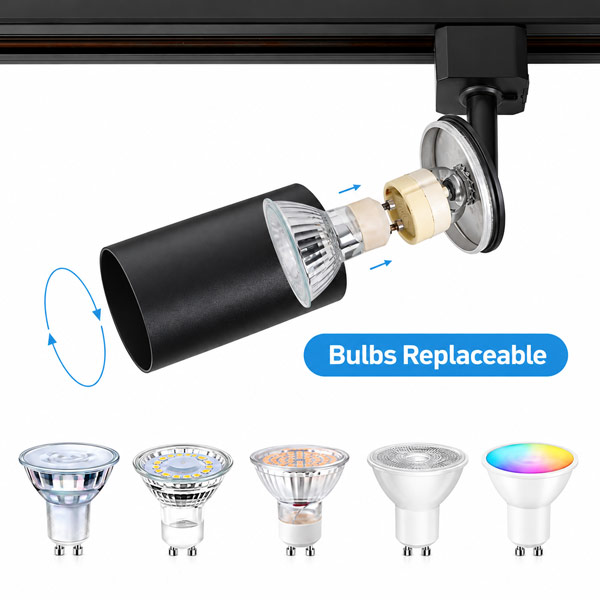
A Fixture with Non-Dimmable Replaceable Bulbs
If the fixture permits dimming and contains no incompatible electronics, replacing the bulbs with suitable dimmable versions and installing a compatible control may be enough.
Check every bulb on the controlled circuit. A mixed group of dimmable and non-dimmable bulbs is not a suitable setup for dimming.
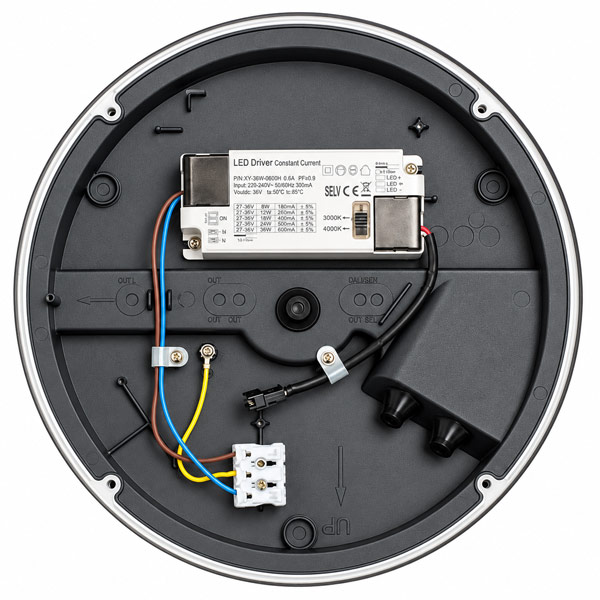
A Fixture with a Non-Dimmable LED Driver
Changing the wall switch will not add a dimming function that the driver lacks.
A driver replacement may be possible when the manufacturer provides an approved option for the fixture. Matching wattage alone is insufficient: the replacement also needs the correct electrical output, control interface, physical fit, and thermal suitability.
For sealed or non-serviceable fixtures, replacing the complete fitting with a suitable dimmable model is often the practical option. Have internal electrical modifications assessed by a qualified professional.
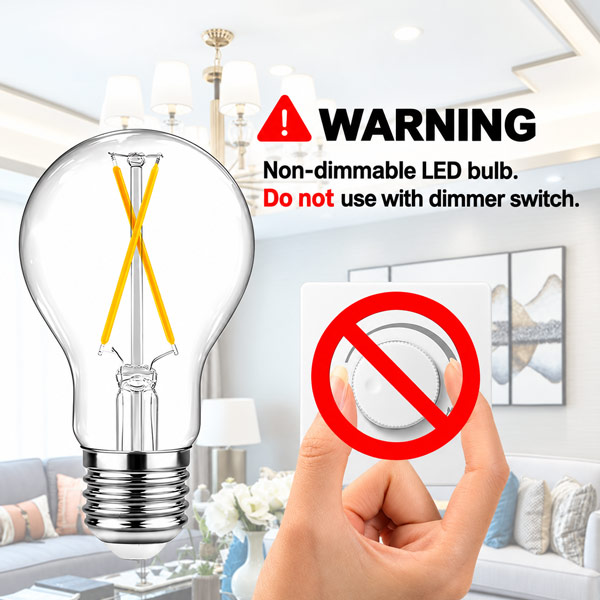
A Fixture Explicitly Marked “Not for Use with Dimmers”
Follow that restriction. Keeping a dimmer at its maximum setting does not establish compatibility with a non-dimmable product.
Use the specified on/off control or choose a fixture designed for the dimming system you want. Incompatible combinations can cause flickering, noise, unstable operation, or premature failure.
Are Outdoor and Landscape Light Fixtures Dimmable?
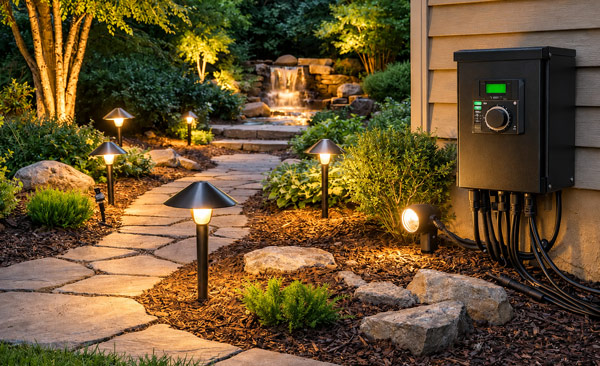
Some outdoor fixtures support dimming, but outdoor suitability and dimming capability are separate specifications.
For line-voltage outdoor lights, check the fixture, lamp, and dimmer compatibility as you would indoors. Also confirm that each component is suitable for its installation location and environmental exposure.
Low-voltage landscape lighting requires additional attention.
A 12V landscape lighting transformer supplies power to the connected lights, but a 12V output does not establish that the transformer accepts dimming. Some landscape power supplies explicitly prohibit connection to a dimmer.
Before choosing a dimming control, confirm:
- Whether the fixtures require AC or DC power.
- Whether the transformer or driver supports the intended dimming method.
- Whether the connected lamps or LED modules support that method.
- Whether timers, photocells, or other controllers permit the proposed arrangement.
Check the complete equipment combination. A dimmable lamp cannot compensate for an incompatible transformer, and a dimmable transformer cannot make a non-dimmable lamp suitable for brightness control.
For paths and steps, test the intended low setting after dark. The lighting should still make changes in level and the walking surface easy to see.
Why Do Dimmable Lights Flicker, Buzz, or Switch Off?
A “dimmable” label confirms a capability, but performance still depends on the installed combination and settings.
| Symptom | Possible explanation | What to check |
|---|---|---|
| Flickering at low brightness | Incompatible control, insufficient load, or an unstable low-end setting | Tested compatibility and the dimmer’s permitted adjustment procedure |
| Buzzing or humming | Electrical interaction between the dimmer and lamp or driver | Correct control type and supported load |
| Switching off before the slider reaches its lowest position | The lamp or driver has reached its minimum operating level | Specified dimming range and low-end trim |
| Different bulbs dimming unevenly | Different lamp models or driver characteristics | Whether matching, approved lamps are installed |
Low-end trim can limit a compatible system to its stable operating range. It cannot turn a non-dimmable product into a dimmable one.
When troubleshooting flickering lights, also consider faults unrelated to dimming, such as loose connections or a failing power supply. Flicker that persists at full brightness should not automatically be blamed on the dimmer.
Stop using the affected circuit and arrange an electrical inspection if there is a burning smell, visible damage, or repeated breaker tripping.
FAQs
1. Can You Use a Dimmable LED Bulb With a Regular On/Off Switch?
Yes, in most cases. A dimmable LED bulb can usually be used with a standard on/off switch and will operate at its full rated brightness when no dimming control is provided.
The bulb must still match the fixture requirements, including voltage, socket type, and operating conditions. Some specialty bulbs with built-in controls may have different operating instructions.
2. Does Dimming LED Lights Reduce Energy Consumption?
Yes. When compatible LEDs are dimmed, they generally use less electrical power because the light output is reduced.
The actual energy reduction depends on the LED driver, dimming technology, and brightness level. A dimmer set halfway does not always mean the light uses exactly half the electricity, since control position and power consumption do not always change proportionally.
3. Does Dimming an LED Make the Light Color Warmer?
Not always. Most standard LED bulbs keep a similar color temperature while their brightness is reduced. Only LEDs specifically designed with a dim-to-warm feature shift toward a warmer color when dimmed.
Reference: U.S. Department of Energy. (n.d.). Understanding LED color-tunable products.
When choosing between 2700K and 3000K landscape lighting, consider the initial color appearance separately from dimming behavior. A lower brightness setting does not automatically change a 3000K LED into a warmer 2700K light.
4. Can One Light Be Controlled From Two Different Locations With Dimming?
Yes, but the controls must be designed to work together. Many multi-location dimming systems use one primary dimmer combined with a compatible companion switch.
Two standard dimmer switches should not be connected to the same lighting load unless the manufacturer specifically supports that arrangement. Always follow the wiring instructions for the selected control system.
5. Can You Dim LED Lights Without Installing a Wall Dimmer?
Yes. Many lighting products provide built-in brightness control through smart features, remote controls, touch panels, or dedicated controllers.
These solutions allow you to dim LED lights without a dimmer switch by using the control system designed for the product. A standard smart plug usually provides only power on/off control and does not add dimming capability to a normal bulb.
