
1. Decide What the Wall Sconces Need to Do
2. Choose the Right Scale
3. Match the Style Without Matching Everything
4. Use Material to Create Character
5. Pay Attention to Finish
6. Consider the Shape of the Fixture
7. Think About Light Direction
8. Choose a Comfortable Color Temperature
9. Pay Attention to Color Rendering and Glare
10. Use Dimmers When Possible
11. Position Wall Sconces Carefully
12. Decide Between Symmetry and Asymmetry
13. Coordinate Sconces With Other Lighting
14. Use Contrast Intentionally
15. Consider Wall Color and Texture
16. Make Sure the Fixture Looks Good When Off
17. Look Beyond Standard Designs
18. Avoid Choosing Only by Trend
19. Check Installation Requirements
20. Evaluate Construction and Light Source Quality
21. Avoid Too Many Statement Pieces
22. Test the Size Before Buying
23. Think About the Entire Wall Composition
24. Avoid Common Wall Sconce Mistakes
FAQs
Choosing unique wall sconces for a living room is not simply a matter of finding an attractive fixture. The right sconces should improve the room’s lighting, complement its furniture and architecture, and add visual character without making the walls feel crowded.
Because wall sconces are usually installed close to eye level, their shape, material, finish, size, and light quality are highly noticeable. A distinctive sconce can work almost like a piece of wall art, while a poorly chosen fixture may look disconnected from the rest of the room.
The best approach is to consider both appearance and function. Start with the purpose of the lighting, then evaluate scale, style, materials, placement, light direction, and compatibility with the overall living room.
1. Decide What the Wall Sconces Need to Do
Before comparing designs, determine the main purpose of the sconces.
For general ambient lighting, choose fixtures that produce a soft, diffused glow. Opal glass, frosted glass, fabric shades, alabaster-style diffusers, and upward-facing designs can create a comfortable atmosphere without harsh brightness.
If the sconces are intended to highlight artwork, textured walls, shelving, or architectural details, directional or up-and-down lighting may be more appropriate. These fixtures create shadows and highlights that make surfaces more visually interesting.
For reading areas, adjustable wall lights or swing-arm sconces are usually more practical. They can be positioned beside a sofa, reading chair, or small desk without taking up floor or table space.
Some wall sconces are primarily decorative. Sculptural metalwork, handmade ceramic, unusual glass forms, or oversized geometric fixtures can become focal points even when the lights are switched off.
2. Choose the Right Scale
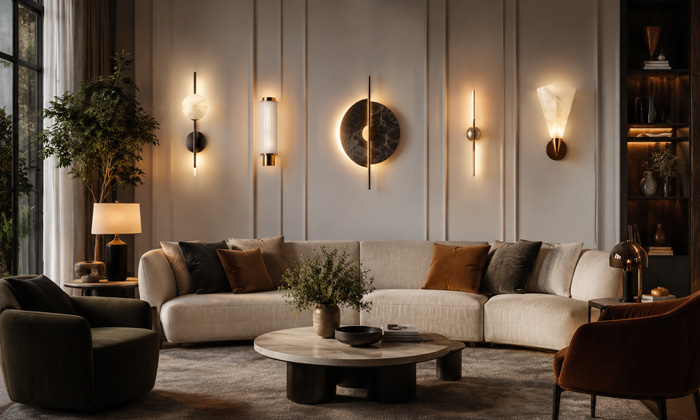
Scale is one of the most important factors in wall lighting.
A sconce that looks substantial in a product photograph may appear very small once installed on a large living room wall. On the other hand, an oversized fixture can overwhelm a compact room.
Consider the fixture’s height, width, and projection from the wall. Projection is particularly important near walkways, doors, or seating areas because a fixture that extends too far can interfere with movement.
Large living rooms with high ceilings can generally support taller and more sculptural sconces. Smaller rooms often benefit from slimmer fixtures with simpler proportions.
The surrounding furniture should also influence the size. Tiny sconces beside a large fireplace may look insignificant, while oversized fixtures beside a small piece of artwork may dominate the entire composition.
Instead of evaluating the fixture alone, think about how it relates to the wall, furniture, artwork, and architectural features around it.
3. Match the Style Without Matching Everything
Unique wall sconces do not need to look completely different from every other object in the room. In most cases, the best result comes from creating visual connections without making every fixture identical.
For example, a living room may include a brass chandelier, dark furniture legs, walnut cabinetry, cream upholstery, and textured stone. The wall sconces could repeat the warm brass tone of the chandelier or the organic texture of the stone without copying the exact design of either.
Modern living rooms often work well with clean geometric forms, architectural lines, matte finishes, and integrated LED lighting. Mid-century spaces may suit globe shades, brass details, curved arms, or conical forms.
Traditional rooms can support candle-style sconces, pleated shades, decorative backplates, bronze finishes, and curved metalwork. Industrial interiors often pair well with blackened steel, clear glass, exposed hardware, and adjustable arms.
For Scandinavian, Japandi, or minimalist interiors, choose restrained fixtures in natural wood, pale metal, white finishes, or simple glass forms. Eclectic rooms provide greater freedom for colored glass, handmade ceramic, asymmetrical fixtures, and unusual sculptural shapes.
The goal is coordination rather than exact matching.
4. Use Material to Create Character
Material is one of the easiest ways to make a wall sconce feel distinctive. Two fixtures with similar shapes can create completely different impressions when made from different materials.
| Sconce Material | Visual Character | Best Suited To | Main Consideration |
|---|---|---|---|
| Brass | Warm and sophisticated | Modern, traditional, mid-century interiors | Choose polished, brushed, or aged finishes carefully |
| Blackened metal | Graphic and architectural | Modern, industrial, minimalist rooms | Creates strong contrast on pale walls |
| Glass | Light and versatile | Most interior styles | Transparency can increase glare |
| Opal glass | Soft and refined | Scandinavian, modern, transitional rooms | Excellent for diffused lighting |
| Ceramic | Artistic and tactile | Organic modern, Mediterranean, eclectic interiors | Handmade variations add character |
| Alabaster or stone | Natural and luxurious | Contemporary and high-end interiors | Natural veining makes each piece unique |
| Wood | Warm and relaxed | Japandi, Scandinavian, rustic interiors | Coordinate with existing wood tones |
| Fabric | Soft and traditional | Classic and transitional rooms | May require more cleaning |
| Colored glass | Expressive and decorative | Art Deco, eclectic, contemporary rooms | Color should relate to the room palette |
If uniqueness is a priority, natural and handmade materials are especially effective because their small variations prevent the sconces from looking overly mass-produced.
5. Pay Attention to Finish
The finish determines how noticeable the sconce feels against the wall.
Polished brass, chrome, or nickel reflects light and naturally attracts attention. Matte black, bronze, and brushed finishes usually feel quieter and more architectural.
There is no requirement for every metal finish in a living room to match. Mixing finishes can produce a more layered interior when done intentionally.
For instance, brushed brass sconces can work well in a room with black curtain rods and darker furniture hardware. What matters is that the combination feels repeated and deliberate rather than introducing a completely unrelated finish only once.
6. Consider the Shape of the Fixture
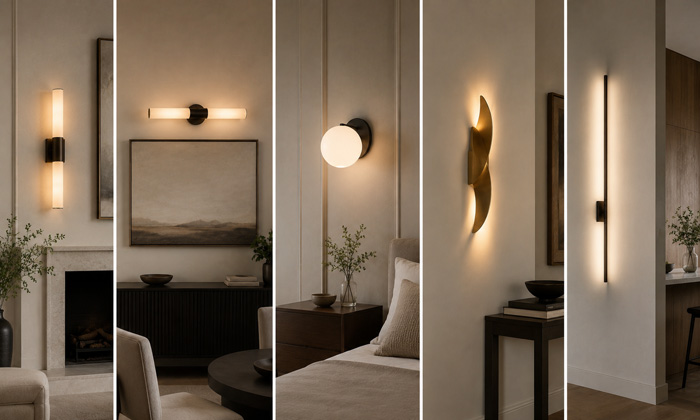
The silhouette of a wall sconce affects how it interacts with the wall and surrounding furniture.
Tall vertical sconces emphasize height and work particularly well beside fireplaces, mirrors, windows, or narrow architectural sections. Horizontal fixtures visually widen an area and can be effective above cabinetry or artwork.
Globe sconces introduce softer curves into rooms dominated by straight furniture lines. Sculptural sconces create a stronger decorative statement, while slim linear fixtures can almost disappear into modern architecture and allow the lighting effect itself to become the main feature.
When selecting an unusual shape, consider whether it complements or contrasts with the dominant geometry of the room. A curved fixture can soften angular furniture, while a linear sconce can introduce structure into a room filled with organic forms.
7. Think About Light Direction
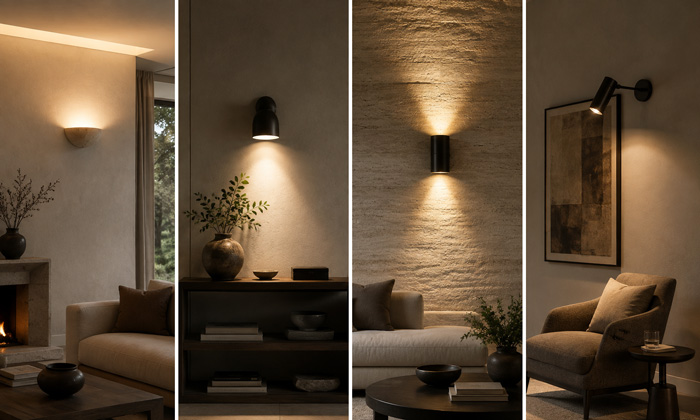
The direction of light can dramatically change how a living room feels.
Upward-facing sconces bounce light toward the ceiling, creating soft indirect illumination and helping a room feel more spacious. Downward lighting is more concentrated and can work well above shelves, consoles, or specific decorative features.
Up-and-down sconces create beams in both directions and are especially effective on textured or architectural walls. They make the wall itself part of the lighting design.
For a softer effect, choose fixtures surrounded by frosted glass, fabric, stone, or another translucent material. Adjustable directional sconces are better when light needs to be aimed toward a reading chair, artwork, or another specific area.
The best choice depends on whether the goal is atmosphere, decoration, or practical illumination.
8. Choose a Comfortable Color Temperature
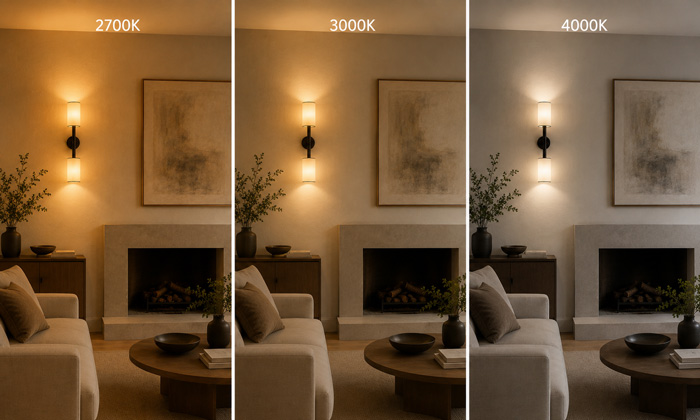
Light temperature has a major effect on how a living room feels.
For most residential living spaces, warm white light is the safest choice. Around 2700K creates a warm, relaxed atmosphere that works particularly well with wood, brass, leather, cream upholstery, and warm paint colors.
Around 3000K feels slightly cleaner and is often suitable for contemporary interiors.
Very cool white lighting can make a living room feel less inviting, particularly when the room contains warm materials and colors.
Consistency also matters. If the ceiling fixtures produce warm light while the sconces produce noticeably cooler light, the room may feel visually fragmented.
9. Pay Attention to Color Rendering and Glare
Good color rendering helps furniture, artwork, wood, fabrics, and wall finishes appear natural. A CRI of 90 or higher is a strong choice for living room lighting when available.
Glare is equally important.
Because sconces are often installed close to eye level, exposed high-output bulbs can become uncomfortable, especially when viewed from a sofa or armchair.
Before choosing a fixture, consider whether the bulb will be directly visible from common seating positions. Deep shades, frosted glass, opal diffusers, or concealed light sources can significantly improve comfort.
A fixture can look dramatic in a showroom but become unpleasant if it shines directly into your eyes every evening.
10. Use Dimmers When Possible
Dimming makes wall sconces much more versatile.
A living room may require brighter illumination when entertaining guests and much softer lighting while watching television or relaxing in the evening. A dimmer allows the same fixture to serve both purposes.
For LED fixtures, check that the bulb or integrated LED system is compatible with the intended dimmer. Incompatible controls can lead to flickering, buzzing, or poor dimming performance.
11. Position Wall Sconces Carefully
There is no single installation height that works for every living room. Placement should depend on the architecture, furniture, fixture size, and intended lighting effect.
Sconces are generally installed around eye level or slightly above, but they should be evaluated from both standing and seated positions.
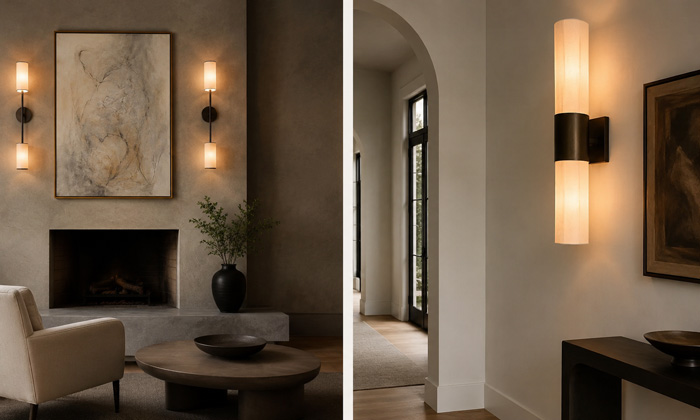
Beside a fireplace, matching sconces can create strong symmetry and help frame the focal point. The fixtures should be substantial enough to relate visually to the size of the fireplace and mantel.
Beside artwork, the sconces should support the artwork rather than compete with it. Detailed or colorful art may benefit from simpler fixtures, while minimal artwork can accommodate more sculptural lighting.
Above or near a sofa, pay particular attention to fixture projection. Avoid positioning deep sconces where someone could easily hit them when standing up or moving around the seating area.
Sconces can also work particularly well around built-in shelving, wall niches, and architectural paneling, where they make the room feel more integrated and custom-designed.
12. Decide Between Symmetry and Asymmetry
Pairs of sconces are common because symmetry creates a sense of order and balance.
Matching fixtures can look particularly effective on either side of a fireplace, console, large artwork, or architectural opening.
However, symmetry is not essential.
A single sculptural sconce beside a reading chair, bookshelf, or artwork grouping can create a more contemporary composition. Different but related sconces may also work in eclectic interiors.
Asymmetrical arrangements should still feel balanced. The surrounding artwork, furniture, lamps, and negative wall space all contribute to the visual weight of the composition.
13. Coordinate Sconces With Other Lighting
A successful living room rarely relies on one type of lighting.
Ceiling fixtures, wall sconces, floor lamps, table lamps, and accent lighting usually work together to create different layers of illumination.
If the main chandelier is already highly decorative, simpler wall sconces may provide better balance. If the ceiling lighting is minimal or recessed, the sconces can take on a stronger decorative role.
Avoid selecting every light fixture from exactly the same collection. Rooms often feel more refined when the fixtures relate through material, finish, or proportion while maintaining different shapes.
For example, a brass chandelier and brass wall sconces can feel connected even if their silhouettes are completely different.
14. Use Contrast Intentionally
Contrast can make a wall sconce feel unique without requiring an overly complicated design.
A black sconce against a pale plaster wall immediately becomes more graphic. A light stone fixture against a deep blue or charcoal wall creates the opposite effect.
Material contrast can be equally effective. Smooth glass beside rough stone, warm brass against cool gray walls, or handmade ceramic in a highly modern room can create visual tension and interest.
The goal is to create contrast that feels deliberate rather than random.
15. Consider Wall Color and Texture
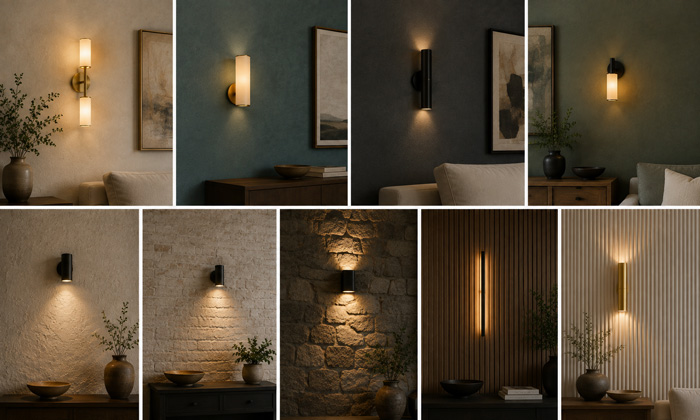
Always evaluate a fixture against the wall where it will actually be installed.
Brass may blend softly into warm beige or ochre walls but create stronger contrast against blue, green, or charcoal paint. Black fixtures become highly visible on white walls but can nearly disappear against dark surfaces.
Wall texture also affects the lighting.
Directional sconces are particularly effective on limewash, brick, stone, wood paneling, textured plaster, and fluted surfaces because the light creates shadows that emphasize depth.
If the living room has an interesting wall finish, choose sconces that reveal that texture rather than visually cover it.
16. Make Sure the Fixture Looks Good When Off
Wall sconces remain visible throughout the day, so they should be considered decorative objects as well as sources of light.
Look carefully at the shape, backplate, materials, joints, and overall proportions. A sculptural fixture should still contribute something to the wall even when it is not illuminated.
Natural daylight may also reveal differences in material quality that are less noticeable when the fixture is switched on.
This is particularly important for sconces placed in highly visible locations such as beside fireplaces, artwork, or main seating areas.
17. Look Beyond Standard Designs
If you want genuinely unique sconces, consider looking beyond standard mass-market lighting collections.
Independent lighting designers, ceramic artists, glass studios, and small design brands often experiment with materials and proportions that are less common in mainstream products.
Vintage sconces can also bring strong character to a living room. However, older electrical components should be inspected carefully and updated when required.
A fixture does not need to be highly decorative to feel unique. Unusual materials, handmade surfaces, interesting proportions, or subtle craftsmanship can often create a stronger impression than excessive ornament.
18. Avoid Choosing Only by Trend
Wall sconces are relatively permanent compared with cushions, accessories, or small decorative objects.
For that reason, choosing a fixture solely because it is fashionable can be risky.
A better long-term choice focuses on strong proportions, quality materials, comfortable illumination, and craftsmanship. Trends can influence the selection, but they should not be the only reason for buying a particular design.
Distinctive lighting does not have to be trendy. A simple bronze, ceramic, or glass fixture with excellent proportions can remain attractive for many years.
19. Check Installation Requirements
Before purchasing a sconce, confirm how it will be installed.
Hardwired sconces generally provide the cleanest appearance because the electrical wiring is concealed inside the wall. They are ideal during renovation or construction.
Plug-in sconces are easier to add to an existing room, although the visible cord becomes part of the design.
Rechargeable fixtures may be useful where wiring is impossible, but they normally require more frequent maintenance and may provide less light than permanently wired options.
Also check how far the fixture projects from the wall. Deep sconces may be unsuitable beside narrow walkways, doorways, or frequently used seating.
20. Evaluate Construction and Light Source Quality
A unique appearance does not necessarily mean a high-quality product.
Look closely at the metal thickness, glass consistency, joints, backplate, mounting hardware, shade attachment, and surface finish.
The light source also deserves attention. Find out whether the fixture uses a replaceable bulb or integrated LED, whether replacement components are available, and whether the light can be dimmed.
Fixtures installed at eye level are easy to inspect closely, so poor construction tends to be more noticeable than it would be on a ceiling light.
21. Avoid Too Many Statement Pieces
Statement sconces work best when they have enough visual space around them.
If the living room already includes a dramatic chandelier, strong wallpaper, colorful artwork, sculptural furniture, and a bold fireplace, highly elaborate sconces may make the room feel overloaded.
In this situation, simpler sconces often provide better balance.
On the other hand, a minimalist living room with neutral surfaces and restrained furniture can support more expressive wall lighting.
The goal is not to make every object a focal point. It is to decide which elements deserve the most attention.
22. Test the Size Before Buying
Product photographs can make fixture dimensions difficult to judge.
One simple method is to create a paper or cardboard outline matching the dimensions of the sconce and temporarily place it on the wall.
This makes it much easier to judge whether the fixture is too small, too wide, or incorrectly positioned relative to furniture and artwork.
For larger fixtures, checking the projection from the wall is equally important.
A simple mock-up can prevent expensive mistakes before wiring or drilling begins.
23. Think About the Entire Wall Composition
The most successful wall sconces do not look like isolated objects.
Consider everything that occupies the same visual area.
A fireplace wall, for example, may contain a mantel, artwork, sconces, molding, and the fireplace itself. All of these elements should feel like one composition.
Similarly, a sofa wall may include artwork, side tables, lamps, and sconces. Their dimensions and spacing should relate to one another.
Looking at the entire wall instead of focusing only on the fixture is one of the easiest ways to achieve a more professionally designed result.
24. Avoid Common Wall Sconce Mistakes
Several problems appear repeatedly when living room sconces are chosen primarily for appearance.
Fixtures that are too small often disappear on large walls, while oversized sconces can overwhelm furniture and artwork. Poor placement may create uncomfortable glare or make the fixture feel disconnected from the room.
Another common mistake is ignoring practical light output. A decorative fixture may look excellent but provide very little usable illumination.
It is also unnecessary to match every lighting fixture exactly. Using the same finish, shape, and design throughout the living room can make the space feel like a coordinated showroom set rather than a layered interior.
Finally, always consider wall proportions, ceiling height, furniture scale, fixture projection, and viewing position before installation.
FAQs
How many lumens should living room wall sconces provide?
For decorative or supplementary lighting, around 300–800 lumens per sconce is often sufficient.
Larger living rooms or sconces used as a primary light source may require higher output.
Can smart bulbs be used in decorative wall sconces?
Yes, as long as the bulb base, wattage, fixture enclosure, and smart bulb specifications are compatible.
Smart bulbs can add app control, scheduling, adjustable brightness, and in some models, tunable white light.
Are wall sconces energy efficient compared with floor lamps?
Energy efficiency depends mainly on the light source rather than the fixture type.
LED wall sconces can consume significantly less electricity than fixtures using traditional incandescent or halogen bulbs while providing comparable brightness.
Do living room wall sconces need to meet electrical safety standards?
Yes. Hardwired sconces should meet the electrical certification requirements applicable in the installation region.
Proper grounding, compatible junction boxes, approved wiring, and professional installation are especially important for permanent fixtures.
How do you clean decorative wall sconces without damaging the finish?
Turn off the power and allow the fixture to cool before cleaning.
Use a soft microfiber cloth for metal, glass, or ceramic surfaces, and avoid abrasive cleaners that may damage plated, painted, aged, or specialty finishes.
