
How Integrated LED Lighting Works
Integrated LED vs. Replaceable LED Bulbs
Why Choose Integrated LEDs for a Garden?
Can You Replace an Integrated LED Light Source?
What Happens When an Integrated LED Stops Working?
How Long Do Integrated LED Lights Last?
What to Check Before Buying Outdoor Integrated LEDs
FAQs
An integrated LED light has its LED light source built into the fixture, instead of using a separate bulb that fits into a standard socket. You buy the light source and fixture as one designed system. When something fails, the repair may involve a manufacturer-specific module, a driver, or the entire fixture, depending on the model.
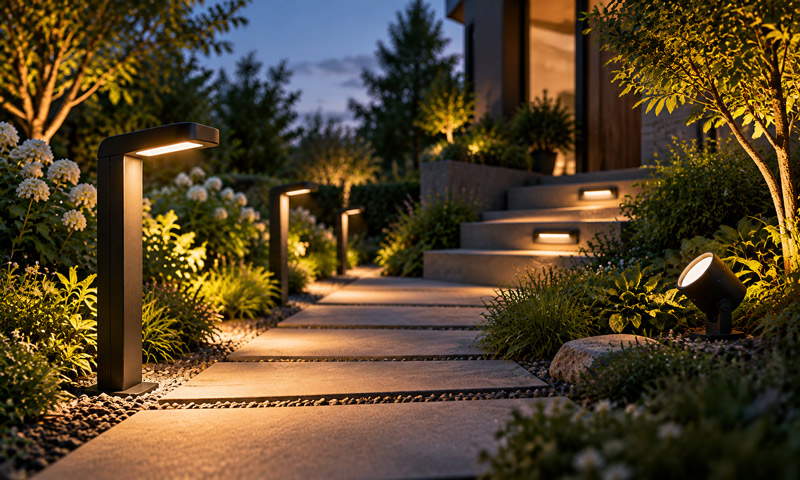
For garden and landscape lighting, this design can make compact path lights, slim step lights, and carefully controlled accent lights possible. Understanding how integrated LEDs work helps you choose a fixture that delivers the lighting effect you want and remains practical to maintain.
How Integrated LED Lighting Works
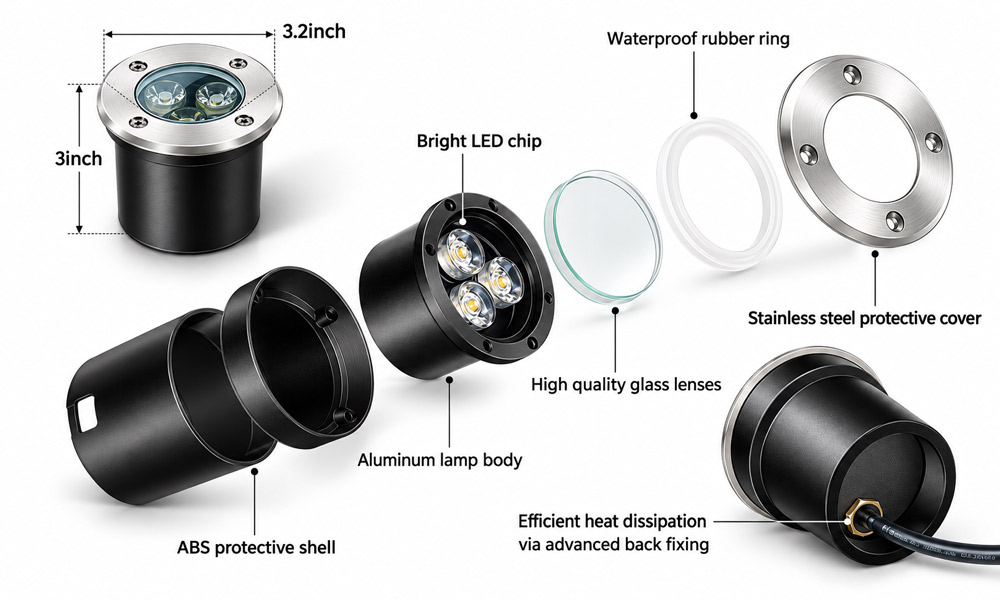
Exploded diagram of an LED underground light showing its main components and assembly structure.
Inside the fixture, LED chips sit on a circuit board or module. A driver supplies the electrical conditions they need, while the housing or heat sink helps move heat away. Lenses, reflectors, or diffusers shape the light for its intended job. The driver may be inside the fixture or in a separate enclosure.
These parts can be designed together around a specific lighting effect. A small step light might spread light across a tread, while an accent light might use a narrow beam to highlight a tree. Neither needs the space required by a conventional bulb and socket.
“Integrated” describes the construction. It does not tell you whether the fixture is low voltage, solar powered, dimmable, smart, or suitable for rain. Each of those is a separate specification.
Integrated LED vs. Replaceable LED Bulbs
Both options use LED technology. The main difference is how the light source fits into the fixture and how you replace it.
| What You Compare | Integrated LED Fixture | Fixture With Replaceable LED Bulb |
|---|---|---|
| Light source | A built-in LED board or module | A separate bulb in a compatible socket |
| Replacement | An approved module or driver, if serviceable; otherwise the fixture | Usually the bulb, when the bulb is the failed part |
| Light adjustments | Fixed settings or built-in controls, depending on the model | Can change with a compatible bulb |
| Design | Can suit slim or purpose-built shapes | Must accommodate the bulb and socket |
| Outdoor suitability | Depends on ratings and installation | Depends on ratings and installation |
For example, a garden spotlight that accepts a removable LED MR16 lamp is a bulb-based fixture. A similar-looking spotlight with a dedicated LED board is integrated.
A product described as “LED bulb included” may still have a replaceable bulb. Check the light-source and replacement specifications instead of relying only on the product name.
Why Choose Integrated LEDs for a Garden?
Compact Fixtures and Controlled Light
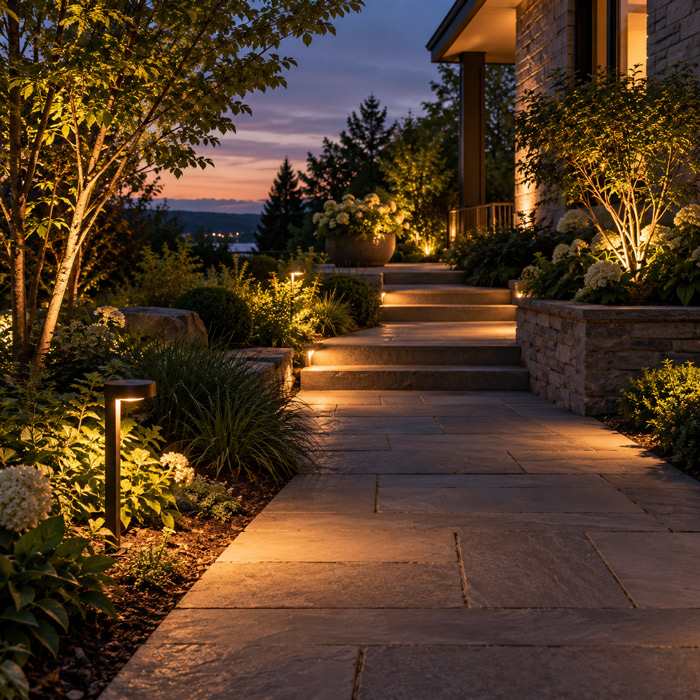
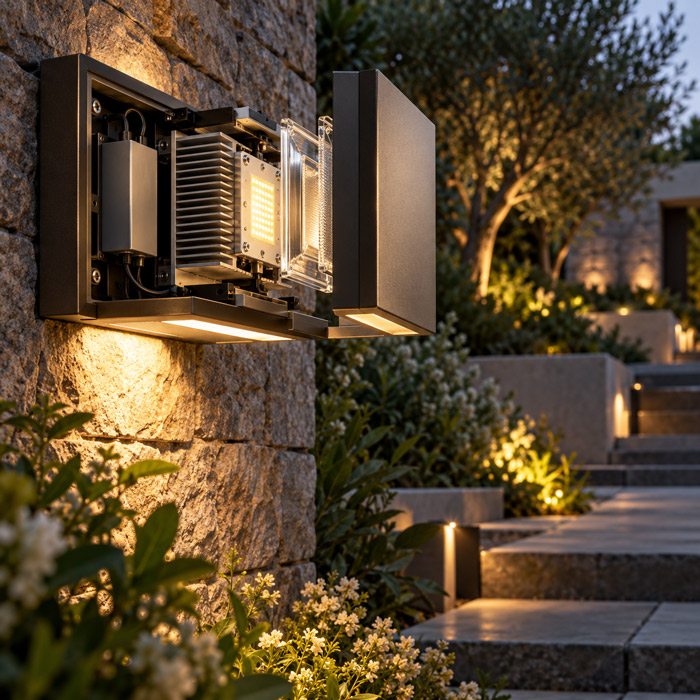
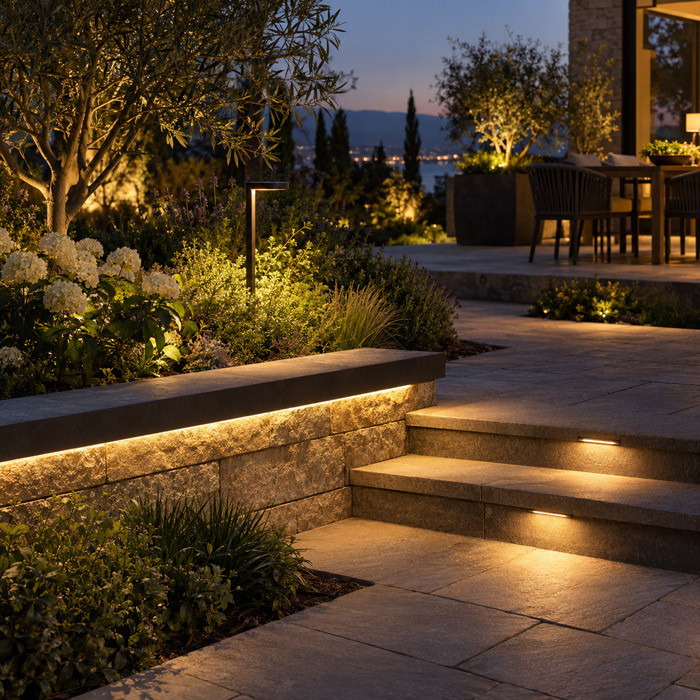
The design freedom is useful where a bulky lamp would be awkward. Integrated LEDs can fit beneath a wall cap, inside a compact pathway head, or into a shallow stair fitting. Well-designed optics can direct light toward paving or planting while limiting glare.
This makes them useful for lighting steps, outlining paths, and highlighting garden features without making the fixtures visually dominant.
Components Designed to Work Together
A matched light source, driver, and housing gives the manufacturer control over thermal performance and light distribution. The fixture can be designed around the LED module’s dimensions and operating requirements.
These are opportunities offered by the design, not guarantees that every integrated fixture performs better. Component quality and the finished product’s specifications still matter.
Efficient Lighting for the Intended Task
Energy savings should be assessed against a specific alternative. Replacing an incandescent lamp with LED lighting can reduce electricity use substantially, but choosing integrated LEDs over replaceable LED bulbs does not automatically save more.
Compare the complete fixtures’ light output, power consumption, and ability to illuminate the intended area. A fixture that directs light accurately onto a path may serve your garden better than a brighter fixture that sends much of its light elsewhere.
Can You Replace an Integrated LED Light Source?
Sometimes. There is normally no standard bulb to unscrew, but some fixtures have replaceable LED boards or drivers. Other products are sealed or assembled in a way that makes component replacement impractical.
Before buying, ask whether the manufacturer supplies replacement parts for the exact model, whether those parts remain accessible after installation, and who is permitted to fit them. A repairable design is only useful if the correct parts and instructions are available.
What Happens When an Integrated LED Stops Working?
If a light stops working, the LED chips are not necessarily the failed component. The power supply, driver, connections, or controls may be responsible.
Follow the product’s troubleshooting instructions and have electrical repairs performed by a qualified person where required. Opening a sealed outdoor fixture without the correct procedure can compromise its weather protection.
Depending on the model and the fault, the solution may be to:
- Correct a supply or connection problem.
- Replace an approved driver.
- Replace a manufacturer-specific LED module.
- Replace the complete fixture if it cannot be serviced.
For a row of matching garden lights, future availability matters. If one non-serviceable fixture fails after the model is discontinued, finding a replacement with the same appearance and beam may be difficult.
A bulb-based fixture can be a practical choice when straightforward replacement is your main priority.
How Long Do Integrated LED Lights Last?
Use the rating for the actual product rather than assuming all integrated LEDs share one lifespan. A quoted life in hours may describe lumen maintenance: how long the light retains a stated proportion of its initial output.
What Does L70 Mean?
L70 means the point at which light output has declined to 70% of its initial level under the stated conditions.
Illuminating Engineering Society. (n.d.). An intuitive metric for lumen maintenance.
It does not mean the light switches off at that hour. An LED-package projection alone also does not establish the service life of the entire fixture. Drivers, connections, and other components can fail separately.
Converting Operating Hours Into Years
As a calculation example, a 50,000-hour rating divided by eight operating hours per night and 365 days per year equals about 17.1 years:
50,000 ÷ (8 × 365) ≈ 17.1 years
LED Lifespan Calculator
Enter the LED rated hours and daily usage to estimate the equivalent lifespan in years.
Years = Rated Hours ÷ (Daily Hours × 365)
What to Check Before Buying Outdoor Integrated LEDs
Weather Protection for the Installation Site
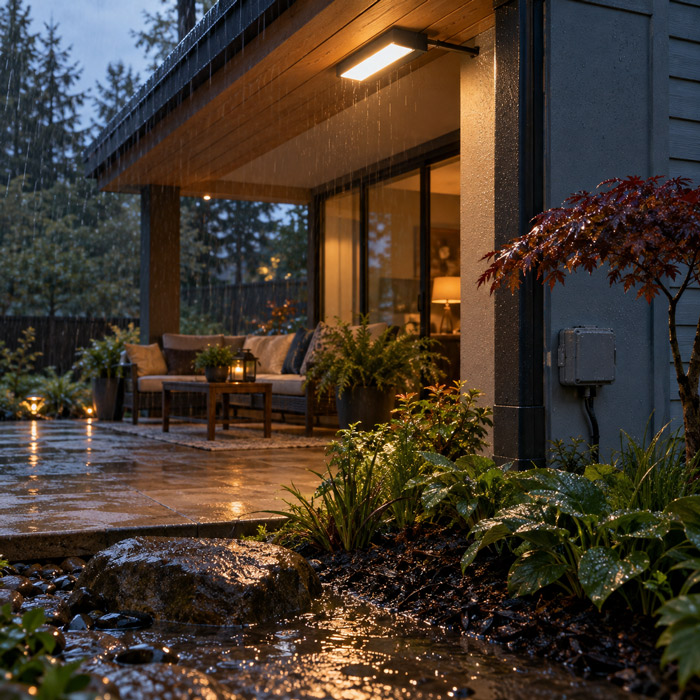
A built-in light source does not make a fixture waterproof. Check its outdoor suitability, permitted mounting position, and exposure limits.
An IP65 rating describes protection against dust and water jets; it does not establish suitability for submersion. A low garden bed that collects water needs different consideration from a wall light above a patio.
Cable entries, connections, and any separate power supply also need protection appropriate to their location. Do not assume the fixture’s rating extends to every accessory in the installation.
Light Output and Beam Distribution
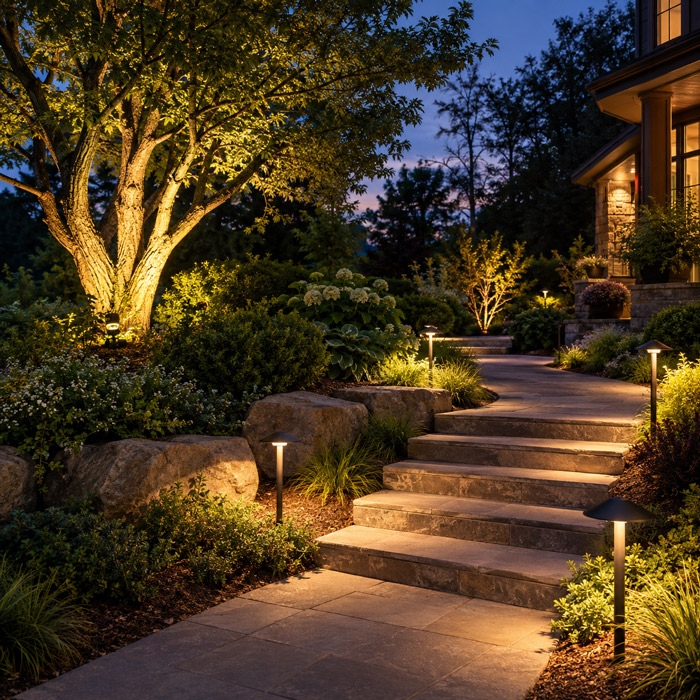
Choose lumens and beam distribution for the task. A narrow tree spotlight and a wide path light can produce very different results at the same lumen output.
For pathways, consider how evenly the fixture lights the walking surface. For steps, check whether the beam reaches the tread without shining directly into people’s eyes. For trees and architectural features, match the beam to the size and shape of the subject.
Color Temperature and Color Rendering
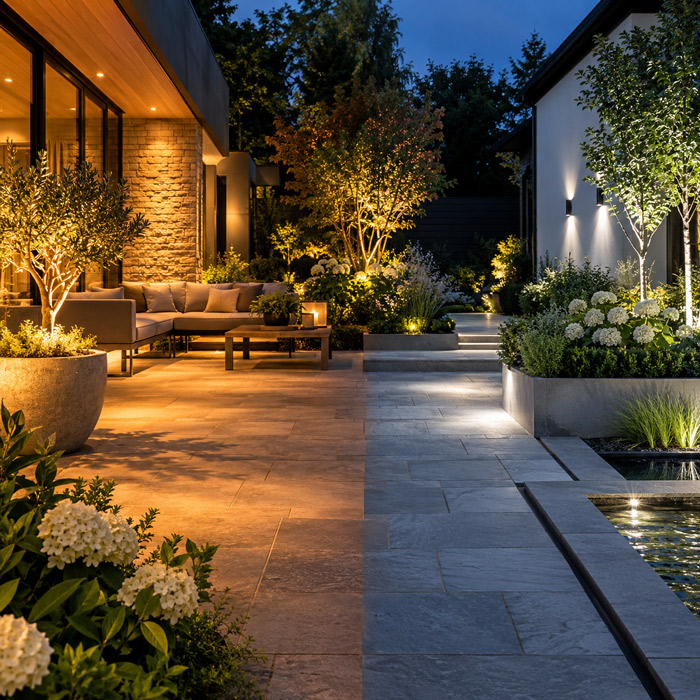
Check CCT and CRI before committing to a fixed light source. CCT describes whether the light looks warm or cool, while CRI describes color rendering relative to a reference source.
Warm white around 2700K to 3000K is a common starting point for residential paths and patios. Preview the effect on your paving, plants, and walls when possible.
If you may want a different appearance later, look for selectable color temperature or an approved replacement module. A fixed-CCT integrated fixture cannot be changed simply by fitting a warmer bulb.
Power Supply Compatibility
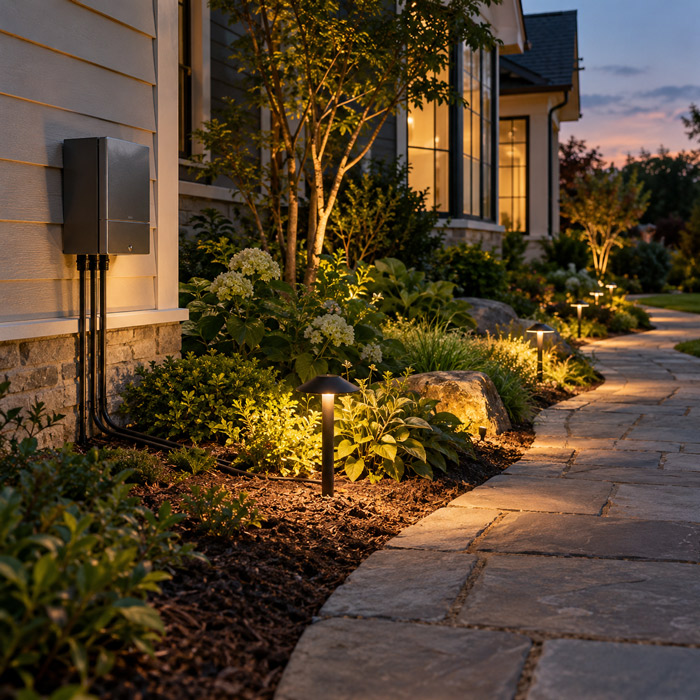
Match the fixture’s specified input voltage and AC or DC requirements. A 12V landscape lighting transformer is appropriate only when its output and capacity meet the connected fixtures’ requirements.
“Integrated LED” alone does not establish electrical compatibility. Some fixtures operate from a low-voltage landscape supply, while others require a different power arrangement.
Check the installation instructions before adding a new fixture to an existing system.
Dimming and Controls
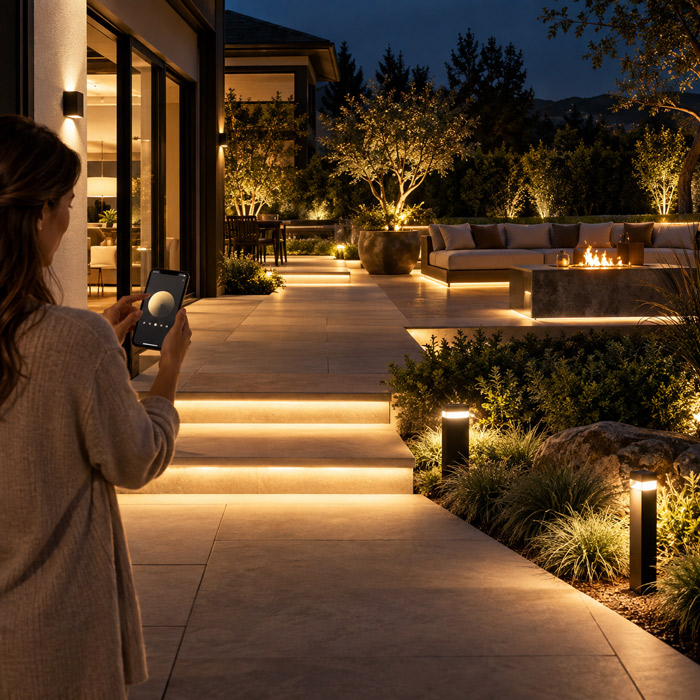
Dimming is model-specific. Confirm that the fixture, driver, and controller work together using the manufacturer’s compatibility information.
A timer that switches lights on and off does not necessarily provide brightness control. Similarly, a fixture with built-in LEDs does not automatically support an app, color changing, or a standard wall dimmer.
Choose the control functions you need before purchasing, especially when the light source cannot be easily changed.
Service Access and Ownership Cost
Ask what the warranty covers: LED module, driver, housing, finish, and any labor or shipping costs.
Compare the purchase price with likely servicing costs, especially for recessed step lights or fixtures in hard-to-access planting. A replaceable module can be valuable, but access to the fixture and availability of parts are equally important.
For a larger landscape project, keep a record of model numbers, light colors, beam options, and purchase dates. These details make it easier to obtain compatible replacements later.
FAQs
Does Integrated LED Mean No Bulb Is Needed?
Yes. Integrated LED fixtures already include the LED light source as part of the fixture design.
Depending on the product, a separate compatible power supply, transformer, or controller may still be required for proper operation.
Are All Integrated LED Lights Dimmable?
No. Dimming capability depends on the specific fixture model, LED driver, and control system.
Before purchasing, confirm the supported dimming method and ensure that all components are compatible.
Does Integrated LED Mean the Entire Fixture Must Be Replaced?
Not always. Some integrated LED fixtures allow replacement of the LED module or driver, while others require replacement of the complete fixture.
Review the manufacturer’s service information and parts availability for the exact model before making a purchase decision.
Is Integrated LED Better for Landscape Lighting?
Integrated LED can be a suitable choice when compact design, precise optics, and specific beam control are important.
Choose a model with appropriate outdoor ratings, reliable construction, and clear service support. If you prefer simple bulb replacement or future changes to light color, replaceable LED bulb fixtures may be more suitable.
What Should You Ask the Seller Before Buying an Integrated LED Fixture?
Ask whether the LED module or driver can be replaced if the fixture stops working, and whether replacement parts are available.
Along with outdoor ratings and warranty terms, this information provides a better understanding of long-term maintenance and ownership costs.
