
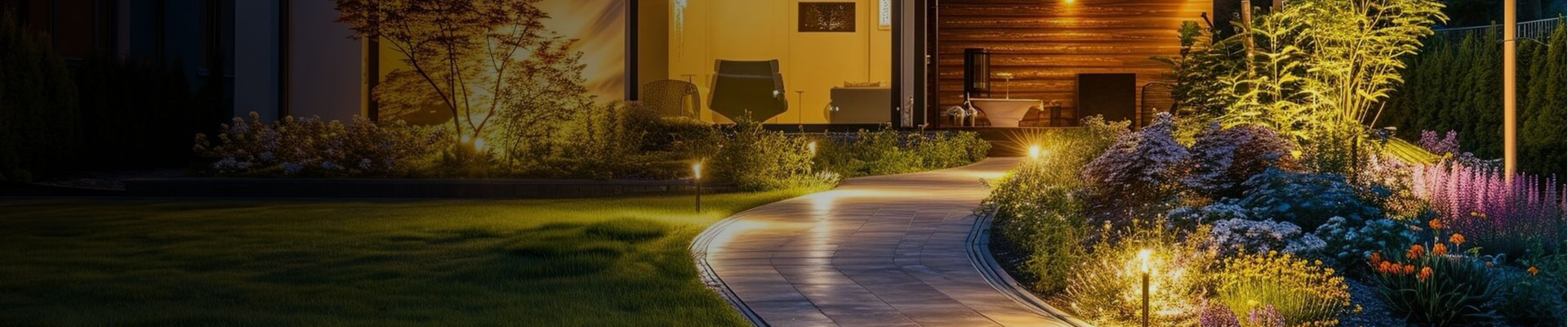
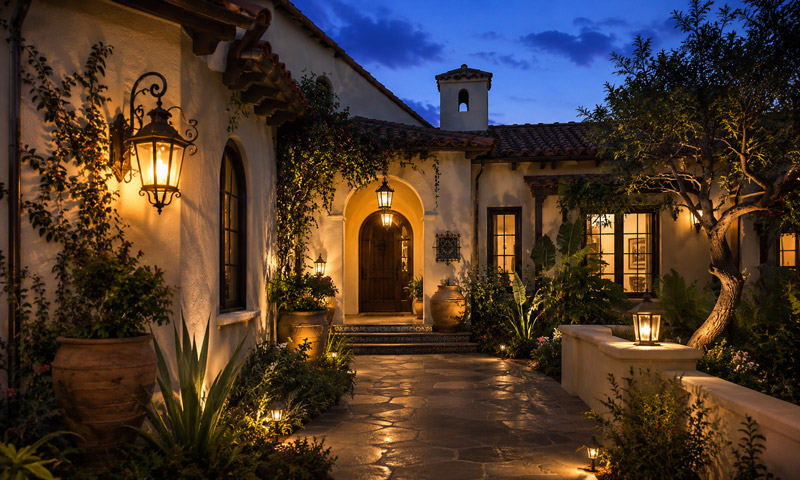
Spanish style outdoor lighting can transform a home’s exterior by doing much more than simply illuminating paths and entrances. When it is planned from a garden and landscape perspective, lighting becomes part of the architecture of the outdoor space. It can emphasize textured walls, frame mature trees, reveal planting layers, make courtyards feel warmer, improve the usability of terraces, and connect the garden visually with the house after sunset.
Spanish-inspired landscapes are especially well suited to layered outdoor lighting because they often combine warm-colored walls, terracotta paving, stone, gravel, Mediterranean planting, ornamental trees, fountains, pergolas, arches, and enclosed courtyards. These materials already have strong character in daylight. At night, carefully positioned lighting can bring out their texture and depth while preserving the relaxed atmosphere associated with Mediterranean gardens.
The most successful approach is not to make the garden brighter everywhere. It is to decide which parts of the landscape deserve attention, which areas need practical illumination, and which areas should remain relatively dark.
Why Spanish Style Outdoor Lighting Works So Well in Gardens
Spanish and Mediterranean garden design relies heavily on texture, shadow, natural materials, and architectural planting. These qualities become even more noticeable under controlled nighttime illumination.
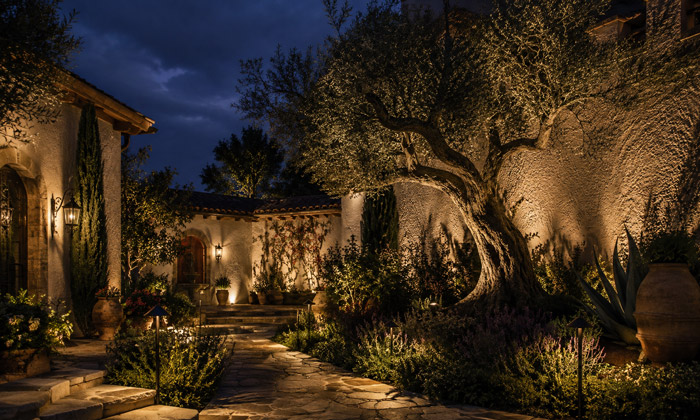
A rough rendered wall, for example, can appear flat under a central floodlight. When illuminated from a low angle, however, the same wall develops strong highlights and shadows that reveal its texture. An olive tree can disappear into darkness if the whole garden is lit uniformly, but a carefully positioned uplight can turn its trunk and silver-green canopy into a focal point.
Spanish style outdoor lighting therefore works best as a composition of smaller lighting effects rather than a single source of general illumination.
- A well-designed scheme usually combines:
- low-level path lighting;
- wall-mounted architectural lights;
- uplighting for trees;
- soft downlighting beneath pergolas;
- discreet planting-bed spotlights;
- step and level-change lighting;
- subtle illumination around fountains or water features;
- warm ambient lighting around dining and seating areas.
Together, these layers give the garden depth without making it look overlit.
Key Lighting Areas in a Spanish-Inspired Landscape
| Garden or Landscape Area | Recommended Lighting Approach | Main Visual Effect | Practical Benefit |
|---|---|---|---|
| Olive trees and feature trees | Narrow or medium-beam uplights | Highlights trunks and canopy structure | Creates strong focal points |
| Stucco or stone walls | Grazing or wall-washing lights | Emphasizes surface texture | Defines garden boundaries |
| Terracotta paths | Low bollards or recessed lights | Adds warm directional light | Improves nighttime navigation |
| Courtyards | Wall lanterns plus concealed accent lighting | Creates intimate layered illumination | Extends evening use |
| Pergolas | Downlights or concealed linear lighting | Produces soft overhead light | Supports dining and seating |
| Steps and level changes | Recessed step lights | Defines edges without glare | Improves safety |
| Fountains | Underwater or directional accent lights | Adds movement and reflections | Creates a nighttime focal point |
| Planting beds | Adjustable spike spotlights | Reveals foliage and planting layers | Adds depth to borders |
| Entrance paths | Bollards, wall lights, or ground lights | Creates visual guidance | Improves wayfinding |
| Outdoor dining spaces | Warm downlighting and indirect light | Builds a relaxed evening atmosphere | Makes dining areas functional after dark |
Use Warm Light to Reinforce the Spanish Character
Color temperature plays an important role in shaping the nighttime character of a Spanish-style garden. Warm lighting generally complements terracotta paving, natural stone, stucco walls, timber pergolas, olive trees, and other Mediterranean landscape elements more effectively than cooler white light. As color temperature rises, the atmosphere gradually shifts from intimate and warm to cleaner and more functional.
The chart below illustrates how different color temperatures can influence their suitability for Spanish and Mediterranean garden environments. The scores are intended as a practical landscape design reference rather than laboratory measurements.
The strongest Spanish-style atmosphere is generally achieved around 2200K to 2700K, where the light retains an amber or warm-white quality that enhances terracotta, stone, timber, and textured walls. Around 3000K remains a versatile choice where slightly greater visual clarity is required, particularly around entrances, paths, and mixed-use garden areas.
Once the color temperature moves toward 3500K and 4000K, the appearance becomes noticeably cooler. These higher temperatures may still be useful for functional exterior areas, but they usually contribute less to the intimate, warm character associated with Mediterranean landscapes. For this reason, most decorative garden zones benefit from prioritizing warmer CCT values while reserving cooler lighting for specific practical applications.
Highlight Architectural Surfaces Without Overpowering the Garden
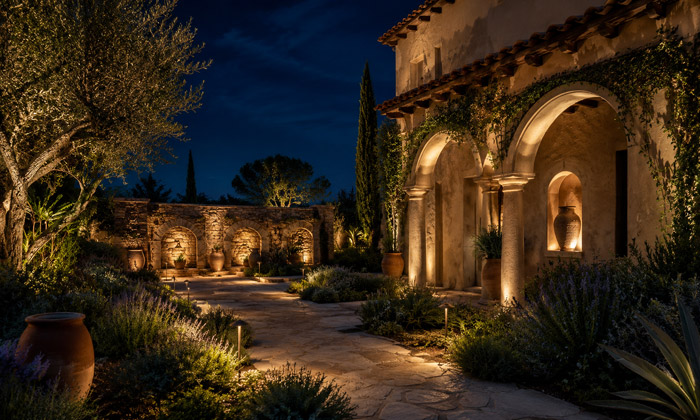
Spanish-style exteriors frequently include textured render, stone cladding, brickwork, archways, columns, alcoves, and boundary walls. These surfaces can become some of the strongest nighttime features in the garden.
The key is beam placement.
Wall Grazing
Wall grazing places the luminaire relatively close to the wall so light travels across the surface at a steep angle.
This technique is ideal for:
- rough stone;
- textured stucco;
- handmade brick;
- decorative masonry;
- irregular retaining walls.
Because small changes in the surface create shadows, grazing reveals texture extremely effectively.
Wall Washing
Wall washing places the light farther from the wall and produces a more even layer of illumination.
Use it where you want:
- a smoother visual background;
- a courtyard wall to feel larger;
- architectural boundaries to remain visible;
- planting silhouettes to stand out against a softly illuminated surface.
In Spanish-style gardens, it is often effective to use brighter illumination on one principal wall while keeping secondary boundaries darker. This produces depth and prevents the whole garden from looking flat.
Turn Olive Trees and Sculptural Plants Into Nighttime Focal Points
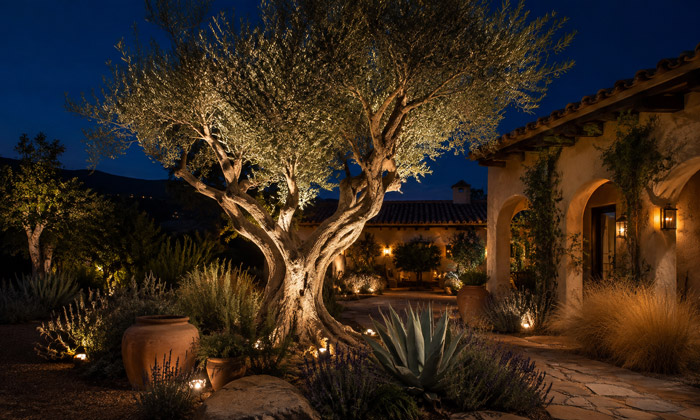
Uplighting is one of the most effective techniques for emphasizing the sculptural form of olive trees and other Mediterranean planting. However, the fixture should be selected according to the tree’s height, trunk structure, canopy density, beam angle, and viewing direction. Narrow beams can emphasize tall trunks and vertical forms, while wider beams are better suited to broad canopies and mature specimen trees. For a more detailed approach, this guide to choosing lights for outdoor trees explains how different fixture types and beam spreads can be matched to specific tree forms and landscape conditions.
Create Depth Through Layered Planting Lighting
A landscape can look surprisingly small at night when only the terrace or house façade is illuminated. Once the distant planting disappears into darkness, the visual boundary of the usable garden seems to move closer.
Lighting selected planting layers helps restore depth.
Consider dividing the landscape into three zones:
Foreground: low planting, paths, steps, and seating areas.
Middle ground: shrubs, decorative walls, fountains, or feature planting.
Background: mature trees, boundary planting, architectural walls, or pergolas.
Illuminating selected elements in each zone creates visual progression. The eye moves from the terrace into the garden instead of stopping at the first dark border.
For example, a terrace might have very low ambient lighting, while a sculptural olive tree 10 meters away receives stronger accent lighting. A softly illuminated stone wall behind the tree then creates another visual layer.
This simple arrangement can make a relatively modest garden feel significantly deeper at night.
Make Courtyards Feel More Intimate
Courtyards are central to many Spanish and Mediterranean homes. Because they are enclosed or partially enclosed, they require a different lighting strategy from open lawns or large gardens.
Rather than depending on bright overhead lighting, combine several lower-output sources.
Wall lanterns can establish architectural character, but additional concealed lighting can make the space more comfortable.
Suitable options include:
- recessed lighting beneath benches;
- uplights at the base of walls;
- small spotlights behind pots;
- downlights hidden within pergola beams;
- subtle planting lights beneath palms or citrus trees;
- low-level lighting near fountains.
The most attractive courtyards often contain both light and shadow. Uniform brightness can remove the sense of enclosure and intimacy that makes these spaces appealing.
Use Light to Strengthen Terracotta, Stone, and Gravel Landscapes
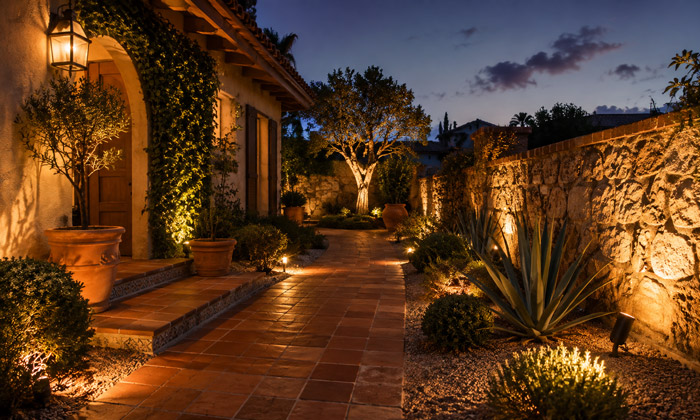
Spanish-style gardens often contain large areas of hard landscaping. Terracotta tiles, natural stone, brick, decorative gravel, and rendered walls all respond differently to artificial light.
Warm directional lighting generally enhances these materials because it emphasizes natural color variation.
Terracotta particularly benefits from warm-spectrum light. Under very cool lighting, its orange and red tones may become visually muted. Warm light makes the surface feel richer and more connected with surrounding planting.
Stone paths and gravel areas can benefit from lower-angle light. Rather than flooding the entire surface, allow light to skim across selected areas. This creates small shadows and makes the texture visible.
Avoid placing very bright fittings close to highly reflective pale stone. The reflected light can create uncomfortable glare and may compete with the surrounding planting.
Improve Garden Paths Without Turning Them Into Runways
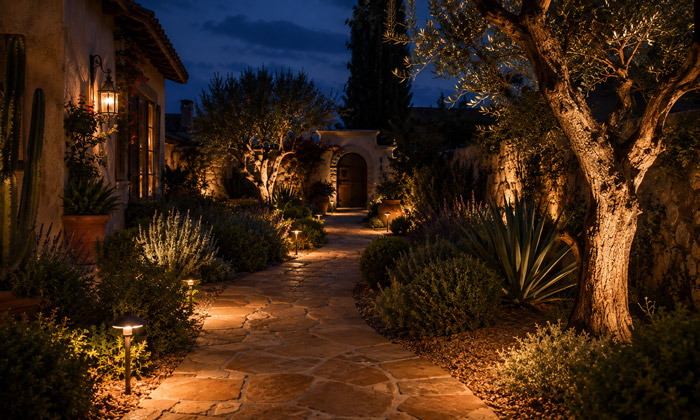
Path lighting is essential for nighttime movement, but it is also one of the areas where garden lighting is most frequently overdone.
A row of identical lights installed at perfectly regular intervals can make a Spanish garden feel more commercial than residential.
Instead, use path lighting selectively.
Place fixtures where people actually need visual guidance:
- direction changes;
- intersections;
- steps;
- entrances;
- narrow sections;
- changes in paving;
- transitions between garden zones.
Light does not always need to come from a dedicated path fixture. Nearby walls, trees, or planting beds can often provide reflected or indirect illumination.
For example, a spotlight aimed at an olive tree beside a walkway may provide enough spill light to help define part of the path. A recessed wall light can simultaneously illuminate a retaining wall and the adjacent paving.
Combining functional and decorative lighting in this way reduces fixture clutter.
Treat Steps and Level Changes as Part of the Lighting Composition
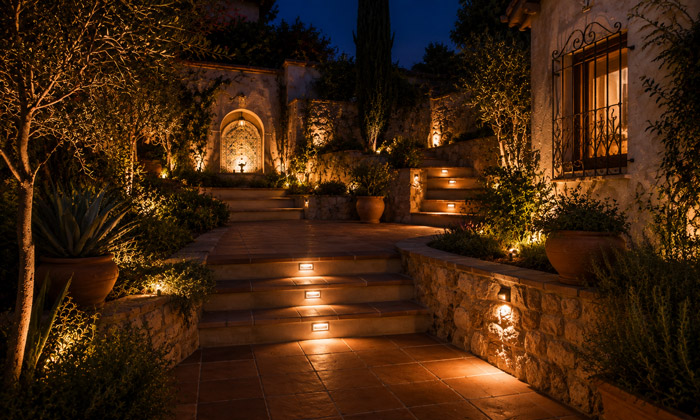
Spanish gardens frequently include terraced levels, raised patios, sunken courtyards, stone steps, retaining walls, and transitions between paved and planted areas.
These features should remain visually clear after sunset.
Recessed step lights are useful, but they should generally be shielded and positioned low enough to prevent direct glare.
Other solutions include:
- under-cap lights beneath retaining-wall coping;
- concealed LED strips beneath floating steps;
- small wall lights beside staircases;
- indirect illumination from nearby planting;
- miniature recessed lights positioned at key changes in level.
Every step does not necessarily require its own fixture. The goal is sufficient visual information to understand the change in level while maintaining the atmosphere of the landscape.
Use Pergola Lighting to Define Outdoor Living Areas
Pergolas naturally create outdoor rooms, making them particularly important in gardens designed for evening dining and relaxation.
Lighting should help reinforce that sense of enclosure.
Small downlights mounted within beams can illuminate tables without lighting the entire garden. Fixtures aimed downward also reduce unnecessary sky glow.
Another effective approach is concealed lighting installed above or within structural elements so the source is less visible.
For Spanish-style landscapes, warm downlighting tends to work especially well with:
- timber pergolas;
- climbing vines;
- rough-rendered columns;
- terracotta paving;
- stone dining tables;
- outdoor kitchens.
Keep surrounding areas slightly darker so the pergola becomes a welcoming pool of light rather than part of a uniformly bright exterior.
Make Water Features More Dramatic After Sunset
Fountains, tiled pools, wall-mounted water spouts, and reflecting basins are common elements in Spanish-inspired gardens.
Lighting can make them significantly more noticeable after dark.
Rather than illuminating an entire fountain evenly, emphasize movement.
A small underwater light aimed through falling water can create reflections and shifting patterns. A directional spotlight placed above a wall-mounted spout can illuminate the stream while leaving the surrounding masonry partially shadowed.
For reflecting pools, fewer light sources are often more effective. Reflections from nearby walls or trees can become part of the visual effect.
Excessively bright underwater lighting can dominate the garden, so water features generally work better as subtle focal points rather than luminous centerpieces.
Choose Suitable Waterproof Fixtures for the Landscape
Garden lights are exposed to rain, irrigation, soil moisture, dust, insects, temperature changes, and accidental splashing. Decorative appearance should therefore never be the only consideration.
Different locations require different levels of environmental protection.
A fitting installed beneath a covered veranda has very different exposure from one positioned beside an irrigation system.
For many exposed garden applications, IP65-rated fixtures are commonly considered because they offer protection from dust and water jets. Before specifying them, it is useful to understand what IP65 means for garden lighting and whether a higher rating is required for particularly wet locations.
Fixtures installed in or extremely close to water require more specialized protection and should be chosen specifically for that application.
Mains-Powered or Solar Lighting for a Spanish-Style Garden?
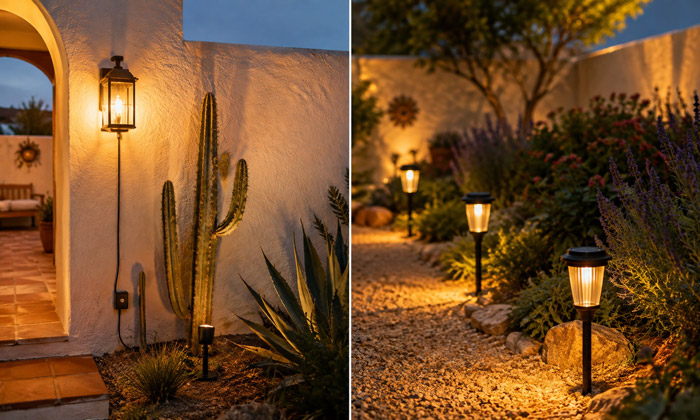
The choice between mains-powered and solar lighting influences both visual performance and installation flexibility.
Mains-Powered Lighting
Mains-powered systems are usually better suited to permanent landscape lighting schemes where predictable brightness, controlled switching, and coordinated zones are important.
They work particularly well for:
- façade lighting;
- large trees;
- pergolas;
- permanent path systems;
- courtyard lighting;
- feature walls;
- professionally designed layered schemes.
Solar Lighting
Solar fixtures can be useful when cable installation is difficult or when additional accent lighting is needed in relatively sunny locations.
They can work well for:
- secondary paths;
- planters;
- decorative accents;
- temporary layouts;
- areas far from electrical infrastructure.
However, output and operating duration depend on the solar panel, battery condition, seasonal sunlight, and energy consumption.
Homeowners planning a solar landscape scheme should understand how long solar-powered garden light batteries typically last rather than evaluating the fixtures by appearance alone.
For a broader comparison of reliability, installation, and garden applications, see this guide to mains-powered vs solar-powered garden lights.
Mains vs Solar Lighting in the Landscape
| Factor | Mains-Powered Garden Lights | Solar Garden Lights |
|---|---|---|
| Brightness consistency | Generally very consistent | Depends on solar charging and battery condition |
| Suitable for large trees | Excellent | Limited for many small consumer fixtures |
| Installation complexity | Requires cabling and electrical planning | Usually simpler |
| Best use | Permanent landscape schemes | Flexible or secondary lighting |
| Control options | Excellent for zones, timers, sensors, and smart controls | Varies significantly by product |
| Maintenance | Low when properly installed | Battery and panel maintenance may be required |
| Placement flexibility | Limited by cable routes | High if the solar panel receives enough sunlight |
| Professional garden design | Highly suitable | Useful as a supporting option |
Adapt the Lighting to Spanish Climate and Outdoor Conditions
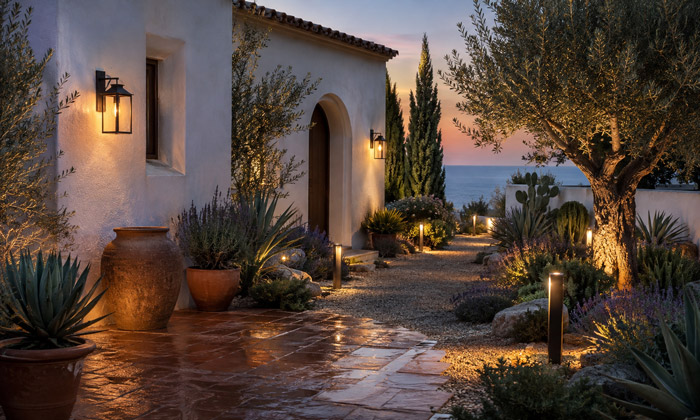
In many Spanish gardens, outdoor fixtures may face strong sunlight, high temperatures, dust, rain, irrigation, and coastal salt exposure. Materials such as powder-coated aluminum, stainless steel, brass, and corrosion-resistant finishes can help improve long-term durability.
Coastal gardens require particular attention because salt and moisture can accelerate corrosion, while dust and mineral deposits may gradually reduce light output. Regular inspection and proper maintenance are therefore important. This guide on how to clean garden lights provides practical advice for keeping outdoor fixtures in good condition.
Cable connections, mounting hardware, drivers, seals, and junction boxes should also be suitable for the installation environment. For homeowners selecting fixtures for local conditions, comparing the best LED garden lights for Spain in 2026 can help identify suitable options for different landscape areas.
Control Glare Carefully
A successful Spanish-style garden should feel calm at night. Glare immediately undermines that atmosphere.
Common sources of glare include:
- exposed LED chips;
- powerful uplights visible from seating areas;
- unshielded wall lights;
- poorly positioned bollards;
- spotlights aimed toward windows;
- very bright fixtures against dark surroundings.
The solution is usually better positioning rather than simply reducing brightness.
Whenever possible, hide the light source behind planting, architectural elements, louvers, shields, or the body of the fitting itself.
For example, an uplight placed directly between a terrace and a tree may be visible to people sitting outside. Moving the fixture slightly to the side can still illuminate the canopy while keeping the source out of the main viewing angle.
Garden lighting should encourage people to look at the illuminated landscape, not at the fixtures.
Use Fewer Fixtures More Intelligently
The transformation created by landscape lighting depends more on composition than fixture quantity.
A garden with 40 poorly positioned lights can feel less sophisticated than one with 15 carefully positioned fixtures.
Before adding a light, ask what it contributes.
Does it:
- reveal an important texture?
- improve navigation?
- emphasize a specimen plant?
- create depth?
- define an outdoor room?
- illuminate a functional activity?
- highlight a valuable architectural feature?
If the fixture does none of these things, it may not be necessary.
This approach is particularly appropriate for Spanish-style gardens because their atmosphere depends on shadow as much as illumination.
Create a Lighting Hierarchy
Not every illuminated object should have the same visual importance.
Establish three levels.
Primary Focal Points
These should attract attention immediately.
Examples include:
- an old olive tree;
- a fountain;
- a stone arch;
- a major courtyard wall;
- an architectural entrance.
Secondary Features
These support the composition.
Examples include:
- planting groups;
- smaller trees;
- walls;
- pergola posts;
- decorative pots.
Functional Lighting
This should help people move safely without becoming the strongest visual feature.
Examples include:
- step lights;
- path lights;
- low-level entrance lighting;
- utility-area lighting.
When everything is equally bright, nothing stands out. A lighting hierarchy creates visual direction.
Integrate Decorative Fixtures With Concealed Landscape Lighting
Spanish-style lanterns can reinforce the architecture, but they should not have to perform every lighting function.
Decorative wall lanterns are excellent around:
- entrance doors;
- courtyard walls;
- covered terraces;
- gateways;
- exterior stair landings.
However, relying entirely on lanterns can create bright pools of light close to the building while leaving the rest of the landscape dark.
A more complete approach combines decorative fixtures with concealed landscape lighting.
For example:
- lanterns can establish the architectural style;
- tree uplights can create distant focal points;
- recessed step lights can improve safety;
- concealed pergola lighting can support dining;
- planting lights can add depth.
The fixtures do not all need to look Spanish. In fact, concealed modern luminaires often work well because they allow decorative lanterns and landscape materials to remain visually dominant.
Consider DIY Lighting for Small Garden Features
Not every landscape lighting project requires a complete professional installation.
Small decorative projects can sometimes be handled independently, particularly when using low-voltage or self-contained lighting systems.
Suitable DIY applications might include:
- illuminated planters;
- simple solar accents;
- decorative jar lighting;
- temporary pergola lights;
- small battery-powered features;
- low-voltage planting accents.
Homeowners interested in experimenting with smaller installations can explore ideas for making DIY garden lights.
DIY solutions are most effective when they follow the same principles as professional landscape lighting: controlled brightness, intentional placement, concealed light sources, and visual hierarchy.
Frequently Asked Questions About Spanish Style Outdoor Lighting
1. How Many Lumens Are Recommended for Spanish Style Garden Lighting?
There is no single lumen level suitable for an entire Spanish-style garden because different landscape features require different amounts of light. Subtle pathway and planting lights may only need around 50–200 lumens per fixture, while larger trees, tall walls, or architectural features may require 300–800 lumens or more depending on distance and beam angle.
For Mediterranean landscapes, lower-output fixtures are often preferable because they preserve contrast between illuminated features and surrounding darkness. Instead of maximizing brightness, designers typically focus on controlled beam distribution and accurate fixture positioning.
2. What Beam Angle Is Best for Lighting Trees, Plants, and Architectural Features?
Beam angle determines how concentrated or widespread the light will appear. Narrow beams of approximately 10°–25° are useful for tall trees, columns, and narrow architectural details. Medium beams around 25°–40° work well for specimen shrubs, small trees, and sculptures, while wider beams can illuminate larger planting groups or broader surfaces.
Spanish-style landscapes often benefit from mixing several beam angles because olive trees, palms, stone walls, pots, and architectural details have very different proportions. Matching the beam to the feature creates a more precise and professional nighttime landscape.
3. Is 12V or 24V Low-Voltage Lighting Better for a Large Garden?
Both systems can work effectively, but 24V landscape lighting can be advantageous in larger gardens because it generally experiences less voltage drop over long cable runs. A 12V system remains popular for residential gardens and can perform well when cable sizes, transformer capacity, and circuit lengths are correctly calculated.
For extensive Spanish-style properties with distant trees, perimeter planting, long pathways, or several garden zones, circuit design becomes especially important. Poor voltage management can cause fixtures at the end of a cable run to appear noticeably dimmer than those closer to the transformer.
4. How Can Outdoor Lighting Reduce Light Pollution in a Mediterranean Garden?
Light pollution can be reduced by directing illumination only where it is needed, using shielded fixtures, controlling beam angles, and avoiding unnecessary upward light. Timers, dimming systems, and automatic shut-off schedules can further reduce energy use and nighttime sky glow.
This is particularly valuable in gardens where the landscape relies on atmosphere. Keeping unnecessary light out of the sky also preserves stronger contrast between illuminated trees, walls, planting, and naturally dark areas.
5. Do LED Garden Lights Attract Insects, and How Can This Be Reduced?
Outdoor lights can attract insects, but the amount varies according to wavelength and color temperature. Cooler lighting with stronger blue and ultraviolet components generally attracts more insects than warmer LED light.
For terraces, courtyards, pergolas, and outdoor dining spaces, warm LEDs—particularly those around 2200K–2700K—can help reduce insect attraction while also complementing Spanish and Mediterranean landscape materials. Keeping unnecessary fixtures away from seating areas and directing beams toward plants or surfaces rather than outward can further improve evening comfort.
