
Table of Contents
- What Does It Mean When an LED Bulb Loses Brightness?
- How Long Does It Take for LED Bulbs to Get Dimmer?
- Why Are My LED Bulbs Getting Dimmer?
- How Can You Tell Normal LED Aging From a Fault?
- Can You Restore an LED Bulb’s Original Brightness?
- How to Help LED Bulbs Maintain Their Brightness
- When Should You Replace a Dim LED Bulb?
- FAQs
Yes, LED bulbs gradually lose brightness over time. This process is called lumen depreciation: an LED continues producing light, but its output slowly decreases as it ages. The change usually develops gradually, which makes it difficult to notice during everyday use.
However, a bulb that suddenly becomes dim, flickers, or fades shortly after switching on may have a different problem. Heat, incompatible controls, electrical faults, and dirty fixture covers can all affect the light you see.
What Does It Mean When an LED Bulb Loses Brightness?
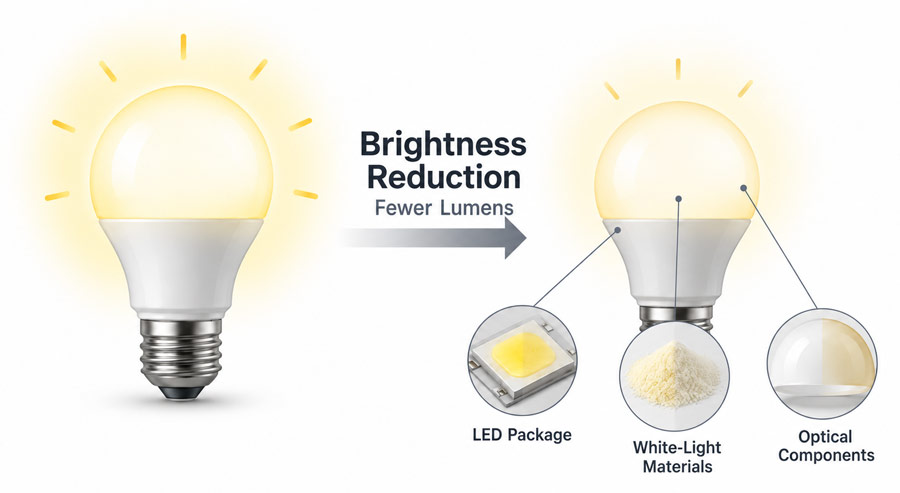
A bulb’s light output is expressed in lumens. When an LED experiences lumen depreciation, it produces fewer lumens than it did when new.
Several parts of an LED lighting system can contribute to this decline. The LED package can deteriorate, the materials used to produce white light can change, and optical components can become less effective at transmitting light. These changes affect performance even while the bulb remains operational.
This is why “still working” and “still providing enough light” are different conditions. An older bulb may switch on reliably but no longer illuminate a reading area, entrance, or garden path adequately.
How Long Does It Take for LED Bulbs to Get Dimmer?
There is no universal number of months or years after which every LED bulb becomes noticeably dimmer. The rate depends on the product’s construction, operating temperature, daily running hours, and installation conditions.
Calendar age alone tells you relatively little. A bulb used for three hours each evening accumulates operating hours much more slowly than one used throughout the night.
Understanding the L70 Rating
A common measure of LED useful life is L70, which describes the operating time at which light output is expected to reach 70% of its initial level under specified conditions. For a bulb that initially produces 800 lumens, that benchmark corresponds to 560 lumens.
U.S. Department of Energy. (2020, July 1). New study examines lumen and chromaticity maintenance of LED packages, based on LM-80 data.
L70 describes light retention. It does not mean the bulb automatically switches off at that point, and it does not guarantee that every other component will last equally long.
For example, if a product specifically states an L70 rating of 25,000 operating hours, the following chart shows how daily use ranging from 1 to 24 hours affects the number of years needed to accumulate those operating hours.
Time to 25,000 operating hours
Daily LED use from 1 to 24 hours
The chart shows operating-hour conversions, not promises of actual service life. Electronics can fail earlier, and installation conditions can affect performance.
You also cannot use an L70 figure to calculate a fixed annual brightness loss. A rating of 25,000 hours does not establish that output declines at the same rate every year.
Why Are My LED Bulbs Getting Dimmer?
Normal aging is one explanation, but several other conditions can reduce brightness or accelerate deterioration.
Excessive Heat
Heat is one of the most important factors affecting LED light retention. Although LEDs use electricity efficiently, they still generate heat that must move away from the LED components.
When operating temperatures remain too high, light output can deteriorate faster and useful life can shorten.
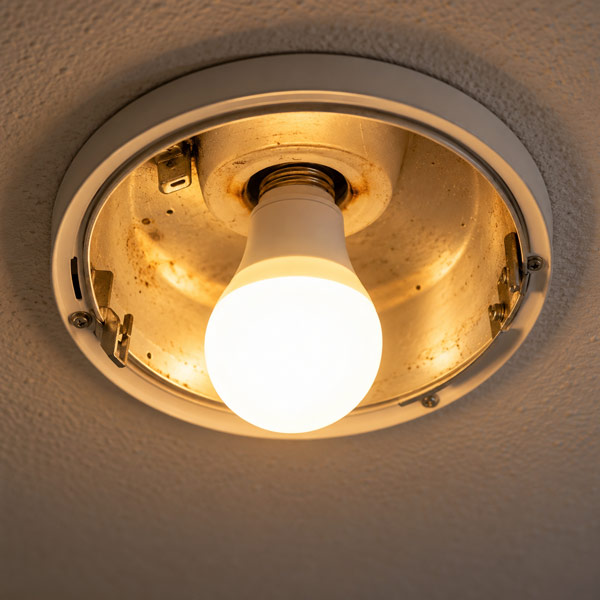
Enclosed ceiling lights, covered porch fixtures, and other fittings with restricted airflow deserve particular attention. A bulb that physically fits inside a fixture may still be unsuitable for the thermal conditions there.
Proper LED bulb and fixture compatibility includes enclosure suitability, voltage, dimensions, and operating-temperature limits.
If the fixture is fully enclosed, choose a bulb explicitly approved for that use. Keep ventilation openings clear and preserve the fixture’s intended construction.
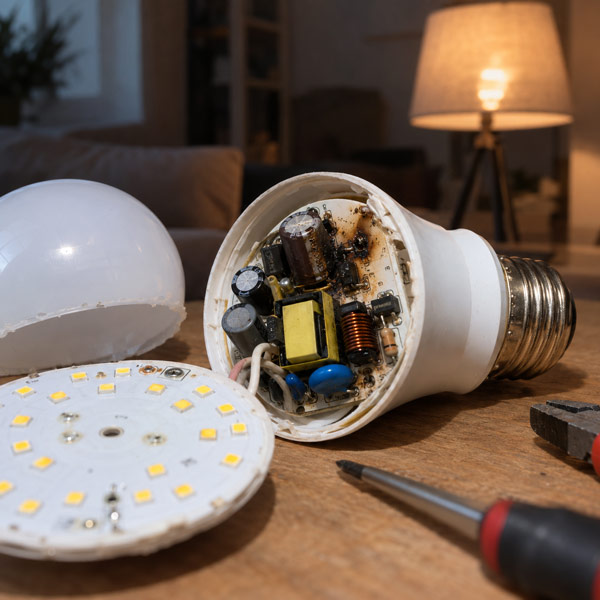
Driver Deterioration
An LED bulb contains electronic circuitry that controls the power supplied to its LEDs. This circuitry is commonly called the driver.
Driver components can deteriorate or fail before the LEDs reach their projected light-output limit. Depending on the fault, the bulb may become unstable, flicker, or stop operating. High operating temperatures also affect driver reliability.
A sudden change in brightness therefore deserves investigation. It should not automatically be treated as ordinary lumen depreciation.
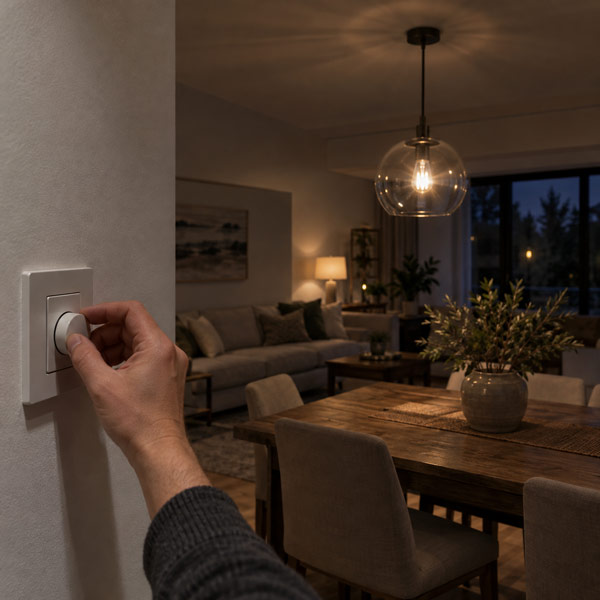
Dimmer or Control Problems
An incompatible dimmer can cause poor brightness control, flickering, or an unstable minimum setting. The bulb must support dimming, and the control must be compatible with that particular lighting load.
A dimmer switch that causes flickering can also make the light appear weaker or inconsistent. Problems that occur only at certain dimmer positions point toward control compatibility rather than gradual aging.
For connected lighting, check the selected brightness level and any active schedules or scenes. An automatic setting may have reduced output without any deterioration in the bulb.
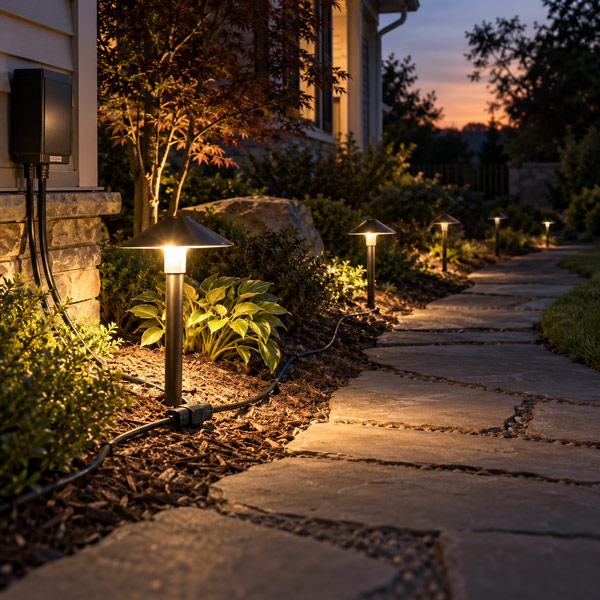
Inadequate Power in Low-Voltage Systems
In low-voltage landscape lighting, excessive cable length, unsuitable wire size, overloaded equipment, or deteriorated connections can affect the power reaching a lamp.
Some LED drivers maintain consistent brightness across a specified input range. If the supply falls outside that range, the light may dim, flicker, or fail to start.
This makes voltage drop in landscape lighting particularly relevant when lights near the power source remain bright while those farther along a cable run look weaker.
Changing bulbs repeatedly will not resolve an underlying supply problem.
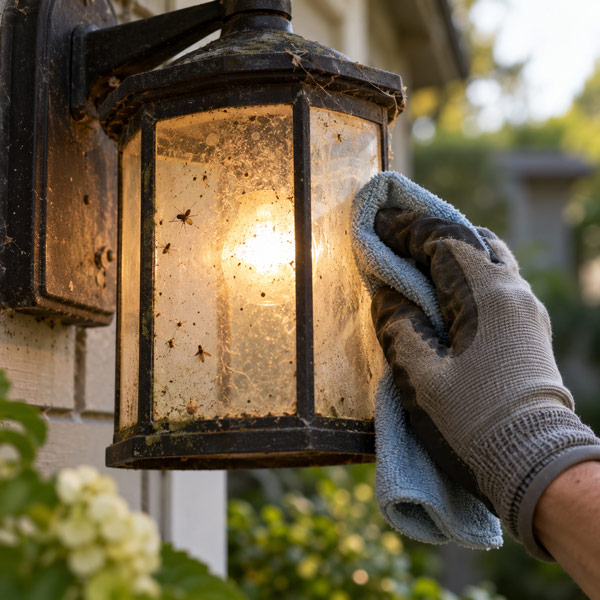
Dirty or Cloudy Fixture Covers
The bulb itself may still be producing adequate light while dirt prevents that light from reaching the surrounding area.
Dust, insects, mineral deposits, and cloudy covers can reduce delivered illumination. Outdoor fixtures are especially exposed to these conditions.
Regularly cleaning garden lights helps distinguish removable surface buildup from permanent deterioration. Turn off the power, let the equipment cool, and use cleaning methods approved for the fixture’s materials.
Moisture inside a fitting requires further attention. Cleaning the outside will not correct damaged seals or internal corrosion.
How Can You Tell Normal LED Aging From a Fault?
The timing and pattern of the change provide useful clues.
| What you notice | What to investigate first |
|---|---|
| Brightness decreases gradually over a long period | Normal lumen depreciation and accumulated dirt |
| A relatively new bulb suddenly becomes dim | Bulb electronics, controls, or supply problems |
| Output repeatedly falls as the fixture warms up | Excessive operating temperature or heat-related driver behavior |
| Problems appear only at certain dimmer settings | Dimmer compatibility and minimum-setting adjustment |
| Several lights change brightness together | A shared control, transformer, or electrical supply issue |
| Outdoor lights perform poorly after rain | Water entry, seals, and electrical connections |
These observations help narrow the investigation, but a brightness change alone cannot identify the failed component.
A useful comparison is to test whether the problem follows the bulb or stays with the fixture. With power disconnected before handling, a replaceable bulb can be checked in another known-good fixture that meets its voltage, enclosure, and other requirements.
If the bulb remains unusually dim there, the bulb becomes the likely cause. If a suitable replacement also performs poorly in the original fitting, investigate the fixture or its supply.
Stop using equipment that shows scorching, damaged insulation, sparking, or a burning smell, and have the fault assessed professionally.
Can You Restore an LED Bulb’s Original Brightness?
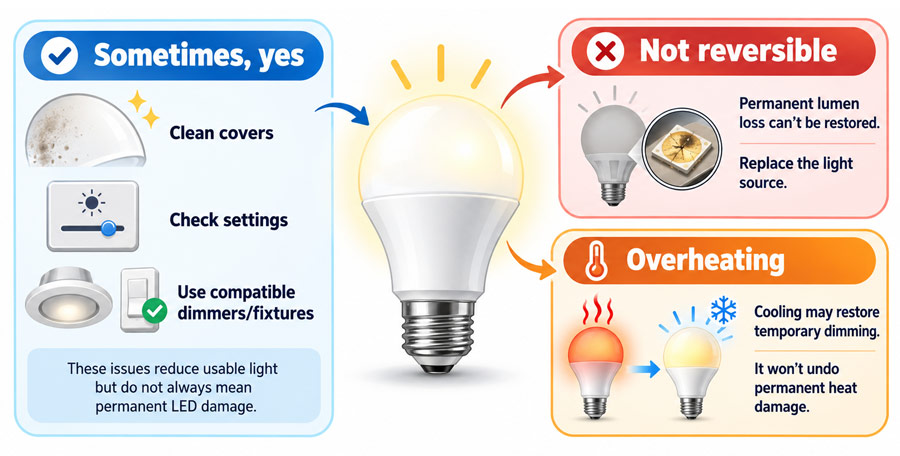
You may be able to restore the light lost through dirty covers, incorrect settings, or incompatible equipment. These conditions reduce usable illumination without necessarily indicating permanent LED deterioration.
Permanent lumen depreciation cannot be reversed through cleaning, resetting, or changing a control setting. Once the light-producing materials have deteriorated, restoring the original output generally requires replacing the affected light source.
Cooling an overheated lamp may resolve a temporary reduction in output. It does not undo permanent damage already caused by prolonged excessive temperature.
Avoid trying to compensate by using an unsuitable power supply or operating the bulb beyond its ratings.
How to Help LED Bulbs Maintain Their Brightness
The most useful approach is to choose suitable equipment and maintain its intended operating conditions.
- Match the bulb to the enclosure. Check whether it is approved for enclosed or recessed applications where relevant.
- Respect temperature limits. Use products suitable for the expected environment and keep designed ventilation paths unobstructed.
- Choose compatible controls. Check dimming support and the manufacturer’s compatibility information.
- Use appropriate outdoor ratings. A sheltered location, exposed wet location, and enclosed fitting present different requirements.
- Limit unnecessary operating hours. Use timers or motion sensors to keep lights on only when needed.
- Correct recurring installation problems. Repeated early failures in one fitting justify checking that fitting and its supply.
A long rated life is most meaningful when the bulb operates under conditions consistent with its specifications.
When Should You Replace a Dim LED Bulb?
Replace a bulb when it no longer supplies adequate light after you have ruled out dirt, incorrect settings, and installation problems.
You do not need to wait for it to stop working. A light that leaves steps difficult to see or makes a work surface inadequately illuminated has already become unsuitable for that task.
When choosing a replacement, compare its lumen output, base, voltage, dimensions, beam distribution, and application ratings. Selecting a higher-output bulb also requires checking that it remains suitable for the fixture.
The replacement should address the cause of the problem. If excessive heat or incompatible equipment caused the original bulb to deteriorate prematurely, correcting that condition helps the next bulb perform as intended.
FAQs
1. Do LED Bulbs Use Less Electricity as They Get Dimmer With Age?
Not necessarily. An aging LED can produce fewer lumens without a proportional reduction in electrical input. Lower brightness therefore does not demonstrate lower energy consumption. Light output and input power are separate measurements, and deliberate dimming works differently from deterioration.
2. Can LED Bulbs Change Color as They Age?
Yes. Aging can affect the materials that determine an LED’s color, producing a warmer, cooler, or otherwise altered appearance. A change in color temperature can occur separately from brightness loss, so an older bulb may look different even while it still provides adequate illumination.
3. Does Dimming LED Bulbs Help Them Last Longer?
Compatible dimming can reduce operating stress and temperature, which may extend LED life. The benefit depends on the dimming method, driver design, and thermal conditions. It is not a guaranteed percentage increase, and operating at half brightness does not automatically double the bulb’s lifespan.
4. Does Cold Weather Make LED Bulbs Dimmer?
LEDs generally perform well in cold conditions. However, the complete bulb includes electronics with their own operating limits. A product used below its specified minimum temperature may have starting or performance problems. For outdoor use, check the temperature rating of the complete lighting product.
5. Does Frequently Switching LED Bulbs On and Off Shorten Their Life?
Normal household switching generally has much less influence on LED life than it does on some fluorescent lamps. There is usually no reason to leave an LED running simply to avoid ordinary switching. For applications involving unusually frequent cycling, check the product’s switching-endurance specifications.
