

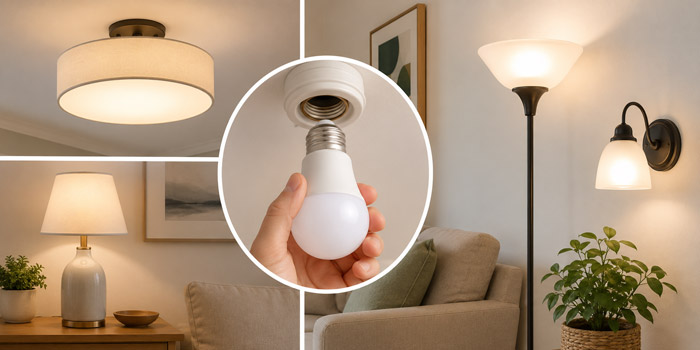
LED Bulbs Are Usually Made for Standard Fixtures
Check the Bulb Base First
Match the Fixture Voltage
Understand Wattage: Use Equivalent Brightness, Not Equal Watts
LED Bulbs Produce Less Heat, but They Still Need Airflow
Dimmers Require Dimmable LED Bulbs
Enclosed Fixtures Need Special Attention
Recessed Lighting May Need the Right LED Type
Ceiling Fans May Need Vibration-Resistant LED Bulbs
Outdoor Fixtures Require Damp or Wet Location Ratings
Color Temperature Affects the Look of the Fixture
Bulb Shape and Size Matter
LED Bulbs in Lamps
LED Bulbs in Bathroom Fixtures
LED Bulbs in Chandeliers
LED Bulbs in Garage Door Openers
Why LED Bulbs Are a Good Choice for Regular Fixtures
Common Problems When Using LED Bulbs in Regular Fixtures
How to Choose the Right LED Bulb for a Regular Fixture
Can LED Bulbs Damage Regular Fixtures?
Can You Use a Higher-Watt Equivalent LED Bulb?
Are LED Bulbs Safe in Old Fixtures?
FAQs
Yes, you can use LED light bulbs in regular fixtures in most cases. LED bulbs are designed to replace traditional incandescent, halogen, and compact fluorescent bulbs in many standard household fixtures. As long as the LED bulb has the correct base, fits physically inside the fixture, matches the fixture’s voltage requirements, and is suitable for the fixture type, it can usually be used safely and effectively.
However, “regular fixture” can mean many things: table lamps, ceiling lights, recessed cans, pendant lights, bathroom vanity lights, outdoor fixtures, ceiling fans, and enclosed glass fixtures. While LED bulbs are broadly compatible with these fixtures, there are important details to check before making the switch. Choosing the wrong LED bulb may lead to flickering, overheating, poor dimming performance, reduced bulb life, or unsafe operation.
This guide explains when LED bulbs can be used in regular fixtures, what to check before installing them, and how to avoid common compatibility problems.
LED Bulbs Are Usually Made for Standard Fixtures
Most LED bulbs sold for home use are built as direct replacements for older light bulbs. The most common type is the A19 LED bulb with an E26 screw base, which is the standard bulb shape and base used in many lamps and ceiling fixtures in North America.
If your existing fixture uses a common screw-in bulb, there is a strong chance that a compatible LED replacement is available. You simply remove the old bulb and screw in the LED bulb, just as you would with an incandescent bulb.
LED bulbs are commonly used in:
- Table lamps
- Floor lamps
- Ceiling fixtures
- Pendant lights
- Wall sconces
- Bathroom vanity lights
- Recessed lighting
- Track lighting
- Outdoor porch lights
- Ceiling fans
- Garage lights
- Closet lights
The key is not whether the fixture is “regular,” but whether the LED bulb is appropriate for that specific fixture.
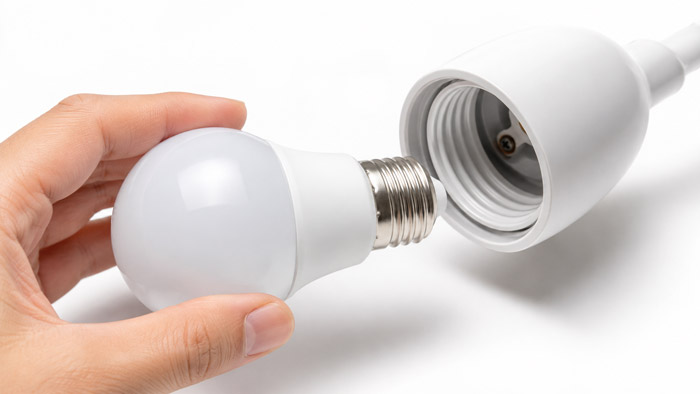
The first thing to check is the bulb base. The base is the part of the bulb that connects to the fixture.
Many household fixtures use a medium screw base, often labeled E26 in the United States and Canada. If your fixture uses a standard screw-in bulb, you will usually need an LED bulb with the same E26 base.
Other fixtures may use different bases, such as:
- Candelabra bases for chandeliers and decorative lights
- GU10 bases for some track lights
- GU24 bases in certain energy-efficient fixtures
- Pin bases for some recessed or specialty fixtures
An LED bulb must have the same base type as the bulb it is replacing. If the base does not match, the bulb will not fit or connect properly. You should never force a bulb into a socket or use an adapter unless the adapter is specifically rated for that purpose.
Most household fixtures are designed for standard line voltage. In North America, that is typically 120 volts. Many LED bulbs are also made for 120-volt household use, so they can be installed directly into standard fixtures.
However, some fixtures use low-voltage bulbs, especially certain landscape lights, under-cabinet lights, recessed fixtures, and track lighting systems. These may use 12-volt or 24-volt bulbs and often require a transformer.
Before installing an LED bulb, check the voltage rating on the fixture and on the bulb package. A 120-volt LED bulb should not be used in a low-voltage fixture, and a low-voltage LED bulb should not be used in a standard 120-volt socket unless the system is designed for it.
See also: Adam, G. K. (2019). DALI LED Driver Control System for Lighting Operations Based on Raspberry Pi and Kernel Modules. Electronics, 8(9), 1021.
Understand Wattage: Use Equivalent Brightness, Not Equal Watts
One of the most important differences between LED bulbs and incandescent bulbs is wattage. Traditional bulbs use wattage as a rough measure of brightness because higher-watt incandescent bulbs produce more light. LED bulbs produce the same amount of light using much less electricity.
For example, an LED bulb that gives about the same brightness as a 60-watt incandescent bulb may use only 8 to 10 watts of power.
When replacing old bulbs, do not choose an LED based only on the actual wattage. Instead, look at the lumen output or the incandescent equivalent listed on the package.
Common replacements include:
- 450 lumens for a 40-watt incandescent equivalent
- 800 lumens for a 60-watt incandescent equivalent
- 1100 lumens for a 75-watt incandescent equivalent
- 1600 lumens for a 100-watt incandescent equivalent
You must also respect the fixture’s maximum wattage rating. If a lamp says “maximum 60 watts,” that rating refers to power consumption and heat limits. A 9-watt LED bulb labeled as a “60-watt equivalent” is generally acceptable because it only uses about 9 watts. But you should not install a bulb that actually consumes more power than the fixture allows.
Feri, M., & Irianto, C. G. (2022). Lighting System Design Based on SNI 6197-2011 and Software-Based Design DIALux Evo 9.2 (Case Study: Pekanbaru High School of Technology). ELKHA: Jurnal Teknik Elektro, 14(2), 73–78.
LED Bulbs Produce Less Heat, but They Still Need Airflow
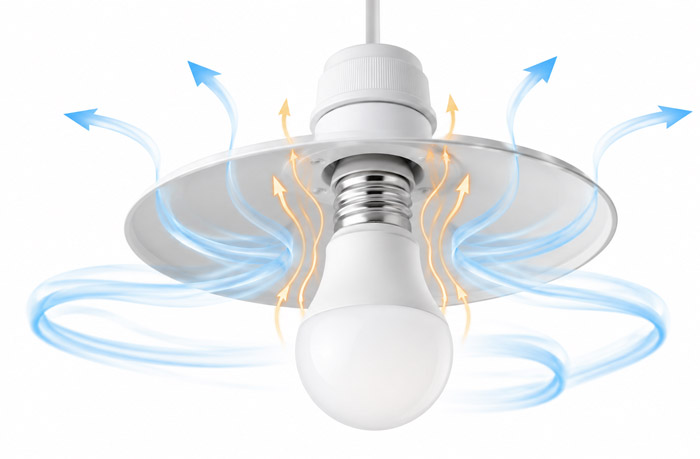
LED bulbs are much more energy efficient than incandescent bulbs, and they usually produce less heat overall. However, LEDs still generate heat at their base and internal electronic components. That heat needs to escape.
This is why airflow matters. In open fixtures, heat can dissipate easily. In enclosed fixtures, heat can build up around the bulb. Too much trapped heat can shorten the life of an LED bulb and may cause early failure.
A fixture is considered enclosed when the bulb is surrounded by glass, plastic, or another cover that limits airflow. Examples include:
- Sealed ceiling lights
- Globe fixtures
- Some outdoor porch lights
- Flush-mount fixtures with glass covers
- Certain bathroom lights
- Enclosed decorative fixtures
- If you want to use an LED bulb in an enclosed fixture, check the package or product description. It should say “suitable for enclosed fixtures” or “enclosed fixture rated.” If it does not, choose a different LED bulb.
Using a non-rated LED bulb in an enclosed fixture may not cause immediate danger, but it can make the bulb fail much sooner than expected.
See also: Baran, K., Różowicz, A., Wachta, H., Różowicz, S., & Mazur, D. (2019). Thermal analysis of the factors influencing junction temperature of LED panel sources. Energies, 12(20), 3941.
Dimmers Require Dimmable LED Bulbs
LED bulbs can be used in dimmable fixtures, but only if both the bulb and the dimmer switch are compatible.
A regular LED bulb that is not labeled dimmable should not be used with a dimmer switch. It may flicker, buzz, fail to dim properly, or shut off unexpectedly.
Even if the bulb is dimmable, an older dimmer switch may not work well with LED technology. Many old dimmers were designed for incandescent bulbs, which draw much more power. LEDs use far less power, and some older dimmers do not handle that low electrical load smoothly.
Signs of dimmer incompatibility include:
- Flickering
- Buzzing
- Limited dimming range
- Lights turning off too early
- Bulbs glowing faintly when turned off
- Uneven brightness between bulbs
For best results, use dimmable LED bulbs with an LED-compatible dimmer switch. If you are replacing multiple bulbs on one dimmer, use the same bulb model in all sockets to reduce performance issues.
Enclosed Fixtures Need Special Attention
Many people ask whether LED bulbs can be used in regular ceiling lights with glass covers. The answer is yes, but only if the LED bulb is rated for enclosed fixtures.
Enclosed fixtures trap heat. Incandescent bulbs tolerate high heat differently because they are simple filament-based devices. LED bulbs contain electronic drivers, and those components can be damaged by excessive heat over time.
If your fixture has a tight glass dome, sealed cover, or limited ventilation, choose an LED bulb specifically designed for enclosed use. These bulbs are built to handle higher operating temperatures.
If the fixture is only partially covered or has good ventilation, a standard LED bulb may work, but it is still best to follow the bulb manufacturer’s rating.
Recessed Lighting May Need the Right LED Type
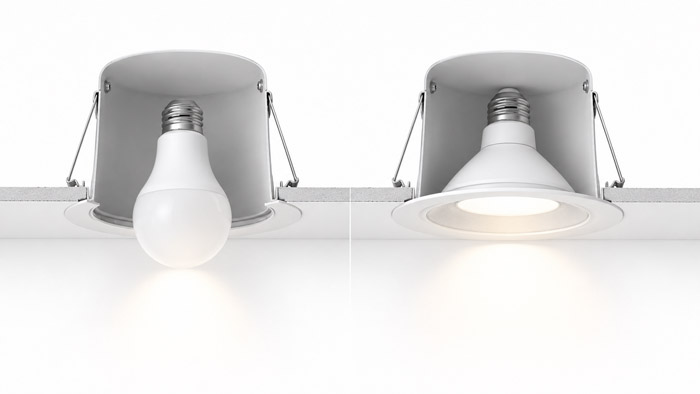
Recessed lighting is another area where compatibility matters. A regular LED bulb may fit into a recessed can, but that does not always mean it is the best choice.
Recessed fixtures can trap heat, especially if they are insulated or have limited airflow. Some older recessed cans were designed for incandescent bulbs and may not manage LED heat properly unless the LED bulb is suitable for that environment.
For recessed lights, look for bulbs labeled for recessed use. Many people choose LED reflector bulbs, such as BR30 or PAR38 bulbs, because they are designed to direct light downward and fit better in recessed housings.
You should also check whether the recessed fixture is IC-rated or non-IC-rated if insulation is involved. This relates to the fixture’s heat safety and contact with insulation, not just the bulb itself.
Ceiling Fans May Need Vibration-Resistant LED Bulbs
LED bulbs can be used in many ceiling fan light fixtures, but ceiling fans create vibration. Some standard bulbs may not perform well over time in a vibrating fixture.
For ceiling fans, choose LED bulbs labeled for ceiling fan use or vibration resistance. These bulbs are designed to handle movement better than ordinary bulbs.
Also check the bulb size. Ceiling fan fixtures often have compact glass shades, so a standard A19 LED bulb may be too large. Smaller A15 LED bulbs are commonly used in ceiling fans.
If the ceiling fan has a remote control or dimming feature, make sure the LED bulb is compatible with that system.
Outdoor Fixtures Require Damp or Wet Location Ratings
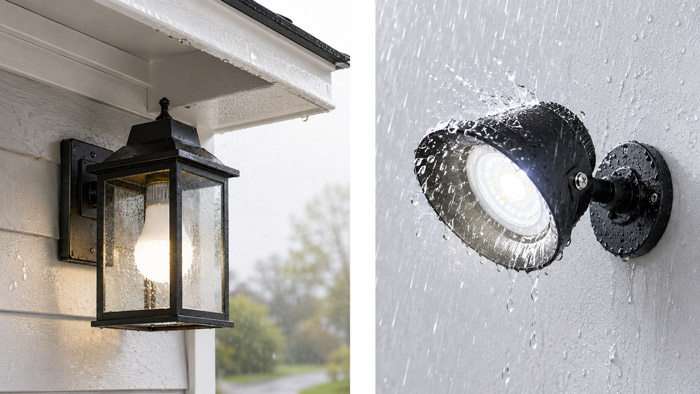
LED bulbs can be used in regular outdoor fixtures, but the bulb must be rated for the environment.
Outdoor fixtures are exposed to moisture, temperature changes, and sometimes direct rain. If the bulb is protected by a covered porch fixture, a damp-rated LED bulb may be enough. If the bulb may be exposed directly to rain, snow, or water spray, it should be wet-rated.
The fixture itself also matters. A weatherproof outdoor fixture protects the bulb and wiring from moisture. But even in a protected fixture, it is best to use bulbs approved for outdoor use.
Cold temperatures are usually not a problem for LED bulbs. In fact, LEDs often perform well in cold weather. This makes them a good choice for garages, porches, sheds, and exterior lighting.
Color Temperature Affects the Look of the Fixture
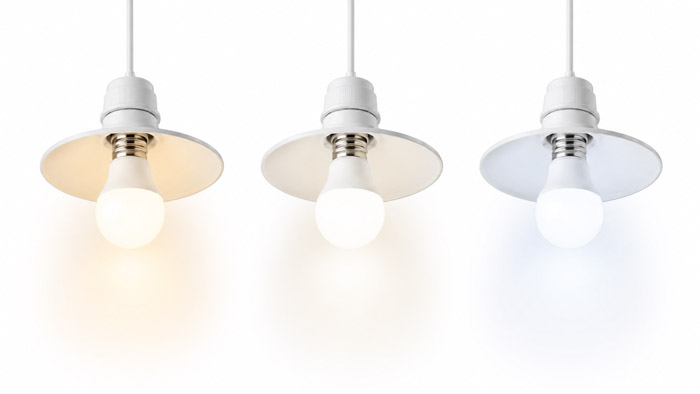
When switching from incandescent bulbs to LEDs, many people notice that the light feels different. This is usually because of color temperature.
Color temperature is measured in Kelvin. It describes whether the light looks warm, neutral, or cool.
Common options include:
- 2700K: warm white, similar to traditional incandescent light
- 3000K: soft warm white, slightly brighter and cleaner
- 4000K: neutral white, often used in kitchens, bathrooms, and work areas
- 5000K: daylight, bright and cool-looking
For most regular household fixtures, 2700K or 3000K is a good choice if you want a comfortable, warm appearance. For task lighting, bathrooms, garages, or laundry rooms, 4000K or 5000K may be more useful.
The fixture may accept the LED bulb, but the wrong color temperature can make the room feel harsh, cold, or unpleasant. Compatibility is not only about whether the bulb works; it is also about whether it produces the right light for the space.
Even when the base matches, the LED bulb must physically fit inside the fixture.
Some LED bulbs are slightly larger, heavier, or shaped differently than the incandescent bulbs they replace. This can be a problem in fixtures with narrow shades, small glass covers, or decorative housings.
Before buying an LED bulb, check the size and shape of the old bulb. Common shapes include:
- A19 for standard household bulbs
- A15 for smaller lamps and ceiling fans
- B10 or flame-tip bulbs for chandeliers
- G25 or globe bulbs for vanity fixtures
- BR30 or BR40 bulbs for recessed lighting
- PAR bulbs for directional lighting
If the bulb is too large, it may touch the fixture cover, block airflow, or prevent the cover from closing properly. Always leave enough space around the bulb, especially in fixtures where heat buildup is a concern.
Using LED bulbs in table lamps and floor lamps is usually simple. Most lamps with standard screw sockets can accept LED bulbs without any problem.
For lamps, focus on:
- Matching the base
- Choosing the right brightness
- Staying below the fixture’s maximum wattage
- Selecting a comfortable color temperature
- Using a dimmable LED if the lamp has a dimmer
Because most lamps are open or semi-open, heat buildup is usually less of a concern than it is in enclosed ceiling fixtures. Still, if the lamp has a tight shade or enclosed glass body, make sure the bulb has enough ventilation.
LED Bulbs in Bathroom Fixtures
LED bulbs can work very well in bathroom fixtures, especially vanity lights. They provide bright, efficient lighting and are available in color temperatures that work well for grooming and makeup.
For bathrooms, moisture is the main concern. If the bulb is near a shower, bathtub, or other damp area, choose an LED bulb and fixture appropriate for damp locations.
For vanity lighting, many people prefer 3000K to 4000K bulbs because they provide a clean but not overly harsh appearance. Good color rendering is also useful in bathrooms. Look for bulbs with a high CRI rating if accurate color appearance matters.
LED bulbs can be used in regular chandeliers as long as the base and shape match. Many chandeliers use candelabra bulbs, so you may need LED bulbs with an E12 base instead of a standard E26 base.
For chandeliers, appearance is often important. LED chandelier bulbs come in clear, frosted, flame-tip, filament-style, and decorative designs. If the bulbs are visible, choose a style that matches the fixture.
If the chandelier is controlled by a dimmer, make sure the bulbs are dimmable and that the dimmer is compatible with LEDs.
LED Bulbs in Garage Door Openers
Garage door openers are a special case. Some LED bulbs can create electrical interference that affects garage door opener remotes. This does not happen with every bulb, but it is common enough that many manufacturers sell LED bulbs specifically designed for garage door openers.
If you want to use an LED bulb in a garage door opener, choose one labeled for that purpose. These bulbs are usually vibration-resistant and designed to reduce remote-control interference.
Why LED Bulbs Are a Good Choice for Regular Fixtures
Switching to LED bulbs has several practical benefits.
First, LED bulbs use much less electricity than incandescent bulbs. This can reduce energy costs, especially in fixtures that are used for many hours each day.
Second, LED bulbs usually last much longer than traditional bulbs. This is especially useful in ceiling fixtures, outdoor lights, and other places where changing bulbs is inconvenient.
Third, LEDs are available in many brightness levels, color temperatures, and shapes. This makes it easier to customize the lighting in each room.
Fourth, LED bulbs turn on instantly and work well in many everyday fixtures. Unlike some older compact fluorescent bulbs, most LEDs do not need a warm-up period to reach full brightness.
Common Problems When Using LED Bulbs in Regular Fixtures
Although LED bulbs are usually compatible with regular fixtures, problems can happen when the wrong bulb is used.
Flickering
Flickering is often caused by incompatible dimmers, low-quality bulbs, loose connections, or voltage issues. If the bulb is on a dimmer, make sure it is a dimmable LED and that the dimmer is LED-compatible.
Buzzing
Buzzing can come from the bulb, dimmer, or fixture. It is most common when dimmable LEDs are used with older dimmer switches.
Early Bulb Failure
If an LED bulb burns out much sooner than expected, heat may be the cause. This often happens when a non-enclosed-rated bulb is used in a sealed fixture.
Poor Brightness
Sometimes people replace a 60-watt incandescent bulb with an LED that is too dim. Look at lumens, not just wattage. For a typical 60-watt replacement, choose around 800 lumens.
Bulb Does Not Fit
Some LED bulbs have larger bases or different shapes than older bulbs. Always check the bulb dimensions if the fixture has a tight cover or shade.
How to Choose the Right LED Bulb for a Regular Fixture
To choose the right LED bulb, follow these steps:
- Remove the old bulb and check its base type.
- Check the fixture’s maximum wattage rating.
- Choose the desired brightness in lumens.
- Select the right color temperature.
- Make sure the LED bulb physically fits.
- Check whether the fixture is enclosed.
- Use an enclosed-rated LED if needed.
- Use a dimmable LED if the fixture has a dimmer.
- Use damp-rated or wet-rated bulbs for outdoor or bathroom locations.
- Choose specialty LEDs for ceiling fans, recessed lights, or garage door openers when needed.
Following these steps will help you avoid most LED compatibility issues.
Can LED Bulbs Damage Regular Fixtures?
A properly selected LED bulb should not damage a regular fixture. In fact, because LEDs use less power and usually produce less heat than incandescent bulbs, they are often easier on fixtures.
Problems usually occur when the bulb is not suitable for the fixture. For example, using a non-enclosed-rated LED in a sealed fixture can cause the bulb to overheat and fail early. Using a non-dimmable LED on a dimmer can cause flickering or buzzing. Using the wrong voltage bulb can create a safety risk.
The fixture itself is not usually harmed by a correct LED replacement. The important point is to match the LED bulb to the fixture conditions.
Can You Use a Higher-Watt Equivalent LED Bulb?
In many cases, yes. Because LED bulbs use much less actual wattage, you may be able to use a brighter LED bulb while staying within the fixture’s maximum wattage limit.
For example, a fixture rated for a maximum of 60 watts may safely accept a 100-watt equivalent LED bulb if that LED only uses around 14 or 15 actual watts and fits properly. However, heat and fixture design still matter. In enclosed fixtures, a brighter LED may generate more heat than a lower-output LED, even though it uses far less electricity than an incandescent bulb.
Always check the actual wattage, enclosed fixture rating, and physical fit before choosing a brighter LED.
Are LED Bulbs Safe in Old Fixtures?
LED bulbs can often be used in older fixtures, but the condition of the fixture matters. If the wiring is damaged, brittle, loose, or outdated, changing the bulb will not fix the underlying electrical issue.
Before installing LED bulbs in an old fixture, check for:
- Loose sockets
- Burn marks
- Cracked insulation
- Flickering with multiple bulb types
- A burning smell
- Corrosion
- Damaged switches
If you notice any of these issues, the fixture should be inspected or repaired before using any bulb, including an LED.
In a properly functioning older fixture, an LED bulb is often a good choice because it uses less power and produces less heat than an incandescent bulb.
etter performance, longer bulb life, and safer lighting throughout your home.
Can LED bulbs be used with motion sensor fixtures?
Yes, LED bulbs can be used with motion sensor fixtures, but the sensor must be compatible with low-wattage LED loads.
Some older motion sensors were designed for incandescent bulbs and may cause LED bulbs to flicker, stay on, or fail to turn on properly. For reliable performance, use LED-compatible motion sensor fixtures or bulbs specifically rated for sensor-controlled lighting.
Can you use LED bulbs in a 3-way lamp?
Yes, but you need a 3-way LED bulb. A regular LED bulb may work only at one brightness level in a 3-way socket.
A true 3-way LED bulb is designed with multiple brightness settings and will operate correctly when used with a 3-way lamp switch.
Can LED bulbs be mixed with incandescent bulbs in the same fixture?
LED and incandescent bulbs can sometimes be used in the same multi-bulb fixture, but it is not always ideal.
Mixed bulb types may create uneven brightness, different color tones, and inconsistent performance. If the fixture is controlled by a sensor, timer, or smart switch, using all LED bulbs of the same model usually provides better results.
Do LED bulbs work with smart switches?
Many LED bulbs work with smart switches, but compatibility depends on the switch design and electrical load requirements.
Some smart switches need a neutral wire, while others require a minimum load that certain LED bulbs may not meet. If the LED bulb flickers, glows when off, or does not respond correctly, use LED-compatible smart switches or add bulbs recommended by the switch manufacturer.
Can LED bulbs be used in dusk-to-dawn fixtures?
Yes, LED bulbs can be used in dusk-to-dawn fixtures if the photocell control is compatible with LEDs.
Older photocells may not detect or control low-wattage LED bulbs properly, which can cause cycling, flickering, or delayed switching. For best performance, use LED bulbs labeled for photocell use or choose a modern dusk-to-dawn fixture designed for LED lighting.
