

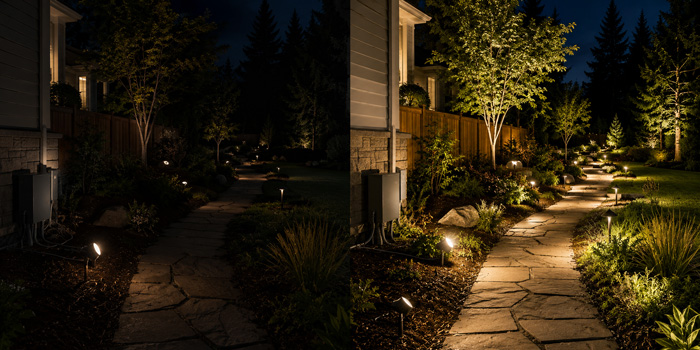
What Voltage Means in Landscape Lighting
What Amperage Means in Landscape Lighting
How Voltage Affects Outdoor Lighting Performance
How Amperage Affects Outdoor Lighting Performance
Why Wire Size Matters
Transformer Capacity and System Load
Amp vs Volt in LED Landscape Lighting
Common Problems Caused by Poor Amp and Volt Planning
FAQs
Understanding the difference between amps and volts is essential when designing or upgrading a landscape lighting system. Both directly affect how well outdoor lights perform, how safely the system operates, and how long the fixtures and transformer will last. In low-voltage landscape lighting, voltage determines how much electrical pressure is available, while amperage shows how much current the system uses. When these two are not properly balanced, the result can be dim lights, overloaded transformers, uneven brightness, or premature system failure.
What Voltage Means in Landscape Lighting
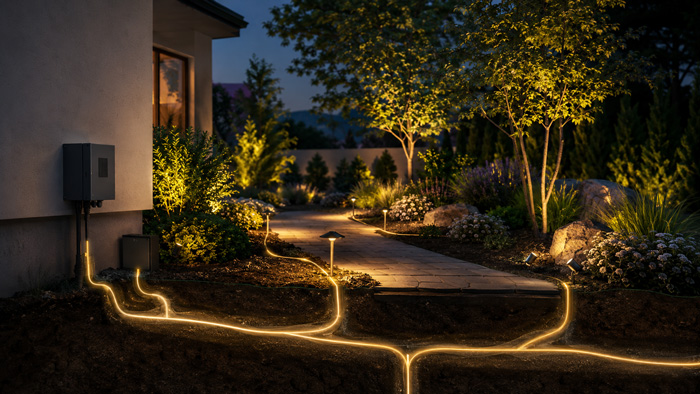
Voltage is the electrical force that pushes power through the wiring to each outdoor fixture. Most residential landscape lighting systems use 12-volt low-voltage power because it is safer, easier to install, and more energy-efficient than standard 120-volt systems.
Voltage plays a major role in brightness consistency. If the voltage reaching a fixture is too low, the light may appear dim or weak. This is commonly called voltage drop, and it usually happens when fixtures are too far from the transformer, the wire gauge is too small, or too many lights are connected to one run.
For example, a path light near the transformer may look bright, while another light at the end of a long wire run may look noticeably dimmer. This does not always mean the fixture is defective. It often means the voltage reaching that fixture is insufficient.
What Amperage Means in Landscape Lighting
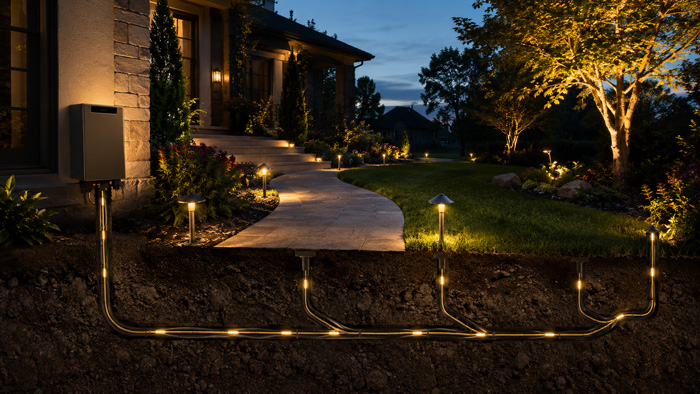
Amperage, or amps, measures the amount of electrical current flowing through the lighting system. In simple terms, amps show how much power the connected fixtures are demanding from the transformer.
Every light fixture uses a certain number of watts. When several fixtures are connected, their combined wattage creates a total electrical load. That load determines how many amps the system draws.
If the amperage demand is too high for the transformer or wiring, the system can become overloaded. This may cause lights to flicker, breakers to trip, wires to heat up, or the transformer to shut down. Proper amperage planning helps keep the entire outdoor lighting system stable and safe.
How Amps and Volts Work Together
Amps and volts are closely connected through wattage. The basic formula is:
Watts = Volts × Amps
In landscape lighting, this formula helps determine how much power your system needs. For example, if you have a 12-volt system using 60 watts of lighting, the system draws about 5 amps.
60 watts ÷ 12 volts = 5 amps
This matters because transformers, wires, and fixtures all have limits. If the system pulls more amps than the components can safely handle, performance and safety will suffer.
How Voltage Affects Outdoor Lighting Performance
Voltage mainly affects light output and consistency. When the voltage is correct, fixtures produce the intended brightness and color temperature. When voltage is too low, lights may look dim, yellowish, or uneven.
LED landscape lights are more forgiving than older halogen lights, but they still need a proper voltage range to perform correctly. If voltage drops too far, LEDs may flicker, lose brightness, or fail to turn on.
Correct voltage also helps protect fixtures. Running lights outside their recommended voltage range can shorten their lifespan and reduce overall system reliability.
How Amperage Affects Outdoor Lighting Performance
Amperage affects system capacity and electrical safety. A lighting system that draws too many amps can overload the transformer or wiring. This does not usually make lights brighter; instead, it creates stress on the system.
High amperage can lead to:
- Transformer overload
- Flickering lights
- Hot wires or connectors
- Tripped breakers
- Shortened fixture lifespan
- Unstable system performance
A well-designed system keeps amperage within safe limits while still delivering enough voltage to every fixture.
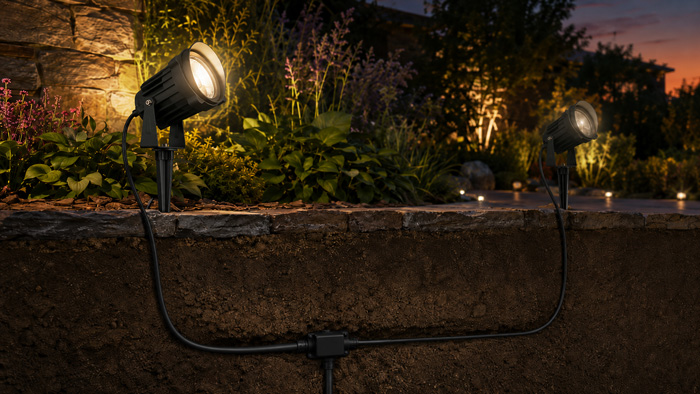
Wire size has a major impact on both voltage and amperage. Longer wire runs create more resistance, which increases voltage drop. Thin wires also have more resistance than thicker wires, making them less suitable for larger lighting loads or longer distances.
Using the correct wire gauge helps maintain proper voltage at each fixture and safely carry the required amperage. For larger systems, it is often better to use multiple wire runs instead of placing every fixture on one long line.
Transformer Capacity and System Load
The transformer is the power source for a low-voltage landscape lighting system. It converts standard household voltage into safer low voltage, usually 12 volts.
To choose the right transformer, you need to calculate the total wattage of all fixtures. The transformer should have enough capacity to handle the load without being pushed to its maximum limit. A common practice is to use no more than about 80% of the transformer’s rated capacity.
For example, if your fixtures use 160 watts total, a 200-watt transformer may be a suitable choice. This gives the system room to operate efficiently and allows space for minor future additions.
Amp vs Volt in LED Landscape Lighting
LED landscape lighting uses much less power than halogen lighting, which means it typically draws fewer amps. This makes LED systems easier to manage, more energy-efficient, and less demanding on transformers and wiring.
However, voltage still matters. Even with efficient LEDs, poor wiring design can cause voltage drop and uneven performance. A low amp draw does not automatically guarantee proper voltage at every fixture. Both must be considered together.
Common Problems Caused by Poor Amp and Volt Planning
When amps and volts are not properly calculated, outdoor lighting performance can suffer in several ways. Lights may be bright near the transformer but dim farther away. Fixtures may flicker because the system is unstable. The transformer may shut off because the total amperage is too high. Connectors and wires may overheat if the electrical load exceeds their rating.
Most of these problems can be prevented by calculating total wattage, choosing the correct transformer, using proper wire gauge, and avoiding overly long wire runs.
What is the best voltage range for low-voltage landscape lights?
Most low-voltage landscape lights perform best when they receive voltage within the manufacturer’s recommended operating range, often around 10.8V to 12V for many 12V systems.
If the voltage drops too low, lights may dim, flicker, or fail to operate properly. If voltage is too high, it may shorten fixture life.
How do I know if my landscape lighting transformer is overloaded?
A transformer may be overloaded if lights flicker, turn off unexpectedly, feel inconsistent in brightness, or if the transformer becomes unusually hot.
To check properly, add up the total wattage of all connected fixtures and compare it with the transformer’s rated capacity. The total load should stay below the transformer’s safe operating limit.
Can I mix different wattage lights on the same landscape lighting run?
Yes, different wattage lights can be used on the same wire run, but the total load and voltage drop must be calculated carefully.
Higher-wattage fixtures draw more power and may affect the performance of lights farther down the line. For better balance, large systems should often be divided into separate runs.
Does wire gauge affect LED landscape lighting brightness?
Yes. Even though LED fixtures use less power than halogen lights, wire gauge still affects brightness and performance.
A wire that is too thin can increase resistance and cause voltage loss, especially over long distances. Thicker wire helps deliver more stable power to each fixture.
Why do some landscape lights turn on but look weaker than others?
Uneven brightness is often caused by voltage drop, poor wire connections, overloaded runs, or incorrect fixture placement on the circuit.
The issue is usually electrical rather than a problem with the light itself. Checking voltage at each fixture can help identify where the power loss occurs.
