

Table of Contents
- Understanding the 5CCT Label
- What Are the Five Color Temperatures?
- How Does a 5CCT Light Work?
- 5CCT vs. 3CCT, Tunable White, and RGB
- What the 5CCT Label Does Not Tell You
- How to Choose a 5CCT Setting for Your Home or Garden
- The Most Useful Benefit of 5CCT Is a Better Final Decision
- How to Test a 5CCT Light Before Final Installation
- FAQs
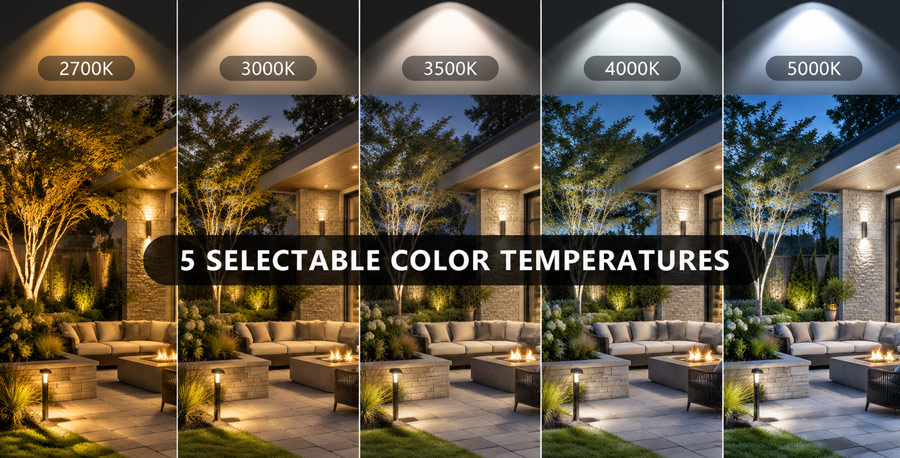
5CCT means a light offers five selectable correlated color temperatures. A common combination is 2700K, 3000K, 3500K, 4000K, and 5000K, giving you several shades of white light within one fixture. The exact settings depend on the product, so always check its specifications.
This flexibility lets you choose the light’s appearance after seeing how it works with your walls, furniture, paving, or planting. That can be more useful than choosing a color temperature from an online photograph.
However, the number of settings tells only part of the story. To choose a suitable 5CCT light, you also need to understand how those settings are controlled, what they change, and which lighting qualities require separate attention.
Understanding the 5CCT Label
CCT stands for correlated color temperature, expressed in kelvin, using the symbol K. It describes the color appearance of a white light source by relating it to the appearance of an ideal heated reference source.
For everyday lighting decisions:
- Lower kelvin values produce warmer, more yellowish white light.
- Higher kelvin values produce cooler, more bluish white light.
The word “temperature” describes the light’s appearance. It does not tell you how hot the fixture becomes during operation.
The “5” simply indicates five available CCT settings. It does not mean five brightness levels, and 5CCT is different from 5000K: one describes the number of choices, while the other describes a particular color temperature.
What Are the Five Color Temperatures?
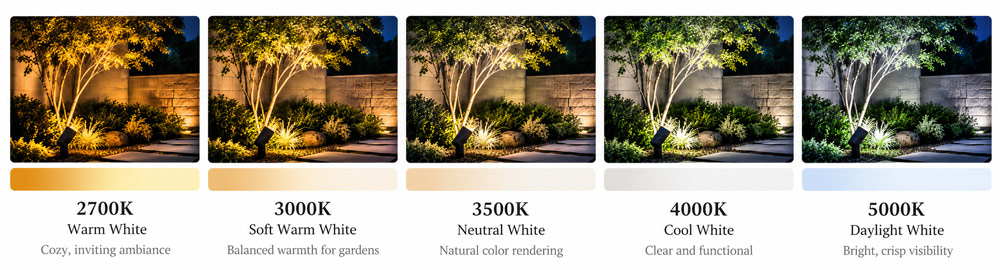
Many residential 5CCT fixtures provide the following combination:
| Setting | General appearance | A practical starting point for comparison |
|---|---|---|
| 2700K | Warm white with a noticeable golden tone | Relaxed seating areas, bedrooms, and intimate outdoor spaces |
| 3000K | Warm white with less yellow emphasis | Entrances, living spaces, patios, and residential landscape lighting |
| 3500K | An intermediate white between warm and cool | Spaces where 3000K feels too warm and 4000K feels too cool |
| 4000K | Cooler white with a relatively crisp appearance | Utility areas and work surfaces where that appearance is preferred |
| 5000K | Daylight-like white, cooler than the other settings | Selected task applications where a cooler appearance is intentional |
These are starting points for a trial, rather than fixed rules for each room. A material palette, neighboring light sources, and personal preference can change which setting looks most appropriate.
Also, “daylight-like” describes an appearance. A 5000K LED does not reproduce every characteristic of natural daylight.
How Does a 5CCT Light Work?
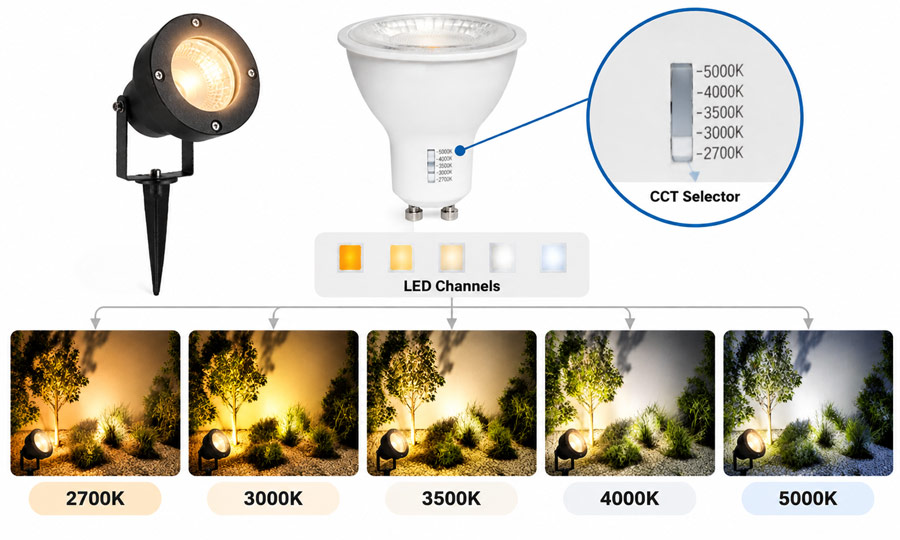
Many adjustable-white LED designs combine warm-white and cool-white LED channels. Changing their relative output produces different shades of white. A selectable fixture provides predefined settings within its available range. Five settings therefore do not necessarily require five separate groups of LEDs.
A physical selector may sit on the fixture, behind its trim, or on an associated driver or connection enclosure. Some products are designed for the installer to choose the setting before completing installation.
That creates an important buying question: How easily can you reach the selector once the light is installed?
A switch behind an accessible trim may be convenient for occasional adjustment. A selector inside a difficult-to-reach enclosure offers much less everyday flexibility. Ask to see the switch location and installation instructions before choosing the fixture.
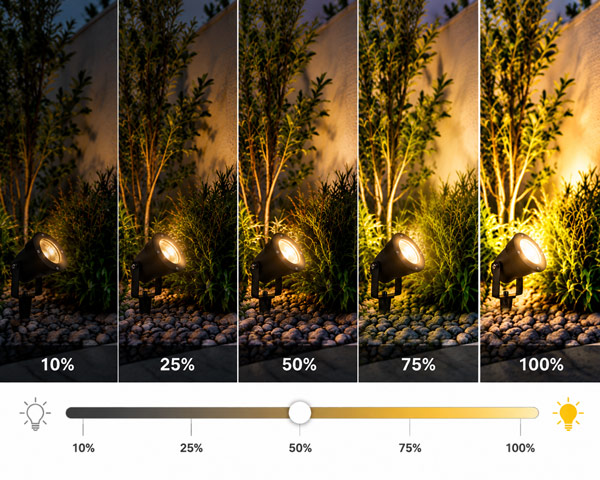
Does 5CCT Also Mean Dimmable?
Dimming capability must be specified separately.
Color-temperature selection changes the shade of white. Dimming changes light output. A product can offer both functions, but the 5CCT label alone does not establish dimmer compatibility.
There is also a separate feature called dim-to-warm, where the color temperature becomes warmer as the light is dimmed. Ordinary selectable-CCT operation does not automatically provide this behavior.
5CCT vs. 3CCT, Tunable White, and RGB
These terms describe different kinds of flexibility.
| Lighting description | What it generally provides | Main consideration |
|---|---|---|
| 3CCT | Three selectable white-light color temperatures | Check whether its three settings already include your preferred choice |
| 5CCT | Five selectable white-light color temperatures | Offers more preset choices, with control access depending on the design |
| Tunable white | Adjustable white light across a specified range | Check adjustment range, controls, and whether adjustment is continuous or stepped |
| RGB | Colored light produced by mixing red, green, and blue channels | Check white-light performance separately if white illumination matters |
A 3CCT fixture that includes exactly the setting you want may be a better purchase than a 5CCT fixture with less suitable optics or color quality.
Likewise, a fixture with an installation selector serves a different purpose from a system designed for frequent adjustments through a controller. Choose according to how you expect to use the light after installation.
What the 5CCT Label Does Not Tell You
The number of presets cannot establish how well a fixture will illuminate a space. Several other specifications deserve equal attention.

Light Output and Power Consumption
Lumens describe the total visible light output of a source, while watts describe its electrical power input. Neither measurement is supplied by the term 5CCT.
When comparing fixtures, check their lumen output and beam distribution alongside the available color temperatures.
If a specification sheet gives one headline lumen figure for the entire CCT range, ask which setting that figure represents. Do the same for wattage. This makes comparisons more useful than assuming every preset delivers identical performance.

Color Rendering
CCT describes the appearance of the light source. Color rendering concerns how illuminated objects appear.
Evaluate CCT and CRI together when skin tones, food, flowers, or decorative materials matter. A higher CRI can support better color fidelity, but the number alone does not describe every aspect of color appearance.
For a color-sensitive seating or feature area, consider a CRI of 90 or above as a purchasing preference, then inspect actual materials under a sample fixture.

Tint and Consistency Between Fixtures
Two lights labeled 3000K can still look different. One may appear slightly pinkish and another slightly greenish because CCT does not fully describe their chromaticity.
This becomes particularly noticeable when several fixtures illuminate the same pale wall.
For repeated installations, compare sample fixtures side by side at the intended setting. Matching the printed kelvin value is a useful first step, but visual consistency deserves its own check.
How to Choose a 5CCT Setting for Your Home or Garden
A useful approach is to choose color temperature according to what people see together.
A patio, garden path, entrance, and living-room window may belong to different lighting zones. From a seated position outside, however, they can form one continuous view. Selecting each zone independently can produce an accidental patchwork of warm and cool light.

Start With the Main Evening View
Stand or sit where the space will normally be used. Include neighboring fixtures and visible indoor lighting in your assessment.
For a residential garden, begin by comparing 2700K and 3000K landscape lighting. Then consider whether another available setting solves a specific visual problem.
For example, imagine a terrace beside a warmly lit living room. A cooler exterior setting may look attractive when viewed alone, yet feel disconnected when both spaces are visible through the glass. Comparing the combined view gives you a more useful basis for choosing.

Test Materials Instead of Following Simple Color Rules
Advice such as “warm light for wood” or “cool light for modern architecture” can help generate an initial comparison, but it should not decide the result.
A pale stone wall may already reflect substantial light. Dark paving may need a different beam arrangement. Painted finishes, foliage, and fabrics can respond differently even within the same project.
Use the five settings to inspect those materials directly. Look for a setting that supports the intended atmosphere while keeping important surfaces and details easy to distinguish.

Treat Glare as a Separate Problem
Changing from 5000K to 2700K may make the light appear warmer, but an exposed LED can remain uncomfortable to look at.
If a fixture shines into seated eye level or neighboring windows, review its shielding, aiming, mounting position, and output.
For outdoor projects, warmer light works best alongside careful direction, restrained light levels, and controls that limit operating time. These measures address different parts of responsible outdoor lighting.
The Most Useful Benefit of 5CCT Is a Better Final Decision
A product photograph cannot show exactly how a fixture will look against your own materials, beside your existing lights, and from your normal viewing position.
Selectable CCT gives you an opportunity to postpone the final color choice until those conditions are visible.
That makes 5CCT particularly useful when:
- Interior or exterior finishes have not yet been finalized.
- New fixtures must coordinate with existing lighting.
- Several similar spaces have different material palettes.
- The preferred color temperature is uncertain before installation.
However, the value of those choices depends on access. If changing the setting requires significant dismantling, treat the selector as a commissioning feature and settle the choice before completing the installation.
For a project with an established, tested color-temperature specification, a suitable fixed-CCT fixture may be sufficient. The priority is achieving the intended result with suitable light distribution and reliable performance.
How to Test a 5CCT Light Before Final Installation
A small trial can prevent a much larger correction later.
- Place a sample in a representative position. Match the intended mounting height, aiming direction, and distance from the illuminated surface as closely as practical.
- Compare settings under normal evening conditions. Turn on nearby lights that will normally operate at the same time.
- Keep other variables consistent. Avoid changing beam direction or the dimmer position while comparing color temperatures.
- Inspect the whole scene. Check faces, steps, paving, walls, planting, and the view from seating areas. Judge the illuminated space rather than staring directly at the LEDs.
- Record the selected setting. For multiple fixtures, document the chosen CCT by location so installation and later maintenance remain consistent.
Disconnect power before accessing a concealed selector, and follow the fixture’s instructions when changing its setting.
Once the choice is made, confirm it across adjacent fixtures before closing enclosures or completing finishing work. That is where five available options become a coherent lighting installation.
FAQs
1. Will a 5CCT Light Remember Its Setting After a Power Outage?
A mechanical selector remains in its selected position, so restoring power should return the fixture to that setting. Products using electronic selection may have different memory or reset behavior. Check the instructions for power-loss memory, default settings, and any wall-switch cycling sequence.
2. Why Does My 5CCT LED Flicker When I Dim It?
Possible causes include incompatibility between the LED driver and dimmer, unsuitable circuit loading, or operation below the combination’s stable dimming range. The five color settings do not establish dimming compatibility.
For dimmer-related flicker, check the fixture’s approved dimmer guidance, permitted load, and adjustment instructions. Persistent problems require assessment of the installation.
3. Are 5CCT Lights Waterproof and Suitable for Outdoor Use?
Only models specifically rated for their installation environment are suitable. The 5CCT designation describes color selection; an IP65 rating describes a defined level of enclosure protection against dust and water.
Check the fixture’s environmental rating, permitted mounting conditions, and connection requirements separately from its color-temperature options.
4. Do 5CCT Lights Attract Insects?
They can. The relationship between light color and insect attraction involves more than the kelvin value. Research has found differences in attraction between lamps with similar color temperatures, showing that spectral composition matters.
A warm setting does not guarantee an insect-free patio. Shielding and limiting unnecessary illuminated areas also deserve attention.
5. Can I Connect a 5CCT Light to a 12V Landscape Transformer?
Only if the fixture is explicitly designed for that supply. Before installing low-voltage garden lights, match the fixture’s required voltage and AC or DC input to the transformer output, then check compatibility and loading requirements.
The 5CCT label provides no information about electrical input. Always use the fixture’s electrical specifications to determine the correct supply.
