

Table of Contents
- What counts as an enclosed light fixture?
- Why heat matters even with a low-wattage LED
- How to choose an LED bulb for an enclosed fixture
- 1. Verify the enclosed-use rating for the exact model
- 2. Match the base, supply voltage, and space inside the cover
- 3. Compare actual watts with the fixture limit
- 4. Check moisture exposure and controls
- Judge the light where you need it
- What to check when an enclosed LED flickers or fails early
- When keeping the existing fixture makes sense
- FAQs
You can use an LED bulb in an enclosed light fixture if the bulb’s exact model is rated for enclosed use and meets the fixture’s requirements. Look for wording such as “suitable for totally enclosed fixtures” on the package or in the manufacturer’s specifications. A glass cover can trap heat around the bulb, affecting both light output and service life.
The easiest way to choose a replacement is to picture the fixture in use. A hallway globe that runs for a few minutes and a two-bulb porch lantern that runs all evening put their bulbs through different conditions. Start with the fixture fully assembled, check how the bulbs will operate, and then decide how much light you need.
What counts as an enclosed light fixture?
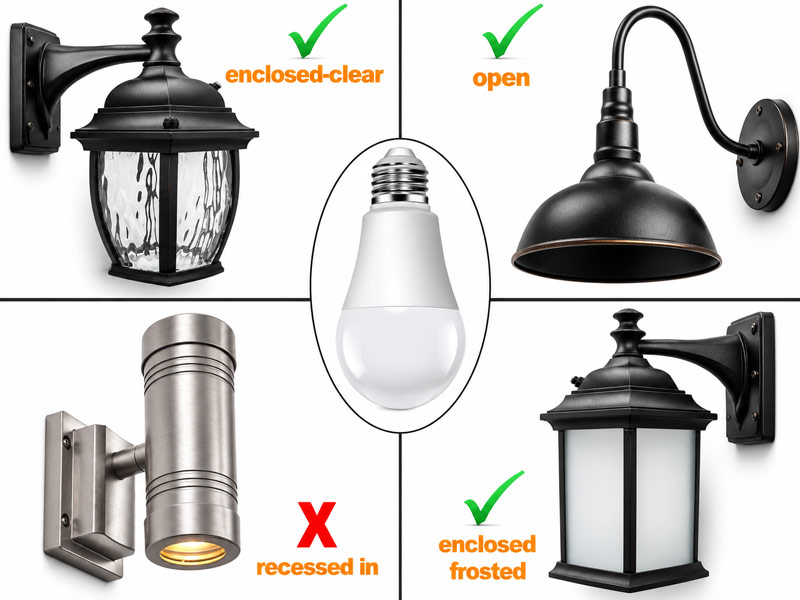
An enclosed fixture surrounds the bulb with a housing and a cover that restrict airflow. A flush-mount ceiling light with a fitted glass dome is a common example. So is a porch lantern with glass sides and a closed bottom. The glass can be clear enough to show every detail of the bulb while still limiting the movement of air around it.
| Fixture | What to look for |
|---|---|
| Flush-mount ceiling light with a glass dome | A dome that seats against the fixture base typically encloses the bulbs. |
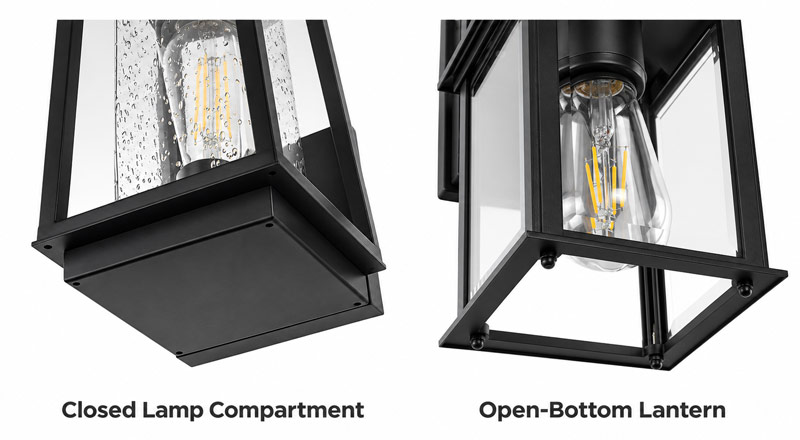
| Porch lantern with glass panels | Check the bottom and top. A closed lamp compartment calls for an enclosed-rated bulb. |
| Pendant with a shade that is open at the bottom | Check where the bulb sits. A bulb exposed to room air differs from one behind a fitted diffuser. |
| Recessed light with a lens | Check the housing and trim instructions for permitted lamp types. A lens can restrict airflow at the opening. |
When replacing the bulb in an outdoor hanging lantern, look at how the access panel or bottom plate closes. Turn off power and let the fixture cool before opening it. Reinstall the cover and any gasket as directed so the fixture operates in its intended configuration.
Recessed lighting deserves a separate check. An IC-rated recessed fixture is designed for contact with insulation under its specified installation conditions. The housing and trim instructions tell you which lamps the fixture accepts. Check the bulb’s documentation for any restrictions on recessed use as well.
Why heat matters even with a low-wattage LED
An LED bulb generally uses less power than an incandescent bulb that produces comparable light. Its LEDs and driver still generate heat, though. The driver regulates power to the LEDs, and the life of its electronic components depends in part on their operating temperature. Inside a closed fixture, heat has fewer ways to leave, and the air around the bulb can become warmer than the room.
That can lead to two different outcomes. The LEDs can gradually produce less light, or the driver can fail while the LEDs still have useful life left. In one hotel retrofit documented by the U.S. Department of Energy, LED lamps in enclosed fixtures lost output and began flickering after extended operation. The report attributed the driver capacitor failures to prolonged heat exposure.
Miller, N. J. (2012, May). GATEWAY demonstrations: What have we learned about LED performance and cost effectiveness? [PowerPoint slides]. Pacific Northwest National Laboratory.
For a replacement you expect to use every day, think about the warmest conditions the fixture routinely sees. A porch lantern can start an evening already warm from the afternoon sun. Two bulbs under one dome share the same pocket of air. If you’re retrofitting several identical lights, try a compatible set in one of the longest-running fixtures first. Observe it with the cover installed through a normal evening of use. That gives you a chance to catch early issues with light distribution, dimming, or intermittent operation before buying bulbs for every socket.
How to choose an LED bulb for an enclosed fixture
1. Verify the enclosed-use rating for the exact model
Check the package, bulb markings, or technical sheet for an explicit enclosed-use statement. If the retailer’s listing is vague, look up the model number. Bulbs with the same shape, brightness, and appearance can carry different application restrictions. Check any stated limits on mounting orientation, ambient operating temperature, or specific fixture types.
2. Match the base, supply voltage, and space inside the cover
Check the fixture label and compare the dimensions of the old bulb with those of the replacement. The distinction between A19 and E26 is useful here. A19 describes the bulb’s shape and nominal size. E26 identifies the screw base. Check voltage separately against the fixture’s requirements.
A bulb can screw in easily and still be too long for a shallow dome. Compare the overall length and widest diameter, especially if the fixture has angled sockets or a narrow neck. The cover should seat as designed, with any clearances specified by the fixture manufacturer.
3. Compare actual watts with the fixture limit
The difference between lumens and watts matters at two different points in the purchase. Use lumens to choose light output. Use the bulb’s actual input wattage to check the fixture’s power limit. A bulb labeled “60 W equivalent” generally provides about 800 lumens, and its actual draw might be around 9 watts. If the fixture gives a specific limit for LED bulbs, use that limit. Check both per-socket and total wattage limits where the fixture specifies them.
Federal Trade Commission. (2023, August 26). Shopping for light bulbs.
Suppose a closed hallway fixture has two sockets marked for up to 10 W of LED power per socket. You find an 8 W, 800-lumen bulb rated for totally enclosed fixtures and a 7 W, 800-lumen bulb specified for open fixtures only. The 8 W bulb meets the wattage and enclosure checks. A pair draws 16 W in total. The 7 W bulb meets the per-socket wattage limit, but its specified use rules it out for this fixture.
4. Check moisture exposure and controls
For a porch or other outdoor location, check the fixture’s location rating at the actual mounting point. A sheltered spot with occasional condensation may be a damp location. Where rain or spray can reach the fixture directly, use a fixture rated for wet locations. For the bulb, follow the fixture’s instructions and check the lamp’s suitability for the conditions inside the housing. A shallow overhang can leave a lantern exposed to wind-driven rain.
For a dimmer-controlled light, confirm that the bulb is dimmable and that its model is compatible with the installed control. An older dimmer may have a minimum load that a pair of low-wattage LEDs falls below. If the light is steady at full brightness and flickers at low dimmer settings, check the bulb and dimmer pairing first.
Judge the light where you need it
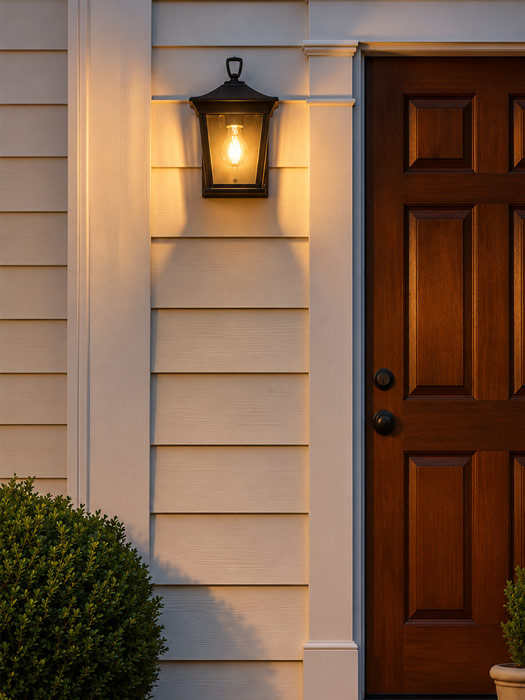
The lumen value describes the bulb’s total light output. Once you put the cover back on, the housing, bulb shape, and diffuser affect where that light lands. Two 800-lumen bulbs can make the same globe look equally bright while giving you different amounts of light on the stairs below it. Directional bulbs can also create a bright patch on the diffuser if the beam points toward one small area.
A practical way to compare bulbs is to pick one surface before you buy. For a porch, look at the lock, threshold, or first step. For a closet, look at the face of the shelves. Compare from the same spot, with the cover fitted and the other lights in the same state. With clear glass, check glare at eye level as you approach. With an opal dome, look for an even glow across the cover and enough light on the surface you picked.
If the cover looks bright and the step is still hard to see, try a compatible bulb with a different light distribution before moving up in lumens. For color, 2700 K gives a warm appearance and 3000 K looks a little cleaner while still reading as warm. Matching nearby fixtures can make more difference than a small change in color temperature, especially when you can see the lights together from the street.
What to check when an enclosed LED flickers or fails early
The timing of the symptom and the number of bulbs affected can help you decide where to look first.
| What you observe | What to check first |
|---|---|
| The light flickers as soon as you turn it on, especially at a low dimmer setting | Check the bulb and dimmer pairing, including the control’s minimum load. |
| The light starts normally and becomes unstable after running for a while | Check the bulb’s enclosed-use rating, operating limits, and the fixture’s lamp requirements. Heat is one possible cause. |
| Different compatible bulbs repeatedly fail in the same socket | Have the socket and fixture inspected. A problem that stays with one socket can point beyond the bulb. |
| Several lights on the same switch flicker together | Check for an issue with the shared control or circuit. Have persistent or unexplained flicker inspected. |
Note which bulb misbehaves, how long it has been on, and what the other bulbs are doing. A porch bulb that fails after hours of operation gives you a different lead from three lamps that flicker together as soon as a dimmer moves. If you see scorching, notice a burning smell, or hear unusual buzzing from the fixture or switch, turn off power to the fixture and have it inspected by a licensed electrician.
Electrical Safety Foundation International. (2023, June 21). Electrical safety dos.
When keeping the existing fixture makes sense
A sound fixture with a standard socket is worth keeping if you can find a rated bulb that fits and gives you the light you need. Consider replacing the fixture when compatible bulbs are hard to source, when the socket or housing needs repair, or when the fixture consistently lights the wrong surface. A shallow porch mount, for example, may look bright from the driveway while leaving the doorstep in shadow. Changing the fixture’s light distribution can solve a problem that another bulb swap leaves in place.
If you’re considering an integrated LED fixture, check how it will be serviced. Some models have a replaceable driver or light module. Others require replacing the complete fixture. For an exposed wall light or a fixture mounted high above a stairwell, how you’ll service it can matter as much as the purchase price.
FAQs
1. Can I use a smart LED bulb in an enclosed fixture?
Yes, if the exact smart bulb model permits the application. A smart light bulb’s wireless controls typically need power even when the light is off in the app. Once the bulb is installed, check that it responds with the cover in place and that its schedules work with the wall switch in its normal position.
2. Will a dusk-to-dawn LED bulb work behind frosted glass?
It depends on how much daylight reaches the bulb’s photocell. A dark or heavily frosted cover, a shaded alcove, or a sensor facing the back of the housing can keep the bulb on during daylight. Check the model’s instructions for sensor placement and compatible housings. Where the cover blocks too much daylight, an external photocell can read the light level outside the lantern.
3. Can I use an enclosed-rated LED bulb in a ceiling fan with a glass bowl?
Yes, when the fan’s light-kit manual allows that bulb type. Check the specified shape, wattage, and clearance under the bowl. If the fan’s remote receiver dims the light, check compatibility with that receiver. Some light kits specify a particular replacement lamp, so use the fan model number to find the correct instructions.
4. Why does my LED bulb glow when the switch is off?
An illuminated wall switch or some electronic dimmers can pass a small current in the off position. An LED bulb may respond with a faint glow. Check whether the control manufacturer identifies this behavior for your setup and lists compatible lamps. If the glow persists and the control does not explain it, have an electrician check the circuit.
5. Can I use an enclosed-fixture-rated LED bulb in an oven?
Use the oven manufacturer’s specified appliance bulb or replacement LED module for that model. The lamp behind an oven’s glass cover has to withstand the heat of the oven even when the light is switched off. Find the replacement by appliance model number so it meets the oven’s temperature and electrical requirements.
