

What Does IC Rated Mean?
IC Rated vs. Non-IC Rated Recessed Lighting
When Do You Need IC Rated Recessed Lights?
How to Tell Whether a Recessed Light Is IC Rated
Are LED and Canless Recessed Lights Automatically IC Rated?
Can You Cover IC Rated Recessed Lights With Insulation?
Is IC Rated the Same as Airtight?
How to Choose the Right IC Rated Recessed Lighting
FAQs
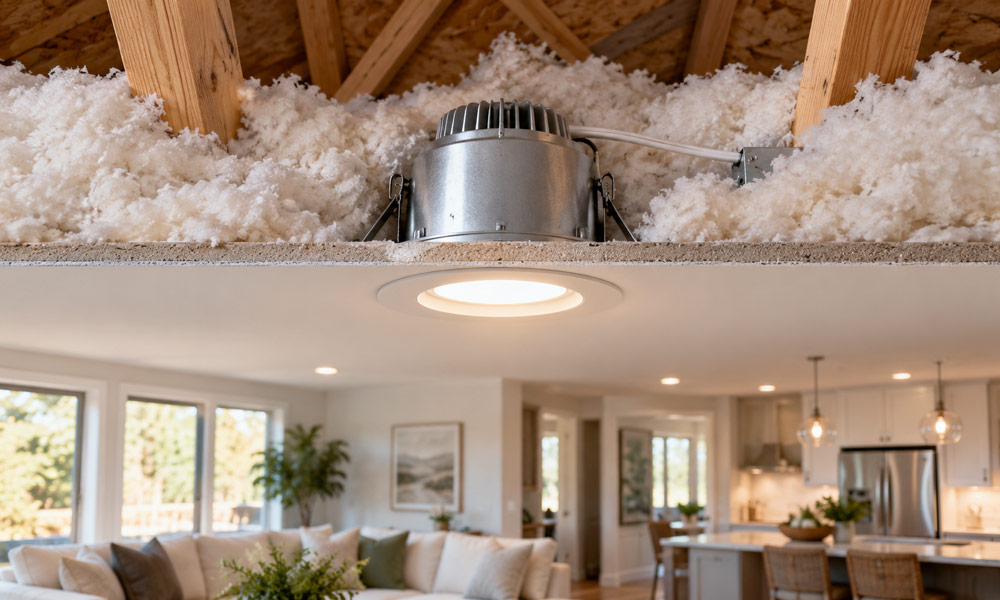
IC rated recessed lighting is lighting approved for direct contact with thermal insulation when installed according to its listing and manufacturer’s instructions. IC is commonly understood as “Insulation Contact.” The rating helps you determine whether insulation can safely touch the recessed fixture inside your ceiling.
This matters because the visible trim tells you little about what happens above it. A recessed light may sit beneath attic insulation, between insulated floors, or inside a roof cavity. Choosing the correct rating helps prevent an installation that traps more heat than the fixture was designed to handle.
What Does IC Rated Mean?
Recessed lights sit partly or entirely inside a ceiling opening. Depending on their design, these lights in the ceiling may also be called downlights, can lights, or pot lights.
An IC rating describes suitability for insulation contact. It does not describe the light’s brightness, appearance, or mounting depth.
For example, an IC-rated fixture can be appropriate beneath attic insulation, provided the insulation material and installation arrangement are permitted by its instructions. The same fixture may also be suitable for an uninsulated ceiling. Insulation is an allowed installation condition, rather than something the fixture needs to operate.
The important distinction is between a product approved for insulation contact and one that needs clearance from insulation.
IC Rated vs. Non-IC Rated Recessed Lighting
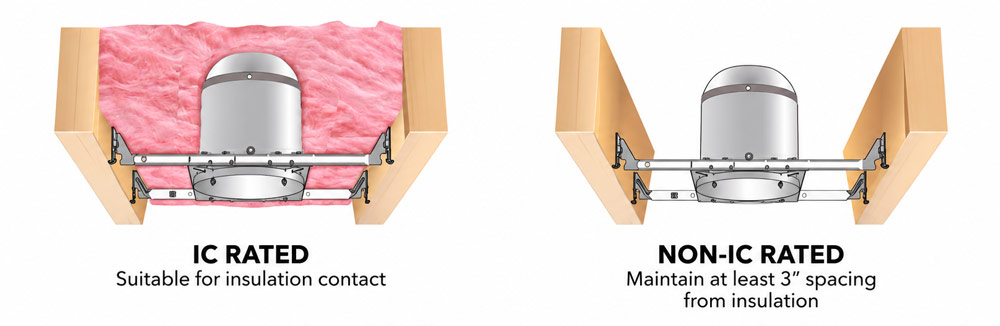
Two recessed fixtures can look identical from below while having different installation requirements.
| Feature | IC-rated recessed lighting | Non-IC-rated recessed lighting |
|---|---|---|
| Direct insulation contact | Permitted within the product’s listed conditions | Not permitted |
| Installation in an insulated ceiling | Suitable when the specified insulation and installation conditions are met | Requires prescribed separation from insulation |
| Insulation coverage | Follow the fixture’s instructions | Do not place insulation directly above or against the fixture |
| LED compatibility | Available in LED designs | Also available in LED-compatible designs |
| Airtight construction | Must be checked separately | Must be checked separately |
U.S. installation guidance commonly specifies keeping thermal insulation at least 3 inches (76 mm) from a non-IC fixture’s enclosure and associated components, and prohibits placing insulation above it unless the luminaire is identified for insulation contact. Follow the applicable local requirements and the specific fixture instructions.
Neither an LED light source nor airtight construction automatically makes a housing IC-rated. Non-IC housings can support LED lamps and still require insulation clearance.
When Do You Need IC Rated Recessed Lights?
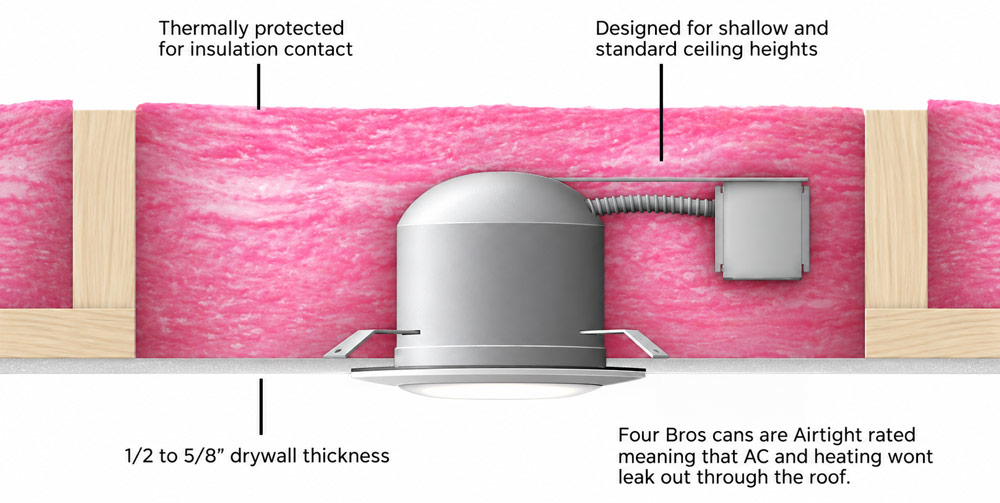
You need an appropriately rated fixture wherever the installation allows insulation to contact the recessed light.
Typical situations include:
- Top-floor ceilings beneath insulated attics.
- Ceiling cavities containing thermal or acoustic insulation.
- Renovations where additional insulation will surround existing lights.
- New construction where the lighting and insulation layouts overlap.
Before adding attic insulation, check existing recessed fixtures. An installation that previously maintained clearance can become unsuitable when loose-fill insulation is added or moves against the housing.
For an existing non-IC installation, replacing the fixture with an appropriate IC-rated model can simplify the insulation arrangement. A purpose-designed enclosure may be another option, but it must maintain the required clearances and heat dissipation. Adding an arbitrary cover does not change the fixture’s rating.
How to Tell Whether a Recessed Light Is IC Rated
Check the product identification and documentation before making decisions about insulation.
- Switch off power at the circuit breaker. Let the fixture cool before inspecting accessible parts.
- Locate the model number and rating label. On a traditional can, these may be inside the housing. On a canless fixture, check the light assembly and its associated driver documentation.
- Look for an explicit insulation-contact designation. Relevant wording can include “Type IC,” “IC rated,” or “suitable for insulation contact.”
- Match the model to its installation instructions. Confirm permitted insulation materials, components, and installation conditions.
Do not determine the rating from housing color, fixture age, or how cool the trim feels. If the label is missing or unreadable, obtain documentation for the exact model before allowing insulation to touch it.
For fixtures assembled from separate housings, trims, and light modules, check the approved combination rather than relying on one component’s packaging. Installation instructions can specify which components are compatible.
Are LED and Canless Recessed Lights Automatically IC Rated?
No. LED describes the light source; IC describes insulation-contact suitability.
Installing an LED bulb in an existing non-IC housing does not automatically change the housing’s classification. Even a housing designed to accept LED lamps may still require insulation clearance.
Canless lights require the same attention. Their thin profile eliminates the traditional large can, but there may still be a separate driver or junction box above the ceiling.
Some canless products explicitly approve both the light and remote driver box for insulation contact. Check that this approval applies to the model you are buying; do not assume it applies to every slim downlight.
Can You Cover IC Rated Recessed Lights With Insulation?
An appropriately listed IC fixture can generally have permitted insulation installed around and over it. However, the instructions must support the actual installation, including the insulation material and treatment of any remote components.
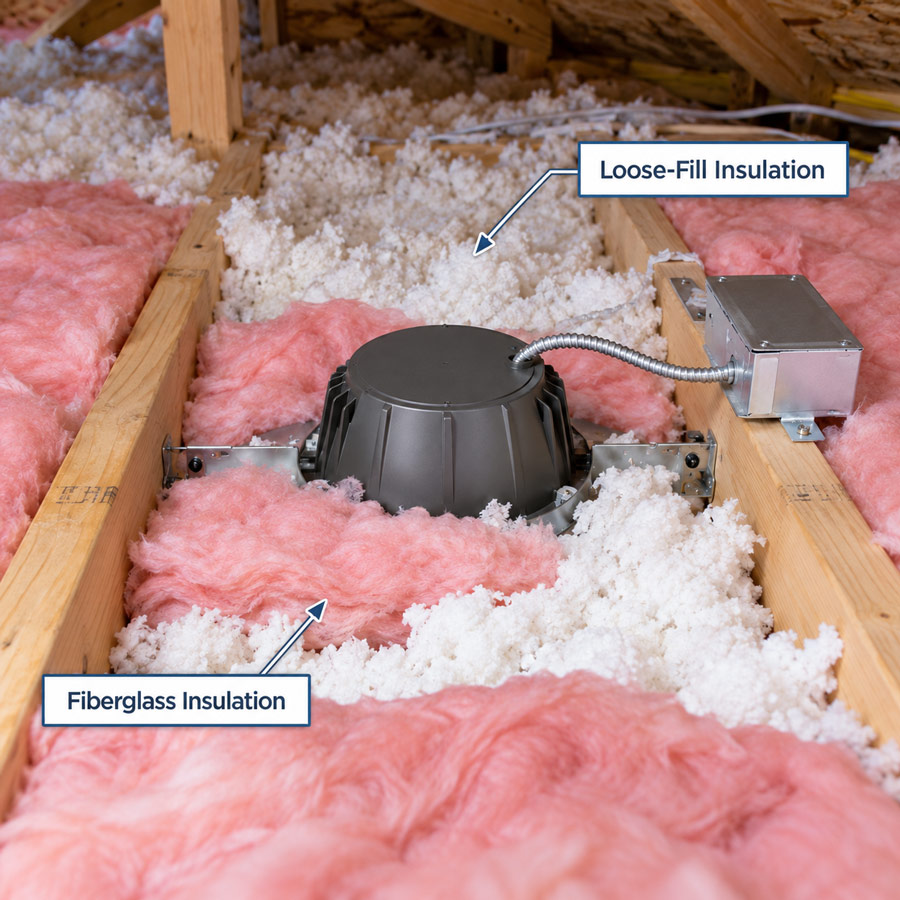
Fiberglass and Loose-Fill Insulation
Check that the fixture permits contact with the insulation being installed. Follow any coverage limitations, and avoid obstructing access needed to service the fixture or electrical connections.
If the assembly includes a separate driver, verify its requirements independently rather than assuming the light’s label covers every component.
Spray Foam Insulation
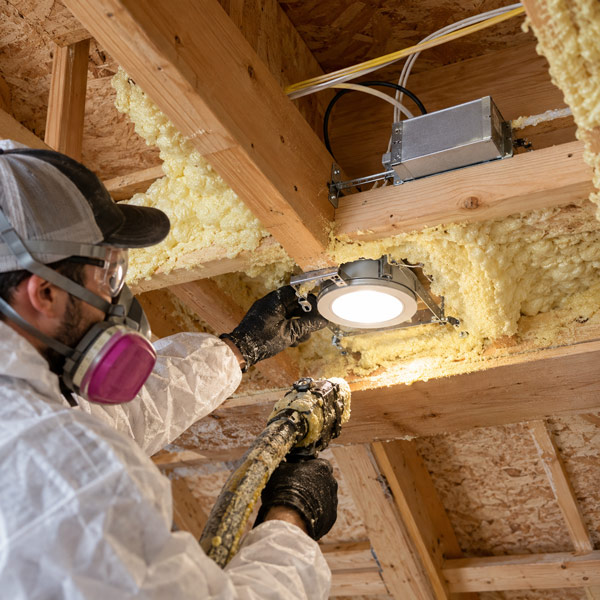
An IC rating alone is not blanket approval for direct spray foam contact.
Recessed luminaires can undergo additional evaluation for compatibility with expandable foam. Suitable products may carry a specific spray-foam compatibility marking, including “SPCL,” together with limits on the insulation they can contact.
Before foam is applied, confirm explicit compatibility for the exact fixture and foam system. If that approval is absent, use an installation arrangement accepted by the fixture manufacturer and applicable requirements.
Is IC Rated the Same as Airtight?
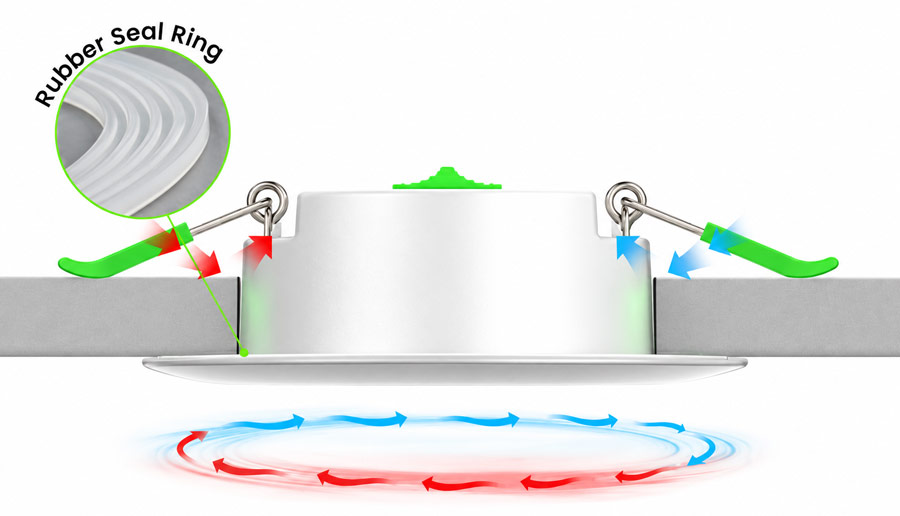
Cross-section of an airtight LED downlight showing the sealing ring that prevents air leakage through the ceiling penetration.
No. These specifications address different issues:
- IC rating: Whether the fixture can contact insulation.
- Airtight rating: Whether the fixture limits air leakage through the ceiling penetration.
A fixture marked ICAT or IC-AT indicates both characteristics.
For recessed lighting between a conditioned room and an unconditioned attic, both can matter. Insulation contact addresses the installation around the fixture, while airtight construction and correct sealing help limit air movement through the ceiling. Applicable energy requirements may call for both ratings and a sealed ceiling interface.
Do not treat insulation stuffed around a leaky fixture as a substitute for proper air sealing.
How to Choose the Right IC Rated Recessed Lighting
Start with the ceiling conditions, then compare lighting performance.
Confirm the Installation Fit
Check the ceiling cutout, available depth, ceiling thickness, and mounting method. A fixture intended for open framing may use a different installation system from one designed to fit through an existing ceiling opening.
Keep the driver and electrical connections accessible as required by the product instructions. A light that physically fits the opening is not necessarily suitable for the entire ceiling assembly.
Match the Rating to the Insulation
Confirm insulation-contact approval, any coverage restrictions, and separate spray-foam compatibility where needed. Review the complete assembly rather than just the visible light.
Compare Lumens and Actual Wattage
The IC rating does not tell you how much light a fixture produces. Compare light output in lumens when assessing brightness.
For replaceable-bulb fixtures, distinguish actual bulb wattage from the “equivalent wattage” printed on LED packaging. A brightness-equivalent label is not the bulb’s electrical input. Stay within the fixture’s permitted lamp type and wattage.
Read the Installation Instructions Before Buying
The most useful product documentation answers three questions: Can this fixture contact your insulation? Does the complete assembly fit your ceiling? Can it be installed and serviced as specified?
Confirming those details before purchase makes it easier to select a light that suits both the room and the space above it.
FAQs
1. Is IC Rated Recessed Lighting Also Fire Rated?
No. Insulation-contact approval does not establish the fire resistance of a ceiling assembly.
Where a ceiling must maintain a specified fire-resistance rating, the recessed fixture or protective enclosure must be suitable for that tested assembly. Cutting an opening and fitting an ordinary IC-rated light can affect the ceiling’s fire performance.
2. Can IC Rated Recessed Lights Be Used in a Shower?
Only when the complete fixture also has the location rating required for that installation. IC approval does not establish resistance to water exposure.
A light exposed to shower spray needs appropriate wet-location approval. The distinction between damp-location and shower suitability matters independently of insulation contact. Check the specified housing, trim, and mounting arrangement; products can carry both IC and wet-location ratings.
3. Are IC Rated LED Recessed Lights Dimmable?
Some are, but IC approval does not guarantee dimming capability. Check whether the LED driver is dimmable, which control method it supports, and which dimmers are compatible.
Also check the minimum dimming level. A fixture described as dimmable may have a specified lower limit rather than dimming smoothly all the way to zero.
4. Why Does an IC Rated Recessed Light Turn Off and Then Come Back On?
One possible cause is a thermal protector switching the light off when it overheats and allowing it to restart after cooling.
Repeated cycling needs investigation. Have the lamp or module compatibility, installation conditions, and electrical components checked. Do not bypass thermal protection or assume repeated shutdowns are normal simply because the fixture is IC-rated.
5. Can an Insulation Cover Convert a Non-IC Light Into an IC Rated Light?
No. A suitable enclosure can maintain separation between insulation and a non-IC fixture, but it does not reclassify the fixture.
The enclosure must meet the requirements for clearance, materials, and heat dissipation. A generic cap or improvised insulated box is not automatically suitable. Where practical, replacing the complete fixture with a correctly specified IC-rated assembly avoids relying on an enclosure to maintain that separation.