

The Meaning of A19
The Meaning of E26
Why People Confuse A19 and E26
A19 and E26 Compared
Can an E26 Bulb Have a Different Shape?
Can an E26 Bulb Have a Different Shape?
Why the Difference Matters in Real Life
A Simple Way to Remember It
Common Buying Scenarios
FAQs
At first glance, A19 and E26 often seem to refer to the same thing. They appear together on product packaging, online listings, and lamp specifications so frequently that many consumers assume they are interchangeable terms. In everyday shopping, that misunderstanding is understandable. If someone buys a standard household light bulb in North America, the box may say “A19 LED, E26 base,” and the bulb will likely fit an ordinary table lamp or ceiling fixture. Because the two labels appear side by side so often, it is easy to think they describe the same feature.
However, A19 and E26 are not the same. They refer to two completely different parts of a light bulb’s design. A19 describes the shape and size of the bulb, while E26 describes the type of screw base that connects the bulb to the socket. Understanding this distinction is important for choosing the right bulb, avoiding installation mistakes, and making smarter decisions when replacing incandescent, CFL, or LED lamps.
In practical terms, you can think of a bulb as having two major physical identities. One is the body of the bulb: its profile, width, and general appearance. The other is the base: the part that twists into the fixture and makes electrical contact. A19 belongs to the first category. E26 belongs to the second. A bulb can be A19 in shape and E26 in base type at the same time, but those terms are not synonyms.
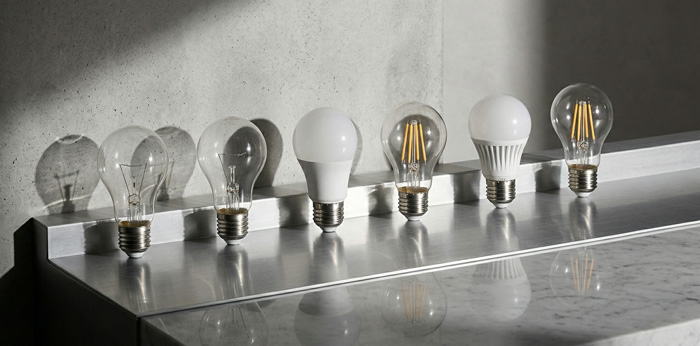
The designation A19 is part of a bulb shape classification system. The letter “A” stands for arbitrary, which historically refers to the classic pear-shaped form associated with traditional household bulbs. This is the bulb silhouette that most people picture when they imagine a standard light bulb: rounded at the top, slightly tapered in the middle, and narrowing toward the base.
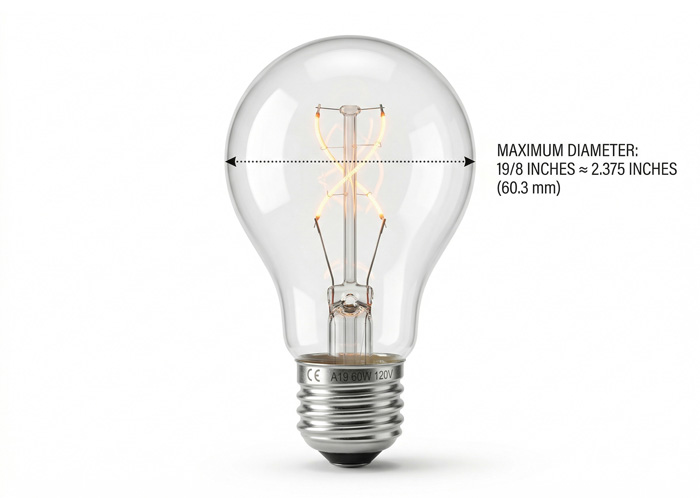
The number 19 refers to the bulb’s maximum diameter in eighths of an inch. That means an A19 bulb is approximately 19/8 inches, or 2.375 inches, in diameter at its widest point. This measurement helps distinguish A19 from other shapes and sizes such as A15, A21, G25, BR30, PAR38, and many others.
A19 is one of the most common bulb shapes used in homes. It is frequently found in:
- Table lamps
- Floor lamps
- Ceiling fixtures
- Pendant lights
- Wall sconces
- Bedroom lamps
- Desk lamps
Because the A19 shape is so common, many LED replacement bulbs are manufactured in this format to mimic the look and dimensions of older incandescent bulbs. Consumers often choose A19 bulbs when they want a familiar appearance, broad light distribution, and compatibility with standard household fixtures.
Still, the A19 designation tells you nothing definitive about the base unless the base is also specified. An A19 bulb may often come with an E26 base in North America, but the shape itself does not guarantee the socket type.
The designation E26 refers to the bulb’s base type, not its shape. The letter “E” stands for Edison, named after Thomas Edison and the screw-style lamp base that became a standard in electric lighting. The number 26 indicates the diameter of the screw base in millimeters. So an E26 bulb has a screw base approximately 26 mm wide.
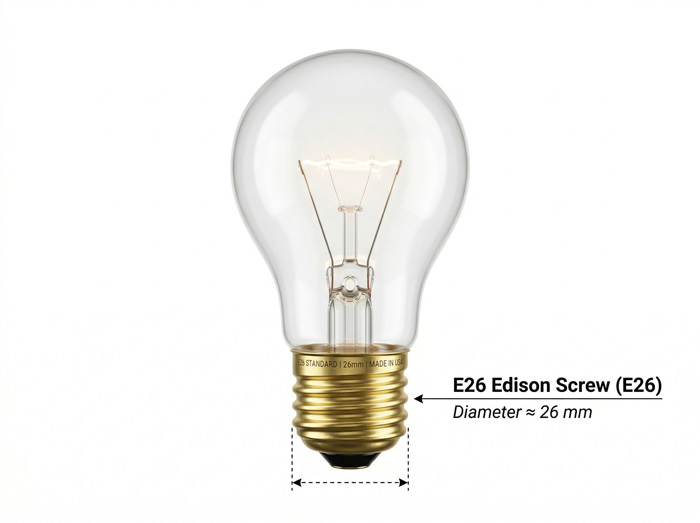
This is the standard medium screw base used in many residential light fixtures in North America. When people say a bulb has a “standard base,” they are often referring to E26. It is commonly used in:
- Household lamps
- Open ceiling fixtures
- Bathroom vanity lights
- Porch lights
- Utility fixtures
- Some decorative lamps
The E26 base determines whether the bulb can physically fit and electrically connect to the socket. If the base is wrong, the bulb will not screw in properly, even if the bulb shape seems suitable. For example, a bulb may have the correct diameter and appearance for a fixture, but if it uses a candelabra base or a pin base instead of E26, it will not work in an E26 socket.
This is why focusing on base compatibility is critical. Many consumers choose a bulb based only on wattage, brightness, or shape, but the base type is often the first thing that determines whether the bulb is even usable.
Why People Confuse A19 and E26
The confusion exists because many everyday household bulbs are both A19 and E26. A typical LED bulb sold as a replacement for a 60-watt incandescent often uses the classic A19 shape and the standard E26 base. As a result, people repeatedly see the two labels together and begin to treat them as equivalent.
But saying “A19 is the same as E26” is like saying a shoe’s size is the same as its sole type. The two features describe different characteristics. They can coexist in one product, but they are not interchangeable concepts.
A bulb listing might read:
- A19 shape
- E26 base
- 800 lumens
- 2700K warm white
- 8.5W LED
Each item describes a different property. Shape, base, brightness, color temperature, and power consumption are all separate specifications. Understanding them individually helps consumers make better purchasing decisions.
The following table shows the difference clearly:
| Feature | A19 | E26 |
|---|---|---|
| What it describes | Bulb shape and size | Bulb base type |
| Meaning of the letter | “A” = arbitrary/common household bulb shape | “E” = Edison screw base |
| Meaning of the number | 19 eighths of an inch in diameter | 26 millimeters in base diameter |
| Refers to | The bulb body | The screw-in connector |
| Determines | Appearance and physical profile | Socket compatibility |
| Common use | Standard household bulb form | Standard North American medium socket |
| Can exist independently of the other? | Yes | Yes |
| Often found together? | Yes | Yes |
| Same thing? | No | No |
This distinction becomes especially important when comparing bulbs across regions, fixture types, and decorative lighting applications.
Can an A19 Bulb Have a Different Base?
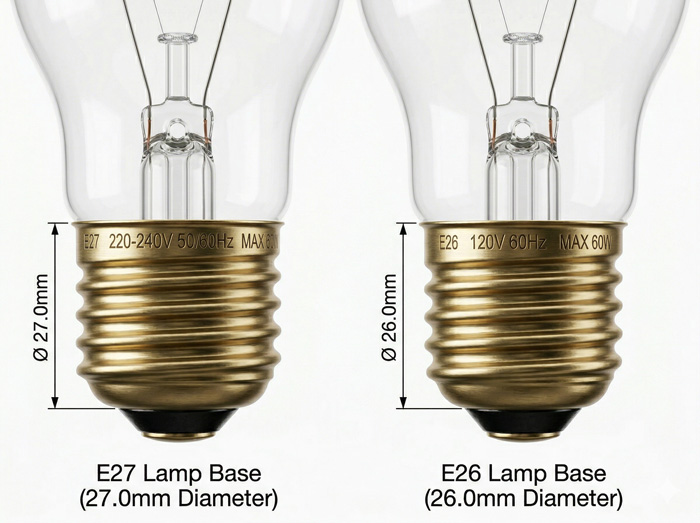
Yes. Although many A19 bulbs use an E26 base, an A19 bulb can be manufactured with a different base depending on the market, voltage standards, or fixture requirements. In some regions, similar bulbs may use E27 bases instead. In specialty applications, the overall bulb profile may resemble A19 while the base differs.
This is why buying a bulb based only on shape can lead to errors. A consumer may think, “I need an A19 bulb,” but if the fixture requires an E12 candelabra base or a GU24 twist-lock base, the bulb will not fit even if the glass or plastic envelope looks similar.
Can an E26 Bulb Have a Different Shape?
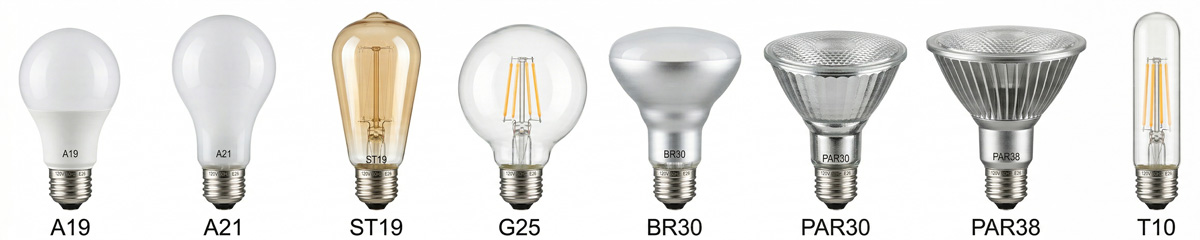
Absolutely. E26 only tells you the base size. A bulb with an E26 base can come in many shapes, including:
- A19
- A21
- ST19
- G25
- BR30
- PAR30
- PAR38
- T10
That means two bulbs can both fit the same socket because they share an E26 base, yet look completely different and produce very different lighting effects. One may be a globe bulb
for a vanity mirror, another may be a floodlight for recessed lighting, and another may be a vintage Edison-style decorative bulb. Same base, different shape.
Why the Difference Matters in Real Life
The difference between A19 and E26 matters for three main reasons: fit, performance, and appearance.
First, there is fit. The base determines whether the bulb screws into the socket. The shape determines whether the bulb physically fits inside the fixture or shade. A bulb might screw in correctly but still be too wide or too long for an enclosed fixture.
Second, there is performance. Shape influences beam spread, heat dissipation, and the direction of light. A19 bulbs are generally good for broad, general illumination, while reflector bulbs like BR or PAR shapes are better for directional lighting.
Third, there is appearance. In open fixtures, visible bulbs contribute to interior design. A19 bulbs look conventional and practical. Globe bulbs look more decorative. Vintage tubular or Edison-style bulbs create a different aesthetic. So even when the base is compatible, shape still affects the final result.
A useful memory trick is this:
- A19 = appearance
- E26 = entry point
That is not the official technical meaning, but it helps distinguish the roles. A19 tells you what the bulb looks like. E26 tells you how it enters and connects to the fixture.
When replacing a bulb, many people should check the following in order:
| What to Check | Why It Matters | Example |
|---|---|---|
| Base type | Must match socket | E26 socket requires E26 base |
| Bulb shape | Must fit fixture and desired style | A19 works in many standard lamps |
| Brightness | Determines how much light you get | 800 lumens for a 60W replacement |
| Color temperature | Affects ambiance | 2700K warm, 5000K daylight |
| Dimmability | Must match switch/dimmer setup | Choose dimmable LED if needed |
| Fixture limitations | Some fixtures need enclosed-rated bulbs | Check packaging and fixture label |
This sequence prevents the most common mistakes. Consumers often focus first on wattage or color temperature, but without the correct base and appropriate shape, the bulb may be unusable.
Is E26 compatible with E27 bulbs?
In many cases, E26 and E27 bulbs are mechanically compatible, because their screw bases are very close in size. However, they are not technically identical standards. E26 is more common in North America, while E27 is widely used in Europe and other international markets. Before mixing them, users should also check the fixture’s voltage rating, wattage limits, and local electrical standards. Physical fit does not always guarantee ideal long-term performance or full compliance with safety specifications.
Can an A19 E26 bulb be used in an enclosed fixture?
Not always. Even if a bulb has the correct A19 shape and E26 base, it may still be unsuitable for a fully enclosed fixture unless the manufacturer specifically labels it as enclosed-fixture rated. This is especially important for LED bulbs, because heat buildup inside enclosed fixtures can shorten lifespan, reduce efficiency, or cause premature failure. Consumers should always read the packaging or product datasheet before installation.
What is the best lumen range for replacing traditional incandescent bulbs with an A19 E26 LED?
The best lumen output depends on the incandescent bulb being replaced. As a general guide, 450 lumens replaces a 40-watt incandescent, 800 lumens replaces a 60-watt bulb, 1100 lumens replaces a 75-watt bulb, and 1600 lumens replaces a 100-watt bulb. This matters because modern bulbs, especially LEDs, should be selected by lumens rather than watts. Wattage tells you energy consumption, while lumens tell you how bright the light actually is.
Do all A19 E26 LED bulbs work with dimmer switches?
No. Not all A19 E26 LED bulbs are dimmable, and even dimmable models may not perform well with every dimmer switch. Incompatible combinations can cause flickering, buzzing, reduced dimming range, or sudden shutoff. For best results, users should choose a bulb clearly marked dimmable and pair it with an LED-compatible dimmer. Checking the bulb manufacturer’s dimmer compatibility list is the most reliable approach.
What color temperature is best for A19 E26 bulbs in different rooms?
The ideal color temperature depends on the function of the space. 2700K to 3000K is usually best for bedrooms, living rooms, and hospitality-style spaces because it creates a warm and comfortable atmosphere. 3500K to 4100K works well in kitchens, bathrooms, and work areas where a cleaner neutral light is preferred. 5000K or higher is often used in garages, task lighting, and utility areas where a daylight-like appearance improves visibility. Choosing the right color temperature can significantly improve both comfort and functionality.
