
Table of Contents
- What Does 2,000 Lumens Look Like?
- How Many Watts Is 2,000 Lumens in LED Lighting?
- How Much Area Will 2,000 Lumens Cover?
- Why Can Two 2,000-Lumen Lights Look So Different?
- Is 2,000 Lumens Enough for a Room?
- Is 2,000 Lumens Bright Enough for Outdoor Lighting?
- How Far Can a 2,000-Lumen Flashlight Shine?
- How to Tell If 2,000 Lumens Is Right for Your Space
- FAQs
A 2,000-lumen light produces about 2.5 times the light output of a traditional 60-watt incandescent bulb and 25% more than a typical 100-watt incandescent bulb. That is a substantial amount of light from one household fixture. Spread across a small room, it can provide general illumination. Aimed through a narrow lens, the same output can create an intense pool of light on a tree, wall, or workbench.
Federal Energy Management Program. (2023, June). Purchasing energy-efficient light bulbs. U.S. Department of Energy.
Whether 2,000 lumens is enough comes down to where the light lands. A covered patio, a kitchen counter, and the end of a driveway can each call for a different beam, even when the fixtures carry the same lumen rating.
What Does 2,000 Lumens Look Like?
A light bulb’s lumen rating describes its total visible light output. Familiar bulb ratings give you a starting point when the number on a package is hard to picture.
| Light output | Familiar reference |
|---|---|
| 450 lumens | Approximately a traditional 40W incandescent bulb |
| 800 lumens | Approximately a traditional 60W incandescent bulb |
| 1,100 lumens | Approximately a traditional 75W incandescent bulb |
| 1,600 lumens | Approximately a traditional 100W incandescent bulb |
| 2,000 lumens | The combined output of two 1,000-lumen lights |
| 3,000 lumens | 50% more total light output than 2,000 lumens |
When comparing products, check what the rating measures. A 2,000-lumen replacement bulb is rated on its own. Once it sits inside a shaded pendant or enclosed ceiling light, the fixture can absorb and redirect some of that output. A 2,000-lumen integrated fixture rated in luminaire lumens delivers that amount from the assembled unit, with its optics and diffuser in place. This distinction matters when you are comparing two fixtures for the same space.
Placement also changes what you see. Two 1,000-lumen ceiling lights positioned apart can reach opposite ends of a long room. A single 2,000-lumen pendant can put more of the available light on a table. The two arrangements start with the same rated output and serve different purposes.
How Many Watts Is 2,000 Lumens in LED Lighting?
Watts measure electrical power. To estimate the power a 2,000-lumen LED uses, divide its output by its luminous efficacy, expressed in lumens per watt (lm/W). Use the efficacy of the complete bulb or fixture when comparing finished products.
| LED efficacy | Power needed to produce 2,000 lumens |
|---|---|
| 80 lm/W | 25 W |
| 100 lm/W | 20 W |
| 125 lm/W | 16 W |
These are calculations at three example efficacies. If a specification sheet lists 2,000 lumens and 20 watts, the fixture delivers 100 lumens per watt. When two options deliver comparable light where you need it, their actual wattages tell you which uses less power.
How Much Area Will 2,000 Lumens Cover?
Start with the surface you want to illuminate. That could be the floor for general room lighting, the countertop for food preparation, or the pavers along a walkway. Lux measures the light arriving on that surface. One lux equals one lumen per square meter. One foot-candle equals one lumen per square foot, or approximately 10.76 lux.
Average illuminance in lux = lumens reaching the surface ÷ surface area in square meters
The table assumes all 2,000 lumens land evenly on the stated area. It shows how quickly average illuminance changes as you spread the same output over more space.
| Area receiving the light | Illustrative average in foot-candles | Illustrative average in lux |
|---|---|---|
| 50 sq. ft. / 4.65 m² | 40.0 fc | 431 lx |
| 100 sq. ft. / 9.29 m² | 20.0 fc | 215 lx |
| 150 sq. ft. / 13.94 m² | 13.3 fc | 144 lx |
| 200 sq. ft. / 18.58 m² | 10.0 fc | 108 lx |
| 300 sq. ft. / 27.87 m² | 6.7 fc | 72 lx |
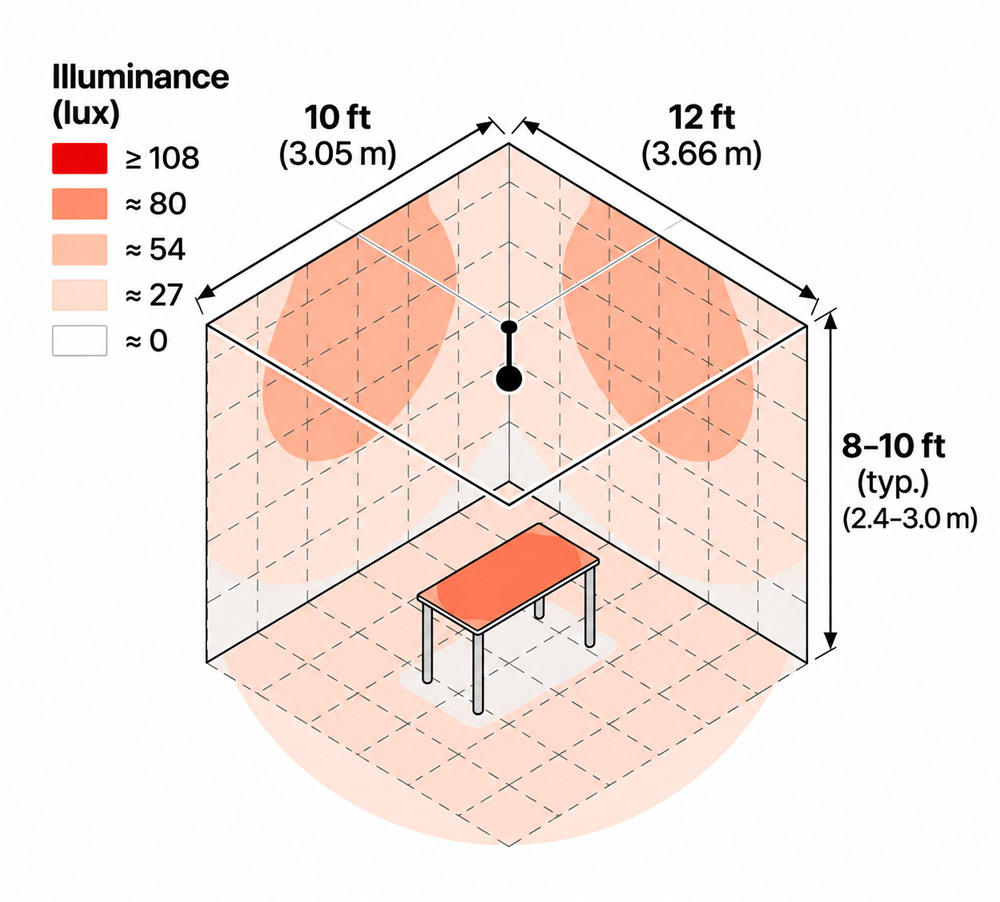
Consider a 10-by-12-foot room. If 1,200 of the fixture’s 2,000 lumens reach the plane you care about, the average across 120 square feet is 10 foot-candles, or about 108 lux. The 1,200-lumen figure is an assumption for the example. In an actual room, the amount reaching that plane depends on the fixture’s distribution, mounting position, and surrounding surfaces.
An average can also hide uneven lighting. A room might have a bright patch under the ceiling fixture and dim corners. If the critical area is a desk or stair tread, check the light on that surface and at its edges. Those readings tell you more about the task than an average across the whole floor.
Why Can Two 2,000-Lumen Lights Look So Different?
The beam angle of a spotlight is measured between the directions where intensity falls to half its peak. It describes the width of the main beam, with some light typically extending beyond that boundary.
Imagine two fixtures aimed straight down at a level surface from 3 meters, or about 10 feet, above it.
| Beam angle | Approximate beam width on the surface | Typical effect |
|---|---|---|
| 30° | 1.6 m / 5.3 ft | A concentrated pool suited to a specific feature or task |
| 90° | 6.0 m / 19.7 ft | A wider wash suited to illuminating more of the area |
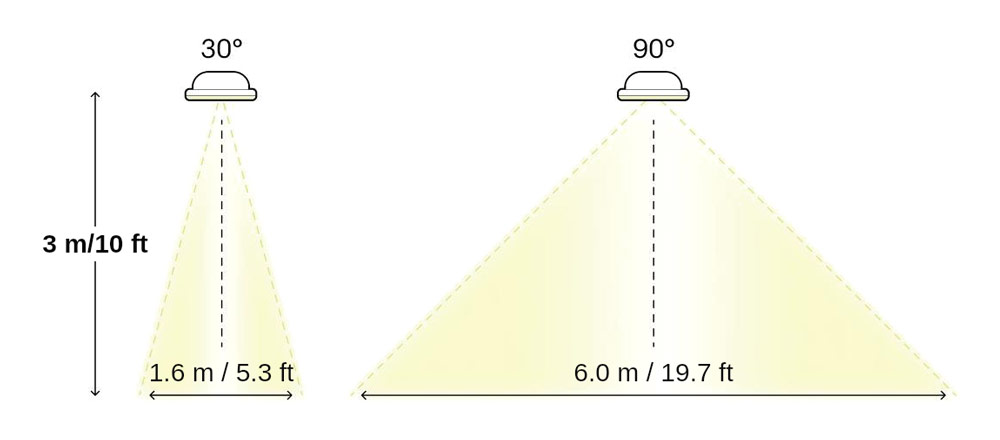
These widths are geometric estimates at the stated beam angle. The fixture’s intensity distribution determines how bright the center and edges actually appear. Tilting the fixture stretches the footprint across the ground, and raising it spreads the beam over a larger area.
The view from where you sit or stand matters too. A small, exposed LED can create glare when you can see it directly. A diffuser or shield can make the light more comfortable from that position. Indoors, pale walls and ceilings also reflect more light back into the room, so the same fixture can make a light-colored room feel brighter than one with dark finishes.
Is 2,000 Lumens Enough for a Room?
It can provide useful general lighting in a modest room with a well-distributed fixture. For close work, check the light on the surface where the work happens. A kitchen can feel bright when you walk in and still have a shadow across the cutting board.
| Space | Where 2,000 lumens can work | What to check |
|---|---|---|
| Bedroom | A diffused ceiling fixture can provide general light for getting dressed and moving around. | Add light beside the bed for reading. A dimmable fixture gives you more control in the evening. |
| Living room | A broad ceiling light can serve a compact seating area. | In a long room, check the far end and the seats people use for reading. Separate light sources can improve coverage. |
| Kitchen | A ceiling fixture can provide background light in a compact kitchen. | Check the counter while standing in your usual working position. Under-cabinet lighting can fill the shadow cast by your body or the cabinets. |
| Bathroom | A ceiling fixture can illuminate the floor and the room generally. | Check how light falls on your face at the mirror. Light at the sides of the mirror can soften shadows from an overhead fixture. |
| Garage or workshop | A 2,000-lumen fixture can be useful above a bench or in one section of a garage. | Check the bench edges and the areas beside a parked vehicle, where a single overhead light can leave shadows. |
For a multipurpose space, it helps to separate general lighting from task lighting. Keep the room comfortably lit and concentrate additional light on the desk, counter, or bench. That gives you more control over shadows and glare than raising the output of the main fixture alone.
Is 2,000 Lumens Bright Enough for Outdoor Lighting?
A 2,000-lumen outdoor floodlight can work well at a garage entrance, gate, or compact section of driveway. In a garden, the same output can feel excessive at close range or provide a useful wash across a tall surface. Match the beam to the part of the property you actually use after dark.
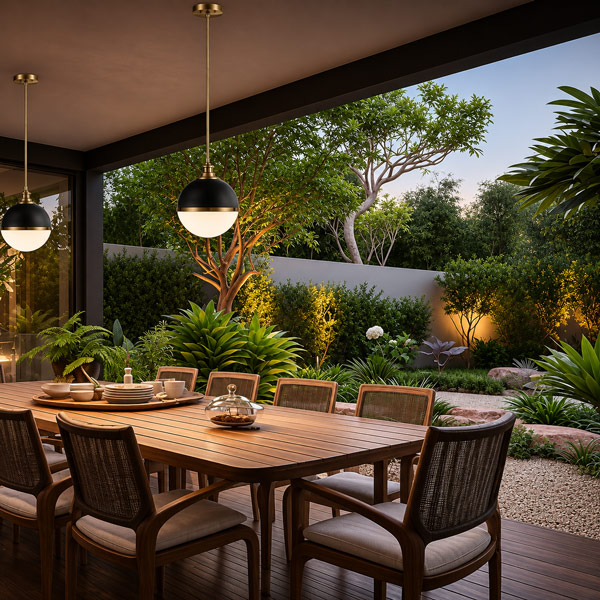
Patios and decks
The right lumen level for a patio depends on whether you are lighting a dining table, an outdoor cooking area, or the route to the steps. A wide, diffused 2,000-lumen fixture can serve an active area on a covered patio. Over a small table, that output may feel harsh if the fixture is close to diners or its light source is exposed. A dimmable fixture lets the same area accommodate food preparation and a quieter evening meal.
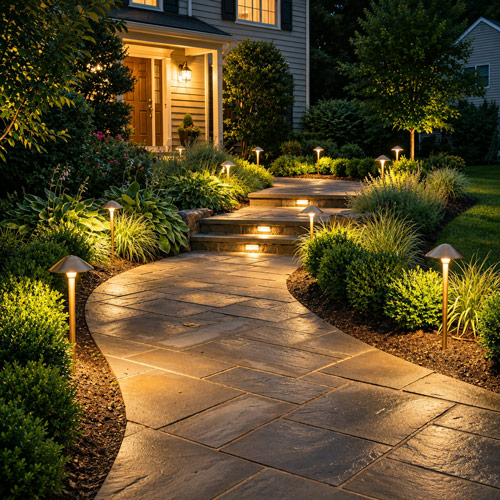
Garden paths and steps
On a walkway, the practical goal is to see the next few steps and any changes in level. Shielded fixtures positioned along the route can create a more even progression of light than a bright beam from one end. Set the pathway light spacing with the fixture height and beam spread in mind. Pay particular attention to turns, steps, and the transition from a brightly lit doorway to a darker path.
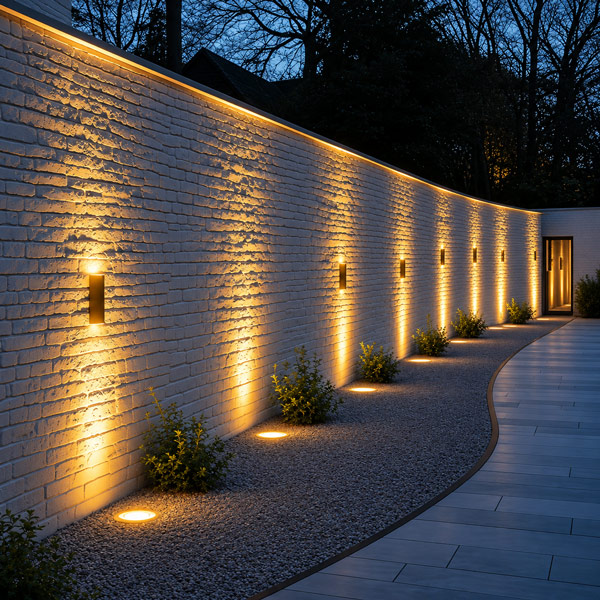
Trees, walls, and garden features
A 2,000-lumen spotlight can bring out the trunk and canopy of a mature tree or illuminate a section of a tall wall. The same fixture placed close to a low planting bed can create a bright patch that draws attention away from the rest of the garden. For a broad canopy, look for a wider optic. For a narrow vertical feature, choose a beam that stays close to the width of the target and check where any spill lands.
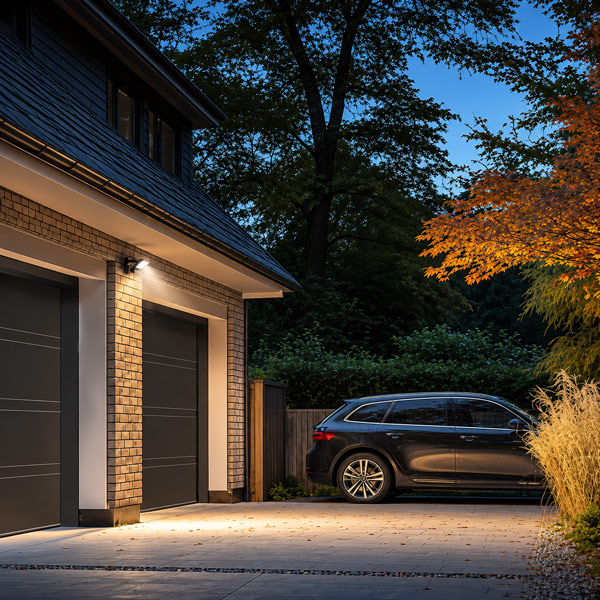
Driveways and entrances
At a driveway, aim the floodlight toward the portion where people walk, park, or unlock a gate. Check the view from the street and from nearby windows after dark. If the beam puts light beyond the property or directly into a driver’s line of sight, adjust the aim or use shielding. Motion controls can provide higher output when someone arrives and keep the area quieter between uses.
How Far Can a 2,000-Lumen Flashlight Shine?
A 2,000-lumen flashlight can produce a broad beam for nearby visibility or a concentrated beam for distance. Compare peak beam intensity, measured in candela, when reach is your priority. The standardized beam-distance figure uses the distance at which illumination at the center of the beam drops to 0.25 lux.
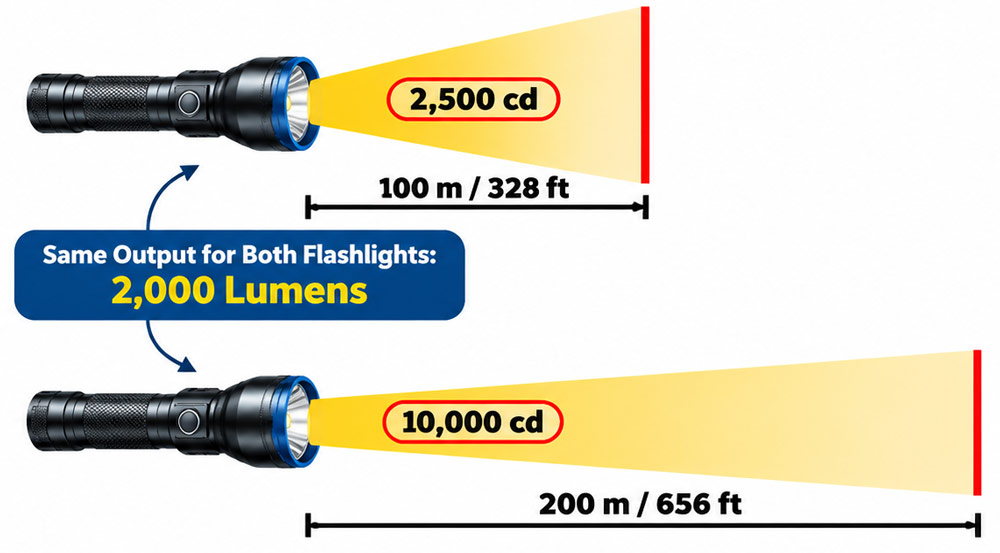
| Example flashlight | Peak beam intensity | Calculated beam distance |
|---|---|---|
| 2,000 lumens with a wider beam | 2,500 cd | 100 m / 328 ft |
| 2,000 lumens with a more concentrated beam | 10,000 cd | 200 m / 656 ft |
That distance describes a low light level at the center of the beam. Recognizing a person, sign, or object at that distance also depends on its size, reflectivity, and the viewing conditions. For regular use, check the output curve as well. A flashlight may offer 2,000 lumens in a short boost mode and settle to a lower level as it manages heat. The sustained setting gives you a better basis for comparing lights for a long walk or an extended task.
How to Tell If 2,000 Lumens Is Right for Your Space
Start with the place where you need the light most. For a countertop, evaluate the work surface. For a driveway, look at the parking area and the route to the door. For a patio, stand where people will sit or walk and check whether the fixture shines into their eyes.
If the center is bright while the edges are dim, look at beam width and fixture placement first. If the light is even and the work surface still feels dim, a dedicated task light or a higher delivered output can help. This gives you a concrete way to decide whether to keep the 2,000-lumen fixture, reposition it, or use more than one source.
FAQs
1. Is 2,000 ANSI lumens enough for an outdoor projector?
It can be enough for a backyard movie after dark on a moderately sized screen. Image brightness falls as you enlarge the picture, and light from a porch or streetlamp can wash out dark scenes. Compare projector ratings measured using the same method, such as ANSI or ISO, and check the output in the picture mode you plan to use. If the image looks washed out, try reducing the screen size or blocking light that falls directly on it.
2. Can I put a 2,000-lumen LED bulb in a fixture marked “60 W max”?
Yes, if its actual input wattage is within the fixture’s limit and the bulb meets the fixture’s requirements for lamp type, base, voltage, and size. A 20-watt LED is below a 60-watt limit even if the package advertises a higher incandescent equivalent. For a fully enclosed fixture, choose a bulb rated for enclosed use. If the fixture is on a dimmer, check the lamp and dimmer for compatibility.
3. Can a 2,000-lumen solar floodlight stay at full brightness all night?
It depends on the battery’s usable capacity, the fixture’s power draw, and how much energy the panel collects during the day. A light that draws 20 watts from its battery needs 160 watt-hours to run at that setting for eight hours. Some models reserve full output for motion events and stay at a lower level the rest of the night. If the light has to charge in shade, check how its runtime changes with reduced sunlight.
4. Is IP65 enough for a 2,000-lumen outdoor floodlight?
An IP65 rating for garden lights indicates a dust-tight enclosure that withstands water-jet testing under IEC 60529. For an exposed location, also check that the manufacturer permits that mounting position and follow its instructions for protecting the electrical connections. A fixture that will sit underwater needs an immersion rating suited to that use.
5. Do 2,000-lumen LED fixtures get dimmer as they age?
Yes. LEDs can gradually lose output through lumen depreciation. An L70 figure describes the operating time at which output is expected to reach 70% of its initial level. For a light that starts at 2,000 lumens, that corresponds to about 1,400 lumens. When comparing lifetime specifications, check whether the figure applies to the complete fixture or the LED components. Driver reliability can also affect how long the fixture stays in service.
