
Start With a Walk Around Your Yard After Dark
Plan Lighting Around Each Outdoor Area
Compare Solar and Wired Low-Voltage Lighting
Choose Light Color and Controls Together
What Affects Landscape Lighting Costs in Beckett Ridge?
Check the Property Before Installation
Decide Between DIY and Professional Installation
Maintain the Lighting as Your Yard Changes
FAQs
A front walk that disappears after sunset, a patio that feels too dark for dinner, or a porch light that shines straight into your eyes: these are useful starting points for a landscape lighting project. Before choosing fixtures, identify what you want to see and where you want to spend time outdoors.
For Beckett Ridge homeowners, a practical lighting plan should address everyday access, comfortable outdoor living, and the appearance of the property from the street. It should also account for nearby windows, changing planting beds, and the work involved in maintaining the system.
This guide explains how to plan the main lighting areas, compare power options, evaluate costs, and prepare for installation. The goal is a yard that feels welcoming after dark and works well for the people who use it.
Start With a Walk Around Your Yard After Dark
Walk from your driveway to the front door, then follow the route to your backyard. Use your existing lights first. Notice where you lose sight of the ground, where a light feels uncomfortable, and which spaces you avoid after sunset.
Repeat the exercise from inside the house. A fixture that looks attractive from the sidewalk may shine into a bedroom or create a distracting reflection in a living room window.
Organize your observations into three priorities:
- Access: entrances, paths, steps, gates, and changes in ground level.
- Outdoor living: seating, dining, grilling, and the routes between these spaces.
- Appearance: selected trees, planting beds, and architectural details.
Start your budget with the areas you use most. If the front walk is difficult to see, address it before adding decorative lighting at the far end of the garden. A simple sketch showing these priorities will make conversations with suppliers and installers more productive.
Plan Lighting Around Each Outdoor Area
Different parts of a yard need different lighting effects. Choosing a fixture because it looks attractive in a catalog is easier once you know what job it needs to do.
| Area | Main goal | Planning question |
|---|---|---|
| Front walk and entrance | Make the route easy to follow | Can visitors see turns and the approach to the door? |
| Steps and level changes | Make tread edges visible | Does the light reach the walking surface without facing the user? |
| Trees and planting beds | Establish a few visual focal points | Which features are worth highlighting from your usual viewpoint? |
| House exterior | Reveal selected architectural details | Will light spill into windows or beyond the intended surface? |
| Patio and deck | Support comfortable evening use | Does the lighting feel comfortable when you sit down? |
Pathways and Steps
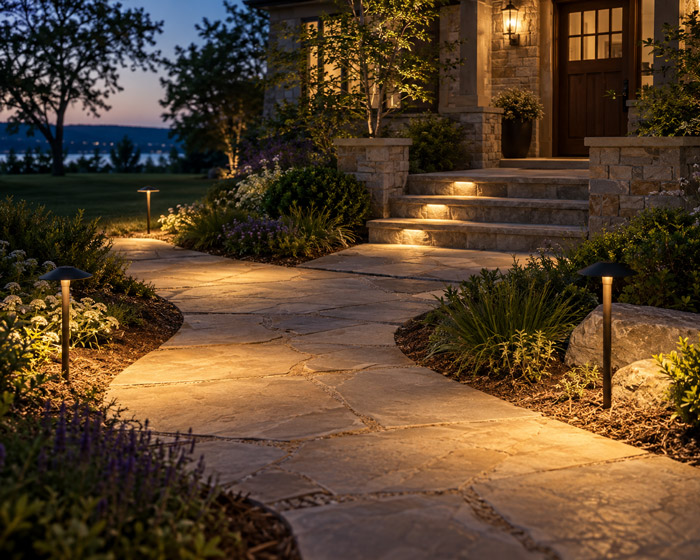
Plan path lights around the route itself, including bends, intersections, and entrances. Check the illuminated ground between fixtures instead of judging the layout only by the distance between stakes.
There is no single spacing measurement that works for every fixture. Mounting height, beam spread, planting, and the width of the walkway all matter. When deciding how far apart pathway lights should be, test a small section after dark before committing to the full layout.
Give steps their own attention. A bright light above a staircase can still leave parts of the treads in shadow. Evaluate the stairs from both directions and keep exposed light sources out of the normal line of sight.
Trees and Garden Beds
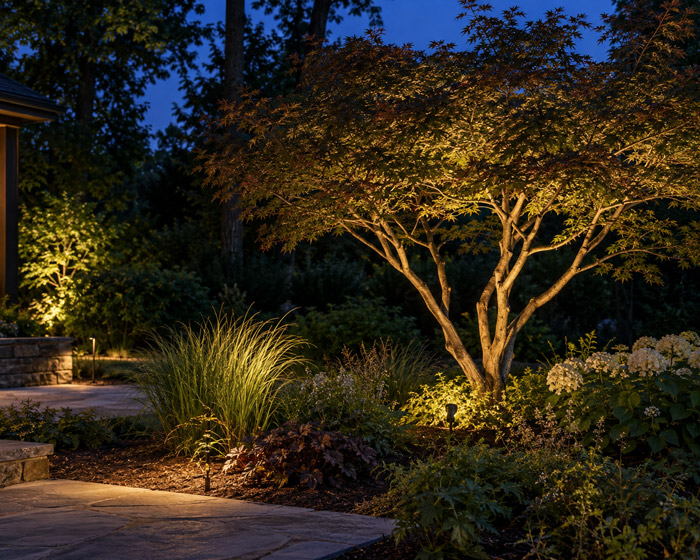
Choose a limited number of focal points. One well-considered tree or a distinctive planting group can give a garden a clear nighttime composition. Lighting every shrub can make the scene busy and leave little separation between foreground and background.
Consider how the view will change as plants grow or lose their leaves. A beam that is contained by foliage in summer may reach beyond it later in the year. Aim carefully, limit operating hours, and avoid sending unnecessary light into the sky.
Place fixtures where they remain accessible for cleaning and adjustment. Keep maintenance equipment and future planting work in mind when planning their locations.
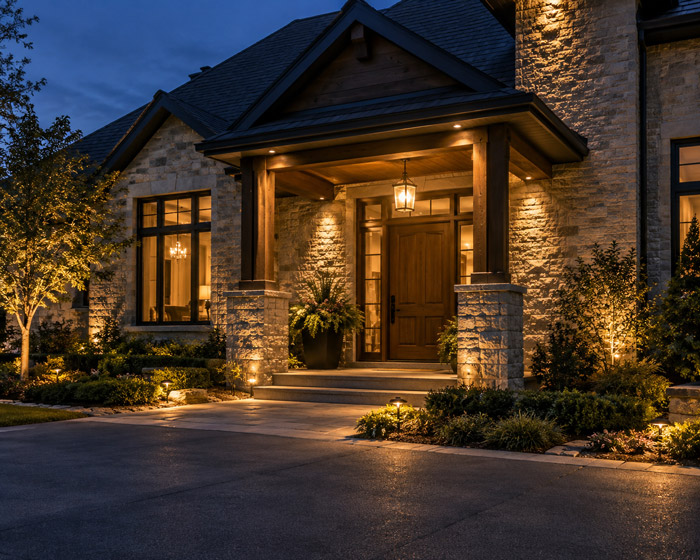
Architectural Features
Look for specific details worth revealing: an entrance surround, a textured wall, or a porch column. Review the effect from the driveway and street as well as close to the house.
Roofline lighting is a separate design choice. It can outline the building or support seasonal displays, but it does not automatically provide useful illumination on paths, steps, or seating areas. Decide whether those effects belong in your project before comparing products or quotations.
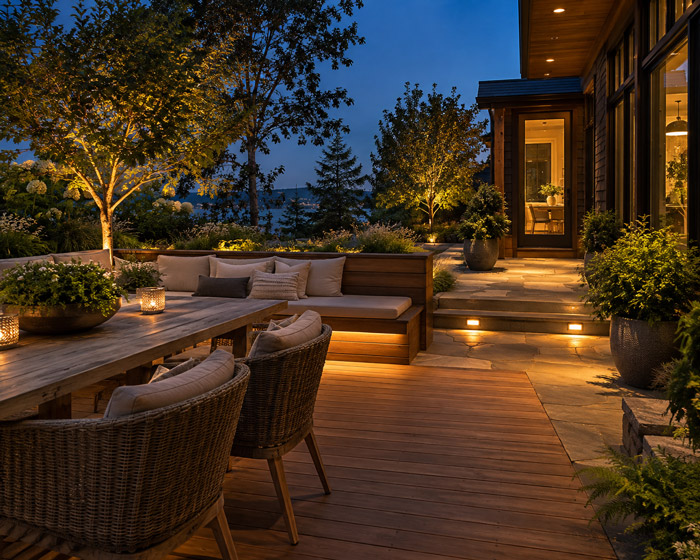
Patios and Decks
Evaluate patio lighting from a seated position. Sit at the dining table and in the chairs you normally use. A visible lamp that seems harmless while standing may feel glaring at eye level.
Separate lighting for circulation from lighting for social use. You may want the route back to the house illuminated while keeping a seating area subdued. Where compatible equipment allows, separate controls make that easier to achieve.
Compare Solar and Wired Low-Voltage Lighting
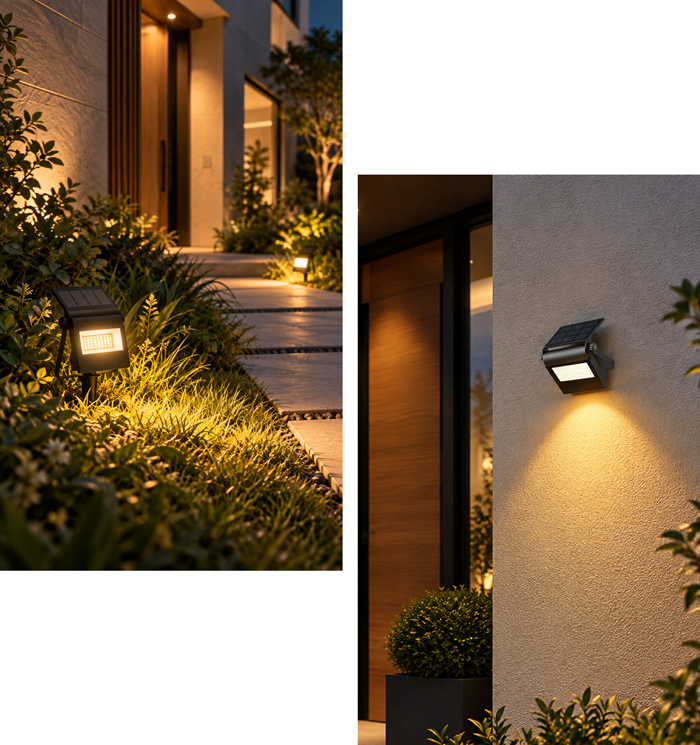
For solar landscape lighting, we recommend the LM-SP04 solar light, which combines a high-capacity battery for extended runtime with bright LED illumination and flexible wall-mounted or stake-mounted installation for a variety of outdoor spaces.
Solar fixtures and wired low-voltage fixtures can both use LEDs. LED describes the light source. Solar and wired low voltage describe how the system receives power.
Solar lights are convenient where running cable is impractical. Their performance depends on panel exposure, battery condition, and the energy available for the intended operating time. Check the proposed panel location throughout the day, including shadows from the house and trees.
Wired low-voltage systems use a compatible power supply or transformer, cable, and fixtures. They require more planning, but their operation does not depend on the amount of sunlight collected that day.
| Consideration | Solar lighting | Wired low-voltage lighting |
|---|---|---|
| Power source | Solar panel and rechargeable battery | Electrical supply through compatible equipment |
| Site planning | Panel exposure and mounting location | Supply location, cable routes, and system load |
| Routine attention | Panels, batteries, and fixtures | Fixtures, connections, and controls |
| Expansion | Often possible by adding individual units | Requires checking available system capacity |
The choice between solar and low-voltage outdoor lighting should follow the needs of each area. For an entrance used every evening, ask how the proposed system will provide the required operating time. For a decorative garden corner, flexibility may matter more.
Choose Light Color and Controls Together
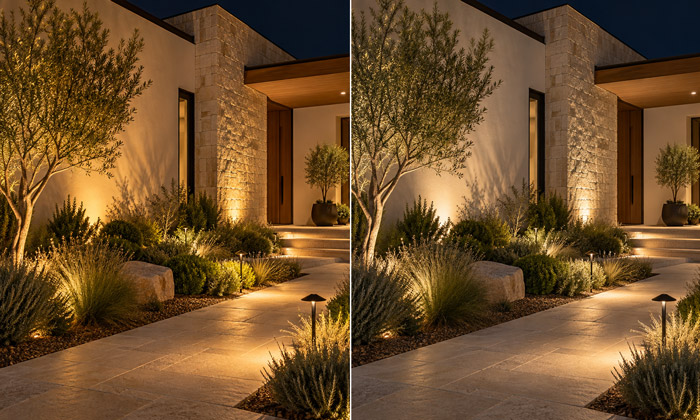
Light color influences how paving, plants, and building materials look after sunset. Test a sample against your actual exterior materials before ordering an entire system.
When comparing 2700K and 3000K landscape lighting, remember that both are warm-white options. The 2700K option generally appears more golden, while 3000K appears slightly less yellow. Neither Kelvin value tells you how much light a fixture produces.
Keep the effect coherent across areas visible together. Existing porch lights should be part of that assessment, particularly if they illuminate the same surfaces as the new fixtures.
Controls determine when you experience that lighting. A timer follows a schedule, a photocell responds to ambient light, and some controllers calculate switching times around sunset. Available functions depend on the equipment and its compatibility with the rest of the system.
A suitable landscape lighting timer can help you stop decorative lighting when it is no longer needed. Consider whether the front entrance and backyard should follow different schedules, and whether you want a straightforward manual override when entertaining.
What Affects Landscape Lighting Costs in Beckett Ridge?
The most useful budget starts with a defined scope. A proposal for a front walk and entrance cannot be compared directly with one covering the entire yard, even if both are described as landscape lighting packages.
Ask for a written breakdown of equipment, installation, and any additional electrical or restoration work. The main cost categories include fixtures, power equipment, controls, cable, connections, labor, and access to the proposed locations.
Use general information about the cost to install landscape lighting as preparation for quotations. A local estimate still needs to account for your property and the agreed design.
Three project scopes can make the discussion clearer:
- Essential access: the entrance, main walkway, and key steps.
- Front-yard design: access lighting plus selected planting and architectural features.
- Outdoor living plan: front and rear areas, seating spaces, connecting paths, and separate controls.
If you expect to expand later, explain that before installation. Ask what capacity and routing provisions are included, and what a later phase would require.
For operating costs, use the system's actual input power and your electricity rate. As a hypothetical example, a system drawing 60 watts for five hours each evening uses about 9 kWh over a 30-day month. Multiply that by your applicable rate. This is a calculation example, not a Beckett Ridge electricity-price estimate.
Check the Property Before Installation
For a Beckett Ridge project, confirm which association documents and local requirements apply to the specific address. If architectural review is required, prepare the fixture specifications, proposed locations, mounting details, and operating schedule before purchasing equipment.
Ask the installer to establish the applicable permit and inspection requirements for the actual scope, particularly if it includes a new outlet, circuit, or other line-voltage work. Do not assume that guidance for a different neighborhood applies to your home.
Walk the planned routes together. Identify irrigation, existing services, tree roots, paved crossings, and places where equipment will need maintenance access. Arrange the appropriate utility locating before excavation, including attention to private lines where applicable.
Cable selection also deserves a place in the design discussion. Run length, connected load, and fixture requirements affect voltage at the lights. A landscape lighting wire size guide helps explain those variables, while final sizing should follow the selected equipment and installation design.
At boundaries, consider the view from adjacent homes. DarkSky International and the Illuminating Engineering Society recommend lighting that has a useful purpose, stays targeted, uses appropriate low levels, is controlled, and favors warmer colors. These responsible outdoor lighting principles provide a helpful framework for limiting unnecessary spill and glare.
Decide Between DIY and Professional Installation
A small solar project may suit a homeowner who wants to try a few locations before deciding on a larger plan. Some packaged low-voltage systems are also intended for homeowner installation, subject to their instructions and applicable requirements.
Professional help becomes more valuable when the project involves long cable runs, several lighting zones, difficult access, permanent mounting, or changes to the electrical supply. Design and nighttime adjustment can be as significant as placing the fixtures.
When comparing installers, ask:
- Does the proposal identify fixture models, quantities, and locations?
- Are power equipment, controls, cable, and site restoration included?
- Will you return after dark to check aiming and brightness?
- What are the separate product and workmanship warranty terms?
- What documentation will I receive for future repairs or expansion?
Before accepting the finished work, walk the usual routes, sit in the outdoor seating areas, and look out from the rooms facing the yard. This gives you a practical basis for requesting adjustments.
Maintain the Lighting as Your Yard Changes
Include lighting in your seasonal yard checks. Look for obscured lenses, leaning stakes, shifted fixtures, damaged visible cable, and planting that blocks the intended beam.
Clean equipment according to its manufacturer's instructions. Check solar panels for shading and debris, and review timer settings after power interruptions or changes to your routine.
If a fixture flickers or a section goes dark, record which lights are affected and when the problem occurs. That information can help with troubleshooting. Damaged wiring, repeated protective-device trips, or water inside electrical equipment call for qualified inspection.
Keep model numbers, warranty records, and a layout sketch together. They make replacement decisions easier when the garden or your lighting needs change.
FAQs
How Long Do LED Landscape Lights Last?
LED lifespan depends on the product, operating hours, temperature, and installation conditions. The LED’s rated life does not guarantee that seals, drivers, connectors, and other components will last equally long.
When comparing fixtures for a Beckett Ridge home, check the warranty coverage, availability of replacement parts, and whether the light source can be serviced separately.
Are Brass or Aluminum Landscape Lights Better?
Both materials can work well when the fixture is properly designed for outdoor use. Brass develops a natural patina and does not depend on a painted finish for its appearance.
Aluminum is lighter and offers a wider range of finishes, but coating quality matters. Compare construction, seals, mounting hardware, and warranty terms alongside the housing material.
Can I Replace Halogen Landscape Light Bulbs With LEDs?
Often, yes, provided the replacement LED matches the fixture’s socket, dimensions, voltage, and power-supply requirements.
Check whether it requires AC or DC input and whether the existing transformer and controls support the reduced load. Test compatibility before converting the entire system, especially if you use dimming. Corroded sockets or damaged housings may justify replacing the fixture instead.
Should I Choose Integrated LED Fixtures or Replaceable LED Bulbs?
Replaceable LED bulbs make it easier to change light output, beam angle, or color temperature without replacing the housing.
Integrated LED fixtures give manufacturers more freedom to design compact optics and housings, but repair options vary. Before buying, ask whether a failed LED module or driver can be replaced and whether those parts will remain available.
What Is the Difference Between Waterproof and Weather-Resistant Landscape Lights?
These descriptions alone do not establish where a fixture can be installed. Check its documented location rating, IP rating where provided, and installation instructions.
A fixture suitable for rain exposure may not tolerate standing water or submersion. Ground-level installations need particular attention to drainage, and cable connections must also be rated for their actual exposure.
