

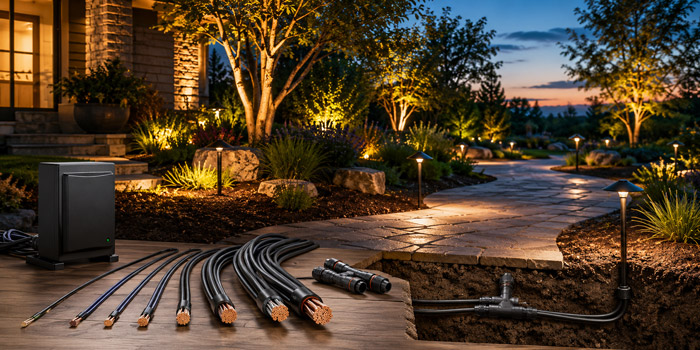
Landscape Lighting Wire Size Chart
How to Read the Chart
Landscape Lighting Voltage-Drop Formula
Choosing Between 16, 14, 12, 10, and 8 AWG
Daisy-Chain, Hub, and Home-Run Layouts
12V Versus 24V Wire Sizing
Transformer Taps and Fixture Voltage
Installation Requirements That Affect Wire Selection
FAQs
Selecting the correct landscape lighting wire size is primarily a voltage-drop calculation. A cable that is too small can cause dim fixtures, inconsistent brightness, LED flicker, unreliable operation, and unnecessary power loss. A larger conductor has lower resistance and delivers more voltage to fixtures at the end of the run.
This guide focuses on 12V low-voltage landscape lighting systems using two-conductor copper cable. Most residential systems use a transformer to convert 120V household power to approximately 12V for outdoor fixtures.
Landscape Lighting Wire Size Chart
The following chart shows the maximum recommended one-way cable distance for common total run loads while limiting calculated voltage drop to approximately 5%, or 0.6V, on a 12V system.
Calculation assumptions
- 12V supply voltage
- Copper conductors
- Two-wire circuit: outgoing and returning conductors
- Maximum 5% voltage drop
- Entire load treated as being at the end of the cable
- Copper resistance based on standard AWG resistance data at approximately 20°C
- Distances rounded down to the nearest foot
- Wattage assumed to be approximately equal to volt-amperes; use fixture VA ratings when available
The calculation uses conductor resistance and both sides of the circuit. Standard copper-wire data show that resistance increases rapidly as AWG numbers become larger; approximately 1 ohm per 1,000 feet for 10 AWG, 1.6 ohms for 12 AWG, 2.5 ohms for 14 AWG, and 4 ohms for 16 AWG at 20°C.
| Total Load on Run | Current at 12V | 16 AWG Maximum Run | 14 AWG Maximum Run | 12 AWG Maximum Run | 10 AWG Maximum Run | 8 AWG Maximum Run | Practical Selection Guidance |
|---|---|---|---|---|---|---|---|
| 10 W/VA | 0.83 A | 89 ft | 142 ft | 226 ft | 360 ft | 573 ft | 16 AWG may be suitable for a short, lightly loaded fixture group. |
| 20 W/VA | 1.67 A | 44 ft | 71 ft | 113 ft | 180 ft | 286 ft | Use 14 AWG for moderate runs or 12 AWG when future fixtures may be added. |
| 30 W/VA | 2.50 A | 29 ft | 47 ft | 75 ft | 120 ft | 191 ft | 12 AWG is generally the practical starting point beyond about 50 feet. |
| 40 W/VA | 3.33 A | 22 ft | 35 ft | 56 ft | 90 ft | 143 ft | Use 12 AWG for short runs and 10 AWG for longer branches. |
| 50 W/VA | 4.17 A | 17 ft | 28 ft | 45 ft | 72 ft | 114 ft | 10 AWG becomes appropriate when the farthest fixture is more than about 45 feet away. |
| 60 W/VA | 5.00 A | 14 ft | 23 ft | 37 ft | 60 ft | 95 ft | Avoid 16 AWG; use 10 or 12 AWG depending on distance. |
| 75 W/VA | 6.25 A | 11 ft | 19 ft | 30 ft | 48 ft | 76 ft | Use 10 AWG for runs approaching 50 feet or divide the load between branches. |
| 100 W/VA | 8.33 A | 8 ft | 14 ft | 22 ft | 36 ft | 57 ft | A separate home run or multiple smaller runs is usually preferable. |
| 125 W/VA | 10.42 A | 7 ft | 11 ft | 18 ft | 28 ft | 45 ft | Split the circuit unless the fixtures are close to the transformer. |
| 150 W/VA | 12.50 A | 5 ft | 9 ft | 15 ft | 24 ft | 38 ft | Multiple cable runs are strongly recommended instead of one heavily loaded branch. |
Important: This is a voltage-drop chart, not an ampacity chart. The cable’s listed current rating, transformer terminal rating, circuit protection, fixture specifications, installation method, and local electrical requirements must also be satisfied. Voltage drop and conductor ampacity should be treated as separate wire-sizing limits.
How to Read the Chart
First, add the electrical load of every fixture connected to one cable run. Use the fixtures’ VA ratings when the manufacturer provides them. LED fixture wattage and VA can differ because of the electronic driver.
Next, measure the one-way distance from the transformer to the farthest fixture. Do not double this measurement when using the chart—the outgoing and returning conductors are already included in the calculation.
For example, consider a 12V circuit with six 5W fixtures:
- Total load: 30W
- One-way distance: 65 feet
- 14 AWG limit at 30W: 47 feet
- 12 AWG limit at 30W: 75 feet
The appropriate selection is 12 AWG, because 14 AWG would exceed the 5% voltage-drop target.
Landscape Lighting Voltage-Drop Formula
For a two-conductor copper circuit:
Voltage Drop = 2 × Cable Length × Current × Conductor Resistance
When resistance is expressed in ohms per 1,000 feet:
Voltage Drop = (2 × L × I × R) ÷ 1,000
Where:
- L = one-way cable length in feet
- I = circuit current in amperes
- R = resistance of one conductor in ohms per 1,000 feet
- 2 = outgoing and returning conductor paths
Current can be estimated with:
Current = Total VA ÷ Supply Voltage
A 60VA load on a 12V circuit therefore draws approximately:
60VA ÷ 12V = 5A
Using 12 AWG copper at approximately 1.588 ohms per 1,000 feet over a 50-foot one-way run:
Voltage Drop = (2 × 50 × 5 × 1.588) ÷ 1,000 = 0.794V
The estimated fixture voltage would be:
12V − 0.794V = 11.206V
That is a voltage drop of approximately 6.6%, so either 10 AWG cable, a shorter run, a smaller load, or a properly selected higher transformer tap should be considered.
The calculation is based on the relationship between cable length, total run load, conductor size, and end-of-run voltage. Each cable run should be calculated separately, and the results should be confirmed with a voltmeter.
Choosing Between 16, 14, 12, 10, and 8 AWG
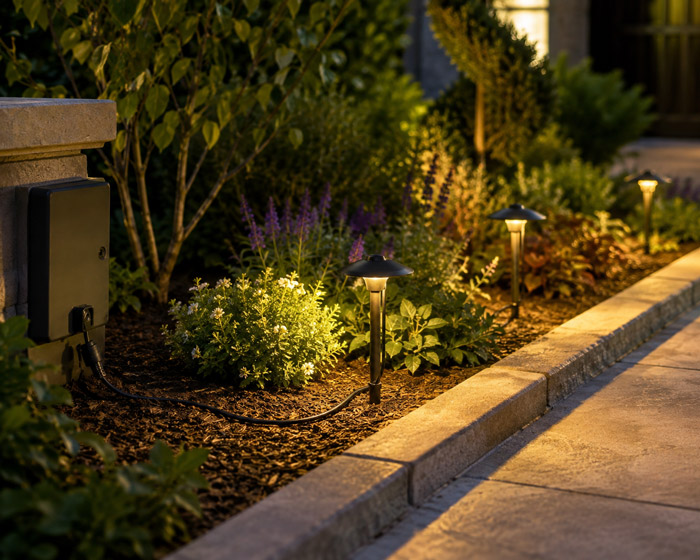
16 AWG
Use 16 AWG only for short, lightly loaded branches. It has relatively high resistance, so voltage drop increases quickly as fixtures or cable length are added.
It provides limited flexibility for future expansion.
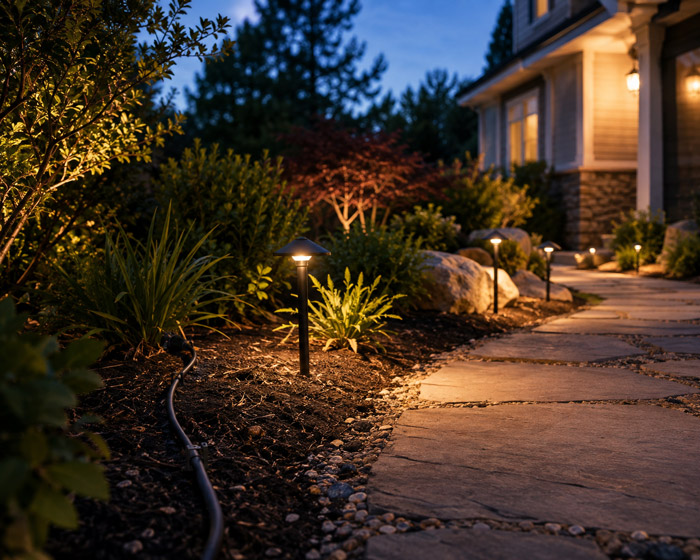
14 AWG
14 AWG is suitable for small LED systems and moderate distances. It can be economical for individual lighting zones, but it should not be selected solely because the total transformer load is small.
Calculate the load and distance of each branch.
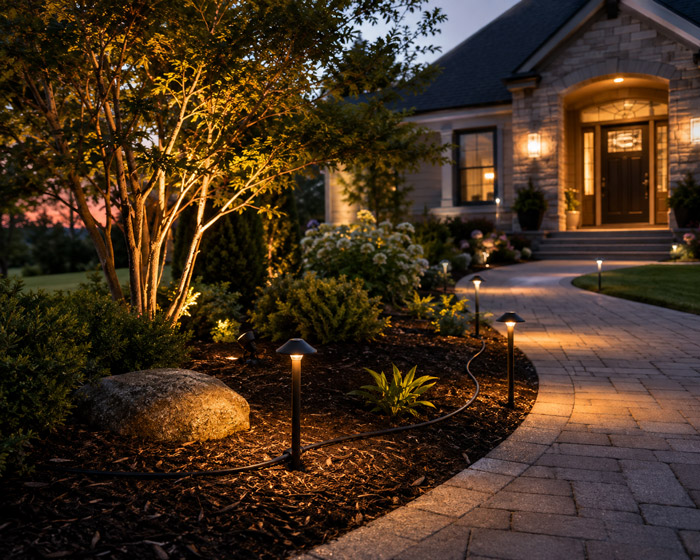
12 AWG
12 AWG is the most practical general-purpose starting size for many residential landscape lighting installations. Manufacturers commonly recommend beginning with 12 AWG and increasing conductor size when calculations show excessive voltage drop.
A commonly used field guideline is the “100/100 rule”: approximately 100 feet of 12 AWG cable for a 100W load.
However, this rule permits considerably more voltage drop than the conservative 5% chart above and should not replace an actual calculation or voltage measurement.
10 AWG
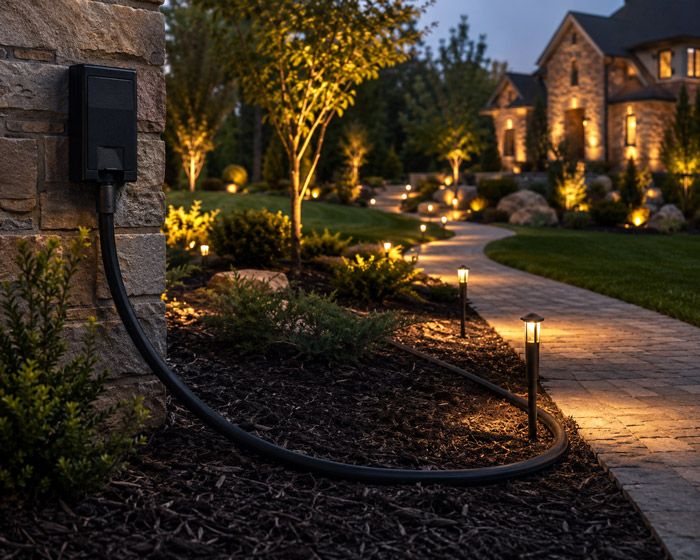
10 AWG is appropriate for longer runs, higher-load zones, or installations that require additional capacity.
Its resistance is approximately 37% lower than 12 AWG, allowing significantly longer distances at the same load and voltage-drop target.
8 AWG
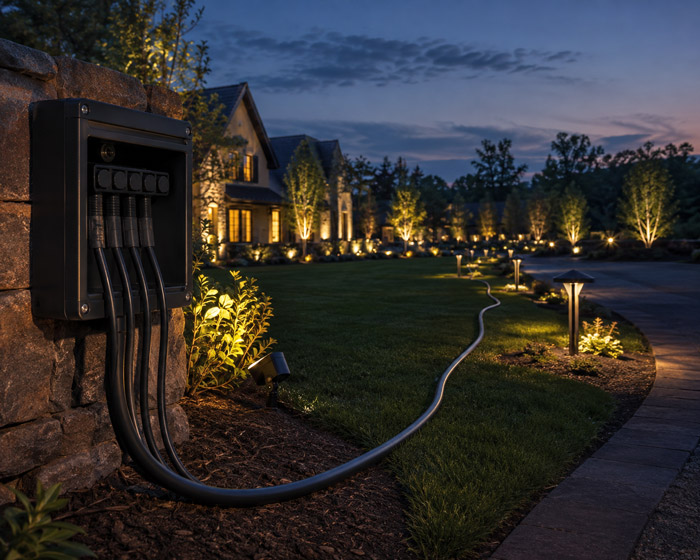
8 AWG is used for long main feeds, heavily loaded zones, remote hubs, or large professional installations.
Before selecting it, confirm that the transformer terminals and connectors are designed to accept the conductor size.
In many cases, several smaller home runs are easier to balance and maintain than one large cable.
Daisy-Chain, Hub, and Home-Run Layouts
Wire size is affected by how fixtures are connected.
In a daisy-chain layout, fixtures are connected sequentially along one cable. The first cable section carries the full branch load, while later sections carry progressively less current. The chart is conservative because it assumes the entire load is located at the farthest point.
In a hub layout, a main cable supplies a central connection point, and shorter equal-length cables run from the hub to fixtures. This can improve voltage consistency when the hub and branch conductors are sized correctly.
In a home-run layout, separate cables return directly to the transformer. Dividing fixtures into distance-based zones reduces individual run loads, simplifies voltage adjustment, and makes troubleshooting easier. Manufacturers recommend grouping fixtures at similar distances and dividing large loads into multiple runs rather than placing every fixture on one long circuit.
12V Versus 24V Wire Sizing
A 24V system carries half the current of a 12V system when supplying the same wattage. It also allows twice the absolute voltage loss at the same percentage limit.
Consequently, at the same load, conductor size, and 5% voltage-drop target, the theoretical maximum cable distance for a 24V system is approximately four times the 12V distance shown in the chart.
For example:
- 50W on 12V with 12 AWG: approximately 45 feet
- 50W on 24V with 12 AWG: approximately 180 feet
Use this multiplier only when every fixture, transformer output, connector, and control device is rated for 24V operation.
Transformer Taps and Fixture Voltage
Multi-tap transformers may provide outputs such as 12V, 13V, 14V, or 15V to compensate for cable loss. A higher tap does not eliminate the need for correct wire sizing. It raises voltage across the entire branch, including fixtures closest to the transformer.
Before changing taps:
- Calculate the expected drop.
- Confirm the fixture’s permitted input-voltage range.
- Energize the completed system.
- Measure voltage at the nearest and farthest fixtures.
- Select the tap that keeps every fixture within its rated range.
It is recommended that fixtures be checked to ensure they operate within the manufacturer’s specified voltage range and that a voltmeter be used to verify the calculated results.
Installation Requirements That Affect Wire Selection
Use cable specifically listed for low-voltage outdoor landscape lighting and for the intended installation environment. Cable placed in soil must be suitable for direct burial unless it is installed in an approved raceway.
All underground splices should use connectors specifically rated for wet locations and direct burial. Ordinary indoor wire nuts can admit moisture, corrode, and add resistance, producing additional voltage loss and intermittent operation.
Keep the following requirements in mind:
- Do not exceed the transformer’s total output rating.
- Maintain the transformer reserve recommended by its manufacturer.
- Verify the maximum load permitted on each transformer terminal or circuit.
- Use connectors rated for the selected wire gauge.
- Keep high-load and long-distance zones on separate runs.
- Account for future fixtures before selecting the cable.
- Measure actual operating voltage after installation.
- Follow the current locally adopted electrical code and all equipment-listing instructions. NFPA identifies the National Electrical Code as the benchmark for safe electrical design, installation, and inspection in the United States.
FAQs
Should landscape lighting wire be solid or stranded?
Stranded copper wire is generally preferred for landscape lighting because it is flexible, easier to route around obstacles, and less likely to break during installation.
Solid wire is stiffer and is not commonly used for typical low-voltage outdoor lighting circuits.
Can aluminum wire be used for landscape lighting?
Copper wire is the recommended choice because it has lower resistance, better corrosion resistance, and greater compatibility with landscape lighting connectors.
Aluminum wire requires larger conductor sizes and connectors specifically rated for aluminum, making it less practical for most residential systems.
Can landscape lighting wire be installed inside conduit?
Yes. Conduit can provide added protection beneath driveways, walkways, patios, retaining walls, and areas exposed to landscaping tools.
The cable and conduit system must be rated for outdoor wet locations, since underground conduit can collect moisture.
Does landscape lighting wire size affect LED color temperature?
Wire size does not directly change an LED fixture’s rated color temperature(CCT).
However, excessive voltage loss can reduce brightness, cause flickering, or make fixtures appear inconsistent, especially when different fixtures receive different input voltages.
Can smart landscape lights use standard low-voltage cable?
Many smart landscape fixtures can use standard two-conductor low-voltage cable, but some products require constant power, dedicated controllers, additional conductors, or proprietary wiring.
Always verify the fixture’s voltage, communication method, polarity requirements, and cable specifications before installation.
