


Table of Contents
- How Does a COB LED Work?
- COB LED vs. SMD LED: What Is the Difference?
- How Bright Is a COB LED?
- Why Beam Angle Can Matter More Than Extra Lumens
- A Uniform Emitting Surface Does Not Guarantee Low Glare
- What Determines COB LED Reliability?
- Where Does COB LED Make Sense in Garden Lighting?
- How to Choose a COB LED Fixture
- FAQs
COB LED stands for chip-on-board light-emitting diode. It is a construction method in which multiple bare LED chips are mounted closely together on a shared substrate. In a typical white-light COB, a common phosphor coating covers the chips, creating a compact emitting surface.
You will often find COB LEDs in spotlights, recessed downlights, and architectural accent lighting. Their compact form gives fixture designers a useful starting point for directing light onto a particular object or surface.
However, the COB label tells you how the light source is built. Choosing a good fixture also requires understanding its optics, heat management, color quality, and intended installation.
For garden lighting, that distinction matters. A light that looks impressive on a specification sheet can still produce an uncomfortable view from a patio chair or spill most of its output beyond the tree it is supposed to illuminate.
How Does a COB LED Work?
A typical white COB LED produces light through three connected processes:
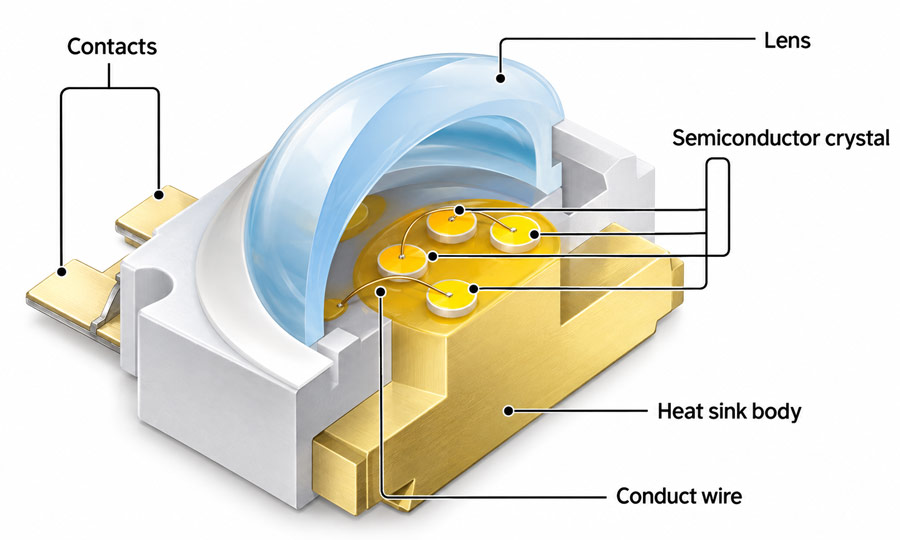
This COB (Chip-on-Board) LED structure diagram illustrates the key components of an LED package, including the optical lens, semiconductor crystals, electrical contacts, bonding wires, and heat sink body, highlighting how these components work together to deliver efficient light emission and thermal management.
- The LED chips emit light. Electrical current passes through semiconductor dies, which commonly produce blue light.
- The phosphor changes the spectrum. The coating converts some of that light into other wavelengths. The resulting mixture appears white.
- The substrate transfers heat. The board supports the chips and provides a thermal path toward the fixture’s heat sink.
The closely packed chips can appear as one continuous luminous area when operating. A reflector or lens then shapes the output into the beam required by the fixture.
The emitting surface and the finished beam are different things. A COB module does not have one universal spotlight angle. The same general source technology can be used in fixtures with substantially different distributions.
The term also appears on COB LED strips. These arrange dense emitters along a flexible board to create a continuous line of light. Their long, narrow geometry serves a different purpose from the compact COB source inside a spotlight.
COB LED vs. SMD LED: What Is the Difference?
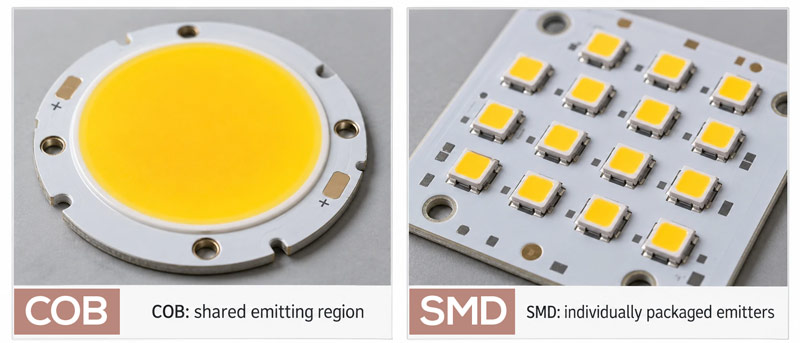
SMD means surface-mounted device. In common lighting terminology, an SMD board uses individually packaged LEDs mounted onto a circuit board, while a COB array places bare dies together on a shared substrate.
The practical differences depend on how the complete fixture uses those components.
| Feature | Typical COB arrangement | Typical SMD arrangement |
|---|---|---|
| LED construction | Bare dies grouped on a shared substrate | Individually packaged LEDs mounted on a board |
| Emitting area | Often one compact, continuous-looking area | Separate emitting points or a distributed array |
| Optical arrangement | Commonly paired with one reflector or lens | May use individual lenses, shared optics, or a diffuser |
| Heat distribution | Heat concentrated around a compact source | Heat can be distributed across a larger board |
| Common applications | Spotlights, downlights, accent fixtures | Linear lighting, panels, decorative fixtures, and many outdoor designs |
These are common design patterns, rather than fixed performance rankings.
An SMD fixture can produce an excellent controlled spotlight. A COB fixture can produce disappointing illumination if its reflector, shielding, or thermal design is poorly matched to the source.
Compare the finished lighting result before treating either construction method as a quality grade.
How Bright Is a COB LED?
There is no single brightness level for COB LEDs. Output depends on the particular module, operating current, temperature, and complete fixture design.
Three measurements help explain the difference:
- Lumens describe total visible light output.
- Candela describes light intensity in a particular direction.
- Lux describes the illumination arriving on a surface.
Understanding what lumens mean in lighting helps when comparing products, but a lumen figure alone cannot tell you how brightly a fixture will illuminate a small garden feature.
Compare Fixture Lumens With Fixture Watts
For example, suppose a complete fixture produces 900 lumens while consuming 10 watts:
900 lumens ÷ 10 watts = 90 lumens per watt
That is the fixture’s luminous efficacy in this illustrative example.
Check that both numbers refer to the complete product. A bare LED module’s laboratory output and power consumption may differ from the finished fixture’s results because the driver, optics, and operating temperature affect performance.
This creates a useful purchasing rule: request measured fixture output and total input power together. Combining module lumens with fixture watts produces a misleading comparison.
Why Beam Angle Can Matter More Than Extra Lumens
Imagine lighting a narrow tree trunk from several meters away. A wide beam may illuminate nearby planting and empty ground while delivering relatively little intensity to the trunk.
A narrower beam can concentrate more light on that particular target, even when its total lumen output is lower.
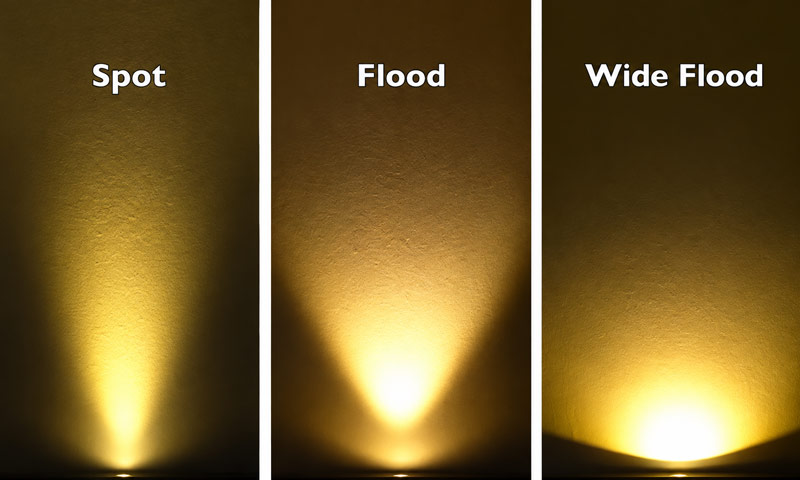
Comparison of spot, flood, and wide flood beam angles for different LED lighting applications.
The approximate diameter of a circular beam can be estimated using:
Beam diameter = 2 × distance × tan(beam angle ÷ 2)
At a distance of 3 meters, the calculated diameters are:
| Beam angle | Approximate beam diameter |
|---|---|
| 15° | 0.79 meters |
| 30° | 1.61 meters |
| 60° | 3.46 meters |
These calculations assume that the beam strikes the surface perpendicularly. An angled installation changes the footprint.
The beam angle of a spotlight also needs context. Beam width is commonly defined at half the peak intensity, so the calculated diameter does not mark a hard boundary where all light stops.
Two fixtures with the same stated beam angle can have different amounts of light outside the main beam. Source size and optical design also influence how tightly the light can be controlled.
For a garden installation, this suggests a more revealing comparison: examine the intended object, the surrounding spill, and the view from nearby seating. A brighter center is only one part of a successful result.
A Uniform Emitting Surface Does Not Guarantee Low Glare
One of the easiest COB characteristics to misinterpret is its continuous-looking surface.
A smooth emitting area can still be intensely bright when viewed directly. Uniformity across the source does not establish whether the fixture will be comfortable from a particular viewing position.
A useful evaluation is to inspect three places:
The target: Does the beam reveal the intended shape, texture, or detail?
The beam edge: Does light spill onto windows, neighboring property, or surfaces that should remain darker?
The viewing position: Can someone walking along the path or sitting on the terrace see the bright emitter?
This approach is particularly useful for low-mounted garden spotlights. A fixture may illuminate a tree effectively while exposing its source to everyone approaching along the path.
Recessing the source, selecting an appropriate shield, changing the mounting position, or adjusting the aiming angle may improve the result. The appropriate solution depends on the fixture and layout.
For project comparisons, a practical nighttime mock-up can reveal these issues more clearly than a close-up photograph of the glowing LED.
What Determines COB LED Reliability?
Heat Must Leave the Complete Fixture
COB construction can provide an effective thermal path, but concentrating output into a small area also makes thermal design important.
Heat needs to move from the LED assembly through its mounting interface and into a housing or heat sink capable of releasing it. Poor contact between those components can undermine an otherwise capable light source.
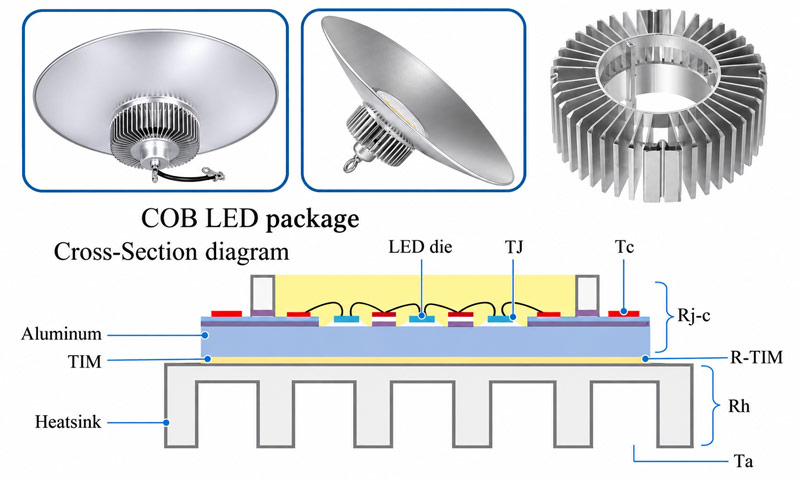
COB LED package cross-section showing LED chips, aluminum substrate, thermal interface material (TIM), and heat sink for efficient thermal management.
A large metal housing does not establish that the internal thermal connection is effective. Likewise, a compact housing should be evaluated against the actual operating power and permitted ambient temperature.
Outdoor installations add practical constraints. An enclosed fitting, restricted mounting space, or accumulated debris can change the conditions under which heat escapes. COB design guidance therefore treats the heat sink and thermal interface as essential parts of the lighting system.
LED Life and Fixture Life Are Different Claims
A projected light-maintenance figure for the LED component does not establish the lifetime of the complete fixture.
Drivers, electrical connections, seals, and optical components also influence whether a fitting continues to perform acceptably. Professional guidance specifically distinguishes LED component projections from complete luminaire reliability.
When comparing products, ask what the lifetime statement covers and under which operating conditions it applies.
Where Does COB LED Make Sense in Garden Lighting?
COB is particularly worth considering when a design needs a compact source working with a controlled optical system.
Highlighting Trees, Sculptures, and Architectural Details
A carefully selected spotlight can draw attention to a specific trunk, sculpture, column, or textured surface.
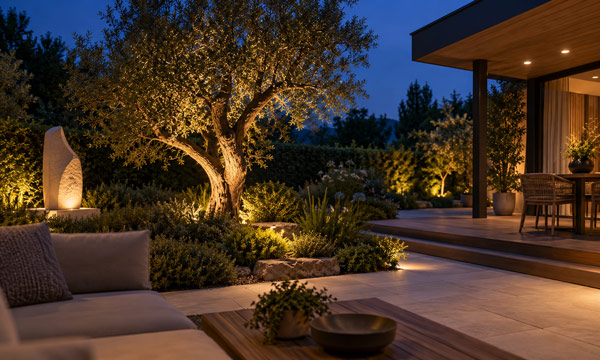
Start with the object’s dimensions and viewing direction. A slender feature and a spreading canopy usually need different distributions, even if they occupy the same garden.
The choice between uplighting and downlighting also changes which surfaces become visible and where shadows fall. Decide on that effect before selecting the emitter technology.
Recessed Lighting Around Covered Outdoor Spaces
A compact COB source can suit a recessed downlight where the fixture provides appropriate optical control and shielding.
For a covered seating area, evaluate the view from the chair as carefully as the illumination on the floor. A downlight positioned directly within a seated person’s normal sightline may need a different location or optical arrangement.
Continuous Decorative Lines
COB strips can be useful where a design calls for a continuous luminous line rather than visible individual LED points.
They can suit concealed details and selected architectural edges, provided the complete assembly is rated for its environment. A COB strip and a COB spotlight should still be specified separately because they solve different distribution problems.
For broad pathway illumination, the more useful starting point may be a shielded area distribution. A compact spotlight is appropriate only when its beam matches the task.
How to Choose a COB LED Fixture
1. Define What Should Be Illuminated
Describe the intended result before choosing wattage.
For example:
- Reveal the bark texture of one tree.
- Illuminate a sculpture without lighting the fence behind it.
- Make a step edge visible from the approach.
- Provide comfortable light around an outdoor table.
Each task requires a different balance of distribution, intensity, and shielding.
This prevents a common specification problem: selecting a powerful fixture first and trying to make its beam fit the landscape afterward.
2. Check the Photometric Information
Look for a beam diagram, intensity distribution, or illuminance information at the intended distance.
A product photograph can show the fixture’s appearance. Photometric information helps explain where its light goes.
Where detailed data is available, compare fixtures at the same mounting distance and orientation. Otherwise, arrange a sample installation before committing to a larger layout.
3. Evaluate Color on the Actual Materials
COB construction does not specify the appearance of white light or the accuracy with which objects’ colors are reproduced.
CCT and CRI in garden lights describe different characteristics. CCT relates to the apparent warmth or coolness of the light, while CRI helps describe color fidelity.
Test the light on the materials that matter: brick, timber, stone, flowers, or foliage. Two fixtures with similar brightness can create noticeably different impressions when their color characteristics differ.
For a project where material color is important, request more information than the description “warm white.”
4. Match the Complete Fixture to Its Environment
The word COB does not establish weather resistance.
Check the housing, cable entry, connectors, installation orientation, and stated environmental limits. Understanding IP44 and IP65 ratings helps distinguish different levels of ingress protection.
An IP rating also needs to be interpreted alongside the installation instructions. Exposure to standing water, irrigation, salt, or cleaning chemicals may introduce requirements beyond a basic rain-exposure comparison.
5. Verify the Electrical Requirements
A bare COB emitter and a complete outdoor fitting are different electrical products.
Bare COB arrays commonly require a specified operating current and a driver that accommodates their forward-voltage range. A finished fixture may include its own regulation and accept a different marked input.
The correct match therefore depends on the product’s electrical specifications. Wattage alone is insufficient to establish compatibility.
6. Review a Sample From Normal Viewing Positions
Allow the sample fixture to reach its normal operating condition, then inspect it from the path, seating area, doorway, and other relevant viewpoints.
Check whether the target is readable, whether the beam stops where intended, and whether reflections become distracting on nearby glass or wet paving.
One especially useful question is: Would moving or shielding this fixture improve the scene more than increasing its output?
That question keeps the selection focused on the installed result. COB earns its place when its source geometry, optics, and housing work together to deliver that result.
FAQs
1. Can COB LED Lights Be Dimmed?
Yes, when the complete lighting system supports dimming. The driver and control must use compatible methods, such as phase-cut, 0–10V, digital control, or an appropriate PWM arrangement.
A COB label alone does not confirm that a finished fixture is dimmable. Check the supported control method, minimum dimming level, and compatibility information before choosing a dimmer.
2. Why Does a COB LED Flicker?
Possible causes include driver output ripple, an incompatible dimmer, unstable power, or a connection problem. In an outdoor system, moisture and excessive voltage drop can also contribute to unreliable operation.
When troubleshooting flickering lights, note whether the problem affects one fitting, an entire cable run, or only a particular dimming level. That pattern helps identify which part of the system needs investigation.
3. Can a COB LED Module Be Replaced?
Sometimes, depending on whether the fixture is designed for module replacement.
A suitable replacement needs more than matching wattage. Its operating current, voltage range, dimensions, mounting arrangement, thermal requirements, and optical alignment must suit the fixture.
Check the manufacturer’s approved parts and servicing instructions. Some sealed integrated fixtures require replacement of a larger assembly or the complete fitting.
4. Can You Cut COB LED Strip Lights?
Many COB LED strips can be shortened, but the permitted cutting positions depend on the exact model.
Disconnect power first and follow the strip’s marked cut points or its explicit cutting instructions. Cutting elsewhere can interrupt the circuit or damage a section.
For an outdoor strip, the cut end and any new connection must also use the specified sealing system. The original environmental rating does not automatically apply to an unfinished cut end.
5. Can COB LEDs Produce RGB Colors or Tunable White Light?
Yes. COB products are available with RGB, RGBW, and tunable-white arrangements.
These versions use different emitter channels and require a compatible controller and power system. A standard fixed-white COB cannot gain color-changing functionality simply by adding a controller.
If both decorative colors and useful white illumination are required, check whether the product includes a dedicated white channel and review that channel’s color specifications.
References & Sources
- Bridgelux. (2024, November). Gen 8 V4 HD F90 TS LED array (DS1361, Rev. C).
- Cree LED. (2025). XLamp CX family LED design guide (Rev. 7B).
- Illuminating Engineering Society. (2018, October 9). PS-10-18: IES position on LED product lifetime prediction.
- LEDiL. (n.d.). Finding the perfect spot: The art and science of narrowing beam angles.
- Lumileds. (n.d.). Understanding CoB LEDs.
- MEAN WELL. (n.d.). Application aspect: Frequently asked questions.
- Schlaker, E. (2023, February 16). COB LED strip lights: Everything you need to know. Super Bright LEDs.
- Super Bright LEDs. (2025, December 15). RGB+White COB strip specifications (Version 1.1).
- U.S. Department of Energy. (n.d.). LED basics.
