
What Does G40 Mean?
What Are G40 Bulbs Used For?
What Base Does a G40 Bulb Have?
G40 LED vs. Incandescent Bulbs
How Bright Is a G40 Bulb?
Which Color Temperature Works Best?
Can G40 Bulbs Be Used Outdoors?
G30 vs. G40 vs. G50: Which Size Should You Choose?
How to Choose the Right G40 Replacement Bulb
FAQs
A G40 bulb is a globe-shaped light bulb. For patio and garden string lights, G40 usually means a round bulb approximately 40 millimeters, or 1.57 inches, in diameter. However, in some household lighting catalogs, G40 describes a much larger globe measuring 5 inches across. Checking the actual dimensions is essential before buying a replacement.
The G40 designation describes the bulb’s shape and size—not its brightness, wattage, voltage, or screw base. Two bulbs labeled G40 can look different, produce different amounts of light, and require different sockets.
For outdoor lighting, understanding these differences helps you choose bulbs that fit your string lights and create the atmosphere you want.
What Does G40 Mean?
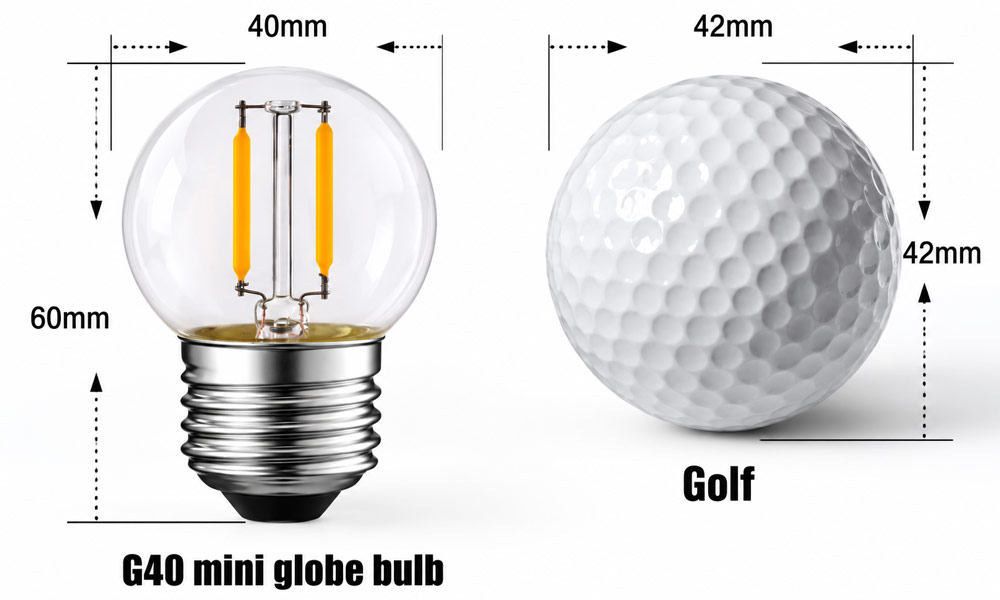
G40 globe bulb with a 40 mm diameter shown beside a golf ball for size comparison.
The letter G stands for globe, referring to the bulb’s rounded shape. The number identifies its nominal diameter, but the measurement convention depends on the product category.
| G40 product category | Meaning of “40” | Approximate diameter | Typical application |
|---|---|---|---|
| Decorative patio and holiday string-light bulbs | 40 millimeters | 1.57 inches | Garden, balcony, and patio string lights |
| Household globes using eighth-inch sizing | 40 eighths of an inch | 5 inches, or 127 millimeters | Large exposed decorative fixtures |
These are substantially different sizes. A small patio G40 bulb is roughly the diameter of a table-tennis ball, while a 5-inch globe is a prominent decorative feature. Both naming conventions appear in lighting catalogs.
G40 does not mean 40 watts. Always check the separate specifications for diameter, overall height, base type, voltage, and power consumption.
What Are G40 Bulbs Used For?
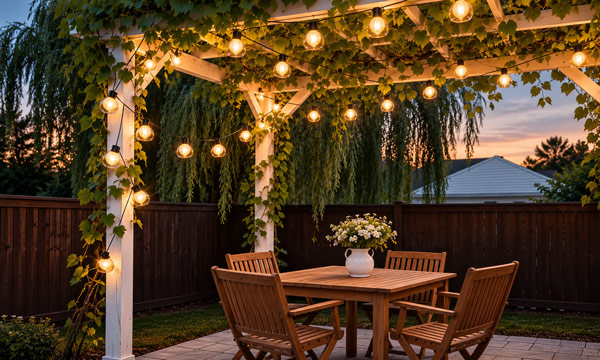
Small G40 bulbs are suited to decorative lighting where individual points of light remain visible. Their rounded shape works well above patios, along pergolas, across balconies, and around outdoor dining areas.
They can define a seating area without the visual weight of large hanging fixtures. Low-output versions provide a gentle glow rather than strong illumination; for example, some small G40 LED bulbs produce only 30 lumens each.
This makes them useful for atmosphere, but decorative string lights should not automatically be treated as the only lighting for steps, cooking surfaces, or other areas requiring clear visibility. Plan those areas separately.
Larger, 5-inch G40 globes serve a different purpose. They are commonly used in exposed pendants and decorative fixtures where the bulb itself forms part of the design. Their dimensions and fixture requirements differ from those of small patio bulbs.
What Base Does a G40 Bulb Have?
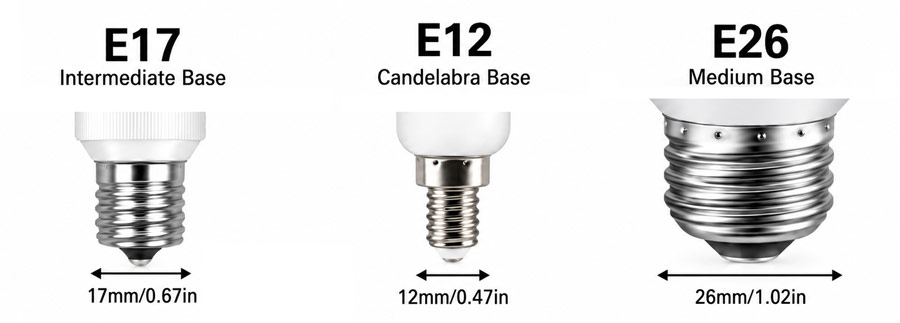
G40 identifies the globe, while a code such as E12 or E26 identifies the screw base. The two descriptions tell you different things.
Small patio G40 bulbs often use an E12 candelabra base, although other versions are available, including E17 bulbs. Larger household globes commonly use an E26 medium base.
| Base code | Nominal screw diameter | What to check |
|---|---|---|
| E12 | 12 mm | Common on small decorative string lights |
| E17 | 17 mm | Used by some decorative lighting systems |
| E26 | 26 mm | Common on larger household globe bulbs |
The difference between E12 and E26 bulb bases matters because they fit different sockets. A matching globe shape does not make the bases interchangeable.
Voltage also needs to match. A bulb that physically screws into a socket is not necessarily electrically compatible with the lighting system. Check the original bulb and the fixture label before ordering replacements.
G40 LED vs. Incandescent Bulbs
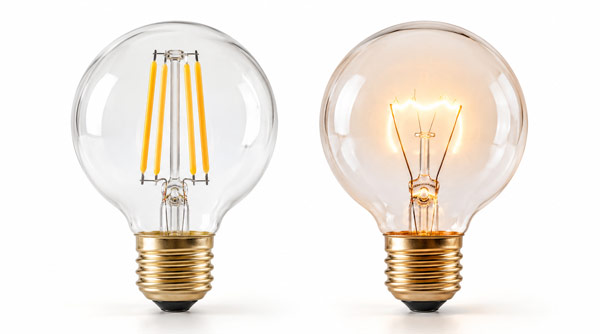
G40 bulbs are available with different lighting technologies. LED and incandescent models may share the same shape, but they use energy differently.
An incandescent bulb produces light by heating a filament. An LED bulb produces light using semiconductor components and generally requires less electricity for a comparable light output. LEDs also typically offer a longer service life, although the actual lifespan depends on the product and operating conditions.
| Feature | G40 LED bulb | G40 incandescent bulb |
|---|---|---|
| Electricity use | Generally lower at comparable brightness | Generally higher at comparable brightness |
| Heat | Usually releases less heat for the same light output | Produces substantial heat |
| Appearance | Available in filament-style and other designs | Traditional glowing filament |
| Replacement interval | Typically longer | Typically shorter |
| Best comparison measure | Lumens and actual watts | Lumens and actual watts |
For an illustrative energy comparison, 25 bulbs rated at 1 watt each use 25 watts in total. The same number rated at 5 watts each use 125 watts. Over five hours, those setups consume 0.125 kWh and 0.625 kWh respectively.
That calculation compares electricity use only. It does not establish equal brightness: the lumen ratings must also be checked.
How Bright Is a G40 Bulb?
There is no single brightness level for all G40 bulbs. Size alone cannot tell you how much light a bulb produces.
Lumens measure light output; watts measure electrical power consumption. Understanding what lumens mean in light bulbs makes it easier to compare LED and incandescent replacements without relying on wattage alone.
For a string-light installation, consider both the output of each bulb and the layout. Hanging height, spacing, nearby surfaces, and the number of bulbs all affect how the space feels.
For example, 20 bulbs rated at 30 lumens each have a combined rated output of 600 lumens. That does not mean all 600 lumens reach the table below: some light travels sideways or upward.
Choose lower-output bulbs when you want gentle decorative points of light. If the area needs useful illumination for dining or activities, assess the complete lighting arrangement rather than choosing by globe size.
Which Color Temperature Works Best?
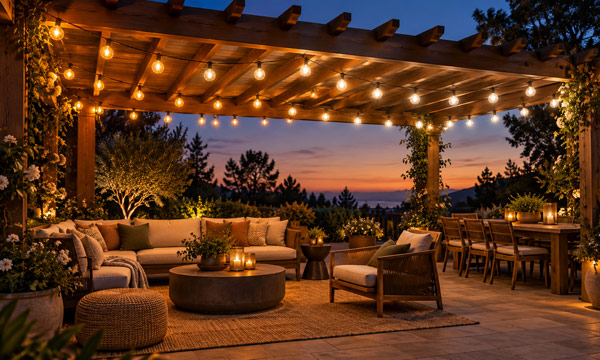
Color temperature describes how warm or cool white light appears. It is measured in kelvins, written as K.
For G40 patio lighting, these ranges create different effects:
- 2200K–2400K: An amber-toned glow suited to intimate decorative lighting.
- 2700K: Warm white light for relaxed seating and dining areas.
- 3000K: A slightly crisper warm white appearance that can coordinate with other outdoor fixtures.
Choosing the color temperature for pergola lighting is easier when you consider the surrounding lights. Matching nearby fixtures can make the overall space feel more consistent.
Color temperature does not indicate brightness. A warm bulb can be bright, and a cooler bulb can have a low lumen output.
Can G40 Bulbs Be Used Outdoors?
Yes, when the bulbs and the complete lighting system are rated for the intended outdoor conditions. The G40 designation itself says nothing about weather protection.
Check the bulb, sockets, cord, connectors, and any power supply. An outdoor-rated bulb does not make an indoor string-light cord suitable for rain.
Where an IP rating is provided, understanding IP44 vs. IP65 helps you interpret the stated protection. IP44 covers splashing water, while IP65 includes protection against water jets and dust ingress. Neither rating means a product can be submerged. Installation instructions and the rating of the complete assembly still matter.
For exposed locations, choose equipment explicitly approved for that exposure rather than relying on a general “outdoor” description.
G30 vs. G40 vs. G50: Which Size Should You Choose?
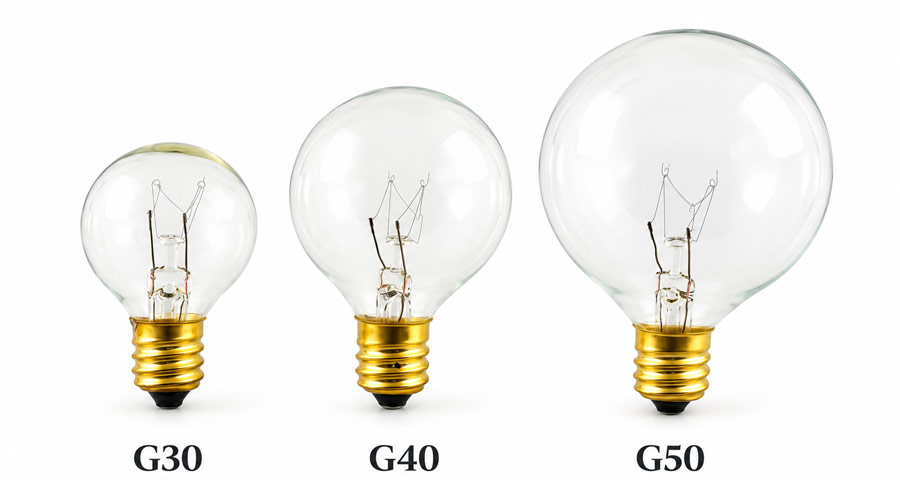
Within the small decorative string-light category, G30, G40, and G50 usually refer to globe diameters measured in millimeters.
| Decorative bulb size | Nominal globe diameter | Visual effect |
|---|---|---|
| G30 | 30 mm / 1.18 inches | Smaller, more delicate points |
| G40 | 40 mm / 1.57 inches | A moderately sized round globe |
| G50 | 50 mm / 1.97 inches | Larger, more prominent globes |
G40 can provide a balanced appearance where G30 looks too small and G50 feels visually dominant. That is an aesthetic choice, not a brightness rating.
A larger globe is not necessarily brighter or compatible with the same string. Compare the lumen output, base, voltage, and available clearance separately. Also confirm that the listing uses millimeter sizing before applying this table.
How to Choose the Right G40 Replacement Bulb
Before buying, compare the replacement against the original bulb and the lighting system’s instructions:
- Confirm the dimensions. Distinguish a 40 mm patio bulb from a 5-inch household globe.
- Match the base. Check the actual base code rather than assuming every G40 uses E12.
- Match the voltage. Use the supply requirements specified for the lighting system.
- Check actual wattage. Stay within the socket and complete string’s permitted load.
- Compare lumens and color temperature. Match neighboring bulbs if you want a consistent appearance.
- Confirm environmental suitability. Check outdoor exposure requirements and any enclosed-fixture restrictions.
The most useful replacement description combines these details. “G40” alone is incomplete; “40 mm G40, E12 base, matching voltage, warm white, approved for the intended outdoor use” gives you a much more reliable starting point.
FAQs
1. Are G40 LED bulbs dimmable?
Some are, and some are not. The product must explicitly state that it is dimmable, and the dimmer must support that LED bulb or string-light system. An LED bulb’s globe shape does not establish dimming compatibility. Some small G40 LED products are specifically listed as non-dimmable.
2. Why do G40 LED bulbs flicker?
Flicker can result from the LED driver or incompatibility between the driver and a dimmer. If flickering appears only when the lights are dimmed, check the supported dimmer type and operating range.
For broader troubleshooting, fixing flickering lights begins with identifying whether the problem affects one bulb or the entire installation. Disconnect power before inspecting bulbs or connections.
3. Do G40 string lights attract bugs?
They can. Insect attraction depends more on the light’s spectrum, intensity, and location than on its G40 shape. Amber or warm, low-output lighting generally attracts fewer insects than bright, blue-rich lighting, but no ordinary decorative bulb guarantees an insect-free patio.
Choosing outdoor string lights that attract fewer bugs also involves keeping unnecessary lighting away from seating areas.
4. Will the whole string go out if one G40 bulb fails?
It depends on the wiring, not the bulb’s shape. In a parallel-wired string, an individual bulb failure normally leaves the other bulbs operating. Series-wired sections can behave differently, and a problem with a shared fuse, controller, or power supply can affect multiple bulbs.
Check the string’s specifications rather than assuming all G40 sets work the same way.
5. How many G40 string-light sets can you connect together?
There is no universal number. Follow the manufacturer’s maximum connected-set count, total wattage, current rating, and run-length restrictions.
Lower-wattage LED bulbs reduce electrical load, but they do not cancel the cord or connector limits. Only connect sets designed for end-to-end operation, and observe whichever specified limit is reached first.
