
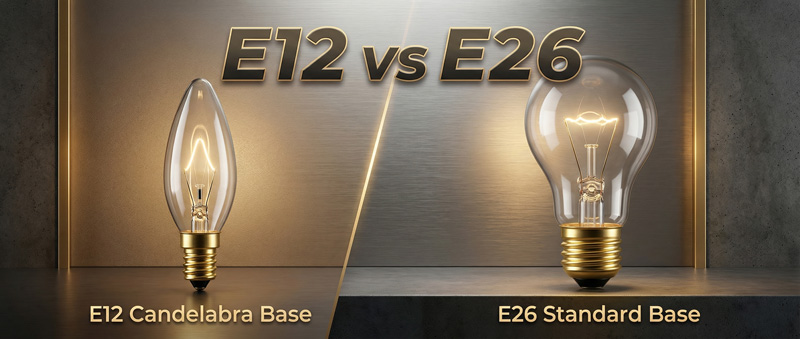
What Is an E12 Candelabra Bulb?
What Is an E26 Bulb?
Core Difference: Base Size and Fixture Compatibility
Quick Comparison Table
Dimensional and Aesthetic Considerations
Brightness and Illumination Performance
Performance Comparison Table
Energy Efficiency and LED Transition
Heat Management and Safety
Installation and Replacement Practicality
Application-Based Selection Guide
Best-Use Comparison Table
Cost and Market Availability
FAQs
When selecting a light bulb, many buyers focus first on brightness, color temperature, or energy savings. However, one of the most important specifications is often the simplest: the bulb base. A bulb with the wrong base will not fit the socket, regardless of how advanced or efficient it may be. Among the most common screw-base options in North America, the E12 candelabra bulb and the E26 bulb serve very different purposes. Understanding the distinction between them is essential for homeowners, interior designers, contractors, facility managers, and lighting retailers.
Although both are Edison screw-base bulbs, the E12 and E26 differ significantly in size, application, light output, fixture compatibility, aesthetics, and overall performance expectations. The E12 is typically associated with decorative and compact fixtures, while the E26 is the standard medium-base bulb used in most general household lighting. Choosing between them is not simply a matter of preference; it is a technical and practical decision shaped by fixture design, illumination needs, and safety requirements.
This article provides a professional, in-depth comparison of E12 candelabra bulbs and E26 bulbs, helping readers understand where each type performs best and how to make the right selection for residential or commercial use.
What Is an E12 Candelabra Bulb?
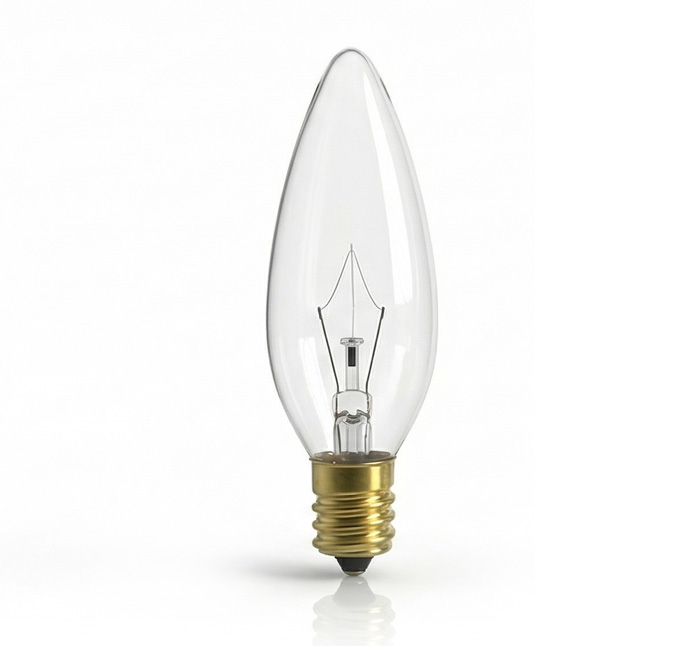
An E12 bulb uses an Edison screw base measuring approximately 12 millimeters in diameter. It is commonly called a candelabra base because it is frequently used in chandelier-style and candle-shaped lighting applications. E12 bulbs are often found in decorative fixtures where visual elegance matters as much as illumination.
Typical applications include chandeliers, wall sconces, ceiling fans, pendant lights, decorative lamps, night lights, and some appliance or specialty fixtures. Because these bulbs are used in smaller fixtures, they are generally more compact and are often produced in ornamental shapes such as candle, bent-tip candle, torpedo, globe, and small decorative LED designs.
E12 bulbs are available in incandescent, halogen, CFL, and LED versions, though modern markets are increasingly dominated by LED models due to energy efficiency, lower heat output, and longer lifespan.
What Is an E26 Bulb?
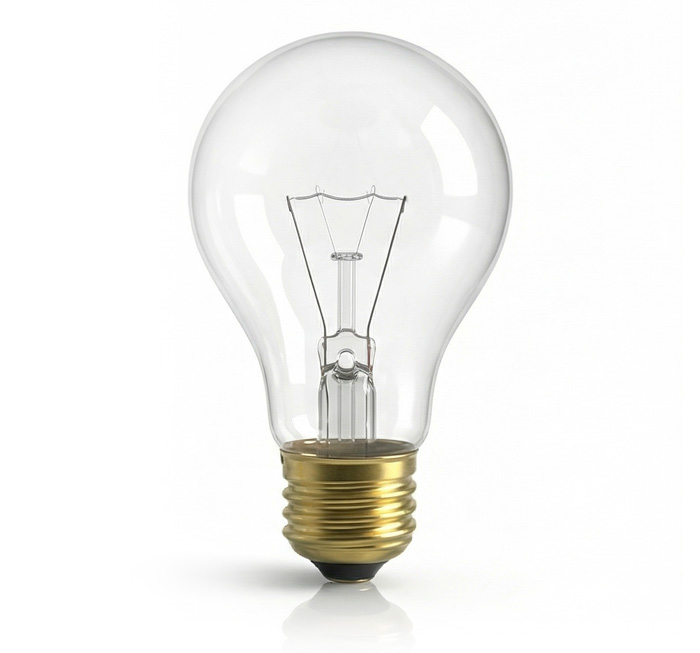
An E26 bulb uses an Edison screw base measuring approximately 26 millimeters in diameter. It is considered the standard medium base in the United States and many other markets using similar residential voltage systems. If a household lamp, ceiling fixture, or floor lamp uses a typical screw-in bulb, there is a strong chance it is designed for E26.
E26 bulbs are used for broad, general-purpose lighting. They appear in table lamps, floor lamps, recessed lights, ceiling-mounted fixtures, porch lights, garage fixtures, desk lamps, and many commercial luminaires. Since E26 is the most common bulb base for general lighting, it supports a wide variety of bulb shapes, including A19, BR30, PAR38, ST19, G25, and many others.
Like E12 bulbs, E26 bulbs are available in multiple lighting technologies, but LED versions now dominate the market because of their excellent energy efficiency and long operating life.
Core Difference: Base Size and Fixture Compatibility
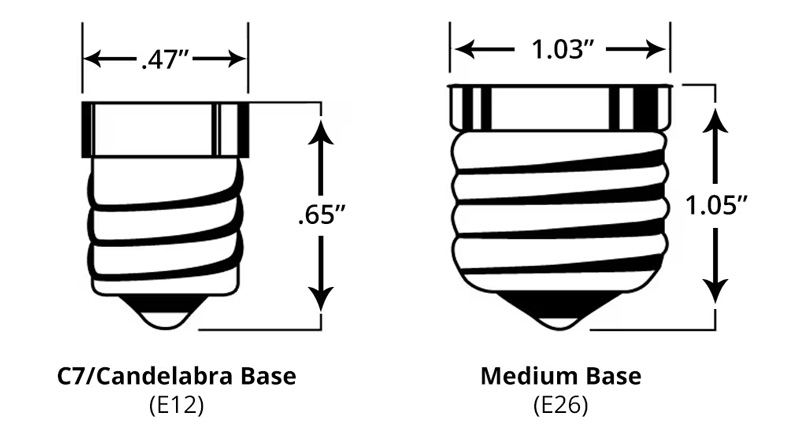
The most immediate difference between E12 and E26 bulbs is the base diameter. An E12 base is much smaller than an E26 base, and the two are not interchangeable without an adapter. Even when an adapter is available, it does not necessarily mean the substitution is advisable. Fixture wattage limits, physical dimensions, ventilation, and design intent must all be considered.
An E12 bulb is designed for small, decorative sockets. An E26 bulb is designed for standard medium-base sockets that support a much wider range of bulb types and output levels. In professional lighting practice, compatibility begins with the fixture manufacturer’s specifications, not with what can physically be forced into a socket.
Quick Comparison Table
| Feature | E12 Candelabra Bulb | E26 Bulb |
|---|---|---|
| Base Diameter | 12 mm | 26 mm |
| Common Name | Candelabra base | Medium or standard base |
| Typical Use | Decorative fixtures | General household and commercial lighting |
| Common Fixtures | Chandeliers, sconces, ceiling fans | Lamps, ceiling fixtures, recessed lights, outdoor fixtures |
| Usual Bulb Shapes | Candle, torpedo, globe, decorative LED | A19, BR30, PAR, globe, vintage, flood |
| Light Output Range | Usually lower to moderate | Moderate to high |
| Design Emphasis | Appearance and compact size | Versatility and broader illumination |
| Socket Compatibility | Fits E12 sockets only | Fits E26 sockets only |
| Common LED Availability | Yes | Yes |
| Ideal For | Accent and decorative lighting | Primary and general-purpose lighting |
Dimensional and Aesthetic Considerations
In lighting design, physical scale matters. E12 bulbs are valued because they fit neatly into smaller fixtures without visually overwhelming the design. In a crystal chandelier, for example, an oversized bulb could ruin the fixture’s proportions and create harsh glare. E12 bulbs preserve the refined, ornamental character of decorative lighting.
E26 bulbs, by contrast, are usually selected for practicality, light coverage, and wide availability. They are not limited to decorative use, although vintage Edison-style E26 bulbs have become popular in hospitality, retail, and residential interior design. Even so, the E26 format is typically associated with functional illumination rather than delicate presentation.
For designers, the choice often comes down to whether the bulb should blend into a fixture or serve as a workhorse light source.
Brightness and Illumination Performance
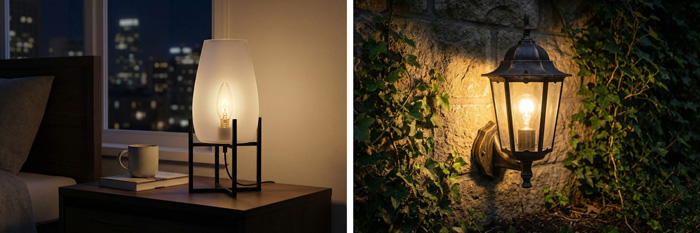
E12 bulbs are often used where softer, localized, or accent lighting is desired. In the past, incandescent E12 bulbs commonly produced relatively low lumen output. Modern LED E12 bulbs can be brighter than their older equivalents, but they are still generally used in fixtures where moderate light levels are appropriate.
E26 bulbs offer a broader performance range and are more suitable for ambient, task, or even high-output lighting applications. A standard E26 LED bulb may easily serve as the main light source in a bedroom, kitchen, office, or living room. The larger form factor also allows for designs such as floodlights and reflector bulbs, which direct light more efficiently for specific purposes.
In other words, if the goal is decorative sparkle or accent illumination, E12 is often the better fit. If the goal is room-filling brightness or practical everyday lighting, E26 is usually the preferred choice.
Performance Comparison Table
| Performance Factor | E12 Candelabra Bulb | E26 Bulb |
|---|---|---|
| Typical Lighting Role | Accent, decorative, supplementary | Ambient, task, general lighting |
| Average Brightness Potential | Lower to medium | Medium to high |
| Coverage Area | Small to moderate | Moderate to large |
| Beam Options | More limited in traditional decorative forms | Very broad, including omnidirectional and directional |
| Fixture Output Potential | Often constrained by fixture size | Usually greater due to larger fixture compatibility |
Energy Efficiency and LED Transition
From an energy-efficiency standpoint, the base type itself does not determine efficiency. The lighting technology does. Both E12 and E26 bulbs are available in LED versions that consume far less electricity than incandescent alternatives.
However, E26 bulbs tend to offer the widest range of high-efficiency LED products because they dominate the general lighting market. Manufacturers prioritize E26 for smart bulbs, high-lumen bulbs, dimmable bulbs, tunable white bulbs, color-changing bulbs, and specialty beam-angle products.
E12 LED bulbs are also efficient and long-lasting, but the selection is often narrower and more specialized. Many are intended to replicate the look of traditional flame-tip or candle bulbs while reducing energy use.
For projects emphasizing utility, scalability, and product variety, E26 has an advantage. For decorative retrofits where aesthetics are central, E12 LED solutions remain highly effective.
Heat Management and Safety
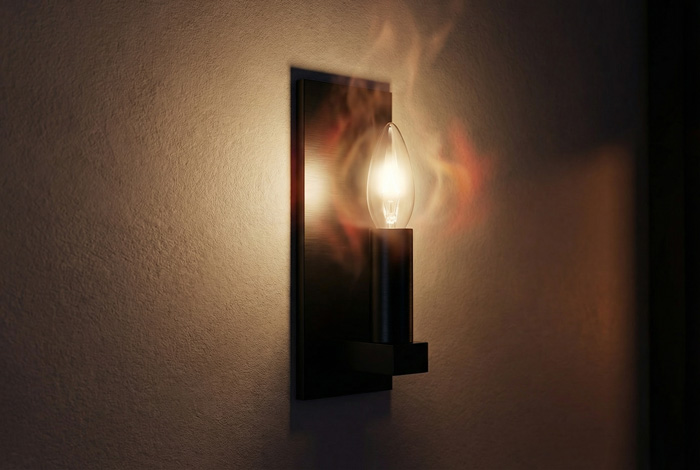
Heat is an important concern in any lighting system. Historically, incandescent E12 bulbs used in enclosed chandeliers or wall sconces could generate substantial heat, especially where multiple bulbs were installed close together. The shift to LED has significantly reduced this problem.
E26 bulbs may support higher wattage or higher lumen output, depending on the fixture. While LED versions run cooler than incandescent and halogen models, heat management still matters. Using a bulb that exceeds fixture ratings can shorten lifespan, damage components, or create safety risks.
Professionals should always check:
- the base type,
- the maximum wattage or LED-equivalent guidance,
- whether the fixture is enclosed or open,
- dimmer compatibility,
- voltage requirements,
- clearance for bulb shape and size.
Adapters should be approached cautiously. Even when an E12-to-E26 or E26-to-E12 adapter seems convenient, it may introduce size, thermal, or electrical compatibility issues that compromise fixture performance.
Installation and Replacement Practicality
E26 bulbs are usually easier to source, replace, and standardize across properties. For building managers or maintenance teams, this makes E26 particularly attractive. Stocking one common bulb type simplifies operations and reduces purchasing complexity.
E12 bulbs require more attention to decorative form, length, and style. For example, in a chandelier with exposed bulbs, the replacement must often match the original shape and finish to maintain visual consistency. A technically compatible bulb that looks different may still be unacceptable from a design standpoint.
Therefore, while E26 offers simplicity and convenience, E12 often requires more curated product selection.
Application-Based Selection Guide
The best bulb base depends on the application.
Choose E12 candelabra bulbs when:
- the fixture has a small candelabra socket,
- the design is decorative or ornamental,
- the bulb will remain visible,
- a chandelier, sconce, or ceiling fan requires compact lamp geometry,
- ambiance and elegance are as important as brightness.
Choose E26 bulbs when:
- the fixture has a standard medium socket,
- the space needs general illumination,
- brighter output is required,
- replacement convenience matters,
- smart lighting features or broad product selection are priorities.
Best-Use Comparison Table
| Scenario | Better Choice | Reason |
|---|---|---|
| Crystal chandelier | E12 | Matches decorative scale and socket design |
| Bedroom table lamp | E26 | Standard fit and strong general lighting |
| Wall sconce with exposed bulbs | E12 | Better visual appearance |
| Kitchen ceiling light | E26 | Higher lumen output for practical visibility |
| Ceiling fan light kit | Often E12 | Compact bulb size fits smaller housings |
| Smart home lamp | E26 | Wider smart bulb compatibility |
| Decorative restaurant fixture | E12 | Elegant presentation |
| Garage or utility room | E26 | Better for functional brightness |
Cost and Market Availability
E26 bulbs are generally more available and often more cost-effective because of their mass-market demand. Consumers can find them in virtually every hardware store, supermarket, home improvement center, and online lighting catalog.
E12 bulbs are also widely available, but the selection is more specialized. Decorative LED E12 bulbs, especially premium dimmable or filament-style versions, may cost more on a per-unit basis. In multi-bulb fixtures such as chandeliers, replacement costs can accumulate, although LED longevity helps offset this over time.
For procurement teams, E26 is usually the more efficient choice from a sourcing and inventory perspective. For decorative installations, E12 justifies its niche by offering the correct scale and visual quality.
FAQs
Can E12 and E26 bulbs have the same color rendering quality?
Yes. The base size does not determine color rendering performance. The key factor is the bulb’s CRI (Color Rendering Index).
For residential and hospitality use, a CRI of 80+ is standard, while 90+ CRI is preferred for spaces where accurate color appearance is important, such as bathrooms, retail displays, and dressing areas.
Are E12 and E26 bulbs available in different voltage ratings?
Yes. Both base types are commonly used in 120V North American systems but are also available in versions designed for 220–240V markets.
The base type only describes the screw size, not the operating voltage. Always match the bulb voltage to the fixture and local electrical standard to avoid failure or safety issues.
Does dimmer compatibility depend on the bulb base?
No. Dimming performance depends on the driver design and bulb electronics, not on whether the bulb uses an E12 or E26 base.
To ensure smooth dimming, verify that the bulb is labeled dimmable and compatible with the installed dimmer switch, especially when using LED lamps.
Are E12 and E26 bulbs suitable for damp or outdoor locations?
Only if the bulb is specifically rated for that environment. Some bulbs are approved for damp locations, while others are suitable for wet locations when used in properly sealed fixtures.
The base type does not indicate environmental resistance. Always check the bulb’s location rating and the fixture’s enclosure requirements for bathrooms, patios, or exterior lighting.
What certifications should professionals check before selecting E12 or E26 bulbs?
Professionals should review certifications such as:
- UL, ETL, or CSA listing for safety compliance
- Energy Star qualification where applicable
For commercial projects, it is also important to verify rated lifespan, beam consistency, color tolerance, and manufacturer warranty terms to ensure long-term performance and code-compliant installation.
