
Why Do Outdoor Lights Attract Bugs?
What Color String Lights Attract the Fewest Bugs?
Which Outdoor String Lights Tend to Attract More Bugs?
Are LED String Lights Better Than Incandescent String Lights for Bugs?
Does Color Temperature Really Matter for Bug Attraction?
Brightness Matters Almost as Much as Color
Use More Small Lights Instead of a Few Extremely Bright Ones
Keep String Lights Away From Dense Vegetation
Keep Lights Away From Doors and Windows
Avoid Lighting the Entire Yard
Timers and Smart Controls Can Reduce Insect Activity
What Specifications Should You Look for When Buying Bug-Resistant Outdoor String Lights?/a>
Are Solar String Lights Good for Avoiding Bugs?
Do Red String Lights Attract Bugs?
Do Bug-Repellent String Lights Actually Repel Bugs?
What About Mosquitoes Specifically?
Can You Mix Warm String Lights With Other Outdoor Lights?
Best String-Light Setup for a Patio With Lots of Bugs
Common Mistakes That Make Outdoor String Lights Attract More Bugs
Are Edison-Style LED String Lights Good for Reducing Bugs?
How Low Should the Color Temperature Be?
FAQs
Outdoor string lights can make a patio, pergola, deck, garden, or backyard dining area feel warm and inviting after sunset. Unfortunately, the same light that creates a pleasant atmosphere for people can also attract moths, mosquitoes, beetles, flies, and other insects.
The good news is that not all outdoor string lights attract bugs equally.
Amber, yellow, and very warm white LED string lights generally attract fewer insects than cool white, daylight, blue, or ultraviolet-rich lights. For most residential outdoor spaces, LEDs in the 2200K to 3000K color-temperature range offer one of the best combinations of comfortable illumination, decorative appearance, energy efficiency, and reduced insect attraction.
No outdoor light can guarantee a completely bug-free space. Insects respond to light in different ways, and attraction also depends on brightness, spectrum, surrounding vegetation, season, location, and how long the lights remain on. Still, choosing the right spectrum and using the lights strategically can make a noticeable difference.
Why Do Outdoor Lights Attract Bugs?
To choose string lights that attract fewer bugs, it helps to start with the reason insects gather around lights in the first place.
Many nocturnal insects use natural light sources such as the moon and stars as part of their orientation and navigation behavior. Artificial lighting can interfere with these systems. A bright point of light may cause insects to circle a fixture, repeatedly approach it, or remain close to it for extended periods.
Light does not affect every insect species in exactly the same way. Different insects have different visual systems, but many flying insects are especially sensitive to shorter wavelengths of light.
These wavelengths are concentrated toward the ultraviolet, violet, and blue portions of the spectrum.
That is why a bright bluish-white lamp often produces more visible insect activity than an amber lamp producing the same general amount of useful illumination.
The issue is therefore not simply whether a bulb is bright or dim. The spectral composition of the light matters.
What Color String Lights Attract the Fewest Bugs?
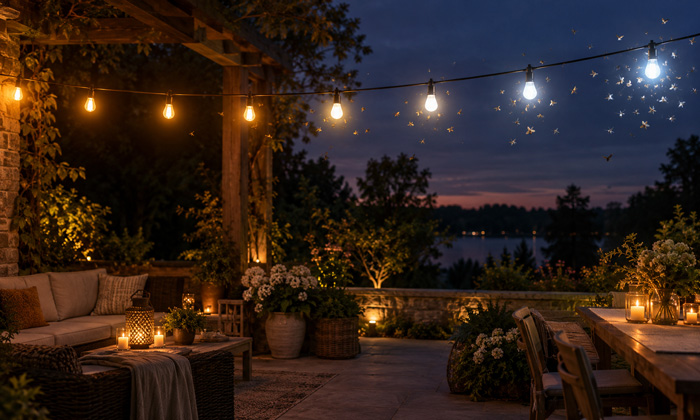
For decorative outdoor lighting, the general order from lower to higher insect attraction tends to favor warmer wavelengths.
Amber String Lights
Amber LEDs are among the strongest choices for areas where reducing insect attraction is a priority.
Amber light contains relatively little short-wavelength blue energy compared with typical white LEDs. Depending on the LED technology, amber output is concentrated largely in longer visible wavelengths, making it less visually stimulating to many nocturnal flying insects.
Amber string lights can work particularly well around:
- Patios
- Garden seating areas
- Outdoor dining tables
- Pergolas
- Gazebos
- Balconies
- Campsites
- Covered porches
They also create a warm decorative atmosphere that resembles candlelight or traditional filament lighting.
The trade-off is color perception. Under deeply amber lighting, greens, blues, and some decorative colors will not look as natural as they do under high-quality white light. That matters less for casual ambience but can become noticeable in outdoor kitchens, dining spaces, and landscaped entertaining areas.
Yellow String Lights
Yellow light also tends to attract fewer insects than blue-rich white light.
Traditional "bug lights" often use yellow because their spectrum reduces the short-wavelength output that attracts many flying insects. Modern LED versions can produce a similar effect while consuming considerably less energy than older incandescent bulbs.
Yellow LEDs are a practical option where insect reduction takes priority over precise color rendering.
They are somewhat brighter-looking and more visually distinct than deep amber products, although the exact appearance depends heavily on the LED spectrum and diffuser.
Extra-Warm White LED String Lights
For homeowners who want conventional white decorative lighting without turning a patio orange or yellow, extra-warm white LEDs are often the best compromise.
Look for string lights around:
2200K–2700K
These lamps create a candlelike or traditional incandescent appearance while generally producing less blue light than 4000K, 5000K, or 6500K LEDs.
String lights around 2200K can look noticeably golden. Products around 2700K provide a familiar warm-white appearance that works well with wood, brick, stone, outdoor furniture, and residential architecture.
Color temperature plays an important role in creating the right atmosphere outdoors. Factors such as CCT and CRI in garden lighting influence both the warmth of the light and how accurately surrounding objects appear under illumination. Lower Kelvin values create a warmer visual effect, while CRI helps determine how naturally colors are displayed.
For decorative string lights, this distinction is useful because two bulbs can both be called "warm white" yet produce noticeably different visual results. Checking the actual Kelvin rating gives a more reliable indication than relying only on marketing terms printed on the package.
Warm White 3000K LEDs
A 3000K LED is still relatively warm and is widely used in residential landscape lighting.
It may attract somewhat more insect activity than a carefully designed amber or 2200K source, but it generally remains a better choice for bug-sensitive areas than high-CCT cool white light.
A 3000K system can be particularly suitable where you need a slightly cleaner white appearance for food preparation, stairs, walkways, or general patio use while maintaining a warm residential atmosphere.
Which Outdoor String Lights Tend to Attract More Bugs?
Some light sources are much less suitable for a patio where insect activity is already a problem.
Cool White LEDs
Cool white LEDs commonly fall around 4000K to 5000K.
They provide a crisp appearance and can make an outdoor space feel brighter, but they normally contain more blue spectral energy than warm-white alternatives.
That stronger short-wavelength component can make the lights more attractive to many nocturnal insects.
For security or task lighting, cool white may have practical applications. For string lights directly above a dining table or seating area, there is usually little reason to choose it when insect reduction is one of the goals.
Daylight LEDs
Daylight lamps commonly range from approximately 5000K to 6500K.
They produce a distinctly cooler white appearance and typically contain substantial blue energy. Although they can create excellent perceived brightness, they are generally a poor choice for decorative string lighting intended to minimize insect attraction.
A backyard covered with daylight-white string lights may also feel visually harsher than one illuminated with warm white or amber light.
Blue Decorative Lights
Blue LEDs are especially undesirable where reducing insect activity is the main objective.
Many insects have visual sensitivity that extends strongly into blue and shorter wavelengths. A decorative blue-light installation can therefore become a highly noticeable nighttime stimulus.
Blue lighting can still be used temporarily for events or decorative themes, but it is not the first choice for a patio where people want to dine or relax without insects clustering around the lamps.
Ultraviolet and Black Lights
Ultraviolet light should be avoided entirely when the goal is to attract fewer insects.
UV is deliberately used in many insect traps precisely because numerous insects respond strongly to it. A UV-rich light source positioned close to a patio can draw insects toward the very area where people are sitting.
This is also why the statement that "all LEDs attract fewer bugs" is too broad. LED technology itself does not determine insect attraction. The spectrum produced by the LED matters far more than the fact that it is an LED.
Are LED String Lights Better Than Incandescent String Lights for Bugs?
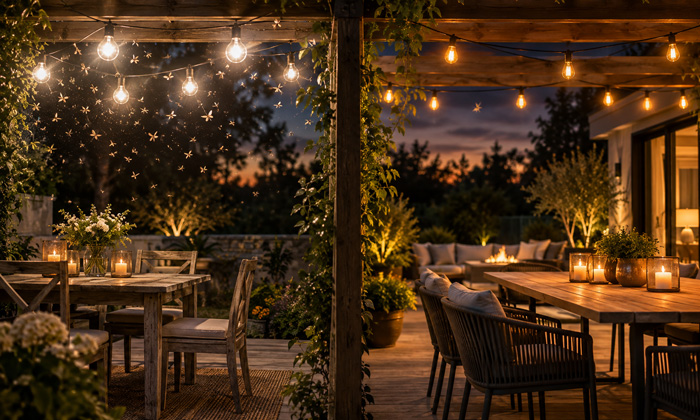
In many cases, yes.
LED string lights offer several characteristics that make them suitable for bug-conscious outdoor lighting.
First, LEDs can be designed with tightly controlled spectra. Manufacturers can produce amber, yellow, 2200K, 2400K, 2700K, and other warm outputs without generating large amounts of ultraviolet radiation.
Second, LEDs operate more efficiently and generally produce less radiant heat around the bulb surface than traditional incandescent lamps.
Heat is not the primary reason insects gather around most lights, but reducing both unnecessary heat and unwanted spectral output can make an installation less attractive to insects overall.
Third, LEDs make dimming and automatic control much easier. A patio does not need maximum output throughout the entire evening. Lowering brightness after dinner or switching decorative lights off when the space is empty reduces unnecessary nighttime illumination.
Traditional incandescent string lights can produce a beautiful warm spectrum and are often less problematic than very cool white sources, but they consume considerably more power and generate more heat. For permanent outdoor installations, modern warm-spectrum LEDs usually provide better efficiency and control.
Does Color Temperature Really Matter for Bug Attraction?
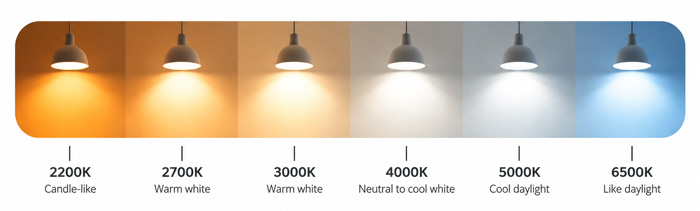
Yes, but color temperature should be treated as a practical indicator rather than a complete description of the spectrum.
CCT, measured in Kelvin, describes the perceived color appearance of white light.
Lower values appear warmer:
- 2200K: very warm, candlelike
- 2700K: warm white
- 3000K: warm to soft white
- 4000K: neutral to cool white
- 5000K: cool daylight
- 6500K: daylight-like, strongly cool
As a general purchasing rule, lower-CCT string lights are usually preferable when trying to reduce bug attraction because they tend to contain less blue energy.
However, two 2700K LEDs made with different LED packages can have different spectral distributions. CCT alone therefore cannot perfectly predict insect response.
Products specifically described as low-blue, amber, wildlife-friendly, or turtle-friendly may provide more targeted spectral control than an ordinary warm-white LED.
For most homeowners, though, choosing a reputable 2200K–2700K LED string light remains a simple and effective starting point.
Brightness Matters Almost as Much as Color
A warm bulb can still attract insects when it is unnecessarily bright.
Insect attraction depends partly on how visually prominent the light source is relative to its surroundings. A bright lamp against a dark backyard produces a strong contrast that can be visible from a considerable distance.
That means a 2200K bulb running at very high output may not necessarily outperform a moderate-output warm light simply because its color temperature is lower.
For patios and decorative spaces, choose enough illumination to provide comfort and orientation without flooding the entire garden with light.
Dimmable string lights are particularly useful because their output can be matched to the activity.
A brighter setting may be convenient during food preparation. Later in the evening, the lights can be reduced to a softer level for conversation and relaxation.
Use More Small Lights Instead of a Few Extremely Bright Ones
String lighting has one natural advantage over high-output outdoor fixtures: illumination is distributed across many small points of light.
That makes it possible to produce useful ambient illumination without creating one extremely bright source.
The goal should still be controlled output, however. A dense installation containing hundreds of high-lumen bulbs can create far more total light than the area actually needs.
Spacing bulbs appropriately and using lower-output LEDs often creates better ambience while reducing glare and the overall visual signal presented to nearby insects.
Keep String Lights Away From Dense Vegetation
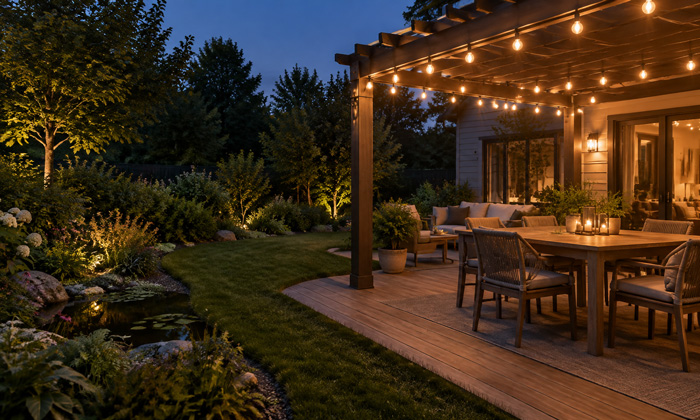
Fixture placement can affect insect activity almost as much as bulb selection.
Gardens, shrubs, trees, flowering plants, ponds, and groundcover naturally support insect populations. Installing string lights directly through dense vegetation can illuminate insects close to their existing habitat.
Instead, concentrate decorative illumination around the human activity zone.
For example, string lights can be suspended over a patio, attached to the outer structure of a pergola, or installed along a deck edge rather than wrapped through shrubs and flowering trees.
Artificial light can influence more than insects. Nighttime illumination may also affect surrounding ecosystems by changing animal activity, plant responses, feeding patterns, and habitat behavior. The way garden lighting affects plants and animals has become an important consideration in outdoor lighting design, especially when trying to balance visual comfort with a healthier nighttime environment. Keeping light concentrated where people actually need it helps reduce unnecessary spill into surrounding vegetation.
This approach can also improve the visual design of the landscape by preserving darker backgrounds, which makes illuminated seating areas feel more defined.
Keep Lights Away From Doors and Windows
Even low-attraction string lights can bring some insects into the general area.
Installing them immediately beside an open door can therefore encourage insects to move indoors whenever people enter or leave.
A better layout positions the main decorative lighting slightly away from entrances while keeping doors, windows, and screened openings comparatively dark.
This is especially useful during warm evenings when moths, flying beetles, and other nocturnal insects are highly active.
Outdoor dining areas can use the same principle. Rather than placing the brightest bulb directly above food, distribute lower-output warm light around the seating space.
Avoid Lighting the Entire Yard
Reducing insect attraction does not require eliminating outdoor lighting. It requires controlling where the light goes.
A common mistake is combining decorative string lights with several bright wall lights, floodlights, path lights, and landscape spotlights operating simultaneously.
Even when the string lights themselves use an insect-friendly spectrum, nearby high-output cool-white fixtures can dominate the environment and continue drawing insects toward the area.
For a patio gathering, use only the fixtures necessary for safe movement and comfortable visibility.
Lighting the occupied zone while preserving darker areas elsewhere often produces a more attractive nighttime environment as well.
Timers and Smart Controls Can Reduce Insect Activity
The length of time a light operates matters.
Lights that remain on from sunset until sunrise create a long period during which insects can encounter the source. Decorative string lights rarely need to operate all night.
Timers, smart plugs, lighting controllers, and built-in schedules can turn them off automatically after the outdoor space is no longer in use.
Motion controls are less common for decorative string lights but can work for supporting pathway or entrance lighting.
Dimming is another useful strategy. Full brightness may be necessary for part of the evening, while a lower level can provide enough ambience later.
The most bug-conscious outdoor lighting system combines warm spectrum, moderate brightness, controlled placement, and limited operating hours rather than relying on bulb color alone.
What Specifications Should You Look for When Buying Bug-Resistant Outdoor String Lights?
Marketing descriptions can be vague, so product specifications deserve more attention than packaging phrases such as "cozy glow" or "warm ambience."
A suitable outdoor string-light product should ideally meet several criteria.
1. LED Light Source
Choose LED rather than fluorescent or ultraviolet-containing decorative light sources.
LEDs provide excellent spectral control, low energy consumption, long service life, and a wide range of warm color temperatures.
2. Color Temperature of 3000K or Lower
For general residential patios, 2200K–2700K is an excellent target.
3000K remains acceptable where a slightly whiter appearance is preferred.
Avoid products advertised only as "bright white," "cool white," or "daylight" when no Kelvin rating is provided.
3. Amber or Low-Blue Output
For areas with severe insect activity, dedicated amber LEDs may outperform ordinary white LEDs.
Products designed to reduce blue spectral energy can also be suitable for gardens near natural habitats.
4. No UV Output
Decorative patio string lights do not need ultraviolet output.
Avoid black-light effects and UV-enhanced products around seating and dining spaces.
5. Dimmable Operation
Dimming gives you direct control over the strength of the nighttime light signal.
It also allows the same string-light installation to support both functional and decorative use.
6. Appropriate Lumen Output
Higher lumen ratings are not automatically better.
Outdoor string lights are usually ambient fixtures rather than floodlights. Moderate output distributed across several bulbs can provide plenty of illumination.
7. Suitable Outdoor Protection
Bug resistance means little when the string lights cannot survive rain, humidity, dust, or irrigation.
For exposed outdoor installations, inspect the ingress-protection rating of the string lights, lamp holders, connectors, plugs, and power supply. Weather resistance is especially important for products used in gardens and patios, where moisture, dust, and rain exposure are common. Understanding IP65 protection for garden lighting helps clarify what level of outdoor protection a fixture actually provides, as this rating indicates dust-tight construction and resistance to water jets rather than protection from continuous submersion.
String-light systems should still be installed carefully, ensuring connectors are positioned away from standing water and allowing proper drainage after rainfall.
Are Solar String Lights Good for Avoiding Bugs?
Solar power itself does not determine whether a light attracts insects.
A solar string light with a cool-white or blue-rich LED can still attract insects. A mains-powered amber string light may attract far fewer.
The same selection principles apply:
- Choose warm or amber LEDs.
- Keep brightness moderate.
- Avoid UV output.
- Position the lights away from dense vegetation.
- Limit operating hours.
Solar string lights do have one practical advantage: their light output is often relatively modest because the system must operate from stored battery energy. Lower brightness can reduce the visual reach of the light source.
However, extremely low output may also make them unsuitable for tasks requiring clear visibility.
The best choice should therefore be based on spectrum and useful brightness rather than power source alone.
Do Red String Lights Attract Bugs?
Red light can be less attractive to many insect species because longer wavelengths are poorly perceived by some insects.
That does not automatically make red string lights the best choice for normal patios.
Human visual performance and color recognition under saturated red illumination are limited. Food, plants, faces, furniture, and architectural materials can look unnatural.
Red string lights may work for specialized decorative applications, but amber or extra-warm white usually provides a more practical balance between reduced insect attraction and comfortable human vision.
For most residential applications, there is little need to sacrifice normal color appearance by switching completely to red.
Do Bug-Repellent String Lights Actually Repel Bugs?
The word "repellent" deserves caution.
Most warm-colored string lights do not actively repel insects. They simply tend to be less attractive than light containing stronger blue or ultraviolet wavelengths.
That distinction matters.
Changing from a cool-white bulb to an amber bulb does not create an invisible barrier around the patio. Insects may still appear because they are naturally present in the garden and may be attracted by flowers, moisture, food odors, people, or other nearby light sources.
A well-designed lighting system reduces one major attractant rather than eliminating every possible source of insect activity.
Claims that a particular visible light color completely eliminates mosquitoes or all flying insects should therefore be treated skeptically.
What About Mosquitoes Specifically?
Mosquito behavior is more complicated than simply flying toward the nearest light.
They use multiple cues to locate hosts, including carbon dioxide, body heat, moisture, and odors. Light can influence their behavior, but changing bulb color does not eliminate the biological signals produced by people sitting outdoors.
Warm and amber lighting can reduce unnecessary visual attraction compared with blue-rich lighting, but it should not be treated as a complete mosquito-control method.
From a lighting standpoint, the useful strategy remains the same: do not create a brighter, bluer environment than necessary.
That keeps the string-light installation from adding another strong nighttime signal to an area already occupied by people.
Can You Mix Warm String Lights With Other Outdoor Lights?
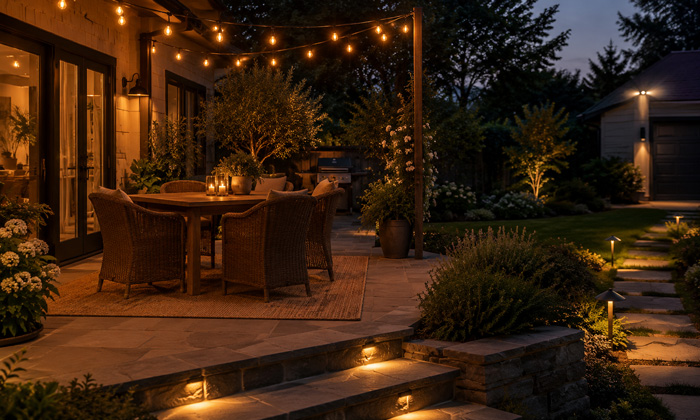
Yes, but the entire lighting environment needs to be considered.
A patio may use 2200K string lights while a nearby 6000K security floodlight remains on throughout the evening. In that situation, changing the string-light color may produce only a limited reduction in overall insect attraction because the floodlight is still emitting a much stronger blue-rich signal.
Try to coordinate nearby fixtures.
Warm path lights, shielded wall lights, low-level step lights, and warm string lights can work together without flooding the entire garden.
Security fixtures can use motion activation so that high-output illumination operates only when needed.
This produces a better balance between visibility, safety, atmosphere, and insect activity.
Best String-Light Setup for a Patio With Lots of Bugs
A practical low-attraction patio installation could use:
- 2200K–2700K LED bulbs
- Amber LEDs in areas with particularly heavy insect activity
- No UV or blue decorative output
- Dimmable controls
- Moderate individual bulb brightness
- String placement centered around the patio rather than surrounding vegetation
- Warm supporting path or step lights
- Automatic shutoff after the patio is no longer occupied
- Outdoor-rated sockets, connectors, and power components
This combination addresses several factors at once.
Spectrum reduces the wavelengths most attractive to many insects. Moderate output prevents unnecessary brightness. Placement keeps the light concentrated around people rather than nearby habitat. Scheduling prevents the system from operating throughout the entire night.
The result is usually much more effective than simply purchasing a product labeled "bug light."
Common Mistakes That Make Outdoor String Lights Attract More Bugs
Even well-chosen string lights can perform poorly when the rest of the installation works against them.
One common mistake is selecting a low-CCT product but operating it at excessive brightness.
Another is hanging warm string lights next to a powerful daylight-white wall fixture.
A third is extending decorative lighting deep into shrubs, flowering plants, or trees where insects are already active.
Leaving lights on until sunrise also increases exposure time unnecessarily.
Finally, buyers sometimes focus entirely on the visible color of a bulb. Two bulbs can look similarly warm to people while having different spectral characteristics. A defined Kelvin rating and low-blue or amber specification provide more useful information than a photograph on the package.
Are Edison-Style LED String Lights Good for Reducing Bugs?
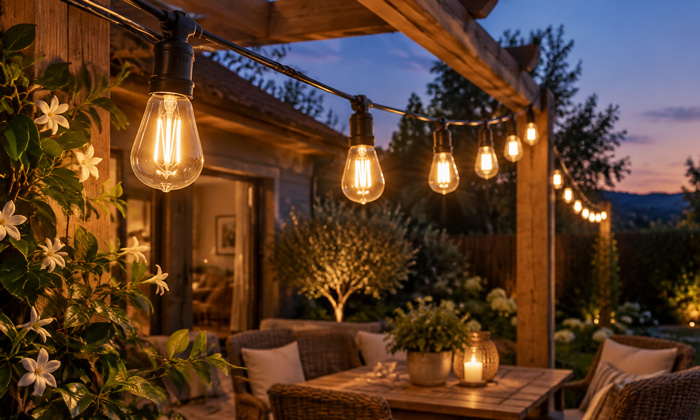
They can be.
Edison-style outdoor string lights are popular because their visible filaments and warm appearance create a traditional café or bistro atmosphere. Many LED versions are available around 2200K or 2700K.
Those warmer versions are well suited to bug-conscious patio lighting.
However, the Edison shape itself has no effect on insect attraction. The LED spectrum, brightness, and color temperature determine how the light behaves.
A 2200K Edison-style LED is likely to be a better choice than a 5000K decorative bulb, while a cool-white Edison-style product offers no special advantage simply because it resembles a vintage lamp.
How Low Should the Color Temperature Be?
For most homes, there is no need to pursue the lowest possible Kelvin value.
A useful guideline is:
2200K: Excellent for very warm decorative ambience and low-blue applications.
2400K: Warm and golden, suitable for hospitality-style patios.
2700K: The most versatile residential choice, balancing warm appearance with good visibility.
3000K: Still warm enough for many outdoor applications, with a cleaner white appearance.
4000K and above: Better avoided in bug-sensitive decorative areas unless a functional requirement justifies the cooler light.
Amber can be considered separately because many amber LEDs are narrow-spectrum sources rather than conventional white LEDs described by normal CCT values.
FAQs
Do outdoor string lights with covers attract fewer bugs than exposed bulbs?
Bulb covers and diffusers can reduce glare and soften the appearance of outdoor string lights, but they do not automatically make the lights less attractive to insects.
The main factors affecting bug attraction are still the light spectrum, color temperature, brightness, and UV output. A covered amber or warm white LED string light will generally perform better than a covered cool white bulb.
Can outdoor string lights near water attract more insects?
Yes, outdoor string lights installed near ponds, fountains, pools, or damp garden areas may experience more insect activity because these locations already provide suitable habitats for many species.
Using warm-spectrum LEDs with controlled brightness and directing light away from water surfaces can help reduce unnecessary attraction around these areas.
Do flickering string lights attract more bugs than steady lights?
Flickering patterns are not usually the primary factor influencing insect attraction, but rapidly changing light effects can create unpredictable visual signals in outdoor environments.
For areas where reducing insect activity matters, steady warm or amber illumination is generally a better choice than flashing or high-frequency decorative effects.
Are solar string lights less attractive to bugs than plug-in string lights?
The power source does not determine whether string lights attract insects.
Solar and plug-in models can have similar insect responses when they use the same LED color and brightness. The important factors are the wavelength output, color temperature, and intensity of the light rather than how the lights receive power.
Can outdoor string lights attract spiders and other insects indirectly?
Yes, outdoor lights may indirectly increase spider activity because spiders often move toward areas where flying insects gather.
Choosing amber or warm white LEDs, reducing unnecessary brightness, and limiting light spill can lower the number of insects around the fixture, which may also reduce the food source that attracts predators.
