
Table of Contents
- How Red, Green, and Blue Light Mix
- What RGB Means on an LED Fixture
- Can RGB Lights Produce White Light?
- Why the Same RGB Setting Looks Different Across a Garden
- How to Test an RGB Lighting Scene Outdoors
- 1. Start with the route people use
- 2. Hold a white card beside the target
- 3. Adjust the footprint before raising the brightness
- 4. Save a setting for an ordinary evening
- FAQs
RGB stands for red, green, and blue. It’s an additive color model, which means it creates colors by combining light. A screen varies the red, green, and blue components of each pixel to build an image. An RGB LED fixture uses the same principle to produce a beam that can change color.
The difference becomes clear when you take that color outside. A teal setting that looks vivid on your phone can look bright on pale stone and subdued on a dark timber fence. The phone shows a sample. In the garden, the fixture, the surface, and the surrounding light all shape what you see. That’s why choosing a color for outdoor lighting starts with deciding where the beam will land.
How Red, Green, and Blue Light Mix
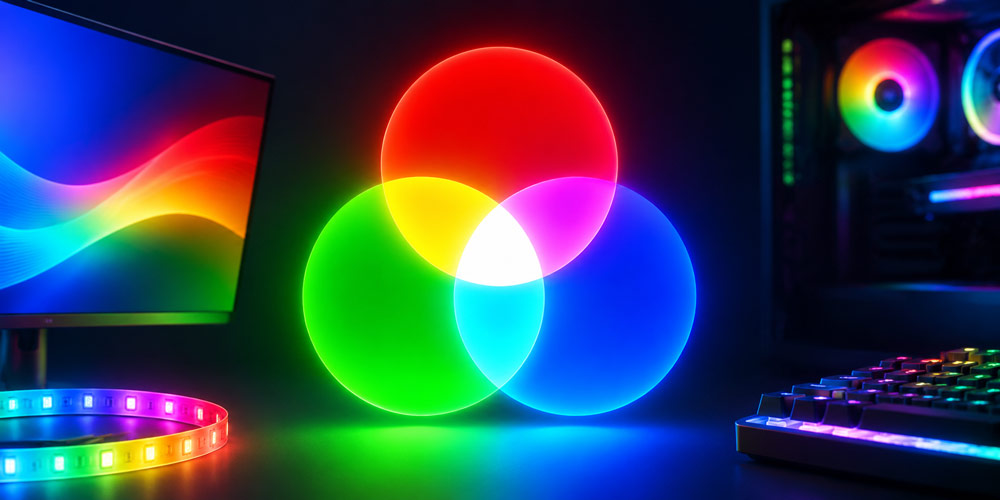
Each letter in RGB represents a channel, an independently adjustable contribution to the color. As a controller raises or lowers each channel, the mixture changes. Add green gradually to red, for example, and the light can move through orange toward yellow. Add blue to a suitable mix of red and green, and it can appear white. Your eye sees the combined effect of the light reaching it.
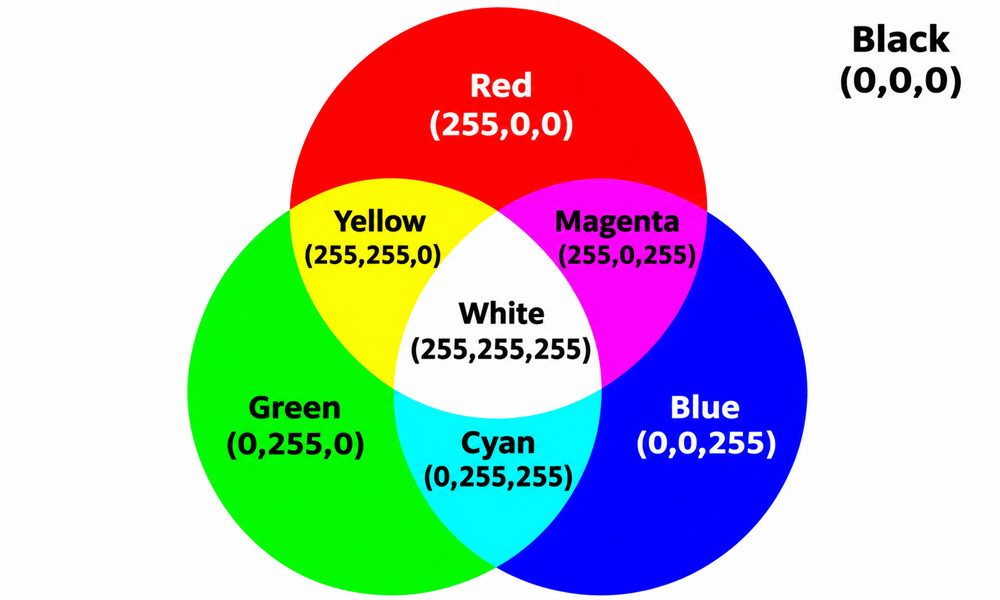
Here’s how common combinations are represented in 8-bit sRGB, a standard color space used on the web.
| Channels contributing | Example RGB value | Result in sRGB |
|---|---|---|
| Red | 255, 0, 0 |
Red |
| Green | 0, 255, 0 |
Green |
| Blue | 0, 0, 255 |
Blue |
| Red and green | 255, 255, 0 |
Yellow |
| Red and blue | 255, 0, 255 |
Magenta |
| Green and blue | 0, 255, 255 |
Cyan |
| All three at their maximum encoded values | 255, 255, 255 |
White |
| All three at zero | 0, 0, 0 |
Black |
With 256 possible values per channel, 8-bit RGB gives you 16,777,216 numerical combinations. That figure counts codes. The range of colors a device can actually reproduce, called its gamut, depends on the primaries it uses. Even the scale has a wrinkle. In sRGB, a channel value of 128 corresponds to about 22% of that channel’s full linear-light level. A fixture’s brightness slider can follow a different curve, so percentages are most useful for recalling a setting on the same system.
What RGB Means on an LED Fixture
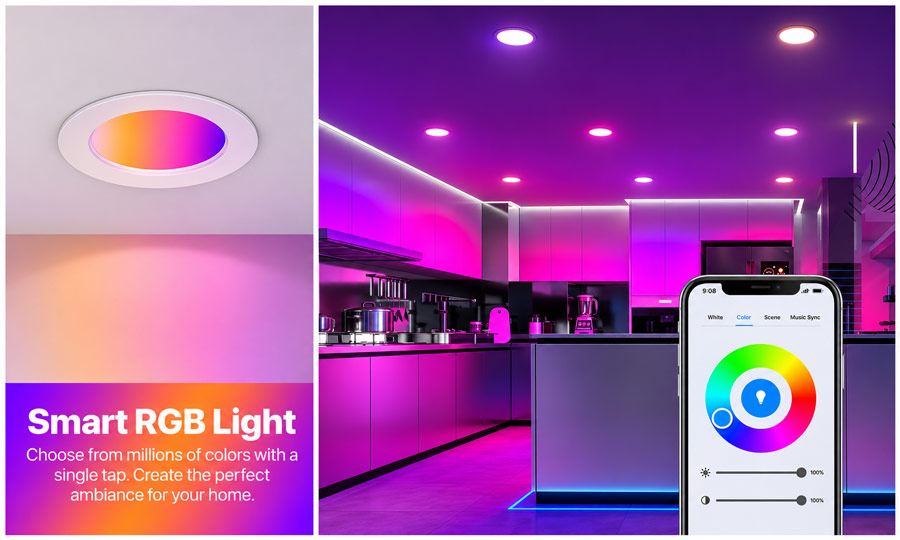
Smart RGB lighting offers app-controlled colors and customizable effects to create the perfect ambiance for any space.
On a light fixture, RGB tells you that the red, green, and blue outputs can be adjusted to create different hues. One channel can drive a single emitter or a group of emitters. In color-changing light bulbs, a compact controller adjusts those channels inside the lamp. In a landscape system, a separate controller may manage several fixtures or lighting zones. Either way, the color control changes how much each channel contributes.
A color wheel is a convenient way to make that adjustment. The swatch on your screen and the fixture’s beam are produced by different devices, each with its own primaries and calibration. Two fixtures set to the same blue-green preset can also differ when aimed at a shared wall. One might lean toward blue while the other reads as mint. If the fixtures will illuminate adjacent sections, judge the transition on the wall itself. A small mismatch can be more obvious where two beams meet than when you look at each fixture separately.
The optics matter as well. A well-mixed beam looks like a single color across the area it covers. At close range, a fixture with separately positioned emitters can show traces of individual colors near the beam’s edges. A sample aimed from the intended mounting distance tells you more about the final effect than a close-up view of the LEDs.
Can RGB Lights Produce White Light?
Yes. An RGB fixture can produce white-looking light when it balances the three channels appropriately. A piece of white paper can look similarly white under two fixtures, while the same red cushion or clay planter looks different under each one. The reason is that different mixtures of wavelengths can produce a similar impression of white. A white made from three narrow color bands can reveal materials differently from a white LED that emits across a broader range of wavelengths.
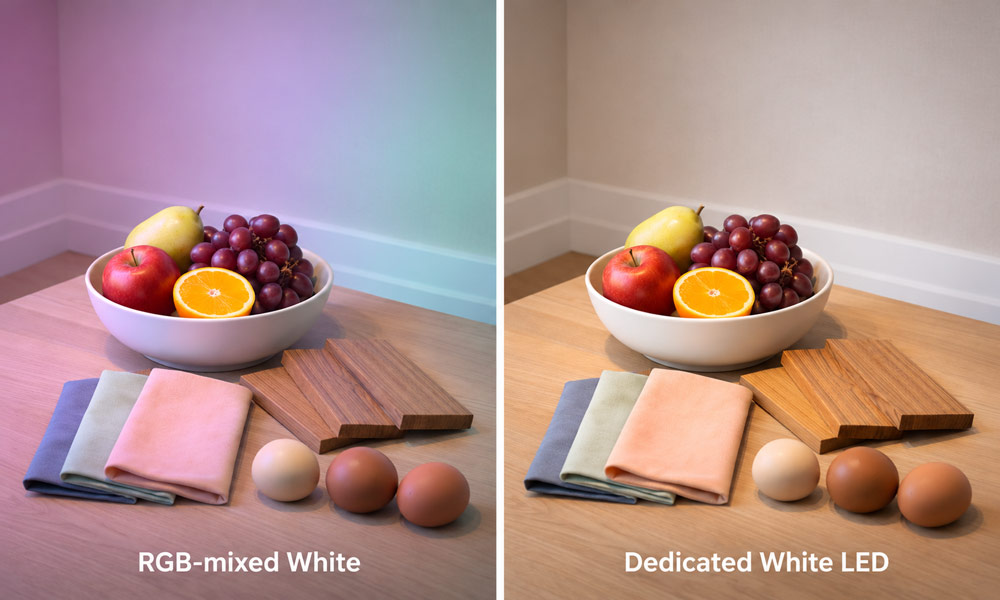
Building Technologies Office. (2016). LED color characteristics (PNNL-SA-117512) [Fact sheet]. U.S. Department of Energy, Office of Energy Efficiency and Renewable Energy.
Two specifications help you evaluate the white mode. Correlated color temperature, or CCT, describes how warm or cool the white appears, in kelvin. Color rendering index, or CRI, summarizes how faithfully a light renders a set of sample colors compared with a reference. When you compare CCT and CRI in garden lights, check that both values apply to the white mode you expect to use. A warm-looking setting and good color rendering are separate qualities.
| Fixture configuration | What it offers | Where it fits |
|---|---|---|
| RGB | Three color channels that can also mix to create a white appearance | A feature wall, planter, or seasonal display with separate everyday lighting |
| RGBW | RGB plus a dedicated white channel | A patio or courtyard fixture that will serve both white and colored scenes |
| RGB with tunable white | Color effects plus a choice of warmer and cooler white settings | An area where the white tone needs to coordinate with existing fixtures or change between scenes |
A dedicated white channel gives you a separate source to evaluate. If a fixture will light an outdoor dining table most evenings, compare its white output on skin tones, food, and timber before spending time on its color presets. For a fixture that will mainly color a backdrop, the evenness and spread of the beam may matter more. In either case, check the performance of the mode you’ll use most often.
Why the Same RGB Setting Looks Different Across a Garden
When you look at a lit surface, you see the light that surface reflects toward you. The result depends on the wavelengths in the beam and how strongly the material reflects each of them. A pale, neutral surface can show much of the beam’s color. A strongly colored surface can suppress some parts of the mix and emphasize others.
International Commission on Illumination. (2020). Colour stimulus function. In ILV: International lighting vocabulary (2nd ed., CIE S 017/E:2020, entry 17-23-003).
Picture a magenta beam, made mainly from red and blue, falling across a pale wall and a green hedge. The wall can show a bright magenta patch. The hedge may look darker because healthy green leaves generally reflect more green light than red or blue in the visible range. Glossy leaves can still catch bright magenta highlights at certain angles. From a seat across the patio, you might see those highlights clearly. From the path beside the hedge, you might see mostly dark foliage.
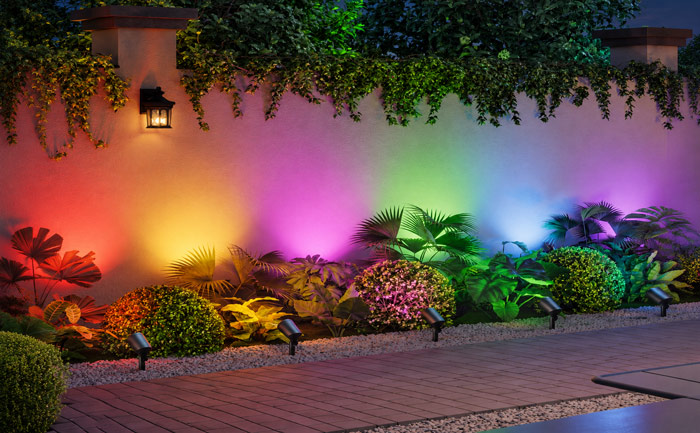
You can use that difference deliberately. A pale wall is a good place to display a recognizable color for a gathering. A planting bed can be a better place to show shape. Light one side of a shrub and let the gaps between branches stay darker. On a textured wall, a beam aimed across the surface can make joints and ridges more visible. In both cases, where the light falls can have a bigger effect on what you notice than another adjustment to the color wheel.
The rest of the scene matters, too. A small pool of color can draw the eye when the background is dark. Turn on a nearby porch light and that same pool becomes part of a brighter scene. Evaluate the accent with the lights you normally leave on, especially if the garden is usually viewed from indoors or from a fixed seating area.
How to Test an RGB Lighting Scene Outdoors
1. Start with the route people use
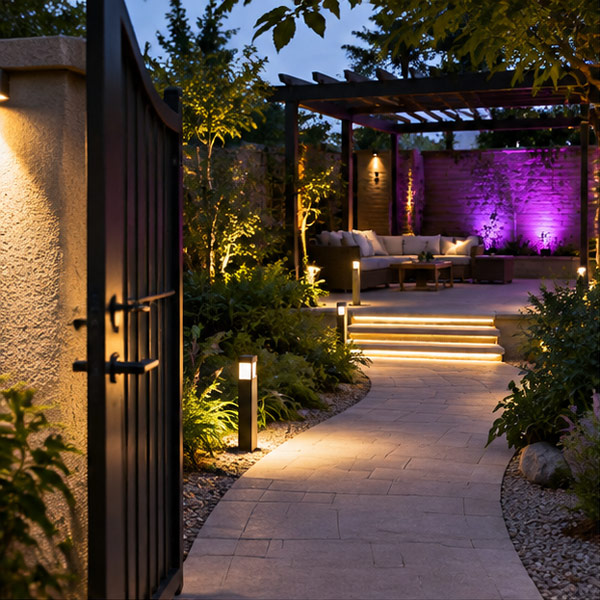
Walk from the gate or door to the seating area after dark. Look for the places where people need to read an edge, find a latch, or see a change in level. Establish that everyday lighting first. A steady white light can make those features easy to pick out, while a colored accent can draw attention farther into the garden. Give each beam a clear target and use only as much light as the job requires.
2. Hold a white card beside the target
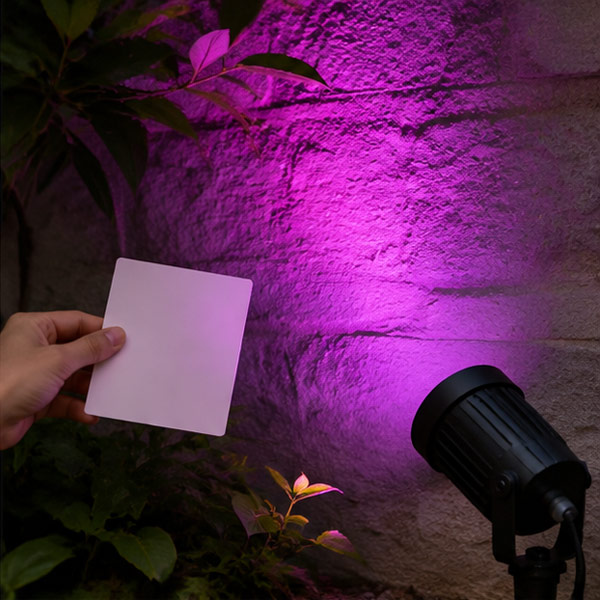
Aim one fixture at the surface you want to light. Hold a matte white card next to it, at roughly the same angle to the beam, and keep the color and brightness steady. If the card shows the hue you wanted but the material looks dull or shifts color, try a mix that the material reflects more strongly. You can also move the accent to a nearby surface. If both the card and the target show an unexpected tint, start by adjusting the fixture’s color setting. This quick comparison helps you decide what to change before you add more fixtures.
3. Adjust the footprint before raising the brightness
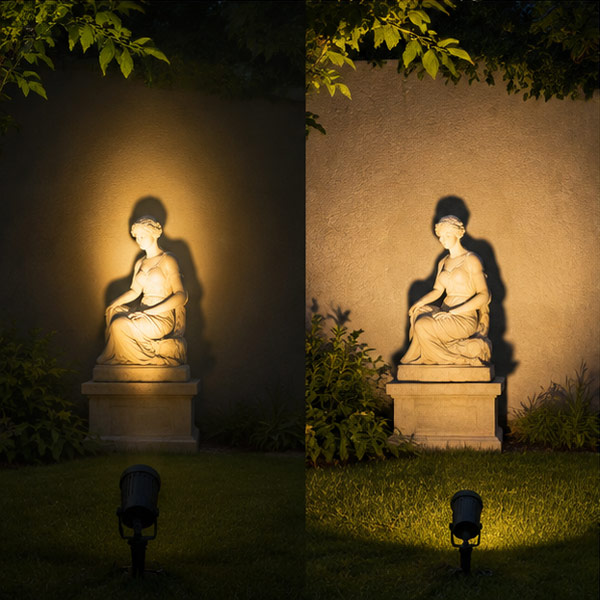
Stand where you’ll normally see the feature. If the beam lights the paving and fence along with a small sculpture, check the spotlight’s beam angle and aim. At the same distance, a narrower beam covers a smaller area. A wider one can suit a broad wall where you want more even coverage. Also look from a seated position. A fixture tucked out of sight from the path can still shine directly into someone’s eyes across the patio.
4. Save a setting for an ordinary evening
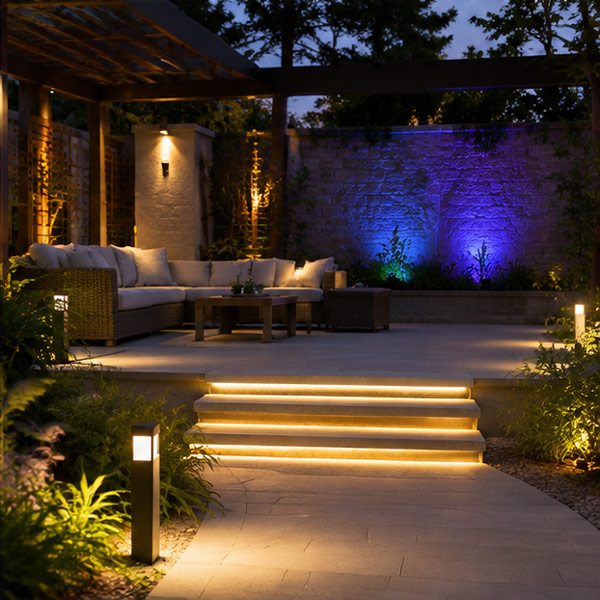
Try a scene you’d want to use on a quiet weeknight. For example, keep the steps and seating in warm white and use a dim color accent on a single wall at the far end of the patio. For a gathering, you can make that wall more vivid while keeping the route through the space easy to read. Once the scene is set, walk in from the entrance and notice where your eye goes first. If the brightest patch is on the paving beside the feature, adjust the aim before you change the hue.
FAQs
1. What is the difference between RGB and CMYK?
CMYK stands for cyan, magenta, yellow, and black. It’s used in four-color printing, where inks absorb parts of the light that hits the paper. An RGB screen color can fall outside the range a particular printer, ink, and paper combination can reproduce. If the same design will appear on a screen and on a printed sign, use the printer’s color profile and review a proof for highly saturated colors.
2. How does RGBIC differ from standard RGB?
A conventional RGB strip usually shows one color across the length connected to a single controller output. With RGBIC lighting, integrated circuits let different sections of the same strip display different colors simultaneously. One controllable section may contain a single LED or several LEDs. Check that grouping if you want a smooth moving gradient or a pattern that travels along the strip.
3. Do RGB lights use more electricity than white lights?
Power use depends on the fixture, the brightness setting, and which channels are active. For a fair comparison, use the input wattage for the settings that deliver a comparable result in your space. To estimate energy use, multiply watts by hours of operation and divide by 1,000. An 18-watt setup running four hours a night for 30 nights uses 2.16 kWh.
4. Can you cut RGB LED strip lights to length?
Yes, if the model is designed to be cut. Disconnect the power supply and use the designated cut line on the strip, often marked with a scissors symbol or positioned between contact pads. For an outdoor installation, follow the manufacturer’s approved sealing procedure for the cut end. Check the cutting interval before ordering if the strip needs to fit a precise length.
5. Do RGB lights attract bugs?
They can. In field studies, several groups of flying insects showed greater attraction to lights with more short-wavelength output, including blue light. The response varies by species and location. If insects gather near a seating area, try an amber or yellow outdoor light with low blue output and compare activity on similar evenings.
