

What Is RGB Lighting?
What Is RGBIC Lighting?
RGBIC vs RGB: Quick Comparison
The Differences That Matter Before You Buy
Which Is Better for Outdoor and Garden Lighting?
How to Choose Between RGB and RGBIC
FAQs
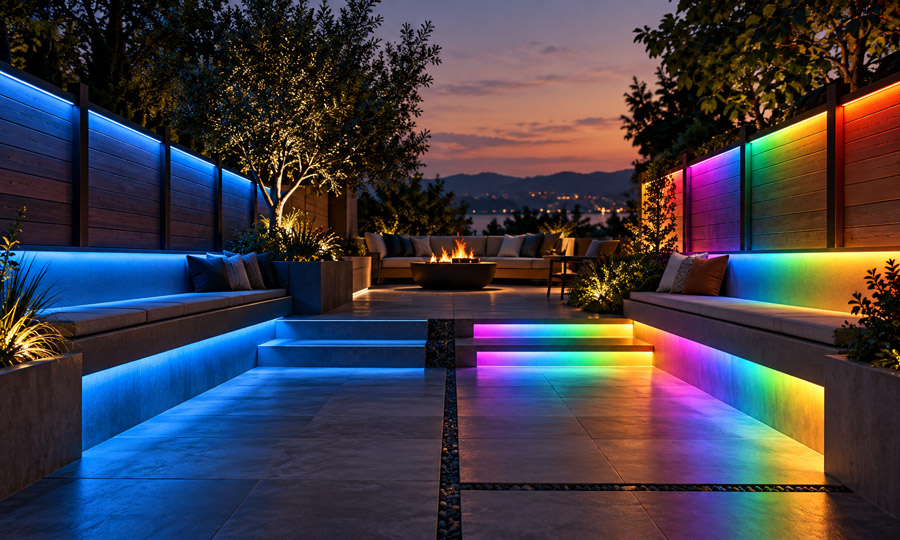
The main difference between RGBIC and standard RGB lighting is color control. A conventional RGB strip displays one color across the entire strip at a time. RGBIC lighting can display different colors in separate sections simultaneously, allowing gradients, chasing patterns, and other moving effects.
For buyers, the decision starts with a simple question: do you want a consistent color throughout your lighting, or different colors along the same run?
RGB can be enough for a steady accent around a shelf or patio. RGBIC makes sense when a changing pattern is part of the design. Brightness, white-light quality, weather resistance, and installation flexibility still need to be checked separately.
What Is RGB Lighting?
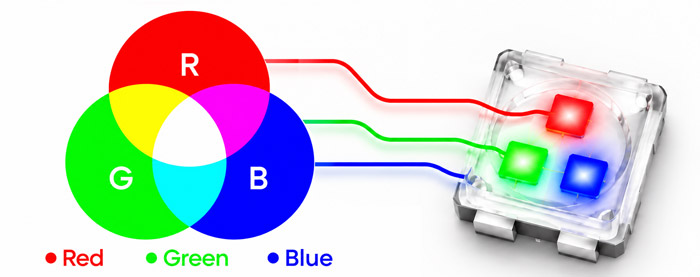
RGB stands for red, green, and blue. By adjusting the output of these three color channels, LEDs can produce a wide range of colors.
On a conventional, non-addressable RGB strip, the LEDs share the same color settings. Select purple, and the whole strip turns purple. Choose a fade effect, and the entire strip changes together.
This does not mean RGB lighting is limited to a fixed color. Depending on the controller, it can dim, cycle through colors, flash, or respond to music. Its limitation is that different sections of the same controlled strip cannot independently display different colors.
Strictly speaking, RGB describes the color channels. In this comparison, “RGB” refers to the conventional non-addressable strips commonly contrasted with RGBIC products.
What Is RGBIC Lighting?
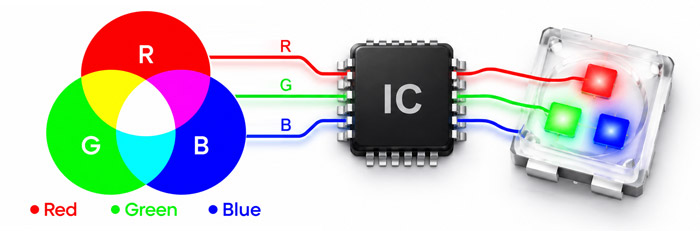
RGBIC lighting adds independent control to RGB color mixing. Integrated circuit chips allow different LEDs or groups of LEDs to receive separate instructions.
One section can show blue while another shows pink and another displays green. Changing those sections in sequence creates the appearance of movement along the strip.
The size of each controllable section varies. Some products control individual LEDs; others control groups. The number of LEDs on a strip is therefore not necessarily the number of independently adjustable zones.
RGBIC vs RGB: Quick Comparison
| Feature | Standard RGB | RGBIC |
|---|---|---|
| Colors displayed simultaneously | One color per controlled strip or zone | Different colors across independently controlled sections |
| Color changes | Whole strip changes together | Sections can change separately |
| Typical effects | Solid colors, whole-strip fades and flashes | Gradients, chasing colors, moving patterns |
| Best reason to choose it | Consistent color with straightforward control | Multiple colors or movement along one run |
| White light | Mixed from RGB unless dedicated white LEDs are included | Also mixed from RGB unless dedicated white LEDs are included |
| Cutting and extension | Depends on the product and marked cut points | Depends on the product, controller, and supported configuration |
| Smart features | Model-dependent | Model-dependent |
| Brightness and power use | Check product specifications | Check product specifications |
The biggest upgrade is control over where colors appear. It is not an automatic upgrade in every other lighting characteristic.
The Differences That Matter Before You Buy
Color Effects and Zone Control
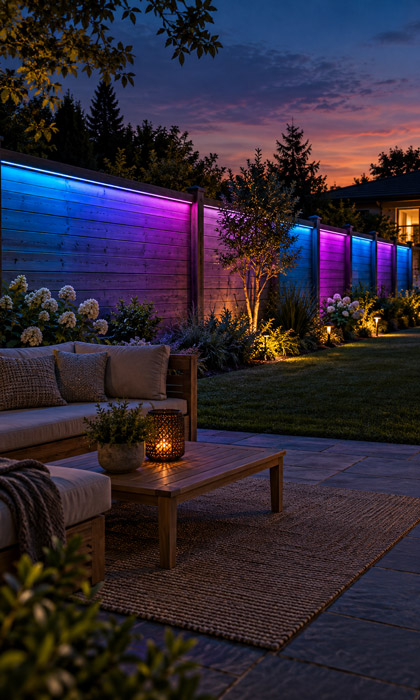
Imagine lighting a long garden fence.
With a standard RGB strip, the entire run might glow blue in the evening, then switch to purple for a party. With RGBIC, that same run could display a blue-to-purple gradient or a moving sequence of alternating colors.
This makes RGBIC useful when the lighting itself is a visual feature. For a quiet, consistent glow beneath a bench, those additional effects may be less important.
For animated displays, check the number of independently controlled zones and the available effects. Closely spaced LEDs can help the light look continuous, but LED density and control-zone density are different specifications.
Brightness
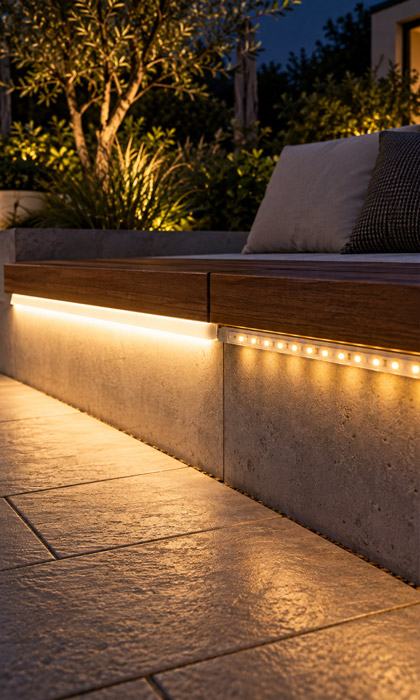
RGBIC is not inherently brighter than RGB. The label describes control capability, so it is not enough to compare light output.
Brightness depends on the actual LEDs, power supplied, operating mode, and optical design. A diffuser or cover also affects how the light is distributed and how visible individual dots appear.
Compare published lumen ratings for the same length and operating mode where available. A white-mode rating should not be treated as the output of every saturated color setting. Manufacturer specifications illustrate why the whole product matters: Govee attributes the M1’s output to its LED density and chip design as well as its lighting technology.
White-Light Quality
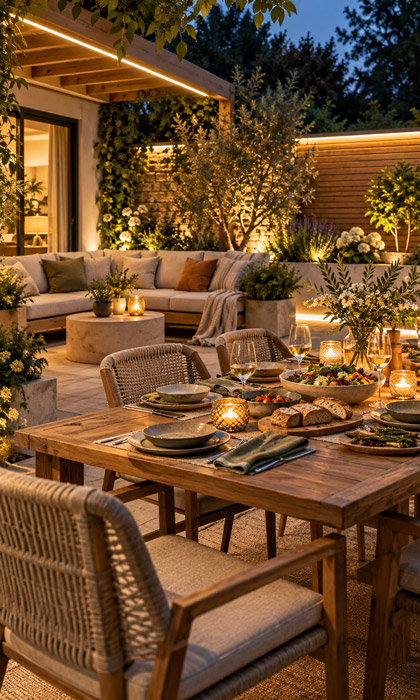
Both basic RGB and basic RGBIC products create a white-looking output by combining red, green, and blue. Independent control does not add a dedicated white LED.
If you want lighting for reading, dining, or everyday visibility, check whether the product includes dedicated white channels. RGBW products add white, while some addressable products combine independent color control with dedicated white LEDs. Naming varies, so confirm the actual specification.
For garden seating and dining areas, color temperature and color rendering are useful checks. Color temperature describes the warm or cool appearance of white light; color rendering describes how naturally illuminated objects appear. Neither can be determined from “RGBIC” alone.
Cutting and Installation
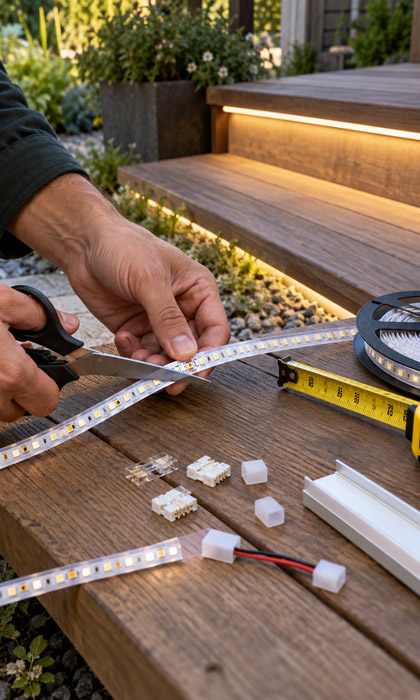
Some RGBIC strips can be cut, and others cannot. Follow the instructions for the exact model.
Before purchasing either type, check:
- Whether cutting is permitted.
- Where the approved cut points are.
- Whether cut sections can be reused.
- Whether extensions are supported.
- Whether the controller needs configuration after shortening.
- How outdoor connections and cut ends must be sealed.
Measure each intended section before ordering. A strip that fits a continuous perimeter may be inconvenient for several short, separate shelves or stair sections.
Controllers and Smart Features
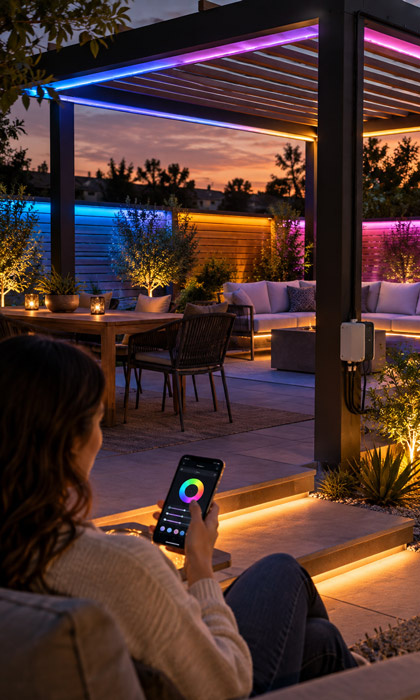
A conventional RGB controller adjusts shared color channels. An addressable controller sends data that determines what individual sections display. These are different control methods.
Do not assume a controller is compatible because the connector fits. Match the strip’s voltage, electrical connections, and supported control protocol. Applying power alone is not enough to operate an addressable strip that requires a data signal.
Likewise, RGBIC does not automatically mean Wi-Fi, voice control, or compatibility with every smart-home platform. Those features belong to the specific controller and product ecosystem. Manufacturer comparison tables list connectivity and voice-assistant support separately for different models.
Choose based on the controls you will actually use: a remote, an app, scheduled scenes, or integration with an existing system.

Purchase Price and Running Cost
RGBIC products often cost more because they provide additional control hardware and effects. Whether that premium is worthwhile depends on how often you will use multiple colors or animations. Compare complete kits of similar length and specification, including the controller and power supply.
Electricity use is a separate comparison. It depends on the product’s power draw, brightness settings, displayed colors, and operating hours. Addressable-lighting documentation shows that power demand can change substantially between full white output and color animations.
For a basic estimate:
Energy use in kWh = average input power in watts × operating hours ÷ 1,000
A lighting system averaging 30 watts for five hours a day uses approximately 4.5 kWh over 30 days. Multiply that figure by your electricity rate to estimate its monthly energy cost. This is an illustrative calculation, not a typical rating for either technology.
Which Is Better for Outdoor and Garden Lighting?
RGB and RGBIC can serve different purposes in the same garden. Start with the effect and location rather than choosing one technology for every fixture.
Choose RGB for Consistent Color Accents
Standard RGB is a practical option when you want an entire feature to share one color:
- A uniform glow beneath outdoor seating.
- A single-color accent along a sheltered perimeter.
- A consistent color wash behind a decorative feature.
- Occasional whole-run color changes for celebrations.
A steady color can keep the scene visually calm while allowing seasonal changes.
Choose RGBIC for Multicolor Displays
RGBIC is better suited to designs where colors vary along the installation:
- Alternating holiday colors along a roofline.
- Gradients around an outdoor entertaining area.
- Moving patterns along a fence.
- Decorative scenes with separately colored sections.
Before buying, consider how the lights will look from the normal viewing position. A pattern that looks clear close up may blend together when viewed across a garden.
Check Outdoor Suitability Separately
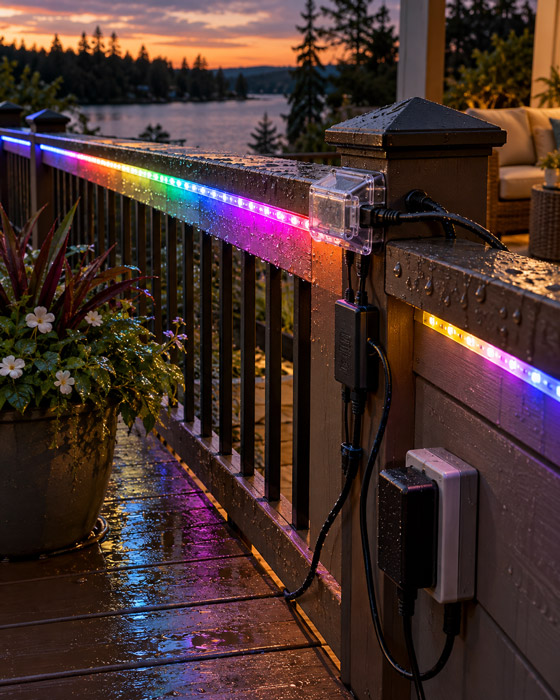
Weather Resistance and Outdoor Use
Neither RGB nor RGBIC indicates weather resistance. Check the rating and installation instructions for the strip, controller, power adapter, and connections.
Understanding IP44 vs IP65 helps distinguish protection levels, but an IP rating does not answer every outdoor durability question. Exposure to sunlight, temperature, standing water, and the way connections are installed also matter.
As a design approach, use decorative color to complement the lighting needed for paths, steps, and entrances. Keep everyday visibility in mind when choosing brightness and scenes.
How to Choose Between RGB and RGBIC
Use these questions to narrow down your options:
-
Do you want different colors on the same strip at the same time?
If yes, look for RGBIC or another suitable addressable system. -
Will you mostly use one steady color?
A conventional RGB product may meet the brief without paying for unused effects. -
Do you also need good everyday white light?
Check dedicated white channels, color temperature, and color-rendering specifications. -
Does the installation require precise cuts or several separate sections?
Confirm the permitted layout before purchasing. -
Will the lights be outdoors?
Verify the suitability of the complete system for the intended exposure. -
Do you need a particular app or smart-home connection?
Check the exact model’s compatibility.
FAQs
Is RGBIC the Same as ARGB?
RGBIC and ARGB both refer to lighting systems with individually controlled colors, but they are not universal compatibility standards.
RGBIC is commonly used in decorative lighting products, while ARGB is frequently used for PC components. Always check voltage, pin configuration, data protocol, and manufacturer requirements before connecting different systems.
Do RGBIC Lights Automatically Match the Colors on a TV Screen?
No. RGBIC allows multiple colors to appear on a strip, but automatic screen matching requires additional hardware or software that can capture and process screen content.
Depending on the product, this may include a camera, HDMI sync box, or compatible software. Standard RGBIC effects do not automatically provide TV synchronization.
Can RGBIC Lights Work Without Wi-Fi?
Yes, if the product supports other control methods such as Bluetooth, a remote control, or built-in buttons.
Without Wi-Fi, some features such as remote access, cloud control, and certain voice assistant functions may not be available. Check the offline functions before purchase.
Can Multiple RGBIC Strips Be Synchronized?
Yes, when the strips and control system are designed to support synchronization.
However, controlling multiple strips together is different from creating synchronized animations or music effects. Check supported devices, connection limits, and whether additional controllers are required.
Why Does My RGBIC Strip Show Different Colors at the Far End?
If the far end of an RGBIC strip appears dimmer or shows different colors, voltage drop may be one possible reason. Resistance along the strip can reduce the voltage reaching distant LEDs, especially at higher brightness levels.
Test the strip using the manufacturer-approved setup and check whether lowering brightness improves consistency. Do not increase the supply voltage to compensate, as this may damage the lighting system.