

The Basic Principle: Mixing Light
What Is Inside a Color Changing Bulb?
How the Bulb Changes Color
How Smart Color Bulbs Are Controlled
Why Some Bulbs Produce Better Colors Than Others
Color Temperature and White Light
Energy Efficiency
Conclusion
FAQs
Color changing light bulbs look simple from the outside, but inside they combine LED technology, electronic control, and color mixing. Unlike traditional bulbs that produce one fixed shade of light, color changing bulbs can create millions of colors by adjusting the brightness of different tiny LEDs built into the bulb.
The Basic Principle: Mixing Light
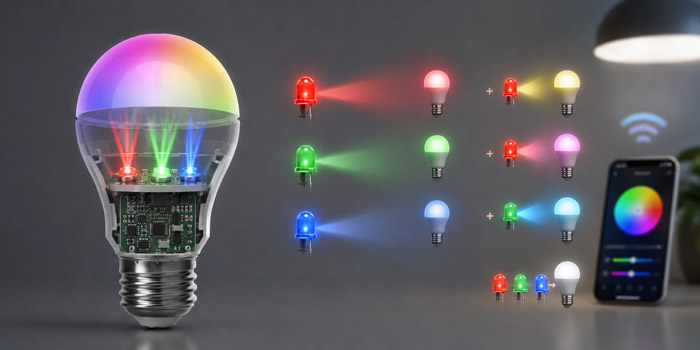
Most color changing bulbs use the RGB color model. RGB stands for red, green, and blue. These three colors are the primary colors of light. By changing how bright each color is, the bulb can create many different shades.
For example, red and green light together can produce yellow. Blue and green can create cyan. Red and blue can create magenta. When red, green, and blue are all turned on at high brightness, the result appears close to white.
Some bulbs also include dedicated white LEDs. These are often labeled as RGBW or RGBCW bulbs. The extra white LEDs help produce cleaner, brighter, and more natural-looking white light than RGB LEDs alone.
What Is Inside a Color Changing Bulb?
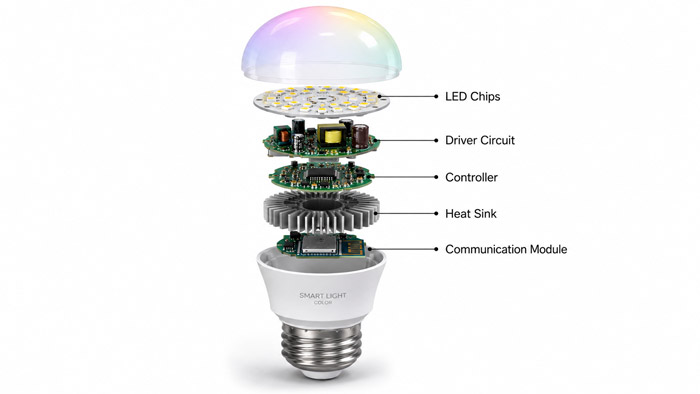
A color changing bulb usually contains several key components: LED chips, a driver circuit, a controller, a heat sink, and a communication module. Each part has a specific job.
|
Component |
Function |
|---|---|
|
Red, green, and blue LEDs |
Produce colored light used for color mixing |
|
White LEDs |
Create more natural white light and improve brightness |
|
LED driver |
Controls electrical power sent to the LEDs |
|
Microcontroller |
Processes commands and adjusts color or brightness |
|
Wireless module |
Allows control through Wi-Fi, Bluetooth, Zigbee, or another system |
|
Heat sink |
Helps remove heat and protects the electronics |
|
Diffuser cover |
Softens and blends the light so colors look smooth |
The bulb changes color by adjusting the power sent to each LED channel. This is usually done through a method called pulse-width modulation, or PWM.
PWM turns LEDs on and off very quickly. The switching happens so fast that the human eye does not notice it. Instead, we perceive the LED as brighter or dimmer depending on how long it stays on during each cycle. If the red LED is on more than the blue and green LEDs, the bulb looks red. If the blue LED is strongest, the bulb looks blue. By carefully balancing the three channels, the bulb can create a wide range of colors.
How Smart Color Bulbs Are Controlled
Many color changing bulbs are smart bulbs. This means they can receive commands from an app, remote control, smart speaker, or home automation system.
When you choose a color in an app, the app sends a signal to the bulb. The bulb’s wireless module receives that signal and passes it to the microcontroller. The microcontroller then adjusts the LED channels to match the selected color and brightness.
Different bulbs use different communication methods. Wi-Fi bulbs connect directly to a home router. Bluetooth bulbs connect directly to a phone or nearby device. Zigbee and Z-Wave bulbs usually connect through a smart home hub.
Why Some Bulbs Produce Better Colors Than Others
Not all color changing bulbs have the same quality. Better bulbs often have more accurate color control, stronger brightness, smoother dimming, and better white light. Lower-quality bulbs may produce weak colors, uneven color blending, or harsh white tones.
The quality of the diffuser also matters. Without good diffusion, the red, green, and blue LEDs may appear as separate colored spots instead of one smooth color. A well-designed diffuser blends the light before it leaves the bulb.
Color Temperature and White Light
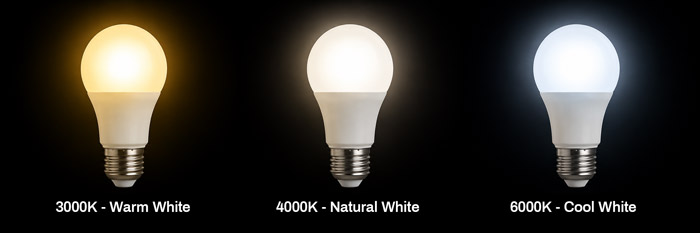
Many color changing bulbs can also adjust color temperature. Color temperature describes whether white light looks warm, neutral, or cool. Warm white light looks yellowish and cozy, while cool white light looks bluish and bright.
Bulbs with both warm white and cool white LEDs can shift between these tones more naturally. This is useful because different lighting temperatures suit different situations. Warm light is often preferred for relaxing, while cool light is useful for reading, working, or focusing.
Color changing bulbs are usually based on LED technology, which makes them far more energy-efficient than incandescent bulbs. LEDs convert more electricity into light and less into heat. Even when producing different colors, they generally use relatively little power.
However, brightness, color choice, and wireless features can affect energy use. A bulb running at full brightness uses more power than one set to a dimmer level. Still, compared with older lighting technologies, LED color changing bulbs remain efficient.
Color changing light bulbs work by combining red, green, blue, and sometimes white LEDs inside one bulb. A small controller adjusts the brightness of each LED channel to mix different colors. Smart versions add wireless communication, allowing users to control color, brightness, schedules, and scenes from an app or smart home system.
The technology is practical, efficient, and flexible. Whether used for mood lighting, decoration, productivity, or home automation, color changing bulbs rely on the same core idea: precise electronic control of LED color mixing.
Can color changing light bulbs work with regular wall switches?
Yes. Most color changing light bulbs can turn on and off with a regular wall switch.
However, advanced features such as color selection, dimming, schedules, and scene control usually require an app, remote, or smart home platform.
Do color changing light bulbs work with dimmer switches?
Many color changing LED bulbs are not designed for traditional dimmer switches.
Using them with incompatible dimmers can cause flickering, buzzing, unstable colors, or shorter bulb life. It is better to use app-based dimming unless the bulb is clearly marked as dimmer-compatible.
What is CRI in color changing light bulbs?
CRI, or Color Rendering Index, measures how accurately a light source shows the true colors of objects.
A higher CRI means colors look more natural. For living rooms, kitchens, studios, and retail spaces, color changing bulbs with a CRI of 80 or above are usually preferred.
How long do color changing light bulbs last?
Most color changing LED bulbs are rated for thousands of hours of use, often much longer than incandescent bulbs.
Actual lifespan depends on heat control, build quality, daily usage, power stability, and whether the bulb is installed in a well-ventilated fixture.
Are color changing light bulbs safe for eyes?
Color changing light bulbs are generally safe when used properly.
To reduce eye strain, avoid extremely bright light in dark rooms, limit strong blue light before sleep, and choose comfortable brightness levels for reading, working, or relaxing.
