
Table of Contents
- 1. Sculptural Lighting With a Personal Material Palette
- 2. Layered Lighting Planned Around Activities
- 3. Warmer Evening Light With Better Visual Comfort
- 4. Lighting That Changes With the Time of Day
- 5. Smart Controls That Simplify Everyday Use
- 6. Outdoor Lighting That Preserves Darkness
- 7. Efficiency Judged Alongside Repairability
- Where to Invest First
- References
- FAQs
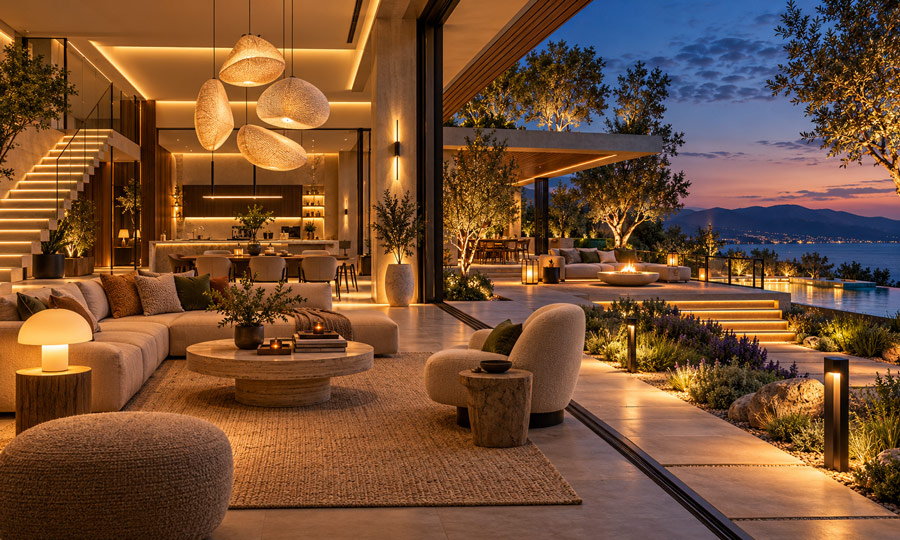
The biggest lighting trends to watch in 2026 include sculptural fixtures, layered architectural lighting, warmer evening settings, lighting that responds to daily routines, practical smart controls, responsible outdoor illumination, and greater attention to repairability.
These directions share a common purpose: making light more useful, comfortable, and personal.
The American Society of Interior Designers’ 2026 outlook highlights both stronger individual expression and growing demand for spaces that deliver well-being, flexibility, and long-term value.[1] Our interpretation is that successful lighting now needs to satisfy two tests: it should contribute to the character of a space and improve the experience of using it.
Here are seven trends worth understanding, with practical ways to apply them indoors and outdoors.
1. Sculptural Lighting With a Personal Material Palette
Decorative lighting has a strong place in the 2026 design conversation. In the National Kitchen & Bath Association’s 2026 Kitchen Trends Report, 87% of respondents said kitchens have become spaces for showcasing decorative, statement lighting. The report surveyed 634 industry professionals, so this figure represents professional observations rather than a percentage of all homeowners.[6]
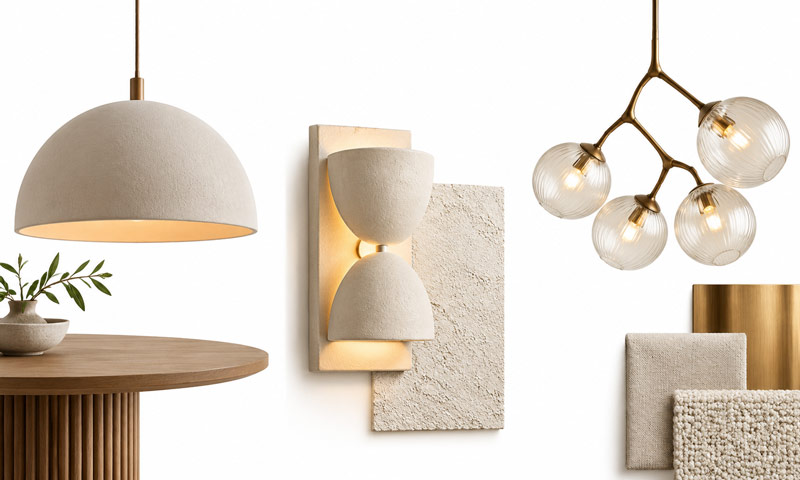
For homeowners, this creates room for fixtures that contribute shape and texture even when switched off. Curved pendants, branching compositions, ceramic shades, textured glass, and softly finished metals offer different ways to introduce personality.
The most effective choice usually relates to something already present in the room. A rounded pendant can echo a curved dining table. A ceramic wall light can complement textured plaster. A restrained metal fixture can bring definition to a room filled with soft fabrics.
Our recommendation is to establish one clear focal point within each connected view. Give that fixture enough visual space, then use quieter supporting lights to handle everyday tasks. This allows decorative lighting to feel intentional without making every fitting compete for attention.
2. Layered Lighting Planned Around Activities
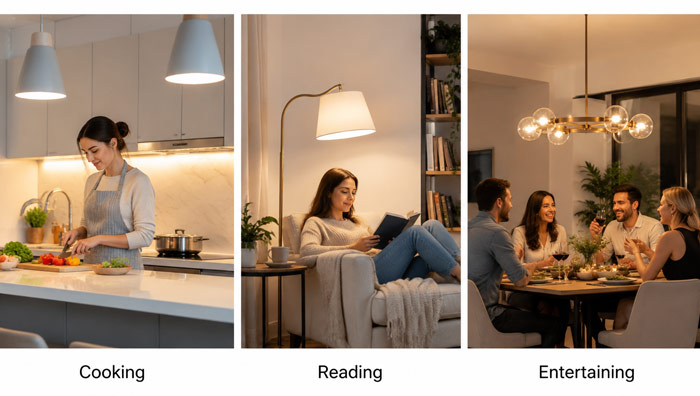
Layered lighting remains relevant because a single room often supports several activities. Cooking, reading, entertaining, and moving through a space require different distributions of light.
The kitchen research provides useful evidence: 82% of respondents identified under-cabinet lighting as a trend, while 72% identified interior cabinet lighting.[6] These findings support a design approach that distributes illumination around specific functions.
A practical lighting plan combines:
- Ambient lighting for general orientation and comfortable movement.
- Task lighting directed toward work surfaces or reading areas.
- Accent lighting that brings attention to selected materials, objects, or architectural details.
Architectural integration helps these layers work together. Concealed linear lighting can illuminate a worktop, while wall washing can reveal a vertical surface and make a room feel more balanced.
Where a clean ceiling is part of the design, trimless recessed lighting can reduce visible fixture outlines. Its value depends on placement, optics, and installation quality.
The essential planning question is what each light helps someone do. Position task lighting first, then build the surrounding atmosphere around it.
3. Warmer Evening Light With Better Visual Comfort
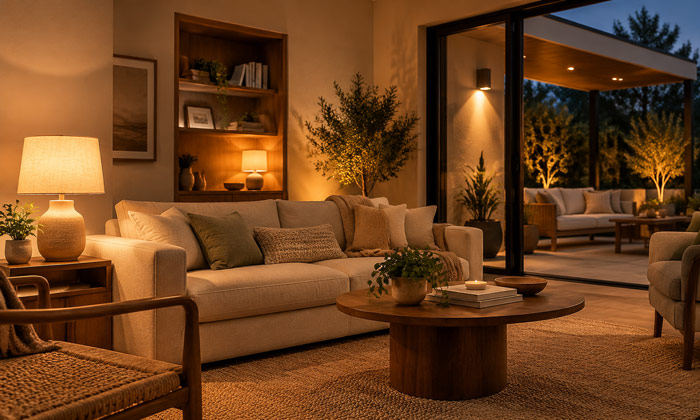
Warm light is a useful starting point for relaxed residential spaces. U.S. Department of Energy guidance identifies 2700 K as warm light and 3000 K as a soft, warm option, with both associated with residential applications.[7]
For living rooms, bedrooms, patios, and sheltered seating areas, this range offers a practical palette to test against actual materials.
Color temperature is only one part of the result. A warm lamp can still feel uncomfortable when its bright surface is exposed directly to the eye. A well-shielded fixture can provide useful illumination while keeping the source less visually intrusive.
Pay attention to the relationship between:
- Light output and the size of the illuminated area.
- Shielding and normal viewing positions.
- Surface reflectance and reflected glare.
- Color temperature and the appearance of surrounding materials.
Understanding CCT and CRI also helps clarify purchasing decisions: CCT describes the light’s color appearance, while CRI concerns color rendering relative to a reference source.
Our view is that visual comfort deserves an on-site assessment. Look at the lighting from the sofa, dining chair, doorway, and garden seating area. Those positions reveal issues that a fixture photograph cannot show.
4. Lighting That Changes With the Time of Day
Time-specific lighting is becoming a more concrete design priority. In the 2026 Bath Trends Report, based on 688 industry respondents, 80% reported including nighttime-specific lighting.[5] This is evidence of professional design practice within the surveyed group.
The scientific foundation extends beyond changing a lamp’s color. Expert consensus recommendations for healthy adults with regular daytime schedules distinguish between daytime, evening, and sleeping conditions:
| Period | Recommended melanopic equivalent daylight illuminance at the eye |
|---|---|
| Daytime | At least 250 lux |
| Starting three hours before bedtime | No more than 10 lux |
| Sleep environment | No more than 1 lux |
These values use a measure that accounts for the light spectrum’s effect on melanopsin-sensitive responses. They cannot be read directly from a bulb’s lumen rating or treated as ordinary worktop illuminance targets.[2]
For a home, the practical direction is straightforward: make good use of daylight, provide sufficient light for daytime activities, and create lower-output evening settings.
A separate night setting can illuminate a necessary route without activating the room’s full lighting system.
Our recommendation is to design the daily sequence before selecting controls. Identify what should happen during breakfast, evening relaxation, and a nighttime visit to the bathroom. Those routines give adjustable lighting a clear purpose.
5. Smart Controls That Simplify Everyday Use
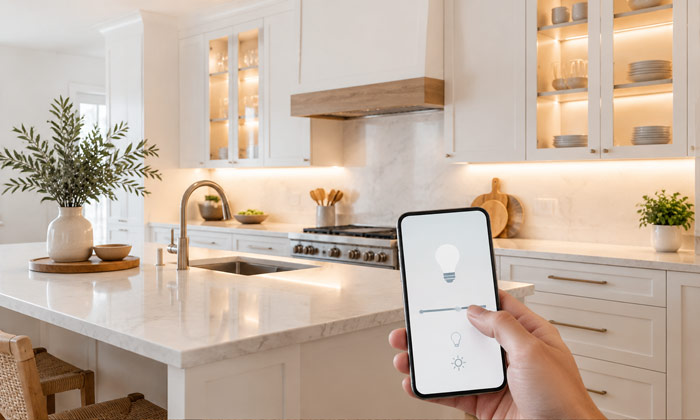
Smart lighting deserves attention when it reduces repeated effort. The 2026 kitchen research identifies app-controlled lighting among the categories gaining traction in connected kitchen design.[6]
The most useful applications often involve simple, repeatable actions:
- Activating an evening scene with one accessible control.
- Adjusting outdoor schedules as sunset times change.
- Switching off decorative lighting after a chosen hour.
- Bringing on circulation lighting when someone enters an area.
- Operating task and ambient lighting independently.
For a garden, dividing the installation into functional zones can be especially useful. An entrance, dining terrace, and planting feature may need different operating hours.
Choose controls around those differences. A system that turns every outdoor light on together can be less flexible than a simpler arrangement with appropriate zoning.
Our priority would be reliable everyday operation. Check whether schedules continue to work during an internet interruption, how visitors operate the lights, and whether a physical control remains convenient. These details determine whether the technology becomes part of daily life.
6. Outdoor Lighting That Preserves Darkness
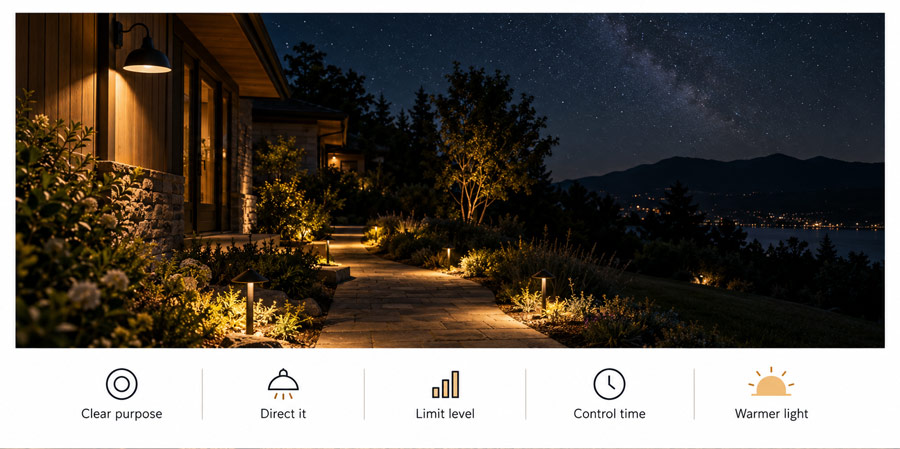
Responsible outdoor lighting deserves a place among the most important directions for 2026.
A study using 51,351 observations collected between 2011 and 2022 found that the decline in visible stars was consistent with an annual increase of approximately 7–10% in visible sky brightness across the dataset.[4] The finding concerns sky brightness inferred from observations, rather than the number of installed lights.
DarkSky International and the Illuminating Engineering Society set out five principles for responsible outdoor lighting: provide light for a clear purpose, direct it where required, limit its level, control its operating time, and favor warmer light where appropriate.[3]
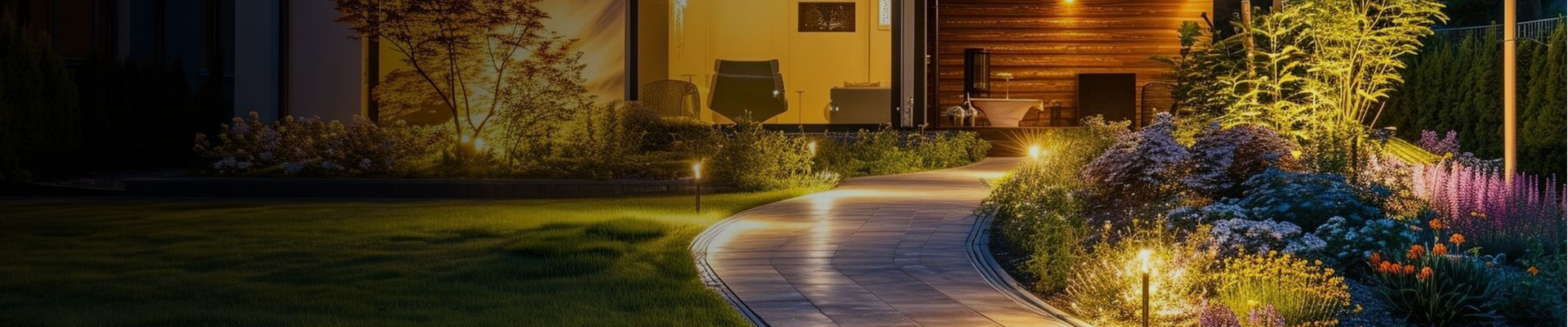
Applied to a residential landscape, this means illuminating paths, steps, entrances, and selected features while retaining darker areas between them.
Shielded downlighting can help place light onto circulation areas. Careful aiming and suitable optics remain essential, since downward-facing fixtures can still produce glare or spill.
Our distinctive recommendation is to treat darkness as a planned part of the composition. A garden gains depth when illuminated surfaces have quieter surroundings. Assess the design from neighboring windows as well as from within the property.
7. Efficiency Judged Alongside Repairability
LED efficiency is an established foundation for modern lighting. The next useful purchasing question is how the complete installation performs over time.
For context, the U.S. Department of Energy’s 2023 comparison lists approximately 800 lumens from a 60 W incandescent lamp, compared with 5.9–10.5 W for the LED alternatives in its table.[7] This illustrates the importance of comparing light output alongside power consumption.
Long-term value also depends on maintenance. Before purchasing, establish whether the light source, driver, or other serviceable components can be replaced and whether suitable parts are available.
This is particularly relevant to integrated LED lighting. Some fixtures allow component replacement; others require replacement of the complete unit.
We see repairability as an important buying priority for 2026, consistent with the broader emphasis on long-term value identified in the professional design outlook.[1]
Ask suppliers to explain the replacement procedure for the exact model. For architectural lighting, confirm that servicing remains possible after ceilings, walls, or landscaping are complete.
Where to Invest First
Start with the part of the property where lighting currently limits an activity. That might be a shaded kitchen worktop, an uncomfortable reading corner, or an entrance where the light creates glare.
Improve that function, then add the decorative layer.
For interiors, one expressive fixture supported by well-positioned task and ambient lighting can provide a clear design direction. Outdoors, begin with essential circulation and entrances, then introduce selected accents.
Before adding another fitting, switch existing groups on and off separately. Observe what each group contributes. This simple exercise can reveal opportunities to reposition, dim, or simplify the installation.
The most worthwhile lighting investment in 2026 is a scheme that adapts to everyday routines, feels comfortable from normal viewing positions, and remains practical to maintain.
References
- American Society of Interior Designers. (2026, January 27). ASID releases 2026 trends outlook report.
- Brown, T. M., Brainard, G. C., Cajochen, C., Czeisler, C. A., Hanifin, J. P., Lockley, S. W., Lucas, R. J., Münch, M., O’Hagan, J. B., Peirson, S. N., Price, L. L. A., Roenneberg, T., Schlangen, L. J. M., Skene, D. J., Spitschan, M., Vetter, C., Zee, P. C., & Wright, K. P., Jr. (2022). Recommendations for daytime, evening, and nighttime indoor light exposure to best support physiology, sleep, and wakefulness in healthy adults. PLOS Biology, 20(3), Article e3001571.
- DarkSky International. (2026, September 30). Five principles for responsible outdoor lighting.
- Kyba, C. C. M., Altıntaş, Y. Ö., Walker, C. E., & Newhouse, M. (2023). Citizen scientists report global rapid reductions in the visibility of stars from 2011 to 2022. Science, 379(6629), 265–268.
- National Kitchen & Bath Association. (2025a, November 11). NKBA | KBIS releases annual 2026 bath trends report.
- National Kitchen & Bath Association. (2025b, September 18). NKBA | KBIS releases annual 2026 kitchen trends report.
- U.S. Department of Energy. (2023, June). Purchasing energy-efficient light bulbs.
FAQs
1. Are Recessed Lights Going Out of Style in 2026?
Recessed lighting can still work well in a 2026 lighting scheme. Its strongest role is providing discreet support for the room’s activities and architectural features. For a more considered appearance, position fixtures around work surfaces, artwork, and circulation areas. Avoid filling the ceiling with an evenly spaced grid before deciding where light is actually needed.
2. Can You Mix Different Lighting Finishes in 2026?
Yes. Mixing finishes offers a way to apply the emphasis on individual expression highlighted in the 2026 professional design outlook.[1] Our recommendation is to choose one dominant finish and repeat a secondary finish selectively. Fixtures can share a similar shape, texture, or level of sheen to create a connection without matching exactly.
3. Do Oversized Pendant Lights Work in Small Rooms?
They can, provided the fixture’s proportions suit the room and preserve comfortable sightlines. An open or translucent shade can introduce sculptural presence with less visual weight than a solid shade of similar dimensions. Test the proposed size with a temporary paper mockup before purchasing. Where ceiling height is limited, decorative wall sconces offer another way to introduce a focal point.
4. How Can Color-Changing Lighting Fit a Sophisticated 2026 Design?
Use color as a deliberate scene for a particular occasion. Keep suitable white light available for everyday activities, then introduce color to a selected feature, such as a patio backdrop or architectural recess. A restrained palette helps color-changing outdoor lighting feel coordinated. Judge the effect on surrounding materials, since colored light can substantially change their appearance.
5. Which 2026 Lighting Styles Are Worth Keeping Beyond This Year?
Our recommendation is to prioritize proportions and materials that relate to your home’s architecture. Place more expressive shapes or unusual finishes in selected decorative fixtures, while keeping permanent architectural lighting visually restrained. This approach allows personal style to evolve without requiring a complete redesign. A fixture’s lasting appeal depends on how convincingly it belongs in the space, alongside its usefulness and construction quality.
