

Table of Contents
- Outdoor Security Lighting Pros and Cons at a Glance
- Key Benefits of Outdoor Security Lighting
- Main Drawbacks of Outdoor Security Lighting
- Motion-Activated vs. Dusk-to-Dawn Security Lighting
- How the Power Source Changes the Trade-Offs
- How to Get More Benefits and Fewer Drawbacks
- Is Outdoor Security Lighting Worth It?
- FAQs
Outdoor security lighting can make entrances easier to see, improve nighttime movement around a property, and support security cameras. However, poorly positioned fixtures can also create glare, disturb neighbors, and increase running costs without providing useful coverage.
The value of security lighting depends on what it illuminates, when it operates, and how well it fits the property. A powerful floodlight aimed in the wrong direction may be less useful than several modest fixtures placed around the areas people actually use.
Understanding outdoor security lighting pros and cons helps you choose a system that improves visibility while keeping its limitations manageable.
Outdoor Security Lighting Pros and Cons at a Glance
| Aspect | Main benefit | Potential drawback |
|---|---|---|
| Visibility | Makes approaches, entrances, and activity easier to see | Uneven coverage can leave important areas obscured |
| Deterrence | May discourage someone who wants to approach unnoticed | Cannot guarantee that an intrusion will be prevented |
| Security cameras | Can improve usable detail in nighttime footage | Direct light and reflections can overwhelm the image |
| Everyday safety | Helps people navigate paths, steps, and driveways | Glare can make nearby hazards harder to distinguish |
| Energy use | Efficient fixtures and suitable controls limit consumption | Unnecessary brightness and long operating hours add costs |
| Convenience | Automatic controls reduce manual switching | Sensors require appropriate positioning and adjustment |
Key Benefits of Outdoor Security Lighting
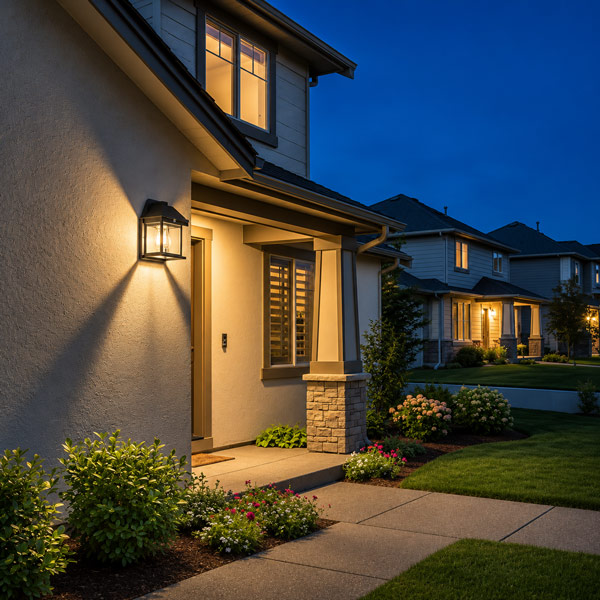
1. Better Visibility Around Entrances and Access Routes
Useful security lighting helps you understand what is happening outside before you step through the door.
It can reveal someone approaching a gate, make a side passage easier to check, and improve visibility when unlocking a garage or collecting a delivery. These benefits are especially valuable where existing porch or street lighting does not reach.
The priority is a clear view of the relevant area. Lighting an entrance and its approach usually serves a more practical purpose than illuminating an entire lawn.
2. A Potential Deterrent to Unwanted Activity
Lighting can make an unnoticed approach more difficult. Someone crossing an illuminated access route may be more visible to occupants, neighbors, or cameras.
Motion activation can also draw attention to a change outside. However, a light switching on does not confirm that a person is present, and it does not ensure anyone will respond.
Treat this as a supporting security measure. Its usefulness increases when the illuminated area is observable and the property also has appropriate locks, access controls, and other protective measures.
3. More Useful Security Camera Footage
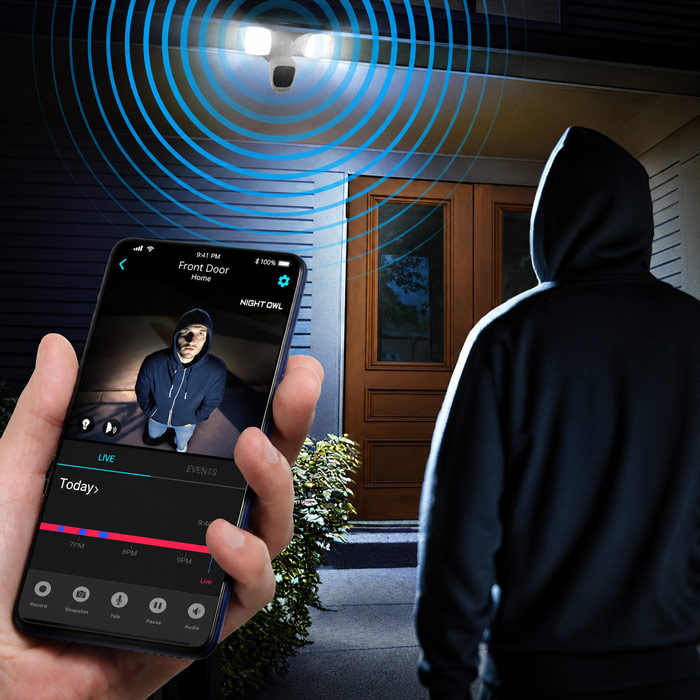
Suitable illumination can help a camera capture details that would otherwise be difficult to distinguish in darkness.
The improvement depends on the camera, the scene, and the lighting arrangement. A bright fixture facing the lens can cause overexposure, while strong differences between illuminated and shaded areas may hide useful detail.
Check recorded footage while someone walks through the monitored area. A clear image of an empty driveway does not necessarily mean the camera can capture a moving face clearly. Camera exposure settings and available light both affect that result.
4. Easier Nighttime Navigation
Security lighting also provides everyday benefits that have little to do with intruders.
It can make changes in level, path edges, and obstacles easier to notice when arriving home, taking out bins, or walking between buildings. Steps and frequently used routes deserve particular attention.
Place the light where it reveals the walking surface without shining directly into approaching eyes. This helps people see where they are going rather than simply making the surroundings appear brighter.
5. Manageable Electricity Costs With an Efficient Design
LED fixtures and automatic controls can keep operating costs relatively modest. The actual consumption depends on total input power and operating time.
For an illustrative calculation, one 20-watt fixture running for 10 hours each night uses:
20 ÷ 1,000 × 10 × 365 = 73 kWh per year
At an assumed electricity rate of $0.20 per kWh, that equals $14.60 annually, excluding standby consumption. Your actual cost will depend on the fixture, tariff, and operating schedule.
Motion activation, timers, and dimming can reduce unnecessary operating hours or output when the equipment supports those functions.
Main Drawbacks of Outdoor Security Lighting
1. Lighting Alone Provides Limited Protection
A standalone security light illuminates an area. It does not secure a door, identify a visitor, record an incident, or arrange a response.
An isolated illuminated space may still be vulnerable if nobody can observe it. Likewise, lighting the front entrance does little to address an unsecured rear access point.
Assess the property as a whole. Decide what you need to see, who can see it, and what other measures protect the same area.
2. Excessive Brightness Can Reduce Visibility
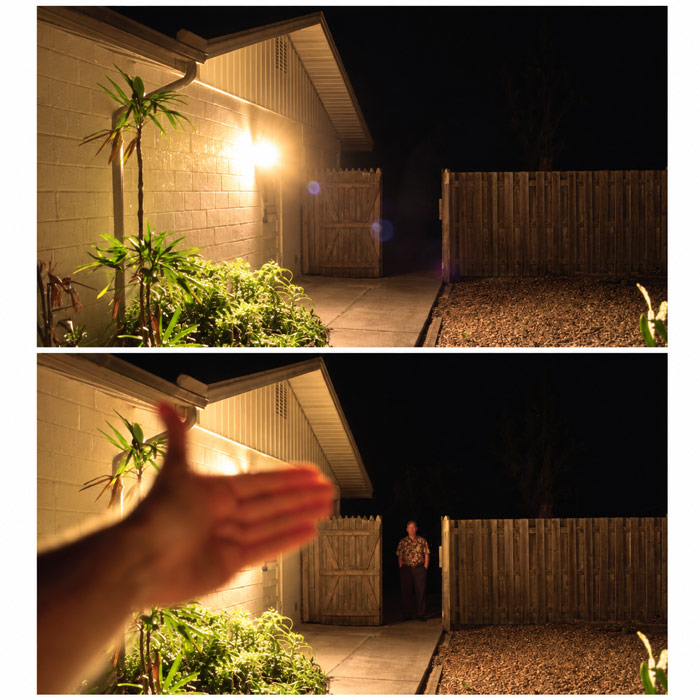
An exposed light source can create uncomfortable glare and make surrounding darker areas harder to see.
This often happens when a powerful floodlight is mounted where its beam faces people approaching the property. Harsh contrast can also make a brightly lit central area appear reassuring while details around its edges remain difficult to distinguish.
Shielding, careful aiming, and more even coverage help address this problem. Increasing the fixture’s output should not be the automatic response to every visibility issue.
3. Light Spill Can Disturb Neighbors and the Nighttime Environment
Light that reaches a neighboring bedroom or extends unnecessarily beyond the property creates a nuisance without improving your own coverage.
Upward and uncontrolled sideways light also contribute to light pollution. Long operating hours increase that unnecessary exposure.
Keep the beam within the intended area, use only the output required for the task, and reduce operating time where continuous illumination serves no clear purpose. These measures can improve comfort while reducing wasted light.
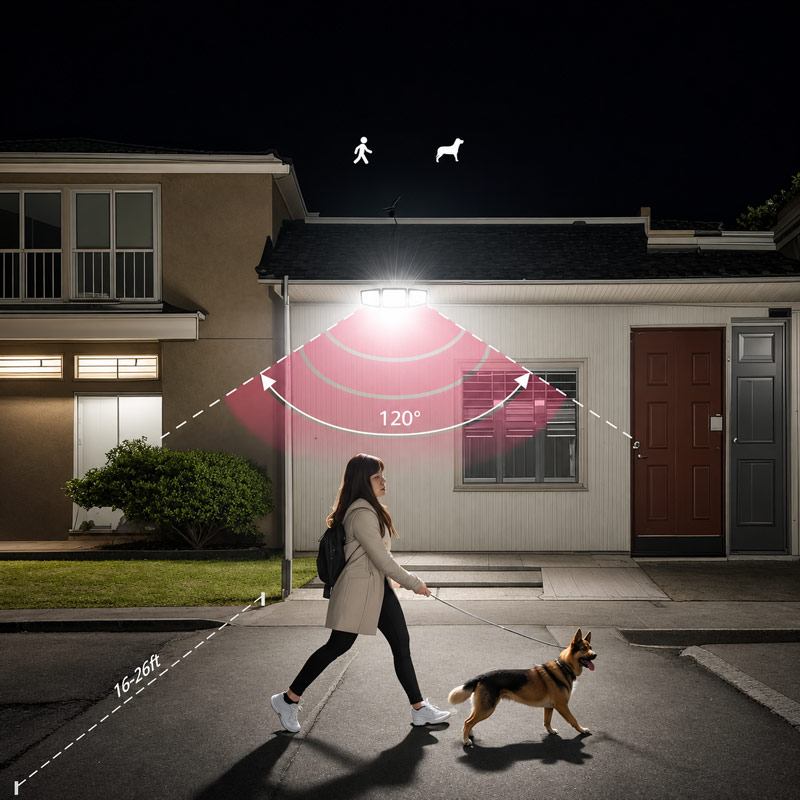
4. Motion Sensors Can Activate Unnecessarily
A motion light may respond to activity that does not require attention. Depending on the sensor and its position, animals, passing traffic, or movement near the detection area can cause unwanted activation.
Sensor technology also matters. PIR and radar sensors detect movement through different mechanisms, so their behavior and placement requirements can differ.
Choose a suitable detection area and test it from the routes people actually use. A sensor covering the road while missing the side gate creates inconvenience and leaves the intended problem unresolved.
5. Installation and Maintenance Add to the Total Cost
The purchase price is only part of the budget.
New wiring, difficult mounting positions, additional fixtures, and changes to the power supply can increase installation costs. A lighting plan that follows existing access routes may also require more than one fixture.
Outdoor equipment needs periodic attention. Dirty lenses, blocked sensors, loose fittings, damaged seals, and growing vegetation can affect performance. Solar models introduce additional checks for panel cleanliness and battery condition.
Choose equipment that is suitable for the location and practical to inspect over time.
Motion-Activated vs. Dusk-to-Dawn Security Lighting
The control method determines when the light operates. It is separate from the fixture’s shape, beam pattern, and power source.
| Control method | Main advantage | Main limitation | Suitable application |
|---|---|---|---|
| Motion activated | Provides light when activity is detected | Coverage depends on sensor position and settings | Side passages, occasional access routes, and rear entrances |
| Dusk to dawn | Provides consistent illumination during darkness | Operates even when an area is unused | Entrances and routes requiring continuous nighttime visibility |
| Timed | Matches illumination to a planned schedule | May need adjustment as routines or daylight hours change | Predictable evening use |
| Low-level light with motion boost | Combines background visibility with brighter light during activity | Requires equipment designed for compatible dimming and sensing | Frequently used approaches where both functions are useful |
A combined arrangement can work well where continuous visibility is necessary, but it should serve a specific need. An infrequently used area may require only motion activation, while a regularly used entrance may benefit from steady, modest illumination.
Avoid assuming that a dusk-to-dawn fixture is inherently brighter or that a floodlight must run continuously. Output, beam distribution, and controls are separate specifications.
How the Power Source Changes the Trade-Offs
Hardwired lighting provides power without routine battery charging or replacement. It is useful where dependable operating time matters, although installation may involve electrical work.
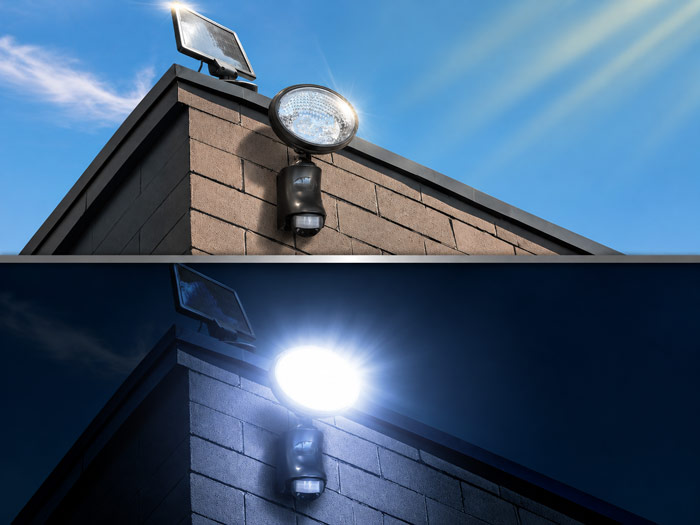
Solar lighting can simplify installation where wiring would be difficult. Its performance depends on available sunlight, battery capacity, panel placement, and the selected operating mode. A fixture that performs well after a sunny day may provide less runtime after several poor charging days.
Battery-operated lighting offers flexible placement, but its usefulness depends on how frequently it activates and how easily the batteries can be maintained.
For important access points, evaluate performance under the least favorable conditions you reasonably expect, rather than relying only on advertised maximum brightness or runtime.
How to Get More Benefits and Fewer Drawbacks
Start With the Areas That Need Visibility
Walk around the property after dark and identify the places where people need to see clearly.
Prioritize the front and rear entrances, gates, garage approaches, side passages, steps, and regularly used paths. Consider whether walls, parked vehicles, or vegetation block either the light or the view of the area.
Assign each fixture a purpose. This makes it easier to avoid unnecessary lighting and gaps in useful coverage.
Choose Output and Beam Coverage Together
Compare light output using lumens, while remembering that the lumen rating does not describe how evenly the light reaches a surface.
Mounting height, beam angle, distance, shielding, and surrounding materials all affect the result. Two fixtures with similar output can illuminate the same space very differently.
There is no single lumen figure that suits every entrance or driveway. For larger or more demanding areas, use the fixture’s light-distribution information to assess coverage.
Aim the Light at the Task
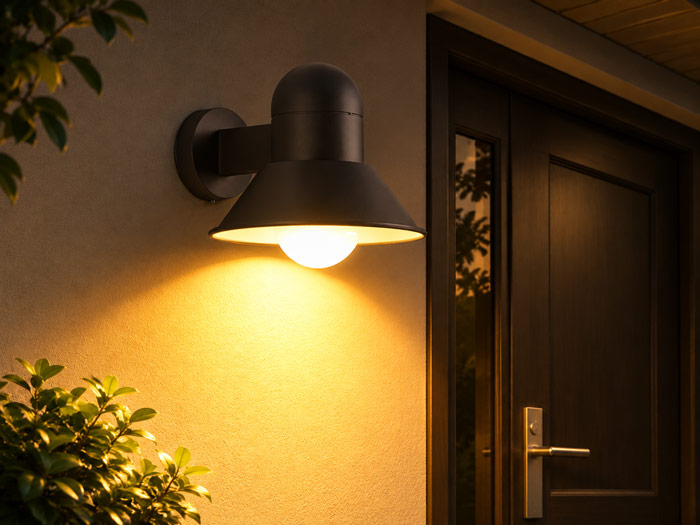
Shielded downlighting can direct illumination toward walking surfaces and access points while limiting unnecessary upward light.
Follow the fixture’s mounting instructions and check the result from the perspective of someone approaching the property. Also inspect it from nearby windows and the property boundary.
Adjust the beam if the light source dominates the view or shines beyond the intended area.
Test the Complete Arrangement After Dark
Check more than whether each fixture turns on.
Walk toward the entrance from different directions. Confirm that sensors activate early enough for normal use, steps remain visible, and bright areas do not obscure nearby details.
If cameras are present, review moving subjects under the actual lighting conditions. Repeat the inspection when seasonal vegetation changes or other alterations affect the scene.
Is Outdoor Security Lighting Worth It?
Outdoor security lighting is worthwhile when it solves a clear visibility problem and operates reliably where it is needed.
Its strongest practical benefits are easier observation, more usable outdoor access, and support for cameras. Its main drawbacks usually arise from excessive output, poor placement, unnecessary operating hours, or unrealistic expectations.
Choose the coverage, controls, and power source around the property’s actual needs, then verify the result at night.
FAQs
1. What Color Temperature Is Best for Residential Security Lighting?
For many residential entrances and access routes, warm white outdoor lighting around 2700K–3000K is a practical starting point.
A higher kelvin number describes a cooler appearance; it does not automatically mean greater light output. Where cameras are involved, check how accurately the chosen lighting renders people and objects in recorded footage. Select the color temperature alongside the required visibility, surrounding environment, and light distribution.
2. What IP Rating Should Outdoor Security Lights Have?
IP65 is a common option for exposed exterior fixtures because it indicates dust-tight protection and resistance to water jets under specified testing conditions.
The difference between IP44 and IP65 matters: splash protection and water-jet protection are different levels of resistance.
IP65 does not mean suitable for submersion. Also check the manufacturer’s intended installation conditions, connection protection, and mounting requirements; the enclosure rating alone does not establish suitability for every outdoor location.
3. Why Does My Motion Security Light Stay On All Night?
First check whether the fixture is operating in dusk-to-dawn mode or manual override mode. Either setting may intentionally keep the light on.
A long shutoff delay or repeated detection can also make motion-controlled lighting appear continuously illuminated. Observe the detection area and check the selected operating mode before assuming the sensor has failed.
Use the reset procedure in the specific product instructions, because override and reset sequences vary between models.
4. Can I Replace a Halogen Security Light Bulb With an LED?
Sometimes, provided the replacement matches the fixture’s base, supply voltage, physical dimensions, and operating requirements.
Also confirm compatibility with any motion sensor or dimmer. If the lamp sits inside an enclosed housing, the LED must be rated for that application because trapped heat can affect its performance and lifespan.
A matching connector alone does not establish compatibility. Linear halogen fittings, low-voltage systems, and fixtures with integrated light sources may require a different replacement approach.
5. Do Outdoor LED Security Lights Attract Bugs?
Yes. LED lighting can still attract insects, and the response varies with the light spectrum and insect species.
Amber and other light colors that attract fewer insects can reduce attraction for many species compared with lighting containing more blue wavelengths. No illuminated option is universally bug-proof.
Shielding the beam and limiting unnecessary operating time can further reduce exposure. Where recognizing colors is important, assess that requirement before choosing strongly amber illumination.
