
Table of Contents
- What Type of Outdoor Beam Light Does Your Event Need?
- Calculate Beam Width at the Actual Throw Distance
- Compare Light at the Target, Not Just Wattage
- Choose Wedding Lighting Around People and Sightlines
- Choose Corporate Lighting Around Attention and Timing
- Make the Design Work Without Haze
- Treat Weather Protection as a Complete System
- Check Power, Dimming, and Quiet Operation
- Evaluate Fixture Quantity by Lighting Tasks
- FAQs
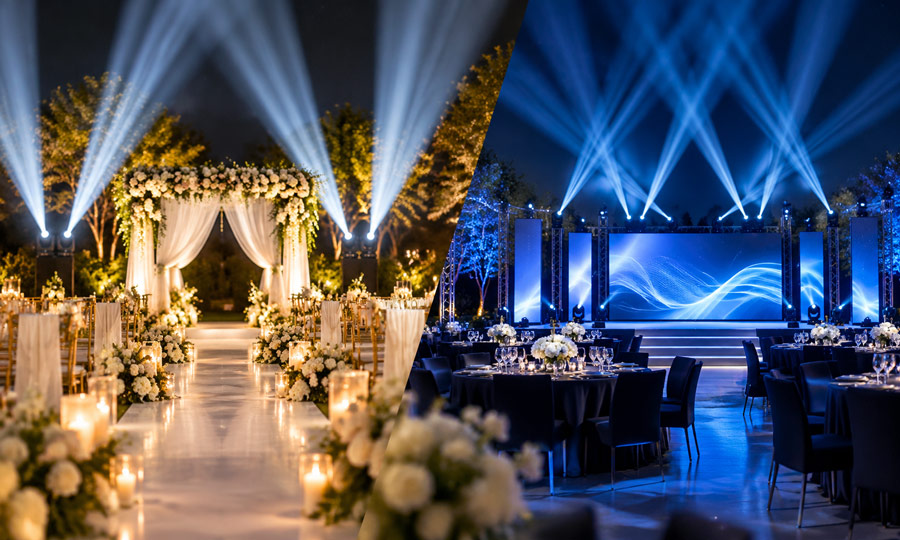
Outdoor beam lights can make an entrance feel ceremonial, give a garden reception depth, or turn a product reveal into a memorable moment. Choosing them starts with a practical question: what should guests notice when each light turns on?
For weddings, the answer may be the couple, a ceremony backdrop, or the first dance. For corporate events, it may be a presenter, an architectural entrance, or a carefully timed reveal. Each task requires a different balance of beam width, intensity, movement, and control.
The strongest lighting plans begin with these moments, then select fixtures that can deliver them at the actual venue.
What Type of Outdoor Beam Light Does Your Event Need?
“Outdoor beam light” can describe both fixed directional fixtures and moving lights that create concentrated aerial effects. They serve different purposes.
A fixed beam can highlight a tree or entrance throughout an evening. A moving beam can create an animated sequence around a stage. Neither automatically provides comfortable illumination for faces, dining tables, or walking routes.
| Event lighting task | Suitable fixture approach | What to check first |
|---|---|---|
| Highlighting trees, columns, or entrance features | Fixed directional beam | Beam width, aiming adjustment, and spill |
| Creating moving shafts around a performance area | Outdoor-rated moving beam | Intensity at distance, movement limits, and control |
| Lighting a couple or presenter | Dedicated white front light or suitable spotlight | Coverage, color rendering, and guest comfort |
| Illuminating broad backgrounds | Wash lighting | Uniformity and coverage |
Choose the lighting role before comparing specifications. A fixture that creates an impressive shaft of light may still be a poor choice for illuminating a speaker.
Calculate Beam Width at the Actual Throw Distance
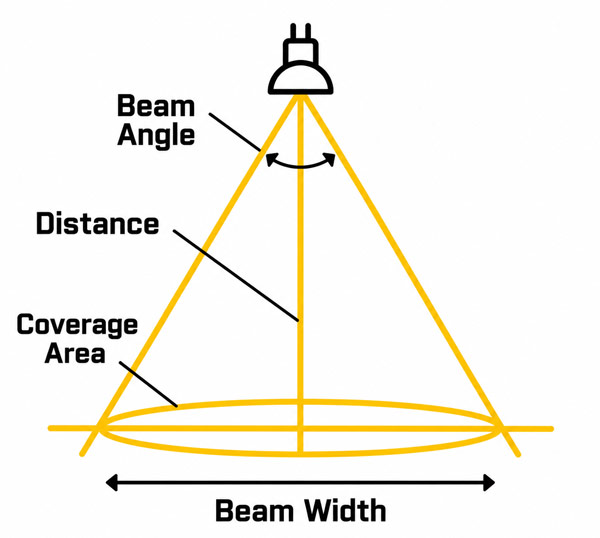
The diagram shows the fixture, throw distance, beam angle, and target plane
Venue size alone cannot tell you which beam angle to choose. The more useful measurement is the throw distance: the distance from the fixture to its target.
Understanding the beam angle of a spotlight helps connect the specification to what guests will actually see.
For a surface perpendicular to the beam, the approximate diameter is:
Beam diameter ≈ 2 × throw distance × tan(beam angle ÷ 2)
The beam angle commonly describes the width between the points where intensity falls to half the central intensity. Light can extend beyond this area, so the calculated diameter is not a sharp boundary.
| Beam angle | Approximate diameter at 10 m | Approximate diameter at 20 m |
|---|---|---|
| 3° | 0.52 m | 1.05 m |
| 10° | 1.75 m | 3.50 m |
| 20° | 3.53 m | 7.05 m |
Imagine a decorative feature approximately two meters wide, with the fixture positioned 12 meters away. A beam angle near 10° produces a nominal diameter of about 2.1 meters.
That gives you a starting point for testing. A feature that needs even illumination may require a wider beam, overlapping fixtures, or different positioning because brightness decreases toward the edges.
Also check the installation angle. A circular beam striking a surface obliquely produces an elongated footprint. A layout that works on a drawing can spill onto nearby seating once the fixtures are aimed on site.
Compare Light at the Target, Not Just Wattage
Wattage describes electrical consumption. Lumens describe total visible light output. Neither figure alone tells you how effectively a fixture will illuminate your target.
For directional event lighting, ask for measured illuminance in lux at the intended distance and beam setting.
Make comparisons under matching conditions:
- The same throw distance.
- The same beam or zoom setting.
- The same white or color setting.
- The same operating mode.
A high center-lux figure from an extremely narrow beam can be impressive while providing very little useful coverage. Ask to see both the brightest central area and the surrounding falloff.
For a corporate backdrop, inspect whether the entire intended surface reads clearly. For a wedding feature, check whether the highlight reveals its shape without creating an excessively bright patch.
A useful purchasing question is: How much usable light reaches the area that matters?
Choose Wedding Lighting Around People and Sightlines
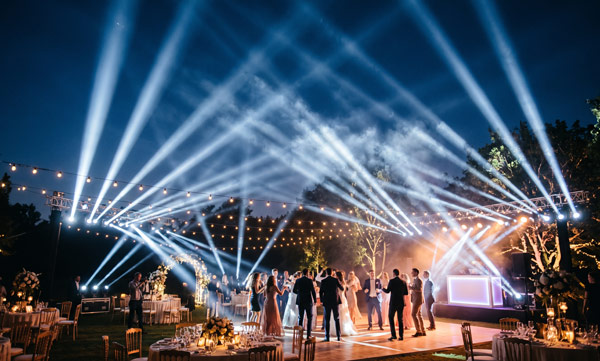
Wedding lighting has to work through several different experiences: arrival, ceremony, dinner, speeches, dancing, and departure.
Start by identifying the locations that will appear repeatedly in photographs. These often include the ceremony position, the couple’s table, the entrance, and the dance floor.
Then give each location a clear lighting purpose.
For example, a ceremony tree may need a stable architectural accent, while the dance floor may benefit from movement later in the evening. Keeping these functions separately controlled allows the atmosphere to change without losing the visual structure of the venue.
Consider how uplighting and downlighting affect the surroundings. An upward accent can reveal a tree canopy or column, while a controlled downward light can illuminate a defined area from above.
For white light falling on people, evaluate the color rendering index. CRI 90 or higher is a useful starting target when the appearance of skin, flowers, fabrics, and food matters. It still helps to inspect those materials under the actual fixture.
Finally, judge the installation from seated eye level. A light that looks comfortable while you stand beside it may point directly toward guests sitting across the garden.
Choose Corporate Lighting Around Attention and Timing
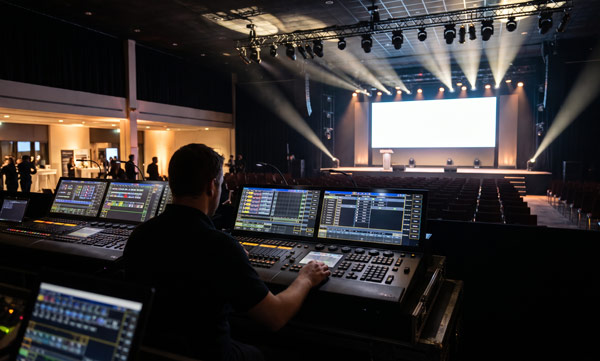
Corporate events often place greater demands on coordination.
A presenter may need to remain clearly visible while a screen is active. A product may need to stay concealed until a specific cue. A reveal may need to transition immediately into a stable presentation scene.
Build the fixture specification around those changes.
Ask whether the lighting system can:
- Recall a consistent presentation scene.
- Keep decorative spill away from projection surfaces.
- Execute a reveal at the required moment.
- Return smoothly to a restrained background state.
The transition after the dramatic moment deserves particular attention. A reveal can succeed visually and still leave the presenter standing in distracting moving light.
Plan the return to normal visibility as carefully as the reveal itself.
For an event with both networking and presentations, preserve a steady background layer around the venue. This lets the stage lighting change while guests retain a clear sense of the space.
Make the Design Work Without Haze
Aerial beam demonstrations often rely on haze or fog to make the light’s path visible. Outdoors, wind can disperse those particles quickly, making the effect less predictable.
Before choosing fixtures primarily for visible shafts, evaluate two versions of the design:
- The intended effect with permitted atmospheric effects.
- The appearance of the venue without them.
In the second version, look for a convincing arrangement of illuminated surfaces, architectural highlights, and focal points.
This is especially useful for garden weddings and open corporate courtyards. If the atmosphere changes, guests should still see a deliberate lighting design.
Where haze is permitted, arrange a test under representative conditions and agree on its use with the venue. Avoid making a major event moment depend entirely on a dense, stationary cloud outdoors.
Treat Weather Protection as a Complete System
A fixture’s weather rating is only one part of an outdoor installation.
When comparing IP44 and IP65, understand what the ratings cover. IP65 indicates a dust-tight enclosure protected against water jets under the applicable test conditions. It does not indicate suitability for immersion.
Check the manufacturer’s permitted installation orientation, operating conditions, and connector requirements.
Then follow the entire connection route. A protected fixture housing does not make an exposed plug, controller, or distribution point suitable for rain.
Outdoor cables and connections also need appropriate protection and routing. Keep them clear of guest circulation where possible, and use suitable cable protection where routes cross walking areas.
For elevated or temporary mounting, have the support arrangement assessed for the equipment and site conditions. Fixture weight alone is insufficient for deciding whether a stand or mounting position is suitable outdoors.
Check Power, Dimming, and Quiet Operation
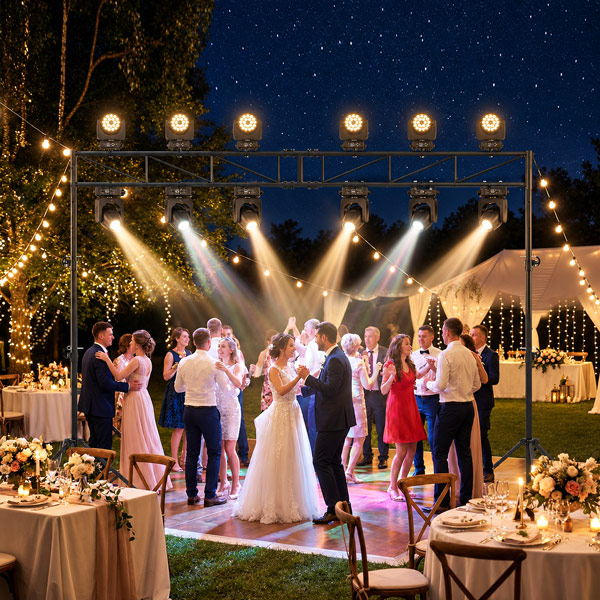
Showcase multiple lights working together at a nighttime outdoor wedding with lighting trusses and beam effects.
Use the Fixture’s Total Input Rating
Use the fixture’s maximum electrical input, including its supporting electronics and motors where applicable. A specification describing only the light source does not necessarily represent the complete fixture’s consumption.
Eight fixtures rated at 250 watts each represent 2,000 watts of lighting load before adding other equipment.
That arithmetic is an inventory figure. Circuit planning also needs the supply voltage, rated current, startup characteristics, distribution equipment, and other connected loads. Have the event’s electrical provider confirm the complete arrangement, including shared services and temporary power.
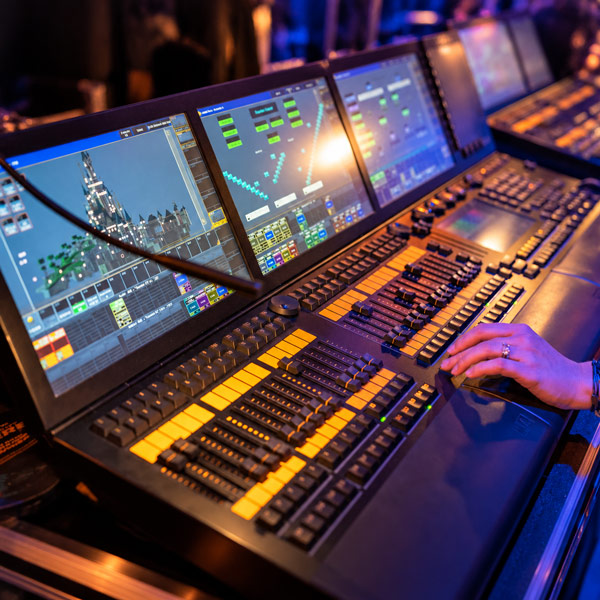
Professional lighting console with faders and control screens.
Test the Lowest Level You Expect to Use
A full-output demonstration tells you little about an intimate dinner scene.
Ask for a slow fade through the dimming range you intend to use. Watch whether the output changes smoothly and whether the final fade to black feels controlled.
For moving fixtures, confirm the available control functions and how the selected operating mode maps to the controller. Also establish the intended behavior if control data is interrupted.
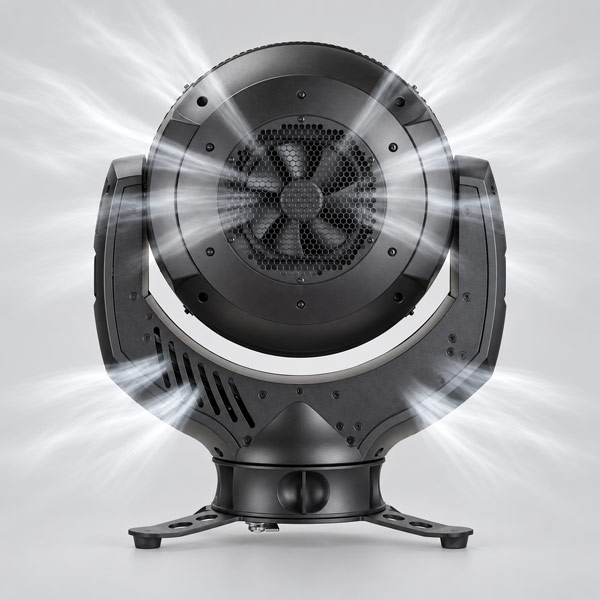
Show the spotlight’s rear cooling fan and ventilation design.
Listen During a Quiet Scene
Cooling fans and movement mechanisms can become noticeable during vows, speeches, or a quiet product presentation.
Evaluate noise after the fixture has reached normal operating temperature, from the position of the nearest guest and microphone.
If a quiet operating mode reduces output, compare the fixture in that mode. The relevant specification is the performance you can use during the event.
Evaluate Fixture Quantity by Lighting Tasks
A universal “lights per square meter” rule is a weak basis for choosing concentrated beams.
Begin with the number of distinct jobs: entrance accents, architectural features, presentation positions, and effect locations. Then determine whether each job needs one fixture, overlapping coverage, or illumination from multiple directions.
For example, a single accent might reveal the front of an entrance column while leaving its side visually flat. A second direction may improve the result more than increasing the brightness of the first light.
Conversely, several beams aimed at the same backdrop can create competing hot spots without improving the wider scene.
Before committing to the quantity, review the proposed layout from three positions:
- The main guest view: Does the intended focal point stand out?
- The nearest seated position: Are glare and equipment noise acceptable?
- The main camera position: Do the lighting layers support the composition?
Ask the supplier to demonstrate the farthest throw, the lowest intended dimming level, and the quietest event scene. Together, these checks reveal more about suitability than a brief demonstration at maximum output.
FAQs
1. Can Outdoor Beam Lights Project a Wedding Monogram or Company Logo?
Only fixtures designed for image projection can reliably perform this task. Check for compatible custom gobos, suitable projection optics, and adjustable focus. A gobo is a patterned or image-bearing insert used to create the projection.
For detailed lettering or artwork, request a demonstration using the actual design at the intended distance. Outdoor-rated image projectors are available specifically for this purpose.
2. Why Do LED Beam Lights Flicker in Wedding Videos?
Some LEDs use pulse-width modulation to control brightness. Its timing can interact with a camera’s exposure and sensor readout, producing bands or pulsing that guests cannot see directly.
Test the actual fixtures with the recording cameras, frame rates, shutter settings, and dimming levels. Adjustable PWM frequency can help, but a “flicker-free” description should still be checked under the intended shooting conditions.
3. Can a Portable Power Station Run Outdoor Beam Lights?
Yes, provided its continuous output, startup capability, voltage, and usable energy suit the connected equipment.
A basic runtime estimate is:
Runtime ≈ usable battery energy in watt-hours ÷ total load in watts
For illustration, a 1,000 Wh unit with an assumed 85% usable capacity would supply a constant 250 W load for approximately 3.4 hours. Actual runtime depends on the unit, operating conditions, and load. Allow additional capacity for setup, rehearsals, delays, and supporting equipment.
4. Is Wireless DMX Reliable for Outdoor Events?
It can be, but reliability depends on compatible equipment, antenna placement, obstructions, and the radio environment.
Maintain clear sightlines between transmitters and receivers where practical, and follow the manufacturer’s antenna guidance. Positioning equipment above crowds can help preserve the signal path.
Test the complete installation after other event systems are operating. For critical cues, prepare a practical contingency, such as a wired connection where feasible.
5. Should You Rent or Buy Outdoor Beam Lights?
Renting often suits occasional events, changing venue requirements, or productions that need specialist operators.
Buying becomes more attractive when the same lighting tasks recur and the equipment will receive regular use.
Compare the complete cost of ownership: fixtures, cases, control equipment, cables, storage, inspections, maintenance, and staff time. A venue repeating a consistent outdoor setup has a different purchasing case from an organizer producing a few events with substantially different requirements.
