

How Is Color Rendering Index Calculated?
What Is a Good Color Rendering Index?
CRI vs. Color Temperature vs. Lumens
Why Is R9 Important Alongside CRI?
What Are the Limitations of CRI?
Why Does CRI Matter for Garden and Landscape Lighting?
How to Choose Lighting With the Right CRI
FAQs
Color Rendering Index (CRI) measures how faithfully a light source renders object colors compared with a reference light source at the same color temperature. A higher CRI generally indicates a closer match to that reference across the standardized colors used in the test.
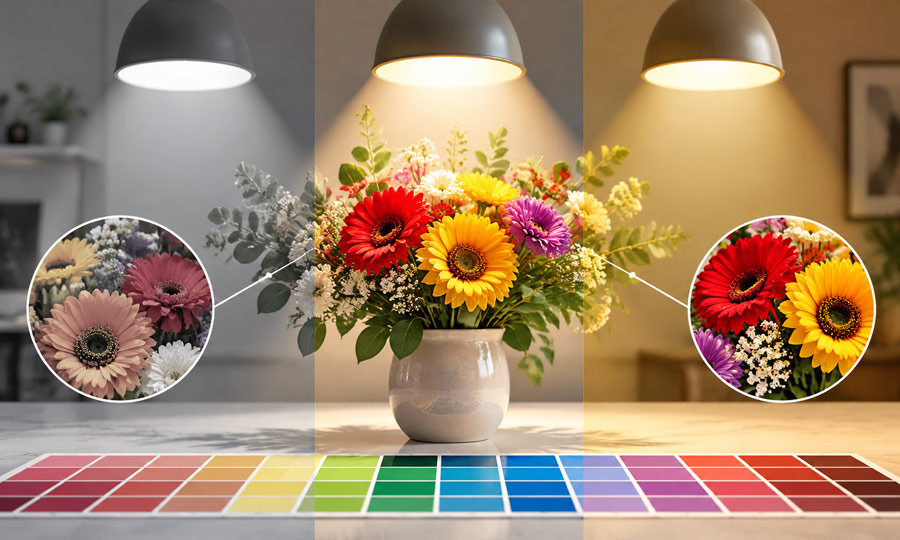
This matters because lighting changes how we see the surfaces around us. Flowers, wood, fabrics, food, and painted walls can look different under different lamps, even when those lamps provide similar amounts of light.
Understanding CRI helps you choose lighting that reveals the colors you want to see. It is particularly useful when comparing white LED lights for homes, gardens, displays, and other spaces where material appearance matters.
How Is Color Rendering Index Calculated?
The CRI value commonly printed on lighting specifications is the general color rendering index, or Ra. It averages the individual rendering scores of eight standardized test color samples, identified as R1 through R8. These samples cover different hues and have low to moderate saturation.
Reference: International Commission on Illumination. (1995). Method of measuring and specifying colour rendering properties of light sources (CIE 013.3-1995).
The calculation follows three basic steps:
- Measure the light source’s spectral power distribution: how much light it produces at different wavelengths.
- Calculate how the test colors appear under that source and a reference illuminant with the same correlated color temperature.
- Convert the color differences into individual scores and average the first eight.
Smaller calculated color differences produce higher scores. The maximum is 100, which represents no color difference for the eight samples under the test conditions. Although CRI is usually described using a 0–100 scale, exceptionally poor rendering can produce negative values.
A CRI of 90 does not mean “90% color accuracy.” It is a calculated index, rather than a percentage of all colors reproduced correctly.
What Is a Good Color Rendering Index?

For general lighting, CRI 80 or higher is a common starting point. A rating of 90 or higher indicates excellent average color fidelity and is useful when accurate material appearance is a priority.
| CRI rating | General interpretation | Practical starting point |
|---|---|---|
| Below 80 | Lower average color fidelity | Areas where accurate color appearance has a low priority |
| 80–89 | Good general color rendering | Everyday illumination and functional spaces |
| 90–94 | High color fidelity | Living areas, outdoor seating, and material displays |
| 95–100 | Very high fidelity on the standard test | Detailed color work, supported by additional color data |
Use these bands to narrow your options, then assess the actual lighting task. The highest number is most useful when it supports a visible benefit in the intended space.
CRI 80 vs. CRI 90: Which Should You Choose?
CRI 80 can be a reasonable choice for routine illumination. CRI 90 is a stronger target when people need to appreciate subtle differences in finishes, fabrics, flowers, or other materials.
The improvement will not look equally dramatic on every object. Its visibility depends on the colors being illuminated, the light level, and the source’s performance on individual colors.
For a useful comparison, evaluate the lamps at similar color temperatures and illumination levels. Place actual material samples under each light instead of relying entirely on the specification sheet.
CRI vs. Color Temperature vs. Lumens
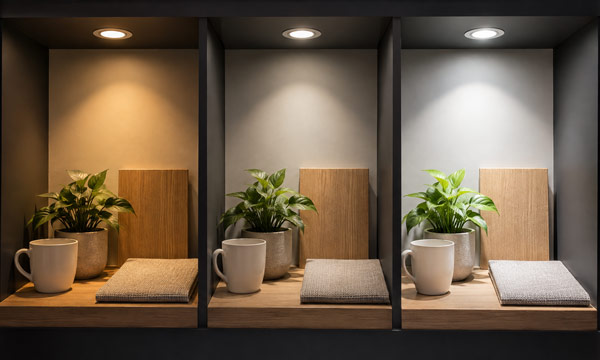
The distinction between CCT and CRI matters because the appearance of the light and its effect on object colors are separate characteristics.
| Specification | What it describes | How it is expressed |
|---|---|---|
| CRI | Color fidelity relative to a reference | An index, with 100 as the maximum |
| Correlated color temperature (CCT) | Whether nominally white light appears warmer or cooler | Kelvin (K) |
| Lumens | Total visible light output | lm |
A warm white lamp can have high or low CRI. A cool white lamp can also have high or low CRI. Choosing a higher Kelvin value does not automatically improve color rendering.
Similarly, more lumens means more total visible light output, while CRI describes color fidelity. Increasing output alone cannot correct poor color rendering.
For example, two 3000K lamps with similar lumen output may illuminate a seating area to a similar level while making its cushions, timber, and decorative objects look noticeably different.
Why Is R9 Important Alongside CRI?
The eight samples used to calculate Ra do not include the saturated red sample. Its separate rendering score is called R9.
R9 provides additional information about how a light source renders strong reds. This is relevant to red flowers, brick, food, fabrics, and skin tones. A respectable average CRI can still conceal weaker performance on saturated red.
Reference: U.S. Department of Energy. (2016). LED color characteristics (PNNL-SA-117512).
When these colors matter, ask for R9 alongside Ra. Compare sources with similar CRI ratings and look at the actual objects under the proposed lighting.
A single average cannot show every color weakness. Checking a relevant individual score makes the specification more useful.
What Are the Limitations of CRI?
CRI summarizes average fidelity across a small set of test colors. It cannot fully describe how every material will appear, which hues will shift, or whether people will prefer the resulting color appearance.
For more detailed evaluation, TM-30 uses 99 color evaluation samples and provides several complementary measures:
- Rf, the fidelity index: describes average similarity to the reference.
- Rg, the gamut index: describes relative gamut area, helping indicate overall increases or decreases in chroma.
- Color vector graphics: show the direction of color shifts across different hue groups.
An Rg near 100 indicates similar overall gamut area to the reference. Individual hue groups can still change, so the graphics provide information that the average alone cannot show.
CRI remains useful for an initial comparison. For demanding color applications, combine it with more detailed data and a physical evaluation.
Reference: Royer, M. P. (2022). Tutorial: Background and guidance for using the ANSI/IES TM-30 method for evaluating light source color rendition. LEUKOS, 18(2), 191–231.
Why Does CRI Matter for Garden and Landscape Lighting?

In landscape lighting design, the illuminated objects become part of the nighttime scene. Their color appearance can influence whether a garden feels natural, carefully composed, or visually flat.
Consider three common applications:
- Flower beds: Color rendering affects how clearly different flower colors and foliage tones remain distinguishable.
- Patios and outdoor dining areas: Material and skin-tone appearance matter where people gather at close range.
- Architectural accents: Brick, timber, stone, and painted surfaces benefit from lighting chosen around their actual finishes.
For functional pathway lighting, CRI 80 can be a practical starting point when light levels and distribution are suitable. For a seating area or prominent garden feature, consider CRI 90 or higher and evaluate the result on site.
Warm white options such as 2700K and 3000K can suit patios and garden features. Choose the color temperature for the atmosphere you want, then assess color rendering separately.
High CRI does not compensate for poor placement. A well-rendered flower bed still needs appropriate beam direction, illumination, and control of unwanted light.
How to Choose Lighting With the Right CRI
Start with the objects and activities the lighting needs to support.
- Identify the color priorities. Decide whether the space needs routine visibility, attractive material presentation, or careful color judgment.
- Set a suitable CRI target. Use 80+ for general applications and consider 90+ where color fidelity carries more weight.
- Check supporting color data. Request R9 when red tones matter and TM-30 data for more detailed evaluation.
- Compare equivalent conditions. Review sources at the intended color temperature and similar illumination levels.
- Test actual materials. Evaluate flowers, finishes, fabrics, or other relevant objects in a small lighting mock-up.
For outdoor installations, also check weather protection, beam distribution, and installation requirements. Color rendering is one part of choosing a fixture that performs well in its intended location.
The most useful CRI specification is one that helps the lighting reveal the materials and details people actually need to see.
FAQs
1. Does Dimming LED Lights Change Their CRI?
It depends on the LED design. Lowering brightness does not automatically reduce CRI, but some advanced fixtures change their light spectrum while dimming, which can affect color rendering performance.
For dim-to-warm or tunable lighting systems, check the CRI specifications at different brightness levels, especially when operating near the minimum output setting.
2. Can You Measure CRI With a Smartphone or Lux Meter?
No. A smartphone camera or standard lux meter cannot accurately determine CRI because CRI calculations require information about the light source’s spectral distribution.
To verify CRI, use calibrated spectral measurement equipment or review a professional test report for the specific light source. Brightness measurements alone cannot confirm color quality.
3. Is High CRI the Same as Full-Spectrum Lighting?
No. CRI measures how accurately a light source renders certain standardized colors, while full-spectrum describes the distribution of wavelengths produced by the light.
A high CRI rating does not automatically mean that a lamp matches the complete spectrum of natural light. Evaluate spectrum information and color-rendering data separately when comparing full-spectrum claims.
4. Does High CRI Guarantee Flicker-Free Lighting?
No. CRI and flicker describe different aspects of lighting performance. CRI measures color accuracy, while flicker relates to changes in light output over time.
A high-CRI fixture can still produce flickering light. Driver quality, electrical compatibility, and dimmer selection should be evaluated separately from color rendering performance.
5. Does CRI Apply to RGB and Color-Changing Lights?
CRI is mainly relevant when evaluating the white-light modes of color-changing light bulbs. Saturated colors intentionally alter how objects appear, making traditional CRI comparisons less meaningful.
When reviewing specifications, check which white-light mode the CRI rating applies to. Do not assume one published CRI value represents every available color setting.
