
1. Match the Brightness to the Flagpole Height
2. Choose the Correct Beam Angle
3. Check the Solar Panel’s Charging Ability
4. Evaluate Battery Capacity and Nighttime Runtime
5. Select a Weather-Resistant Design
6. Consider Light Color and Flag Appearance
7. Choose the Right Mounting Method
8. Decide Whether One or Two Spotlights Are Needed
FAQs
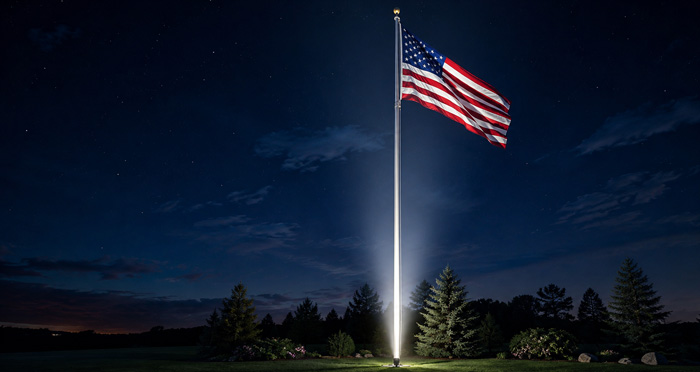
A properly illuminated flag remains visible and respectful after sunset without requiring complicated wiring or ongoing electricity costs. However, not every solar spotlight can provide consistent, even lighting throughout the night. To select the right model, you need to evaluate brightness, beam coverage, solar charging performance, battery capacity, durability, and installation conditions.
1. Match the Brightness to the Flagpole Height
Brightness is usually measured in lumens. A small residential flag does not require the same output as a large flag mounted on a tall commercial pole.
For a flagpole below 15 feet, a solar spotlight producing approximately 200 to 400 lumens may be sufficient. Poles between 15 and 25 feet generally require 400 to 800 lumens. Taller flagpoles may need a stronger light or two separate spotlights to illuminate the entire flag evenly.
Avoid selecting a light based only on a high advertised lumen rating. The spotlight must also direct that brightness toward the flag rather than spreading it across the surrounding area.
|
Flagpole Height |
Suggested Brightness |
Recommended Setup |
Suitable Beam |
|---|---|---|---|
|
Up to 15 ft |
200–400 lumens |
One spotlight |
Medium beam |
|
15–25 ft |
400–800 lumens |
One powerful light or two smaller lights |
Narrow to medium beam |
|
25–40 ft |
800–1,500 lumens |
Two spotlights |
Narrow, focused beam |
|
Above 40 ft |
1,500+ lumens |
Multiple high-output lights |
Adjustable narrow beam |
2. Choose the Correct Beam Angle
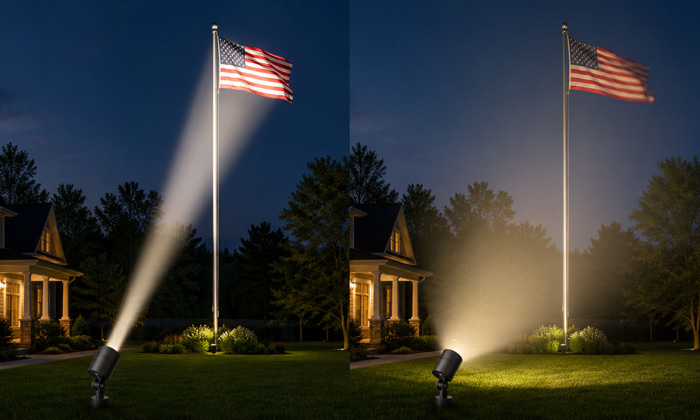
The beam angle determines how widely the light spreads. A narrow beam concentrates light over a longer distance, making it suitable for tall flagpoles. A wider beam covers a larger area but loses intensity more quickly.
For most residential flagpoles, an adjustable beam is the most practical choice. It allows you to focus the light directly on the flag and reduce wasted illumination. The spotlight head should also tilt far enough to follow the flag’s position near the top of the pole.
When the flag frequently moves in strong wind, a slightly wider beam can provide more reliable coverage. For a stationary or sheltered flag, a narrower beam produces a brighter and more defined result.
3. Check the Solar Panel’s Charging Ability
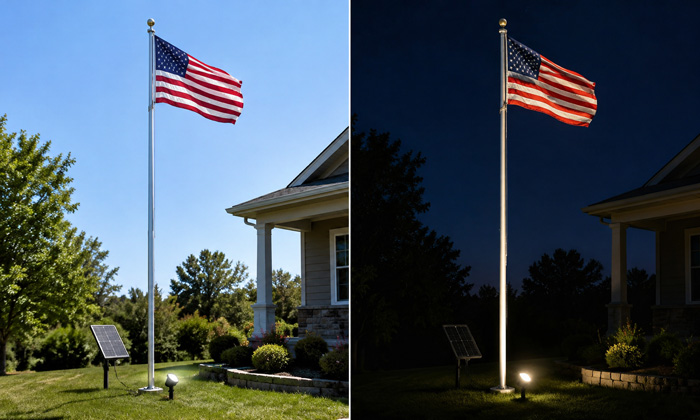
A solar spotlight is only effective when its panel can collect enough sunlight during the day. Look for a high-efficiency panel that can fully charge the battery within approximately six to eight hours of direct sunlight.
The solar panel should be adjustable independently from the light. This design lets you position the panel toward the sun while aiming the spotlight at the flag. Models with fixed panels can be difficult to install correctly, especially when the flagpole is located near a wall, tree, fence, or shaded area.
Before installation, observe the location during the day. The panel should receive direct sunlight and should not be blocked by the flagpole, landscaping, buildings, or seasonal shadows.
4. Evaluate Battery Capacity and Nighttime Runtime
Battery capacity affects how long the spotlight can operate after sunset. A suitable flag light should provide at least eight hours of usable illumination after a full charge. Longer runtime may be necessary during winter, when nights are longer and daylight hours are shorter.
Many solar spotlights offer several operating modes. A high-brightness mode provides stronger illumination but drains the battery faster. A medium or automatic mode often provides a better balance between brightness and runtime.
Because a flag may need to remain illuminated throughout the night, choose a model with automatic dusk-to-dawn operation. The built-in sensor should turn the light on at sunset and switch it off when daylight returns.
5. Select a Weather-Resistant Design
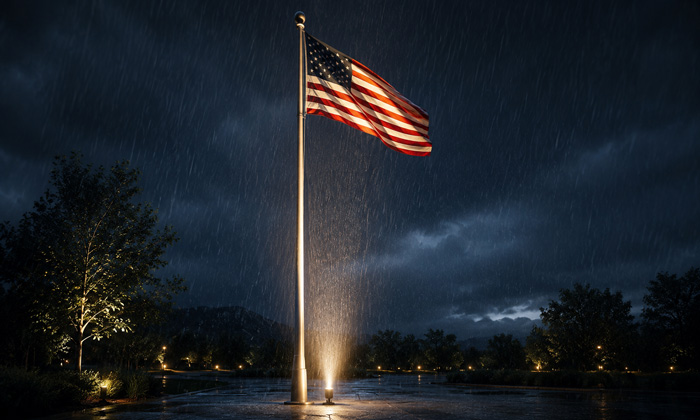
A flag spotlight remains outdoors throughout the year, so weather resistance is essential. Choose a product with at least an IP65 rating. This level generally provides protection against dust, rain, and water spray.
The housing should be made from durable materials such as aluminum, stainless steel, or high-quality UV-resistant plastic. Metal housings usually dissipate heat more effectively and provide better long-term durability.
Also consider local weather conditions. In coastal areas, corrosion resistance is important. In colder regions, confirm that the battery and electronics can operate at low temperatures. In areas with heavy rain or snow, strong seals and secure mounting hardware are especially valuable.
6. Consider Light Color and Flag Appearance
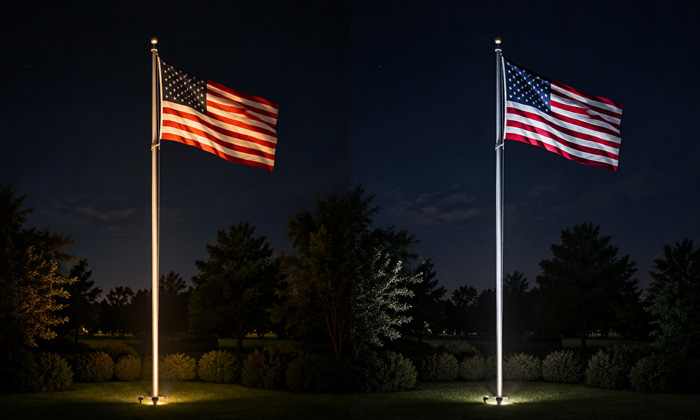
Color temperature influences how the flag appears at night. Warm white light creates a softer appearance, while cool white light often makes colors look brighter and more defined.
A color temperature between 4,000K and 6,000K is commonly suitable for flag illumination. Neutral white light provides balanced color, while cool white light offers greater visual contrast. Extremely blue light may make the display look harsh, so brightness and color quality should be considered together.
A spotlight with a good color rendering index can also display the flag’s colors more accurately.
7. Choose the Right Mounting Method
Solar flag spotlights are commonly installed with ground stakes, wall brackets, or pole mounts.
Ground-mounted lights are simple to install and work well when there is open soil near the flagpole. Wall-mounted models are useful when the pole stands near a building. Pole-mounted lights save ground space but may receive less sunlight if the solar panel is shaded by the flag or pole.
The mounting system should remain stable during wind and allow precise adjustment. A loose spotlight may gradually shift away from the flag, reducing illumination.
Position the light far enough from the base of the pole to create an effective upward angle. Placing it too close may illuminate only the lower section of the pole instead of the flag.
8. Decide Whether One or Two Spotlights Are Needed
One spotlight may be enough for a small flag in a sheltered location. However, two lights often produce better results for larger flags or poles exposed to wind.
Installing lights on opposite sides reduces shadows and helps keep the flag visible as it changes direction. Two moderate-output lights can also create more even illumination than one extremely bright spotlight.
For tall flagpoles, multiple lights provide greater reliability. Even if the flag moves outside one beam, it may remain within the coverage of the second light.
How often should a solar flag spotlight battery be replaced?
Most rechargeable batteries last about two to three years, depending on temperature, charging frequency, and product quality.
Replace the battery when illumination time becomes noticeably shorter despite adequate sunlight.
Do solar flag spotlights require regular maintenance?
Yes. Clean the solar panel every one to three months to remove dust, pollen, leaves, and bird droppings.
Check the lens, mounting hardware, wiring connections, and battery compartment for damage or corrosion.
See also: How to Clean Garden Lights?
Is a motion-sensor solar spotlight suitable for a flag?
A motion-sensor model is generally unsuitable because a displayed flag may need continuous nighttime illumination.
A dusk-to-dawn spotlight provides more consistent lighting without relying on nearby movement.
Can nearby streetlights interfere with a solar flag spotlight?
Yes. Strong artificial light can confuse the photocell and prevent the spotlight from switching on automatically.
Position the sensor away from porch lights, streetlights, security lights, and other bright nighttime sources.
Do solar flag spotlights attract insects?
Solar spotlights can attract insects, especially when they emit cool white or blue-toned light.
A warmer light source and proper placement can reduce insect activity around the fixture without significantly affecting flag visibility.
See also: What Impact Do Garden Lights Have on Plants and Animals?
