
Table of Contents
- Find the Waste Before Choosing Fixtures
- Choose LEDs by Delivered Light and Visual Comfort
- Build a Home Lighting Plan Around Everyday Tasks
- Match Commercial Lighting to Occupancy and Closing Time
- Design Outdoor Lighting for Greensboro’s Seasons and Neighbors
- Use Solar Where Its Daily Energy Budget Works
- Calculate Savings From Both Wattage and Operating Hours
- Make Maintenance and Verification Part of the Upgrade
- FAQs
Energy-efficient lighting in Greensboro, North Carolina, starts with understanding how a property is used. A kitchen counter, front walkway, retail display, and commercial parking area each need a different combination of brightness, light distribution, and operating hours.
LEDs provide an efficient foundation. The larger opportunity comes from deciding where light should land, when it should operate, and how easily the system can be maintained.
For homeowners and business owners, the most useful question is: How much electricity does it take to provide the visibility this particular space needs? That question leads to better decisions than comparing bulb wattages alone.
Find the Waste Before Choosing Fixtures
Begin with two lighting walkthroughs: one during normal activity and another after the household has settled down or the business has closed.
During the first visit, look for tasks that are difficult to see. During the second, identify lights that continue operating after their purpose has ended.
Record four details for each area:
- What people need to see.
- When they use the space.
- Which fixtures provide that visibility.
- Where the light goes beyond the intended area.
This often reveals problems that a simple bulb replacement would leave unresolved. A bright wall fixture may illuminate a neighboring window while leaving a doorstep shadowed. An office may keep an entire lighting circuit running because one employee remains at a desk.
Prioritize projects using wattage multiplied by operating hours, then consider maintenance access. A frequently used fixture usually offers more savings potential than a similar fixture that operates briefly.
An existing LED installation may benefit more from revised schedules and better aiming than from another fixture replacement.
Choose LEDs by Delivered Light and Visual Comfort
Understanding what lumens mean in light bulbs helps separate brightness from electricity consumption. Lumens describe light output, while watts describe electrical input.
However, a lumen rating does not show how much light reaches a countertop, walkway, or entrance. Fixture optics, mounting position, and beam direction affect that result.
When comparing products, examine the output and input power of the complete fixture. An efficiency figure for an LED component alone does not describe the performance of the finished lighting system. Light distribution and color quality also deserve attention.
For residential patios, porches, and garden seating, 2700K and 3000K landscape lighting provide useful starting points for comparing warm appearances. Test a sample against the property’s brick, siding, paving, and planting before committing to an entire installation.
Kelvin describes color appearance. It does not tell you how much electricity a fixture consumes or how brightly it illuminates a surface.
Where color judgment matters, such as food preparation or merchandise displays, compare color rendering as well. A CRI of 90 or higher is a useful specification to consider for these applications, alongside an actual viewing test.
Build a Home Lighting Plan Around Everyday Tasks
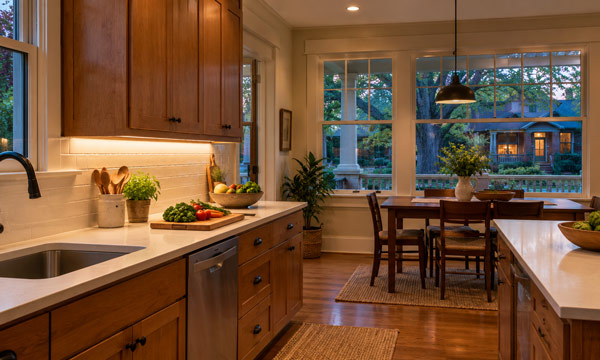
A Greensboro home benefits from lighting that follows household routines.
In kitchens, illuminate preparation surfaces directly. Under-cabinet lighting can improve visibility where ceiling fixtures cast shadows behind the person working. In living rooms, combine comfortable general lighting with a reading light near the chair that needs it.
This approach allows different activities to receive appropriate light without requiring every fixture in the room to operate at full output.
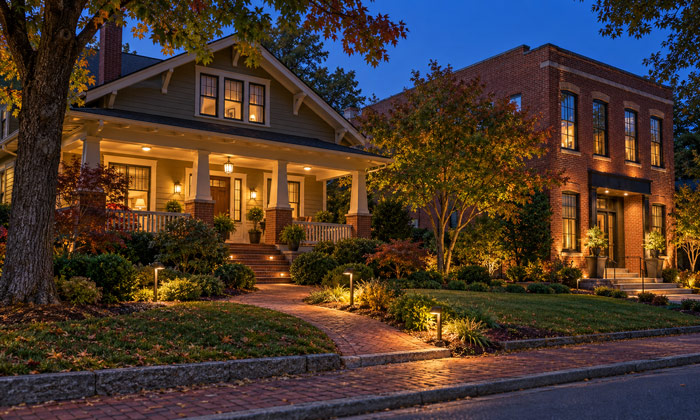
Outside, follow the route people actually take: driveway to walkway, walkway to steps, and steps to the door. Position pathway lights so changes in direction and walking surfaces remain visible from the approaching person’s viewpoint.
Treat decorative planting and façade lighting as a separate zone. A household may enjoy those features during the evening without needing them illuminated until sunrise.
Separating access lighting from decorative lighting also makes later adjustments easier. The front entrance can remain usable while the garden follows a shorter schedule.
Match Commercial Lighting to Occupancy and Closing Time
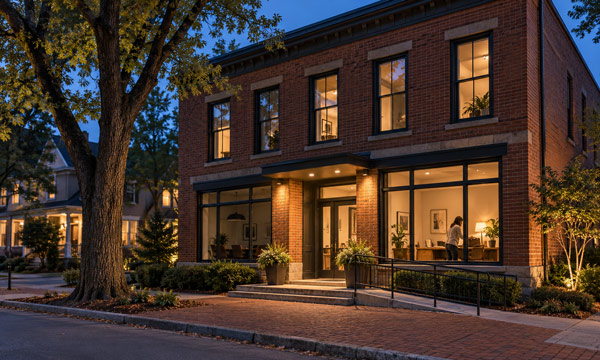
Commercial lighting should reflect the different activities occurring within the same building.
An office perimeter with substantial daylight may need less electric light than an interior work area. A retail display may require focused illumination while a stockroom needs lighting only during access. Meeting rooms can remain empty for long periods between appointments.
Task lighting, occupancy controls, and the use of available daylight are established ways to reduce unnecessary lighting energy. Their effectiveness depends on matching the controls to the space.
For a Greensboro business, establish a clear transition between customer hours, staff cleanup, and overnight operation.
For example, a small storefront could use:
- Display and customer-area lighting during opening hours.
- A smaller cleaning zone after closing.
- Separately controlled entrance and other required lighting overnight.
Outdoor decorative circuits can follow landscape lighting timers that accommodate seasonal changes in sunset. Required circulation and safety lighting should follow the applicable design requirements.
Test occupancy controls during realistic activity. A sensor that detects someone entering a room may still need adjustment to recognize a seated employee.
Design Outdoor Lighting for Greensboro’s Seasons and Neighbors
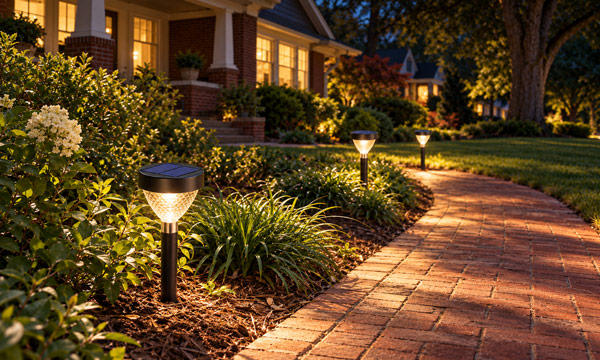
Greensboro experiences seasonal temperature changes and precipitation throughout the year. Exterior lighting selection should therefore account for environmental exposure as well as electrical efficiency. Check the manufacturer’s suitability information for the installation location, including exposure to rain and the expected operating temperatures.
Properties with deciduous trees benefit from an additional design check: inspect the lighting with foliage present and again after leaf fall.
Leaves may conceal a light source during summer. Once they fall, that same fixture may become visible from a neighboring bedroom or an approaching driveway. Plan shielding and aiming so the installation works in both conditions.
For commercial projects, Greensboro’s Land Development Ordinance includes outdoor lighting provisions covering fixtures, shielding, height, light trespass, and exterior lighting plans. Confirm which provisions apply to the site before finalizing equipment and mounting positions.
A useful purchasing question is: Can this fixture illuminate the intended surface while keeping its brightest emitting area out of normal viewing angles?
That question encourages attention to glare and placement before extra wattage is added.
Use Solar Where Its Daily Energy Budget Works
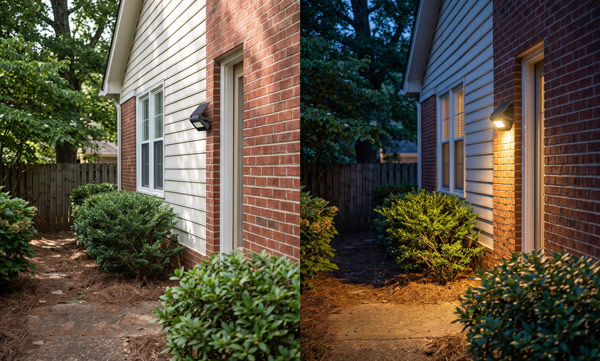
Solar lighting deserves consideration where extending electrical service would require substantial trenching or disruption. Its suitability depends on the panel, battery, lighting load, and available sunlight working together. Nearby buildings and trees can reduce the solar energy reaching a panel.
When comparing solar and low-voltage outdoor lighting, start with the required service:
- How bright must the area remain?
- For how many hours each night?
- What performance is needed after several cloudy days?
- Can the panel receive adequate sunlight at its proposed location?
Ask for runtime at the intended brightness setting. A long runtime achieved through substantial automatic dimming may not meet the needs of the space.
For a shaded garden feature used mainly during the early evening, modest solar output may be acceptable. For a route that needs dependable illumination throughout the night, evaluate a wired system or an engineered solar installation with verified performance.
A property can use both approaches. The power source can vary by zone while the overall appearance remains consistent.
Calculate Savings From Both Wattage and Operating Hours
A useful lighting estimate separates equipment efficiency from schedule changes.
The basic calculation is:
Annual electricity use in kWh = fixture quantity × input watts × annual operating hours ÷ 1,000
Consider an illustrative group of 20 decorative exterior fixtures. Assume the existing fixtures use 60 watts each and the proposed LEDs use 10 watts each while providing suitable illumination.
The example below uses an assumed electricity price of $0.15 per kWh, rather than a quoted Greensboro utility rate.
| Decorative lighting configuration | Average operation | Annual electricity use | Annual electricity cost |
|---|---|---|---|
| Twenty existing 60W fixtures | 12 hours per day | 5,256 kWh | $788.40 |
| Twenty replacement 10W LED fixtures | 12 hours per day | 876 kWh | $131.40 |
| The same LED fixtures on a shorter schedule | 6 hours per day | 438 kWh | $65.70 |
In this example, the LED replacement reduces lighting electricity consumption by approximately 83.3%. Halving the LED operating hours then saves half of the remaining consumption, producing a combined reduction of approximately 91.7%.
The percentages apply to this lighting group, rather than the property’s entire electricity bill.
The shorter schedule is appropriate only where the lighting’s purpose allows it. Use the actual input power, operating hours, and applicable electricity charges when evaluating a real project.
For purchasing decisions, compare the installed cost with expected annual energy savings and realistic maintenance savings. Keep these assumptions visible so competing proposals can be assessed on the same basis.
Make Maintenance and Verification Part of the Upgrade
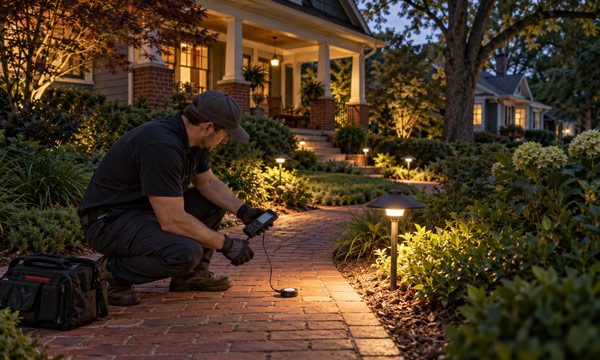
Long service life depends on the complete lighting system. Electronics and other components can fail before the LED light source reaches its expected operating life. This makes repairability a practical purchasing consideration.
When evaluating commercial landscape lighting lifespan, ask whether replacement drivers, light sources, seals, and other service parts are available. Also consider how a technician will reach the fixture.
A small difference in purchase price can matter less than the labor required to service a difficult location.
After installation, repeat the original walkthrough at the same activity periods. Check walking surfaces, work areas, entrances, neighboring windows, and control schedules. Where measured illumination is part of the design, compare readings at the same locations.
Keep a record of fixture models, aiming positions, schedules, and control settings. Review them when business hours, room layouts, or landscaping change.
The installation should continue to earn its energy savings through everyday operation.
FAQs
1. Why do LED lights flicker when connected to an existing dimmer?
A common cause is incompatibility between the dimmer and the LED’s electronic driver. Confirm that the light is dimmable and that the manufacturer supports the proposed control. Checking compatibility is a useful first step when troubleshooting flickering lights. Persistent flickering may require inspection of the driver, connections, or electrical supply by a qualified electrician.
2. Can fluorescent fixtures be converted to LED without replacing the entire fixture?
Often, yes. Options include compatible LED replacement tubes or retrofit kits fitted into the existing housing. Some tubes operate with a compatible fluorescent ballast, while others require rewiring or a separate driver. Select the conversion method for the specific fixture and follow its installation instructions. Physical fit alone does not establish electrical compatibility.
3. Will automated lighting still work if the internet connection fails?
Standalone occupancy sensors, photocells, and timers can operate autonomously. Connected systems vary: some retain schedules locally, while others rely on a hub or online service for particular functions. Before purchasing, confirm which switching, scheduling, and manual controls remain available during an internet outage.
4. Do energy-efficient LED lights stay on during a power outage?
Ordinary LED lights still require a power supply. Continued illumination needs a battery-backed fixture or another compatible backup source. For businesses, required emergency lighting needs equipment and an installation suited to that purpose. Replacing a standard bulb with an efficient LED does not itself provide outage protection.
5. Do LED outdoor lights attract fewer insects?
They can, although results depend on the light and insect species. One field study found fewer insects around the tested LEDs than around tungsten and compact fluorescent lamps, but found no significant difference between its warm-white and cool-white LEDs. Color temperature alone therefore cannot guarantee fewer insects. Consider fixture placement and unnecessary operating hours as well.
