
Table of Contents
- What Does “60W Equivalent” Mean on an LED Bulb?
- How Many LED Watts Replace a 60W Incandescent Bulb?
- Why Can a 7W LED and a 9W LED Both Be 60W Equivalents?
- Why Two 800-Lumen Bulbs Can Illuminate a Space Differently
- Match the Color of the Old Bulb, Too
- Can You Put a 60W-Equivalent LED in a 60W Fixture?
- How Much Electricity Does a 60W-Equivalent LED Save?
- What Should You Buy for the Closest Brightness Match?
- FAQs
To replace a traditional 60W incandescent bulb, look for an LED that produces about 800 lumens. An LED using about 9 watts can deliver the same 800-lumen output, but check its lumen rating to confirm the brightness match. Some models deliver the same light output with fewer watts.
Federal Trade Commission. (2023, August). Shopping for light bulbs. Consumer Advice.
The more useful question is what happens after you install it. An LED can match the old bulb’s total light output yet leave a lampshade looking darker, a countertop better illuminated, or a porch less comfortable because of glare.
Choosing the right replacement means matching the light output, checking where that light goes, and confirming that the bulb suits the fixture.
What Does “60W Equivalent” Mean on an LED Bulb?
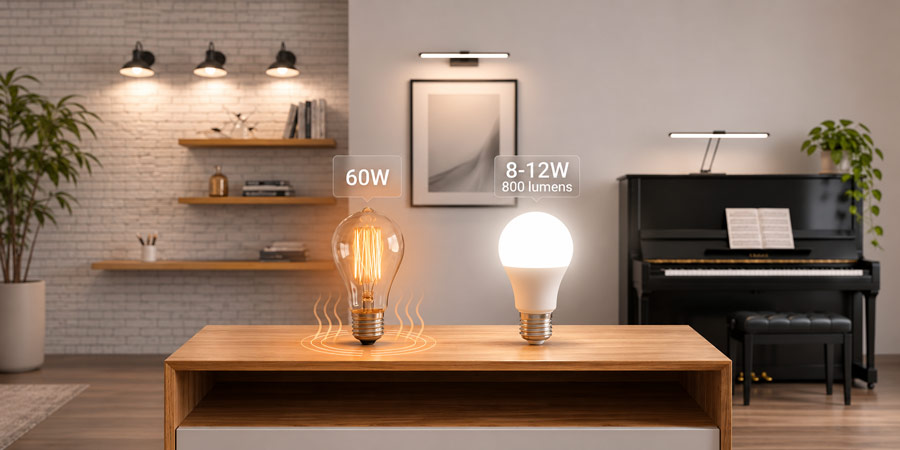
A package marked “60W equivalent” describes the incandescent brightness level the LED is intended to replace. The LED’s actual power consumption appears separately.
For example, a bulb might carry these three specifications:
| Specification | Example | What it tells you |
|---|---|---|
| Incandescent equivalent | 60W | The traditional bulb output it is intended to replace |
| Actual power consumption | 9W | The electrical power it uses while operating |
| Light output | 800 lumens | The total visible light it produces |
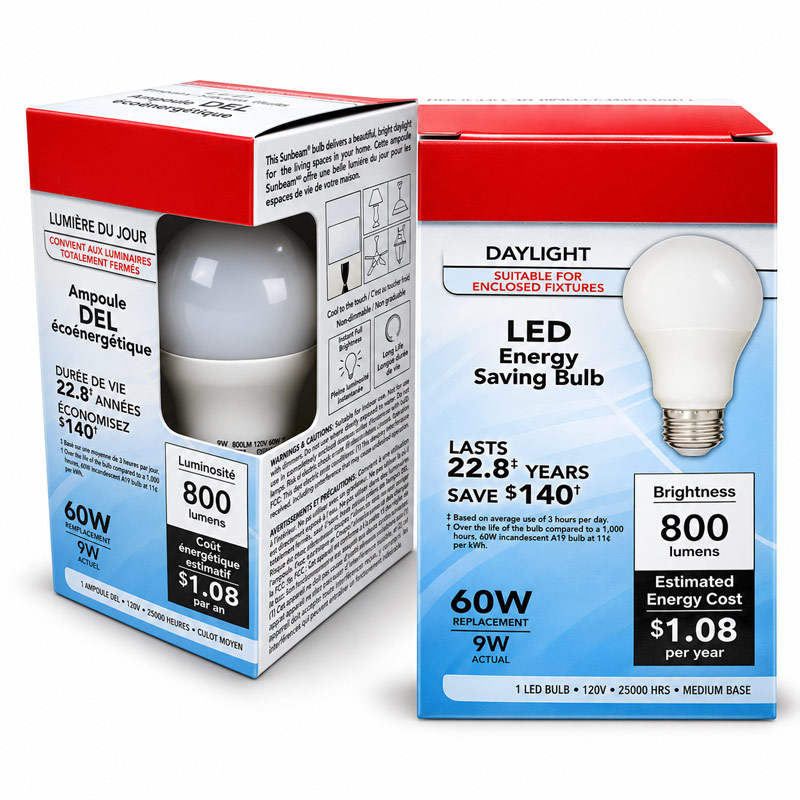
Understanding what lumens mean in light bulbs makes comparisons easier: lumens describe light output, while watts describe electrical power consumption.
Be especially careful with listings that say “60W LED” without explaining whether that means actual wattage or incandescent equivalence. Those descriptions can refer to very different products. Find both the actual wattage and the lumen output before buying.
How Many LED Watts Replace a 60W Incandescent Bulb?
For a standard household replacement, approximately 800 lumens is the familiar 60W incandescent benchmark. The LED wattage needed to reach that output varies.
The following table provides a practical comparison:
| Traditional incandescent bulb | Approximate light output | Approximate LED power range |
|---|---|---|
| 40W | 450 lumens | 4.5–7W |
| 60W | 800 lumens | 6–11W |
| 75W | 1,100 lumens | 9.5–14W |
| 100W | 1,600 lumens | 11–18W |
These ranges are starting points for general-purpose replacement bulbs. Product design and efficiency affect the actual wattage, so always confirm the output on the label.
For a straightforward replacement, begin with the 800-lumen row. Moving to 1,100 or 1,600 lumens deliberately increases the light output.
The 800-lumen benchmark also applies specifically to a conventional general-purpose incandescent bulb. When replacing a reflector or spotlight, compare the original lamp’s output and beam characteristics as well.
Why Can a 7W LED and a 9W LED Both Be 60W Equivalents?
Different LEDs convert electrical power into visible light with different levels of efficiency. This is described as luminous efficacy, measured in lumens per watt.
Consider two hypothetical bulbs:
| Bulb | Light output | Actual power | Calculated efficacy |
|---|---|---|---|
| LED A | 800 lumens | 7W | About 114 lumens per watt |
| LED B | 800 lumens | 9W | About 89 lumens per watt |
Both produce the same total light output. LED A uses less electricity to do it.
However, efficiency is only one selection criterion. Optical design, power-supply losses, and color quality can influence performance. Higher color fidelity can also involve an efficiency tradeoff.
For example, when the appearance of food, wood, fabrics, or faces matters, a bulb with better color rendering may be worth choosing even if it consumes slightly more power at the same lumen output.
A useful buying order is to establish the light output and quality you need, then compare the power consumption of bulbs that meet those requirements.
Why Two 800-Lumen Bulbs Can Illuminate a Space Differently
An 800-lumen rating describes the bulb’s total output. It does not tell you how much light will reach your book, kitchen counter, front steps, or seating area.
Light distribution changes the result
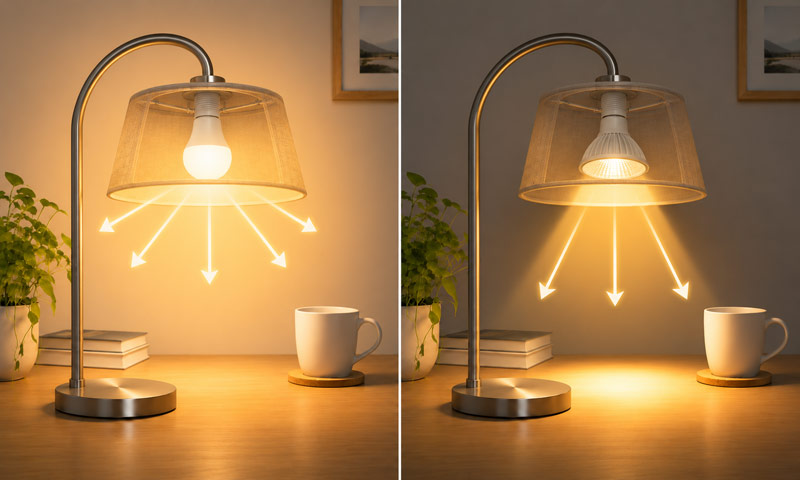
A general-purpose bulb spreads light broadly. A directional bulb concentrates more of its output into a particular area. Even when their lumen ratings match, their illumination patterns can differ substantially.
U.S. Department of Energy, Establishing LED Equivalency, 2011, p. 2.
This matters in familiar situations:
| Installation | What to check |
|---|---|
| Table lamp with a fabric shade | Whether light reaches both the shade and the surface below |
| Downward-facing reading lamp | Whether the useful light falls across the page |
| Porch lantern | Whether the bulb illuminates the entrance comfortably from normal viewing positions |
| Accent spotlight | Whether the beam covers the intended object without excessive spill |
For directional lamps, the beam angle helps explain how widely the light spreads. A concentrated beam can illuminate a small target strongly while leaving the surrounding area relatively dark.
Lumens and lux answer different questions
Lumens describe light output. Lux describes the light arriving on a surface, measured in lumens per square meter.
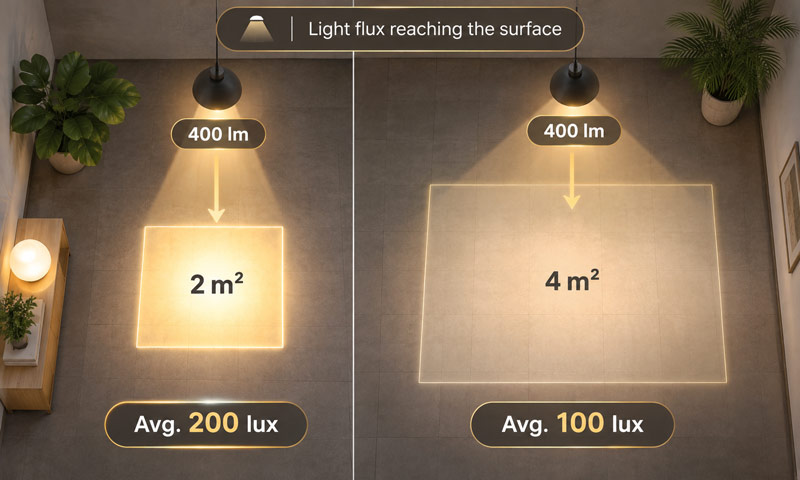
As a simplified example, suppose 400 lumens reach a surface:
- Spread across 2 square meters, the average illumination is 200 lux.
- Spread across 4 square meters, the average illumination is 100 lux.
These are illustrative calculations, rather than predictions for a particular bulb or fixture. They show why distributing light across a larger area reduces its average concentration.
The practical implication is that an apparently dim replacement may need a different distribution pattern or position within the fixture. Increasing the lumen rating is one possible adjustment, but first check where the existing light is going.
Test one bulb before replacing every bulb
A useful comparison takes place in the fixture where the replacement will operate.
Keep the shade, other lighting, and viewing position consistent. Compare the surface you need to see clearly, such as a page or step. Then look from the positions where people normally sit or walk to assess glare.
If you use a lux meter, take both readings at the same location and orientation. That comparison can reveal a difference that the two packages’ identical lumen ratings cannot explain.
Match the Color of the Old Bulb, Too
A successful replacement should also produce a suitable light appearance.
Traditional household incandescent light is typically around 2700K, so a 2700K LED is a sensible starting point when you want a familiar warm tone. A higher color temperature changes the appearance of the light without automatically increasing its lumen output.
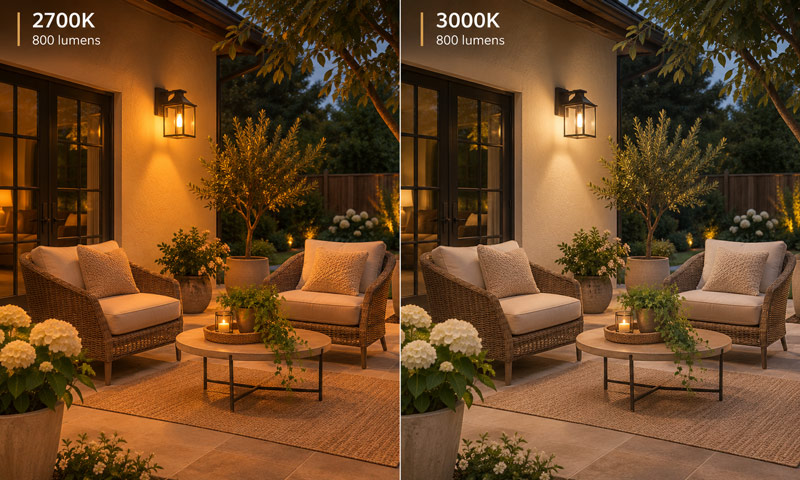
For outdoor lanterns and seating areas, choosing between 2700K and 3000K helps determine whether the result feels warmer or slightly cleaner in tone.
Keep color temperature consistent when comparing brightness. Otherwise, a change in light appearance can make it harder to judge whether the replacement provides the amount of illumination you wanted.
Can You Put a 60W-Equivalent LED in a 60W Fixture?
Usually, provided the fixture permits that bulb type and the replacement meets all applicable requirements.
For a fixture labeled “Max 60W,” compare the limit with the LED’s actual input wattage. A 9W LED described as a 60W equivalent uses 9 watts.
The same distinction applies when considering a higher-wattage-equivalent LED bulb. Its equivalent rating describes a brightness comparison. Follow the fixture’s actual wattage limit, any separate LED limit, and its lamp-type restrictions.
Also check:
- Enclosure suitability: A closed globe or sealed lantern needs a bulb approved for that operating environment.
- Base and supply voltage: Both must match the fixture.
- Physical clearance: The bulb must fit within the fixture’s specified dimensions.
- Outdoor suitability: Follow the required moisture and operating-temperature ratings.
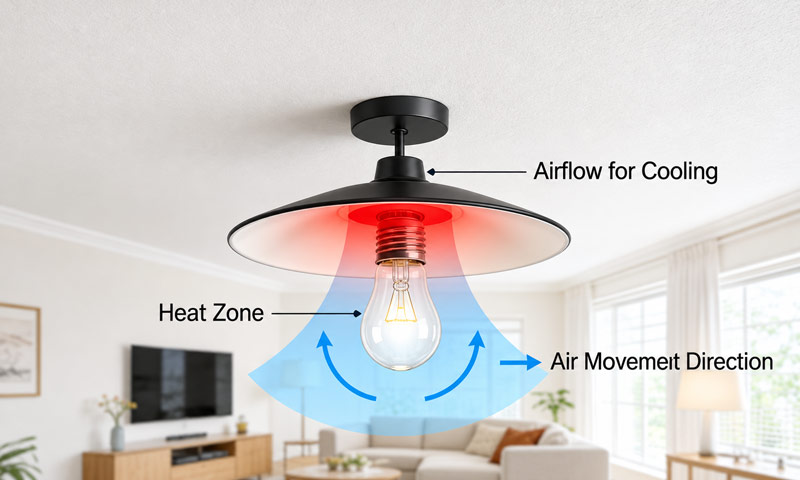
An open light fixture allows air to circulate around the bulb, helping a 60W equivalent LED dissipate heat during operation.
Enclosed fixtures deserve particular attention because trapped heat raises the temperature around the bulb. Check the packaging or technical specifications for explicit enclosure approval.
U.S. Department of Energy, Purchasing Energy-Efficient Light Bulbs, “Type of Fixture.”
A low power rating is only part of the compatibility assessment.
How Much Electricity Does a 60W-Equivalent LED Save?
Use the actual LED wattage to calculate running costs:
Annual electricity use = watts × hours used per day × 365 ÷ 1,000
For illustration, assume four hours of use each day and an electricity price of $0.20 per kWh:
| Bulb | Annual electricity use | Illustrative annual electricity cost |
|---|---|---|
| 60W incandescent | 87.60 kWh | $17.52 |
| 9W LED | 13.14 kWh | $2.63 |
| 7W LED | 10.22 kWh | $2.04 |
Replacing the 60W incandescent with a 9W LED reduces electricity use by 85% under these assumptions.
The difference between the 9W and 7W LEDs is about $0.58 per year for one bulb at that usage level.
That gives the efficiency comparison some perspective. When two suitable bulbs have the same output, lower wattage saves energy. For a single household lamp, however, a small wattage difference may matter less than comfortable light distribution, suitable color, and reliable operation.
Longer operating hours and larger installations make those small differences more significant.
What Should You Buy for the Closest Brightness Match?
For a conventional 60W incandescent replacement, use about 800 lumens as your initial target. Around 8–10W of actual LED power is a useful starting point, while the label provides the final confirmation.
Then match the color temperature, choose an appropriate light distribution, and check the fixture requirements.
If the old lamp already illuminated the space well, preserve those characteristics as closely as possible. If it left a reading area or entrance poorly lit, treat the replacement as an opportunity to improve where the light falls.
FAQs
1. Are all 60W-equivalent LED bulbs dimmable?
No. The equivalent wattage rating says nothing about dimming capability. Choose explicitly labeled dimmable LED bulbs, then check compatibility with the specific dimmer and connected load. Supported dimming methods and minimum brightness levels vary between products.
2. Why does my 60W-equivalent LED flicker?
Possible causes include an incompatible dimmer, an unsuitable or failing driver, and unstable power delivery. Flicker that appears only at low brightness can point toward the dimmer and bulb combination.
Start by identifying when it happens before troubleshooting flickering lights. Persistent problems across several fixtures warrant an electrical inspection.
3. Can a 60W-equivalent LED work with a motion sensor or dusk-to-dawn control?
Yes, when the bulb and control are compatible. Check that the control supports LED loads and that the connected load falls within its specified operating range.
If the system reduces brightness as well as switching the light on and off, the bulb and control must also support the same dimming method.
4. Can I use a 60W-equivalent LED in a 12V landscape lighting system?
Only if the LED is specifically rated for that system’s voltage and AC or DC supply. A household mains-voltage bulb is unsuitable simply because its brightness matches.
With low-voltage landscape lighting, also verify transformer compatibility. Some transformers designed for halogen lamps have minimum-load requirements that a small LED load may not satisfy.
5. Will a 60W-equivalent LED stay equally bright throughout its life?
LED output can gradually decline through a process called lumen depreciation. Where a specification uses L70, it describes the projected time to 70% of initial light output under stated conditions.
For an initially 800-lumen source, that level is 560 lumens. It describes output maintenance rather than guaranteeing when the complete bulb will stop working.
