

Table of Contents
- What Measurements Determine Bedside Lamp Size?
- How Tall Should a Nightstand Lamp Be?
- How Wide Should a Lamp Be on a Nightstand?
- Size the Lamp Around the Space You Actually Use
- How Should Lamp Size Change With Your Bedroom Setup?
- Does a Bigger Bedside Lamp Give Better Reading Light?
- Test the Lamp in Two Positions
- FAQs
For a conventional shaded bedside lamp, 24–28 inches tall (61–71 cm) is a useful starting range, with a shade roughly half the width of the nightstand. Adjust those proportions to suit your mattress height, reading position, table depth, and the space you need for everyday items.
The most useful measurement is where the bottom of the shade sits when you are in bed. A lamp can look perfectly proportioned from the bedroom doorway and still expose its bulb when you lean against your pillows.
Choosing the right size means checking three things together: the shade’s position beside your eyes, the space the lamp occupies, and where its light actually lands.
What Measurements Determine Bedside Lamp Size?
Before comparing lamps, distinguish these dimensions:
| Measurement | What it tells you |
|---|---|
| Overall lamp height | The distance from the bottom of the base to the highest point of the assembled lamp |
| Maximum shade width and depth | How much space the lamp occupies above the tabletop |
| Base footprint | How much surface area the lamp physically covers |
| Height to the shade’s lower rim | Where the shade begins relative to your eyes |
Check whether a product listing includes the shade in its stated height. Some listings describe the base separately, which can make a lamp appear considerably smaller online.
For adjustable lamps, check the dimensions in the position you expect to use. An extended arm can reach beyond the nightstand even when the base fits comfortably.
How Tall Should a Nightstand Lamp Be?
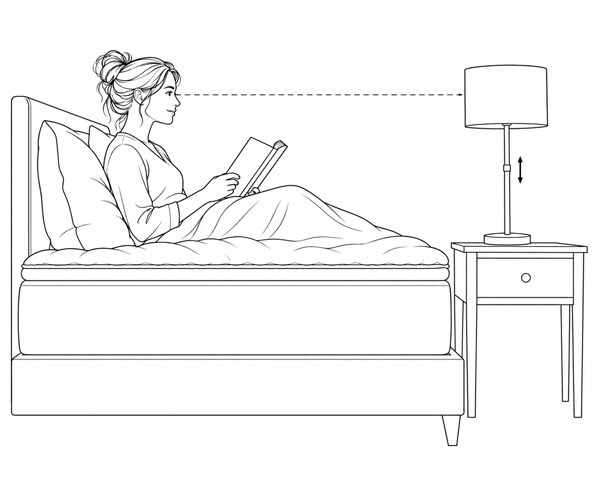
Start by positioning the bottom of the shade around your eye level when you sit in your usual reading position. Then check that the shade hides the bright bulb from that position.
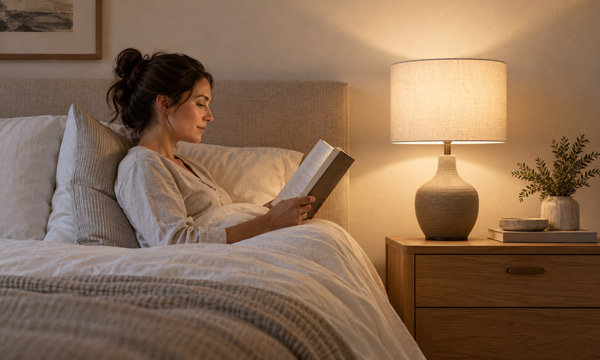
The right bedside lamp height places the shade’s lower edge near seated eye level, helping shield the bulb during reading.
Treat this as a fitting test. Your pillows, mattress, posture, and the lamp’s shade design all affect the result.
Calculate Height From Your Actual Position
A useful way to estimate the required overall height is:
Overall lamp height ≈ seated eye height above the floor − nightstand height + the distance from the shade’s lower rim to the lamp’s highest point
For example:
- Your eyes are 43 inches above the floor while reading.
- Your nightstand is 25 inches high.
- The distance from the shade’s lower rim to the lamp’s highest point is 9 inches.
The estimated lamp height is:
43 − 25 + 9 = 27 inches
This calculation gives you a starting point for a lamp with that particular shade configuration.
It also explains why two lamps advertised as 27 inches tall can behave differently. One may have a tall shade and short body, while another has a shallow shade and long stem. Their lower shade rims can sit at different heights.
When specifications are incomplete, ask for the tabletop-to-shade-rim measurement. That detail can be more useful than overall height.
Adjust for a Low or High Nightstand
A low nightstand may need a taller lamp to bring the shade into a comfortable position. A high nightstand may work better with a shorter lamp.
Avoid choosing height solely by matching the lamp to the height of the table. That approach leaves your actual position in bed out of the calculation.
How Wide Should a Lamp Be on a Nightstand?
As a first comparison, try a shade around half the nightstand’s width. Then check its depth, your bedside essentials, and the space beside the mattress.
The following examples are practical starting points for conventional shaded lamps. All dimensions are in inches.
| Nightstand top, width × depth | Shade width to try | Main consideration |
|---|---|---|
| 16–18 × 12–14 | 8–10 | Preserve space for essentials and check shade depth carefully |
| 20–24 × 16–18 | 10–13 | Balance the lamp with a usable area beside it |
| 26–30 × 18–20 | 13–16 | Check that the larger shade remains easy to reach around |
These ranges are suggestions for initial comparison. A rectangular shade, an unusually broad base, or a crowded tabletop may require a different size.
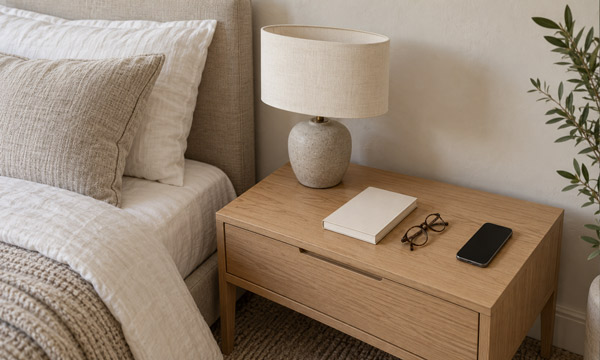
An oval lampshade suits a shallow nightstand by reducing front-to-back depth while leaving space for books, glasses, and a phone.
Table Depth Can Set the Real Limit
Consider a nightstand that is 24 inches wide but only 12 inches deep. A 14-inch round shade may look reasonable against the table’s width, yet project beyond its front and back edges.
An oval or rectangular shade can provide visual presence while using less depth. Check both dimensions before buying.
Also account for the wall, headboard, curtains, and bedding. Allow the clearances required by the lamp manufacturer.
Size the Lamp Around the Space You Actually Use
A nightstand’s most valuable space is often the area closest to your hand.
Before choosing a base, place your usual items on the table: your phone, glasses, book, water, or any essential equipment. Notice which items you reach for without sitting fully upright.
Choose a lamp that leaves that area accessible.
A narrow stem can help, although a small base still needs adequate stability. Check whether the lamp moves or rocks when you operate its switch.
The shade also matters. A broad shade above an open tabletop can obstruct your hand even though the base occupies very little room.
A simple paper template helps reveal this problem. Mark the base footprint and the shade’s outline separately on the tabletop, then rehearse reaching for your essentials. This gives you a more realistic sense of fit than measuring the base alone.
How Should Lamp Size Change With Your Bedroom Setup?
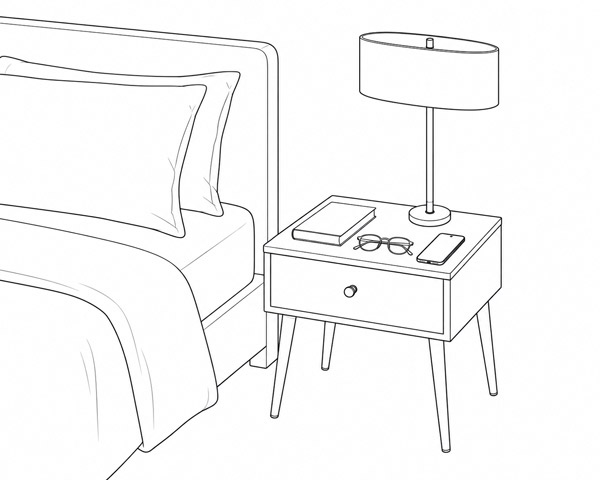
For a Small Nightstand
Look for a compact base and a shade with limited depth. A tall, slim lamp may provide a better fit than a short lamp with a wide shade.
If every option blocks your essentials, consider an adjustable wall-mounted reading light. Check its reach and light position using the same seated and reclining tests.
For a High Mattress
Measure your eye position after sitting on the mattress. Its compressed height, your pillows, and your posture determine where the lamp needs to work.
An adjustable lamp can be useful when you alternate between sitting upright and reclining.
For a Large Bed or Tall Headboard
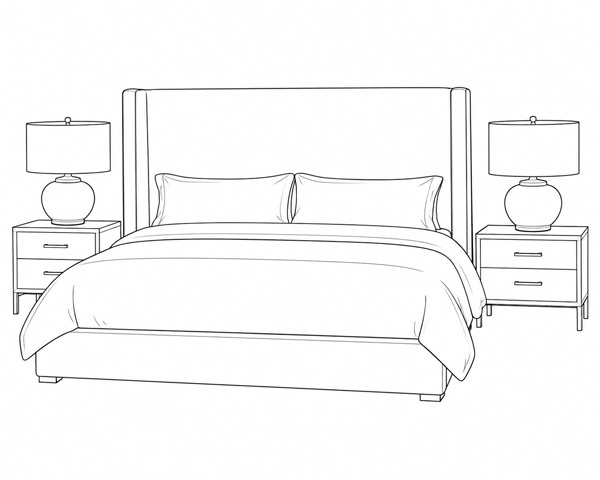
A substantial shade can help the lamp look balanced against large furniture. Increase its visual presence only as far as the tabletop and your sightline allow.
A wider shade or fuller body may provide the desired scale without raising the light source.
For a Floating Bedside Shelf
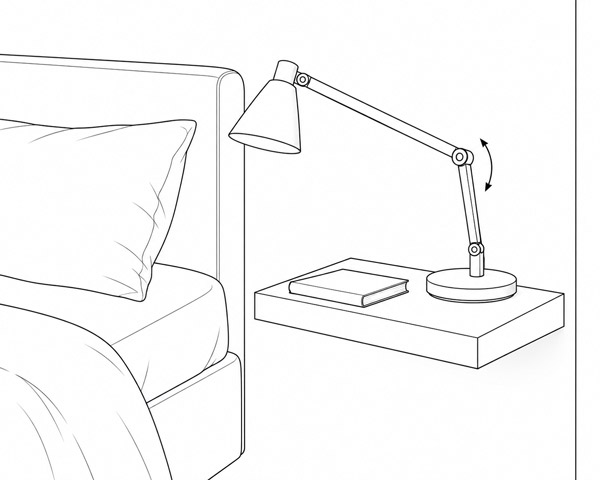
Check the usable depth and the shelf’s load rating. A compact lamp with a stable base is usually easier to accommodate.
Remember that an adjustable arm changes the lamp’s balance as it extends. Assess the lamp in its intended operating position.
Does a Bigger Bedside Lamp Give Better Reading Light?
Physical size does not establish light output. Compare lumens to understand how much visible light a bulb produces. Watts describe electrical power consumption.
For an initial home trial, consider a dimmable bulb in roughly the 400–800-lumen range, then assess it through the actual shade. This is a trial range rather than a reading-light standard.
The result depends on several factors:
- How much light the shade transmits.
- How far the lamp sits from your book.
- Whether the opening directs light toward the page.
- The contrast and print size of your reading material.
- Your personal visual needs.
If the page is dim, first check where the light lands. A brighter bulb may increase glare without correcting poor positioning.
Also confirm whether the lamp supports dimming. The bulb or LED driver and the control must work together. A dimmable label does not establish compatibility with every dimmer.
Test the Lamp in Two Positions

A comfortable bedside reading setup keeps the page evenly lit, limits distracting shadows, and places the lamp switch within easy reach.
Position One: Sitting Up to Read
Sit against your usual pillows and hold a book where you normally read.
Check that:
- The bulb is hidden from direct view.
- Light reaches the page.
- Your hand or shoulder does not create a distracting shadow.
- You can operate the switch comfortably.
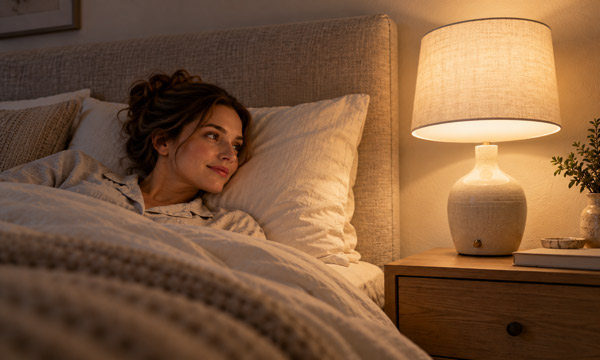
Checking a bedside lamp from the pillow helps confirm that its shade or bottom diffuser conceals the bulb when you recline.
Position Two: Reclining on the Pillow
Lower yourself into your normal resting position and look toward the lamp.
A shade that hides the bulb while you sit upright may expose it from below when you recline. If this happens, test a different lamp position, a shade that provides better shielding, or a lamp with a suitable diffuser.
Dimming can reduce brightness, but it does not change the viewing angle. Correct the shielding and placement as part of the fit.
For a shared bed, check the view from the other pillow as well.
FAQs
1. Do Lamps on Both Nightstands Have to Match?
No. Matching lamps create an orderly appearance, but different lamps can work together when they share a feature such as shade shape, finish, or color.
For different-height nightstands, consider coordinating the shades’ positions above the floor. Each lamp should still suit the person using that side of the bed.
2. What Color Temperature Is Best for a Bedside Lamp?
A 2700K bulb is a sensible starting point if you prefer warm light for evening use. This color temperature produces an appearance similar to familiar incandescent lighting.
Compare alternatives in your own bedroom, where wall colors and fabrics affect the impression. Choose brightness separately so the light remains comfortable for your intended activity.
3. What Size Light Bulb Fits a Bedside Lamp?
Follow the lamp’s specified socket type and check the bulb’s physical dimensions.
An A19 bulb describes a bulb shape and size, while a designation such as E26 identifies its base. Check both specifications, along with voltage and the lamp’s permitted wattage. A bulb that fits the socket can still be too large for the shade.
4. What CRI Should a Bedside Lamp Have?
Consider CRI 90 or higher when the appearance of bedding, artwork, wood, or other materials matters to you.
The color rendering index describes color fidelity relative to a reference light source. It is separate from brightness and color temperature, so a warm-looking bulb does not automatically have high CRI.
5. Can You Replace the Light Source in an Integrated LED Bedside Lamp?
It depends on the design. An integrated LED lamp uses LEDs built into the fixture rather than an ordinary screw-in bulb.
Some models have serviceable modules or drivers. Others require replacement of the complete lamp when those components fail. Check the maintenance instructions, replacement-part availability, and warranty before purchasing.