


Regular Light Bulb Dimensions at a Glance
What Does A19 Mean?
What Is the Difference Between A19 and E26?
Is a Regular Light Bulb the Same Size Everywhere?
How Does A19 Compare With Other Common Bulb Sizes?
How to Check Which Bulb Size Your Fixture Needs
Does Bulb Size Determine Brightness or Wattage?
Can a Regular Light Bulb Be Used Outdoors?
FAQs
A regular household light bulb in the United States and Canada is usually an A19 bulb with an E26 screw base. Its body measures approximately 2⅜ inches (60 mm) across, while its screw base has a nominal diameter of 26 mm. A typical A19 bulb is around 4.1 inches (105 mm) long, although the exact length varies by model.
When buying a replacement, check both the bulb’s body size and its base. The base determines whether it connects to the socket, while the bulb’s width and length determine whether it fits inside the shade or housing.
Regular Light Bulb Dimensions at a Glance
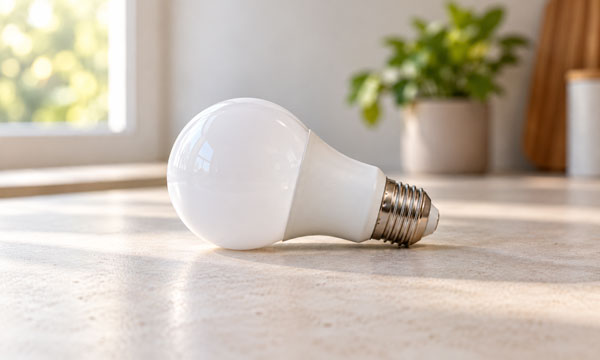
For a common North American household bulb, these are the measurements to look for:
| Specification | Common Size or Description |
|---|---|
| Bulb shape | A19, the familiar pear-shaped bulb |
| Nominal body diameter | 2⅜ inches, or approximately 60 mm |
| Typical overall length | Around 4.1 inches, depending on the model |
| Common screw base | E26 medium base |
| Nominal base diameter | 26 mm, or approximately 1.02 inches |
Overall length includes the base and bulb body. It is a typical product measurement, not a fixed dimension guaranteed by the A19 designation. Check the actual specifications when replacing a bulb inside a compact fixture.
What Does A19 Mean?
The A19 designation describes the bulb’s shape and nominal diameter.
- A identifies the familiar general-purpose, pear-shaped bulb.
- 19 indicates a diameter of 19 eighths of an inch.
The calculation is straightforward:
19 ÷ 8 = 2.375 inches, or approximately 60.3 mm.
This measurement refers to the widest part of the bulb’s body. It does not describe the screw base, total length, wattage, or brightness.
For example, two packages can both say “A19” while listing different power consumption, light output, or overall lengths. The shared designation helps identify the body shape and width, but you still need the remaining specifications to choose a replacement.
See also: What Is an A19 Lamp?
What Is the Difference Between A19 and E26?
A19 and E26 describe different parts of a light bulb.
| Code | What It Describes | Measurement |
|---|---|---|
| A19 | Bulb body shape and diameter | Approximately 60 mm wide |
| E26 | Screw base type and diameter | Nominally 26 mm across |
The difference between A19 and E26 matters because bulbs with different body shapes can share the same E26 base. A larger globe or reflector bulb may screw into an E26 socket but still be too wide for the fixture.
For a straightforward replacement, look for both codes on the packaging. “A19 E26” gives you more useful information than “standard bulb” alone.
Is a Regular Light Bulb the Same Size Everywhere?
The meaning of “regular” depends partly on location. E26 is common in North American household lighting, while E27 screw bases are widely used in Europe and many other markets. E27 has a nominal base diameter of 27 mm.
You may also encounter an A60 designation in metric markets. It describes an A-shaped bulb approximately 60 mm wide, making it broadly comparable in body size to an A19.
However, similar dimensions do not establish electrical compatibility. Match the fixture’s specified base and the bulb’s marked operating voltage. Do not assume that a bulb is suitable simply because its threads appear to fit.
How Does A19 Compare With Other Common Bulb Sizes?
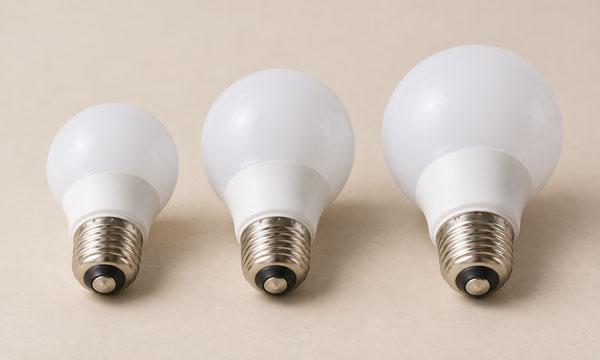
A19 is a useful starting point for general household lighting, but compact fixtures, decorative fittings, and recessed lights may need another shape.
| Bulb Code | Nominal Body Diameter | Common Application |
|---|---|---|
| A15 | 1⅞ inches / 47.6 mm | Compact lamps and selected appliance fixtures |
| A19 | 2⅜ inches / 60.3 mm | Table lamps, floor lamps, and general lighting |
| A21 | 2⅝ inches / 66.7 mm | Larger fixtures and some higher-output bulbs |
| B11 | 1⅜ inches / 34.9 mm | Decorative sconces and chandeliers |
| BR30 | 3¾ inches / 95.3 mm | Recessed lighting with a broad beam |
| PAR38 | 4¾ inches / 120.7 mm | Directional floodlighting and spotlighting |
These measurements describe the bulb body. They do not specify its base, length, voltage, or environmental rating.
An A21, for instance, is nominally ¼ inch wider than an A19. That difference may seem small, but it can prevent the bulb from fitting through a narrow opening or beneath a close-fitting shade. Check the larger bulb’s length as well.
How to Check Which Bulb Size Your Fixture Needs
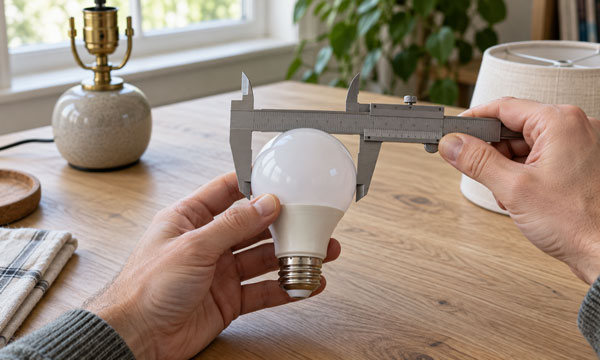
1. Read the Fixture Label and Existing Bulb
Turn off the power and allow the bulb to cool before removing it. Unplug portable lamps.
Look for the base code, operating voltage, and any bulb restrictions on the fixture label or instructions. The old bulb can help identify a replacement, but the fixture’s requirements take priority if the previous bulb was unsuitable.
2. Check the Base
Identify the base from its marking whenever possible. For a removed screw-base bulb, measuring across the outside of the threads can help distinguish a medium base from a much smaller decorative base.
A ruler is less useful for distinguishing closely sized fittings such as E26 and E27. Use the printed specifications to confirm the correct type. Never force a bulb into a socket.
3. Compare Width and Overall Length
Measure the old bulb at its widest point and from the bottom contact to the top. Compare those measurements with the replacement’s published dimensions.
Also check the fixture opening. A bulb might fit inside the housing but be too wide to pass through its opening.
4. Confirm Clearance and Fixture Suitability
The shade or cover should close normally, with the clearances required by the fixture instructions. Physical fit alone does not confirm that an LED bulb is suitable for a fully enclosed housing.
When using LED light bulbs in regular fixtures, check enclosure suitability and any damp- or wet-location requirements in addition to dimensions.
Does Bulb Size Determine Brightness or Wattage?
No. A19 describes physical dimensions, while lumens describe light output and watts describe electrical power consumption.
Understanding what lumens mean in light bulbs helps you select the brightness you want without assuming that a larger bulb will always produce more light.
For example, a traditional 60-watt incandescent bulb produces approximately 800 lumens. An LED can produce a similar output while using around 9 watts, although actual consumption varies by product. Both may use an A19 body.
A “60W equivalent” label describes comparable brightness. It does not mean the LED consumes 60 watts.
When checking LED wattage against a fixture’s rating, compare actual power consumption with the applicable limit and follow any separate LED restrictions. A low wattage does not override enclosure, voltage, or installation requirements.
Can a Regular Light Bulb Be Used Outdoors?
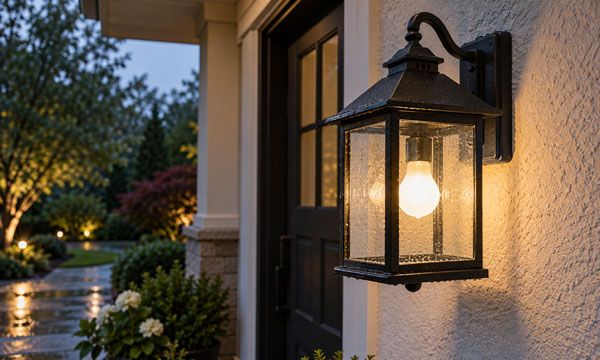
An A19 bulb may fit an outdoor porch light or wall lantern, but its shape does not establish outdoor suitability.
Check the bulb and fixture instructions for the expected moisture exposure, operating temperature, and enclosure conditions. A protected porch and a fitting exposed directly to rain can have different requirements.
Garden lighting also includes fixtures with other bases, lower operating voltages, or integrated LED modules. Identify the fixture’s light source before buying a household replacement bulb.
FAQs
1. Can a Standard LED Bulb Work With a Dimmer Switch?
Only LED bulbs specifically labeled as dimmable should be used with a compatible dimmer switch. Matching the bulb shape or base type does not confirm dimming ability.
A non-dimmable LED connected to a dimming circuit may flicker, produce noise, or fail to operate correctly. A dimmable LED can still be used at normal full brightness when connected to a standard on/off switch.
2. Do Three-Way Lamps Need Special Light Bulbs?
Yes. To use the different brightness settings provided by a three-way lamp switch, the bulb must be designed as a three-way bulb.
Three-way bulbs are available in common household shapes such as A19 and A21, so the appearance of the bulb does not indicate whether it supports multiple brightness levels. A standard single-output bulb cannot provide the same function.
3. Can a Smart Bulb Replace a Regular Light Bulb?
In many cases, yes, as long as the smart bulb matches the fixture’s base, voltage, size, and operating requirements. Smart bulbs need continuous power to maintain their connection and control features.
For proper operation, the wall switch usually needs to remain on. Check compatibility before installing a smart bulb in a fixture controlled by an existing dimmer, timer, or automated switch.
4. What Color Temperature Looks Like a Traditional Household Bulb?
Around 2700K is commonly used to create the warm yellow-white appearance associated with traditional household lighting. A 3000K bulb appears slightly cleaner and less amber, while 5000K produces a cooler daylight-style effect.
Color temperature affects the visual tone of the light and is separate from the bulb’s physical size, shape, or brightness output.
5. Can I Use a Regular Household Bulb in an Oven?
No. An oven bulb must be selected based on more than just socket size. It needs to meet the appliance’s requirements for temperature resistance, wattage, dimensions, and base type.
A standard household LED bulb may fit physically but is not designed for the high temperatures inside an oven. Always use the replacement specified by the appliance manufacturer.
