
Table of Contents
- How Do LED and Incandescent Bulbs Work?
- LED vs. Incandescent Bulbs at a Glance
- Energy Savings Depend on How Long the Light Stays On
- Why the Fixture Can Matter as Much as the Bulb’s Rated Life
- Warm Light and Good Color Rendering Are Separate Choices
- The Overlooked Difference: Where the Light Goes
- How to Choose an LED Replacement That Works Well
- Choosing Lighting for Everyday Use
- FAQs
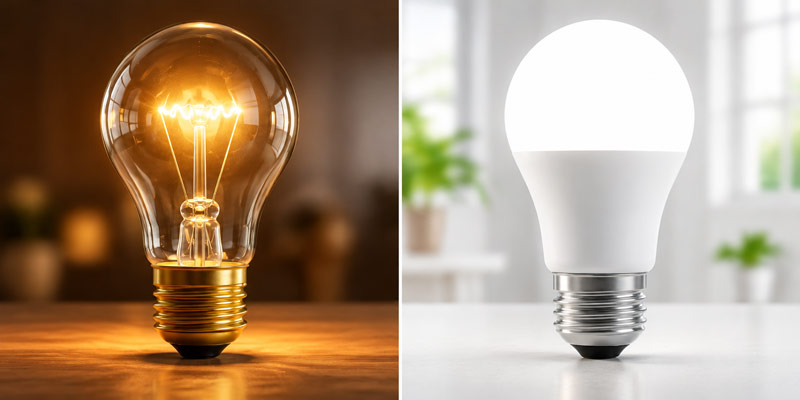
The main difference between LED and incandescent bulbs is how they produce light. An incandescent bulb heats a metal filament until it glows. An LED uses a semiconductor to emit light, providing comparable illumination with much less electricity.
That difference affects running costs, heat, lifespan, and lighting design. But a successful replacement also depends on the fixture, the way light spreads, and how the space looks after dark. An efficient bulb can still be the wrong choice if it creates glare or leaves the area you need poorly lit.
How Do LED and Incandescent Bulbs Work?
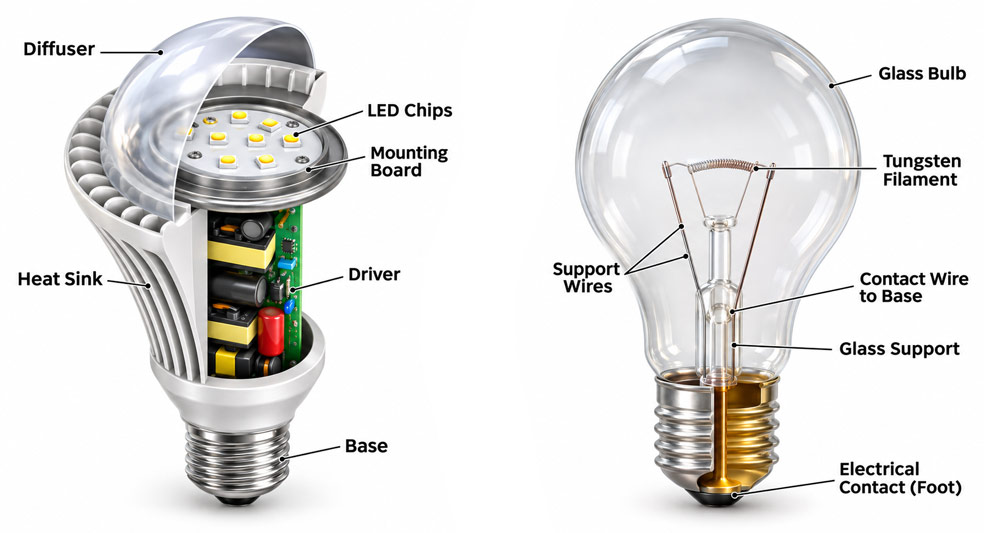
A comparison of LED and incandescent bulb structures, showing how LEDs use semiconductor chips and electronic drivers, while incandescent bulbs produce light by heating a tungsten filament.
An incandescent bulb passes electricity through a thin tungsten filament. The filament becomes hot enough to produce visible light, while much of the electrical energy becomes heat.
LED stands for light-emitting diode. LEDs produce light through semiconductor materials. Many white LEDs combine a blue light source with a phosphor coating that converts part of its output into other wavelengths. An electronic driver regulates power to the LEDs. LEDs also generate heat, which must be managed to maintain performance.
This makes an LED bulb a small lighting system: its light source, electronics, optics, and thermal design all influence the result.
LED vs. Incandescent Bulbs at a Glance
| Factor | Incandescent bulbs | LED bulbs |
|---|---|---|
| Light production | A heated filament produces light | Semiconductor devices produce light |
| Electricity for approximately 800 lumens | About 60 watts | Around 9 watts in a typical replacement example |
| Lifespan | Commonly around 1,000 hours | Can reach tens of thousands of hours, depending on the product and conditions |
| Heat | Substantial heat for the light produced | Less heat at comparable light output, but still requires thermal management |
| Light appearance | Usually a warm tone | Available in warm, neutral, and cooler tones |
| Light distribution | A bare bulb generally emits light in many directions | Can provide broad or focused illumination, depending on bulb design |
| Purchase decision | Simple construction, but higher electricity use | Compare efficiency, light quality, compatibility, and rated life |
These are general comparisons. The label and specifications of the individual bulb remain the best guide to its performance.
Energy Savings Depend on How Long the Light Stays On
Watts measure electrical power. Lumens measure the total visible light a bulb produces. Understanding what lumens mean in light bulbs makes it easier to compare different technologies fairly.
For example, a traditional 60-watt incandescent bulb produces approximately 800 lumens. An LED can provide similar output using about 9 watts. That particular replacement reduces electricity consumption by 85% while maintaining comparable total light output.
Federal Trade Commission. (2023, August). Shopping for light bulbs. Consumer Advice.
The financial value depends on operating hours.
A Practical Running-Cost Example
Assume one bulb operates for six hours every day and electricity costs $0.15 per kilowatt-hour.
| Annual calculation | 60W incandescent | 9W LED |
|---|---|---|
| Operating hours | 2,190 | 2,190 |
| Electricity consumption | 131.40 kWh | 19.71 kWh |
| Electricity cost | $19.71 | $2.96 |
The calculated electricity saving is approximately $16.75 per bulb per year.
These figures illustrate the calculation rather than a fixed savings promise. They exclude purchase prices, replacement costs, and maintenance.
Compare Payback in Operating Hours
Suppose the LED costs $4 more than the incandescent when comparing two new purchases. Under the same electricity rate, the extra purchase cost is recovered after approximately 523 operating hours.
That means roughly:
- 87 days for a light used six hours daily.
- 5.7 years for a light used only 15 minutes daily.
Both bulbs offer the same percentage reduction in power, but their financial priorities are very different.
A practical upgrade sequence therefore starts with lights that run longest, followed by bulbs that are difficult or expensive to replace. A rarely used cupboard light usually has a weaker electricity-saving case than a porch light used every evening.
If you are replacing a functioning incandescent early, use the full LED purchase cost in the immediate payback calculation. The price difference between two new bulbs answers a different purchasing question.
Why the Fixture Can Matter as Much as the Bulb’s Rated Life
Incandescent bulbs commonly fail when their filament breaks. LED products can lose brightness gradually, while their electronics can also fail before the LED light source reaches its expected useful life.
This makes a lifespan claim worth examining.
Useful Life Does Not Always Mean Time Until Failure
LED light-source life is often described using lumen maintenance. For example, L70 identifies the point at which output is expected to fall to 70% of its initial level. It does not automatically describe the survival of every component in the bulb.
A 25,000-hour rating translates mathematically to about 11.4 years at six hours of daily use. That conversion is an estimate based on operating hours, rather than an 11-year warranty.
When comparing products, check the rated-life definition, warranty terms, and permitted operating conditions together.
Enclosed Fixtures Change the Operating Environment
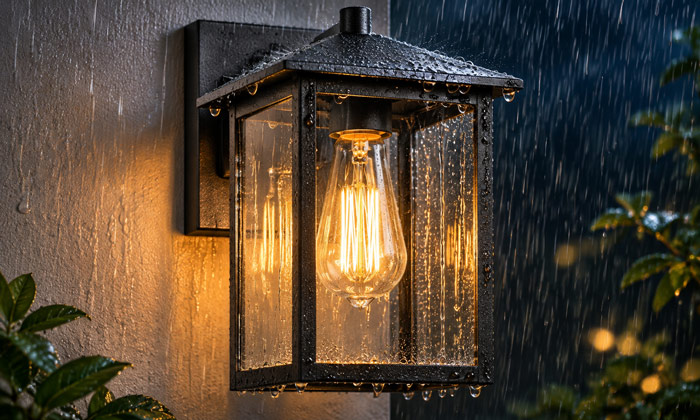
A sealed glass lantern may protect a bulb from weather while also trapping heat. Some LED bulbs are unsuitable for that environment, even when their base fits perfectly.
For an enclosed fixture, choose a bulb explicitly approved for enclosed operation. Otherwise, accumulated heat can reduce performance and shorten service life.
For garden and entrance lighting, this leads to a useful purchasing principle: evaluate the bulb inside its intended fixture, rather than judging it only from the packaging.
Warm Light and Good Color Rendering Are Separate Choices
Incandescent bulbs are familiar for their warm appearance. LEDs can provide a similar warm tone, but choosing the same color temperature does not guarantee identical color quality.
Two specifications help explain the difference:
- Correlated color temperature, or CCT, describes whether white light appears warm or cool. Around 2700K is a common starting point for an incandescent-like appearance.
- Color rendering index, or CRI, describes how faithfully a source renders colors compared with a reference source. A CRI of 90 or higher can be useful where material and color appearance matter.
Understanding CCT and CRI in garden lighting helps when choosing illumination for timber decking, brickwork, flowers, and outdoor dining areas.
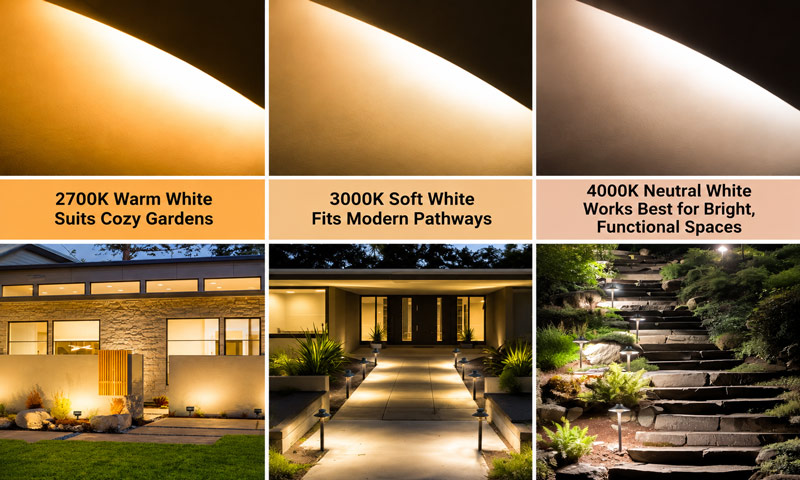
A comparison of warm white, neutral white, and cool white garden lighting, showing how different color temperatures (CCT) create distinct outdoor atmospheres.
A useful test is to compare bulbs against the same materials after dark. Look at faces, painted surfaces, foliage, and food. A bulb that looks pleasantly warm when viewed directly may render those objects differently from another bulb with the same Kelvin rating.
For a patio, this visual comparison can reveal more than simply choosing the product with the highest lumen output.
The Overlooked Difference: Where the Light Goes
Lumens describe total light output. They do not tell you how much light reaches a pathway, tabletop, or wall.
A bulb can produce plenty of light while directing too much of it toward the viewer or into an unhelpful part of the fixture. LED designs offer considerable control over light distribution, although the finished bulb determines whether the output is broad or concentrated.
Consider two hypothetical replacements for a garden spotlight:
- One spreads light widely across the planting bed.
- The other concentrates similar total output on a small tree.
The second can create a brighter highlight without producing more lumens. Conversely, it may leave surrounding areas darker. The beam angle of a spotlight helps explain this tradeoff between concentration and coverage.
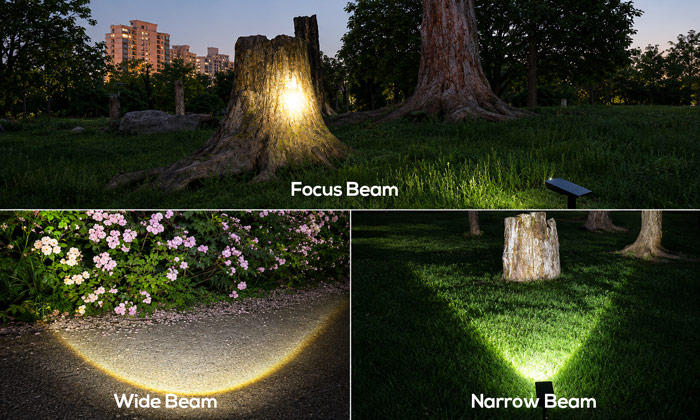
A comparison of narrow, focused, and wide spotlight beams, illustrating how beam angles affect light concentration, brightness, and coverage area in outdoor lighting.
Our practical recommendation is to judge the illuminated surface from the position where people will actually stand or sit. Check whether steps are visible, whether faces look natural, and whether the light source causes discomfort.
This also helps prevent overlighting. After switching to LED, installing brighter bulbs everywhere can consume part of the potential savings and create an unnecessarily harsh outdoor space.
How to Choose an LED Replacement That Works Well
When using LED light bulbs in regular fixtures, work through these checks:
- Choose the required light output. Use lumens to establish a starting point, then consider whether the existing installation is already too bright or too dim.
- Match the electrical and physical requirements. Confirm the base, supply voltage, bulb dimensions, and clearance inside the fixture.
- Check the installation environment. Select appropriate enclosed-fixture approval and damp- or wet-location suitability where required.
- Compare the finished effect. Review color appearance, color rendering, coverage, and glare in the actual space.
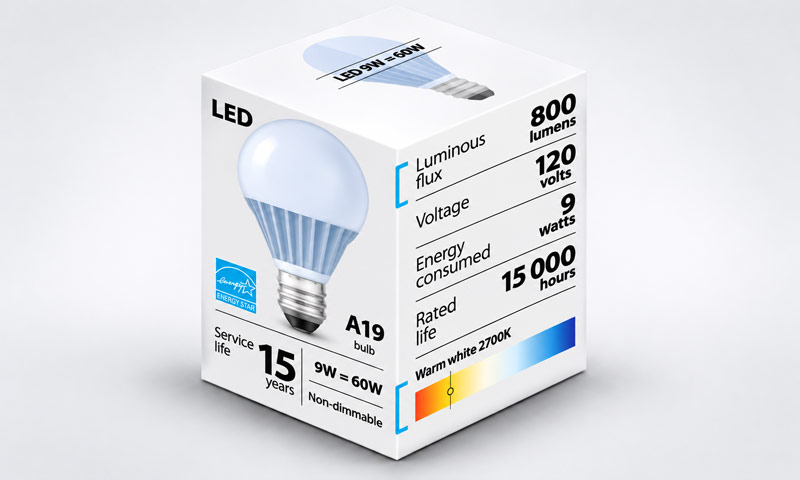
This 9W LED bulb delivers 800 lumens, providing brightness comparable to a 60W incandescent bulb while using less electricity.
Use the bulb’s actual power consumption when checking wattage limits. A “60W equivalent” description refers to approximate brightness, while the LED’s actual wattage may be much lower. Always follow the fixture’s labeling and the bulb’s installation instructions.
For a group of matching fixtures, testing one suitable replacement first can reveal differences in appearance or coverage before you replace every bulb.
Choosing Lighting for Everyday Use
LED bulbs offer a strong combination of lower electricity consumption, long potential service life, and flexible light distribution. Getting those benefits requires attention to the complete installation.
When choosing Lumetro lighting for a home or garden, start with the surface you want to illuminate and the atmosphere you want to create. Then compare light output, color quality, fixture compatibility, and operating cost. That approach makes the upgrade useful every evening, beyond the savings shown on a calculation.
FAQs
1. Why Do LED Bulbs Flicker When Used With a Dimmer?
An LED bulb may flicker if its driver does not work properly with the dimmer, particularly at low settings. First confirm that the bulb is marked dimmable and that the dimmer supports the specific LED load. A dimmer that worked well with incandescent bulbs may require replacement for satisfactory LED operation.
2. Can LED Bulbs Work With Motion Sensors and Dusk-to-Dawn Switches?
Yes, provided the bulb and control are compatible. Check that the sensor or switch supports LED loads, including any minimum-load requirement. Motion sensors respond to movement, while dusk-to-dawn controls respond to ambient light. Matching the control to the application can reduce unnecessary operating hours without sacrificing light when it is needed.
3. Do LED Bulbs Attract Fewer Insects Than Incandescent Bulbs?
Sometimes, but the LED label alone does not guarantee fewer insects. Spectrum, brightness, and insect species all matter. Amber or yellow light can attract fewer flying insects than blue-rich lighting. When selecting light that attracts fewer bugs, use only the illumination needed and avoid treating any bulb as completely insect-proof.
4. Do LED Bulbs Work in Freezing Weather?
LED light sources generally perform well in cold conditions, making them useful for outdoor applications. However, the complete bulb still needs an operating-temperature rating suitable for the location. Check the specified minimum temperature along with the fixture’s weather protection. An outdoor-use designation alone does not tell you the lowest temperature at which a product will operate reliably.
5. How Should LED Bulbs Be Disposed Of?
Check with a local waste authority, bulb collection service, or electronics recycler that explicitly accepts LED bulbs. Avoid putting them into household glass recycling unless the service permits it. Collection rules vary, so confirm acceptance before taking bulbs to a recycling point, and ask for separate guidance if a bulb is broken.
