

Table of Contents
- What Is Direct Lighting?
- What Is Indirect Lighting?
- Direct vs. Indirect Lighting: Key Differences
- How Do They Affect Glare, Shadows, and Comfort?
- Is Direct Lighting More Energy Efficient?
- Where Should You Use Direct and Indirect Lighting?
- How Do Direct and Indirect Lighting Work Outdoors?
- Are Uplighting and Downlighting the Same as Indirect and Direct Lighting?
- How to Combine Direct and Indirect Lighting
- FAQs
Direct lighting sends light straight onto the area or object you want to illuminate. Indirect lighting first directs light onto a ceiling, wall, or another surface, which then reflects it into the surrounding space. Direct lighting provides targeted visibility and definition, while indirect lighting usually creates softer background illumination.
Both approaches can improve a home, garden, or commercial space. The right choice depends on what people need to see, how the space will be used, and the atmosphere you want to create. In many settings, combining the two produces the most useful and comfortable result.
What Is Direct Lighting?
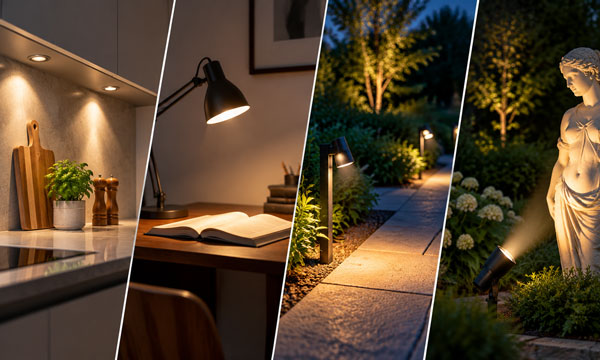
Direct lighting illuminates its intended target without first bouncing off another surface in the room or landscape. A reading lamp shining onto a book and a spotlight aimed at a garden sculpture are straightforward examples.
Common applications include:
- Downlights illuminating a kitchen worktop.
- Desk lamps lighting a reading or working area.
- Shielded pathway lights directing light onto paving.
- Spotlights highlighting trees, artwork, or architectural details.
The main advantage is control. You can place useful light exactly where it is needed, making direct lighting effective for detailed tasks, circulation routes, and decorative accents.
Direct lighting does not automatically mean a narrow, harsh beam. The fixture’s optics, position, and apparent size influence the result. The beam angle of a spotlight, for example, affects how tightly its light is concentrated. A narrow beam can isolate a small feature, while a wider beam can cover a broader target.
The light source also does not have to remain visible. A shielded or deeply recessed fixture can provide direct illumination while keeping the brightest part of the fitting out of normal sightlines.
What Is Indirect Lighting?
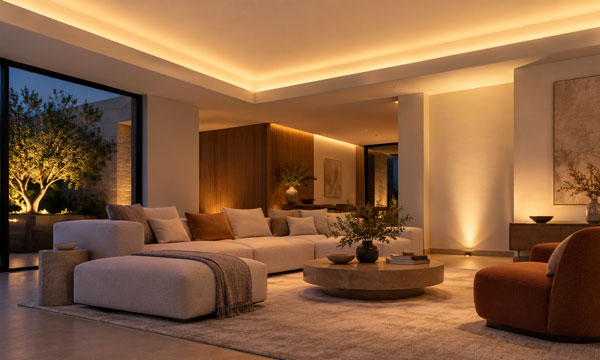
Indirect lighting uses another surface as a secondary reflector. Instead of aiming the main light output at the occupied area, the fixture illuminates a ceiling, wall, or similar surface. Reflected light then helps illuminate the space.
Typical examples include:
- Concealed cove lighting directed onto a ceiling.
- Uplights that illuminate a room through ceiling reflection.
- Hidden linear lighting aimed at a pale architectural surface.
- Wall lighting that contributes reflected illumination to a nearby seating area.
Because the reflecting surface spreads the light over a larger area, indirect lighting typically produces gentler shadows and a more even background brightness. Its performance depends heavily on the surface receiving the light. Light, matte finishes generally work better than dark finishes that absorb much of the output.
A wall washer light fixture illustrates how the two approaches can overlap. It directly illuminates the wall, while light reflected from that wall contributes indirect illumination to the surrounding area.
Direct vs. Indirect Lighting: Key Differences
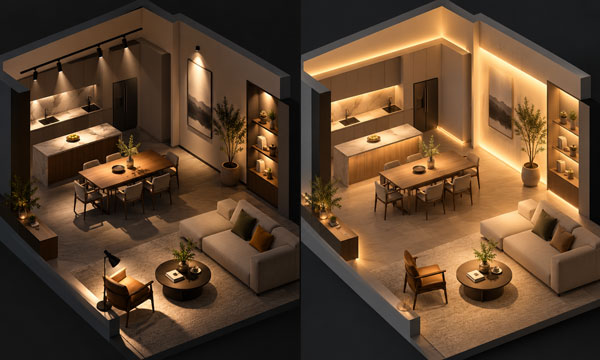
| Feature | Direct Lighting | Indirect Lighting |
|---|---|---|
| Light path | Travels from the fixture to the intended target | Reflects off another surface before reaching the intended area |
| Main purpose | Task visibility, accent lighting, and controlled coverage | Background illumination and visual comfort |
| Shadows | Can create stronger definition and contrast | Usually produces softer shadows |
| Glare | Requires careful shielding, aiming, and placement | Often reduces direct source glare |
| Surface dependence | Relies mainly on fixture distribution and positioning | Relies strongly on reflecting surfaces |
| Task efficiency | Often delivers useful light efficiently to a defined target | Usually needs more output for the same task illuminance |
| Typical examples | Task lamps, downlights, spotlights | Cove lighting, ceiling uplighting, reflected wall lighting |
These are general tendencies. Fixture design and installation quality can significantly change how either approach performs.
How Do They Affect Glare, Shadows, and Comfort?
Direct lighting creates definition by making some surfaces brighter than others. This helps reveal texture, shape, and detail. A carefully aimed garden spotlight, for example, can bring out the structure of a tree trunk or the texture of stonework.
Problems arise when the contrast becomes excessive. An exposed source may be uncomfortable to look at, and poorly positioned lighting can create reflections on screens, glass, or polished surfaces.
Indirect lighting can soften these contrasts by brightening the surrounding space. However, it is not automatically glare-free. An excessively bright reflecting surface or a visible strip of exposed LEDs can still cause discomfort.
Evaluate the installation from the positions people actually occupy. A light that looks comfortable while standing may shine directly into someone’s eyes when they sit on a low outdoor chair.
Is Direct Lighting More Energy Efficient?
For a defined task, direct lighting often delivers more useful illumination from the same fixture output because it avoids the additional losses associated with reflection.
Indirect lighting loses some light when it strikes the reflecting surface. A dark ceiling or wall absorbs more light, so additional output may be needed to achieve the desired illumination below.
However, overall energy use depends on the complete design. Lighting a small work area directly while maintaining lower background lighting can be more efficient than making the entire room equally bright. Task and ambient lighting can work together to support this approach.
When comparing options, distinguish between:
- Lumens: The total visible light emitted.
- Lux: The amount of light reaching a surface.
- Watts: The electrical power consumed.
A high lumen rating alone does not tell you how well a desk, pathway, or dining table will be illuminated. Distribution, distance, and surface conditions also matter.
Installation cost follows a similar principle. A simple indirect fitting may cost less to install than a complex direct lighting system. Concealed channels, architectural alterations, wiring access, and maintenance requirements influence the final price.
Where Should You Use Direct and Indirect Lighting?
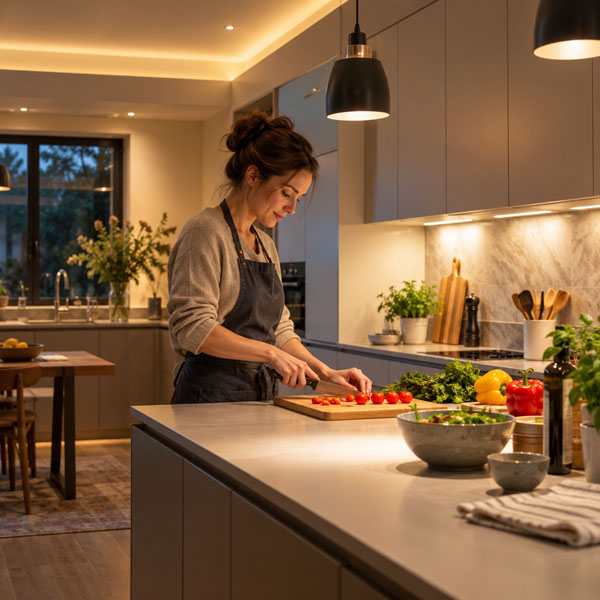
Kitchens and Work Areas
Direct lighting suits activities that require clear visibility. Food preparation, reading, and detailed work benefit from fixtures positioned to illuminate the task without letting the user’s body block the light.
Indirect illumination can support the surrounding space, reducing the abrupt transition between a bright work surface and a dark room.
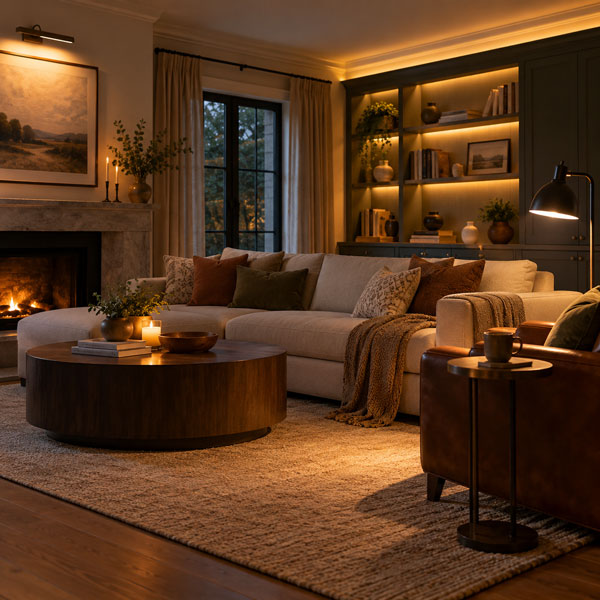
Living Rooms and Bedrooms
Indirect lighting can provide a comfortable background for relaxing or socializing. Direct lighting remains useful beside a reading chair, above a desk, or on artwork.
This combination lets different parts of the room serve different purposes without requiring the same brightness everywhere.
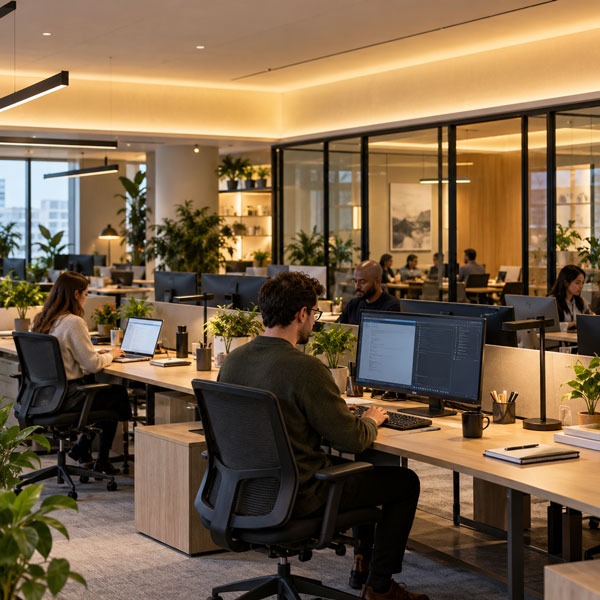
Offices and Shared Interiors
Indirect lighting can brighten ceilings and upper walls, helping the room feel more evenly illuminated. Direct task lighting can then provide additional visibility at workstations.
Placement remains important around monitors. Check both the visibility of the light source and reflections on the screen.
How Do Direct and Indirect Lighting Work Outdoors?
Outdoor spaces require particular attention because they often lack the continuous ceilings and walls that make indirect lighting effective indoors.
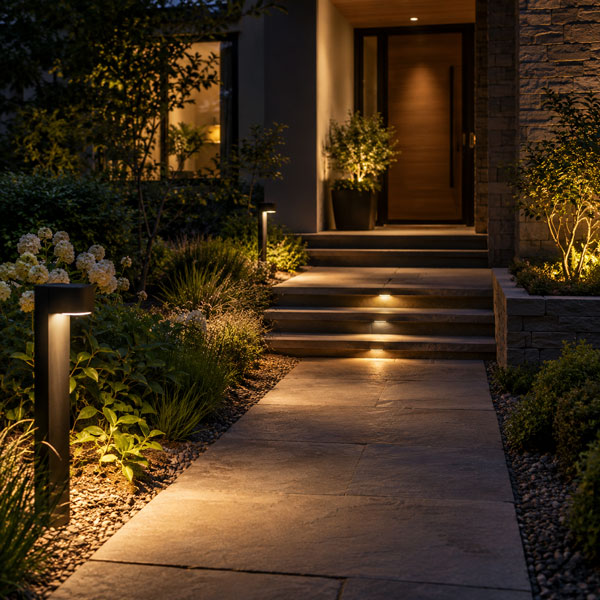
Pathways, Steps, and Entrances
Direct lighting is generally the more practical starting point for illuminating walking surfaces and changes in level.
Position fixtures so that light reaches the route ahead. Shield the source where possible, and check that people can distinguish step edges without looking into a bright fitting.
Reflected decorative light can support the setting, but its contribution should be checked before relying on it to illuminate a route.
Patios and Outdoor Seating Areas
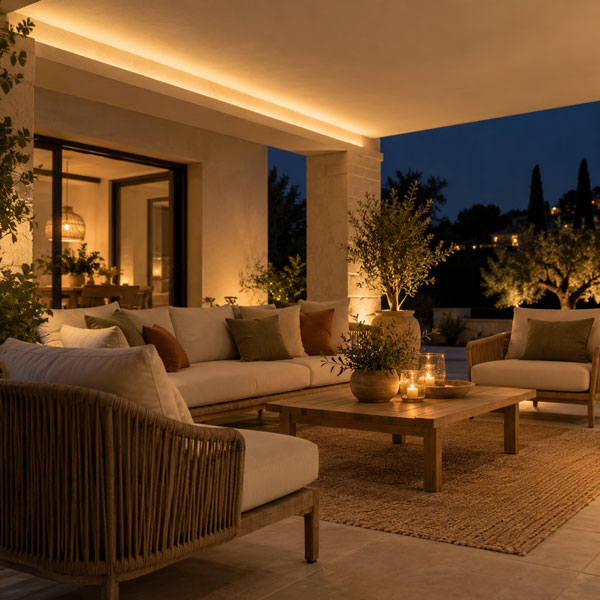
Indirect lighting works particularly well where there is a suitable reflecting surface, such as a pale patio ceiling, rendered wall, or masonry surround.
For example, a concealed fixture can illuminate the underside of a covered terrace roof. The reflected light then provides gentle illumination around the seating area.
An open lawn offers fewer useful reflecting surfaces. Simply aiming a fixture upward will not create effective indirect lighting if most of its output escapes into the sky.
Garden Features and Architectural Details
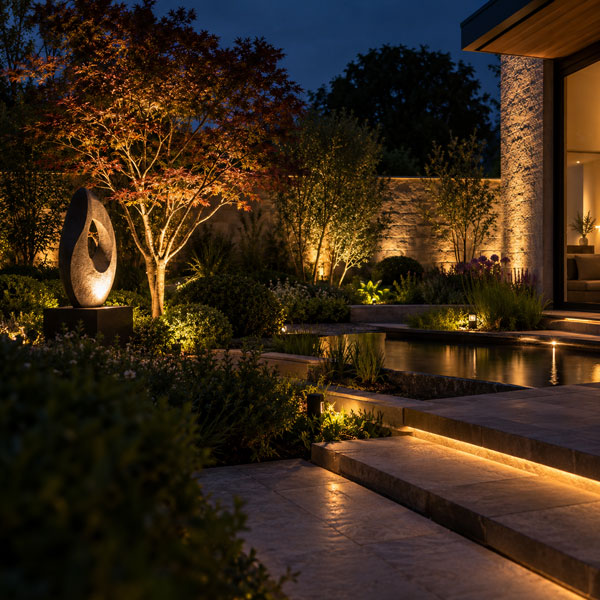
Direct lighting helps highlight individual features, including sculptures, trees, columns, and textured walls. Use selective illumination to establish focal points rather than lighting every feature equally.
Indirect lighting can then provide a softer background around those accents. A gently illuminated boundary wall, for example, can help define the edge of a courtyard while a direct beam highlights a central feature.
Are Uplighting and Downlighting the Same as Indirect and Direct Lighting?
The distinction between uplighting and downlighting describes the direction in which light is aimed. Direct and indirect lighting, in practical design discussions, describe how light reaches the intended target.
Consider three examples:
- A ground-mounted spotlight aimed at a tree provides direct accent lighting to that tree.
- An uplight aimed at a patio ceiling creates indirect illumination for the seating area below.
- A downlight aimed at a pathway provides direct illumination to the paving.
The intended target matters. An illuminated wall receives direct light from a fixture, while nearby occupants may benefit from the wall’s reflected light.
Likewise, concealing a fitting does not automatically make its illumination indirect. A hidden light under a bench that shines straight onto the ground still provides direct light to that ground.
How to Combine Direct and Indirect Lighting
Start with how people use the space, then assign each lighting layer a clear purpose.
1. Identify Tasks and Circulation Routes
Mark the areas where visibility matters most: worktops, reading positions, entrances, pathways, and steps.
Provide direct illumination where it helps people perform those activities or recognize changes in level.
2. Find Suitable Reflecting Surfaces
Look for ceilings, walls, and architectural elements that can distribute reflected light.
Consider their color, finish, and location. A pale wall close to a seating area may contribute useful background illumination, while a dark fence farther away may contribute very little.
3. Add Background Light
Use indirect lighting to support the occupied area and soften excessive contrast. Adjust its output so the space feels comfortable without losing the definition created by direct lighting.
4. Introduce Selective Accents
Highlight a few features that deserve attention. Keeping some areas quieter helps the illuminated features remain distinct.
5. Check the Result After Dark
Assess the installation from seating positions, doorways, and walking routes. Check for exposed sources, distracting reflections, deep shadows, and light spilling beyond the intended area.
The lumens needed for a patio should reflect its size, activities, and lighting distribution. A fixture’s stated output cannot replace checking how much useful light reaches the occupied surfaces.
For example, a covered patio might use reflected ceiling light around the seating area, a shielded direct light over the dining table, and a separate accent on a nearby garden feature. Each layer serves a purpose without requiring the whole space to be equally bright.
FAQs
1. Is Indirect Lighting the Same as Diffused Lighting?
No. Indirect lighting describes a light path that includes reflection from another surface. Diffused lighting describes light that is scattered and spread out.
A fixture with a large frosted cover can produce soft, diffused light while still illuminating a table directly. Indirect lighting often creates a diffused effect because matte walls and ceilings scatter reflected light, but the terms describe different characteristics.
2. What Color Temperature Works Best for Indirect Lighting?
Indirect lighting does not require a particular color temperature. Choose the color appearance according to the atmosphere, materials, and neighboring light sources.
For residential gardens and patios, 2700K and 3000K landscape lighting offer common warm-white options. The reflecting surface can also influence the result: a strongly colored wall may tint the reflected light. Test a sample against the actual surface before committing to a large installation.
3. Can Indirect Lighting Work in a Room With a Low Ceiling?
Yes, but the fixture and architectural detail need enough space to distribute light effectively.
A poorly positioned uplight close to the ceiling can produce a bright patch instead of an even wash. A shallow cove or wall-based arrangement may be more suitable than a suspended uplight, depending on the room. Check the fixture’s distribution and recommended clearances, then test the effect on the ceiling before final installation.
4. Can Direct and Indirect LED Lighting Share One Dimmer?
They can share a dimmer when all connected equipment is compatible with that control and its load limits.
Check that the lamps or drivers support dimming, use a compatible control method, and operate within the permitted load range. Different products may dim unevenly or flicker when combined. Separate controls also allow the direct and indirect layers to be adjusted independently for different activities.
5. What IP Rating Does Outdoor Indirect Lighting Need?
The required protection depends on exposure to dust and water, rather than whether the fitting is concealed.
When comparing IP44 and IP65 ratings, consider rain, splashing, cleaning, and the installation position. IP65 indicates dust-tight protection and resistance to water jets under specified test conditions; it does not establish suitability for submersion. Fixtures, connectors, and power supplies must each be suitable for their installed environment.
