


Table of Contents
- Which House Lights Are Usually Wired in Parallel?
- What Changes When Lights Are Connected in Series?
- Why a Cable Running From Light to Light Can Still Be Parallel
- An LED Fixture Can Contain Both Series and Parallel Connections
- Why Several Lights Can Fail Together Even When They Are Parallel
- What About Low-Voltage Garden and Landscape Lights?
- How to Plan a Reliable Household Lighting Circuit
- FAQs
- References & Sources
Most permanent house lights are wired in parallel. Ceiling lights, recessed lights, wall sconces, and ordinary porch lights generally receive their rated supply voltage through separate electrical branches. Current does not need to pass through one lamp before reaching the next.
Series connections also appear in residential lighting, particularly inside LED products and certain systems powered by a shared driver. The important distinction is whether you are discussing the connections between complete fixtures or the components inside a lighting product.
Another distinction matters just as much: a cable that runs from light to light can still supply parallel connections. The physical arrangement of the wiring does not, by itself, reveal the electrical arrangement.
Which House Lights Are Usually Wired in Parallel?
Most ceiling lights, pendants, and wall sconces use parallel wiring so each fixture receives the nominal supply voltage.
For ordinary household lighting, parallel wiring allows each compatible fixture to operate at the nominal supply voltage.
| Lighting application | Typical connection | Important qualification |
|---|---|---|
| Ceiling fixtures and pendant lights | Parallel | Each complete fixture receives its specified supply voltage |
| Chandeliers with conventional replaceable bulbs | Parallel between lamp holders | Decorative LED assemblies may use a different internal arrangement |
| Recessed lights with individual mains-powered drivers | Parallel at the driver inputs | The LEDs connected to each driver may have a different configuration |
| Wall sconces and vanity lights | Parallel | Sharing a switch does not make the lamps a series circuit |
| Mains-powered porch and security lights | Parallel | Sensors and controls must suit the connected lighting load |
| Constant-voltage landscape fixtures | Usually parallel | Fixture voltage and AC or DC requirements must match the supply |
The fixture’s input requirements are more informative than its location. A bathroom light and a garden light may both use parallel connections while requiring completely different power supplies.
Likewise, two recessed fittings that look identical from below may use different driver arrangements above the ceiling. Appearance alone cannot establish how their LED modules should connect.
What Changes When Lights Are Connected in Series?
In a series circuit, the same current passes through every connected load, while the supply voltage is distributed across those loads. In a parallel circuit, each branch has the same voltage across its connection points, while branch currents can differ.
Consider a small teaching circuit with a 12-volt supply and three identical resistive lamps:
- Connected in series, each lamp receives approximately 4 volts.
- Connected in parallel, each lamp receives approximately 12 volts.
That explains why ordinary lamps designed for the full supply voltage are generally connected in parallel.
Modern LED lamps require additional care in this comparison. Their drivers contain electronic components, so connecting several complete LED lamps in series does not guarantee that they will divide the voltage evenly or operate reliably.
A series arrangement must be part of the product’s intended electrical design. It is not a substitute for the normal parallel connections used by standard household fixtures.
Why a Cable Running From Light to Light Can Still Be Parallel

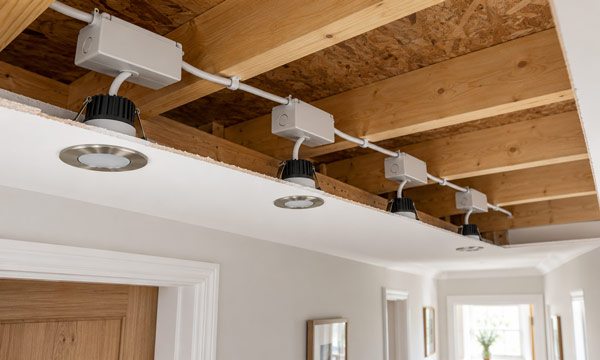
A daisy-chain cable route links four hallway ceiling lights, running from one junction box to the next while allowing parallel electrical connections.
Imagine four ceiling lights positioned along a hallway. The cable enters the first ceiling box, continues to the second, and then reaches the remaining fixtures.
That layout is often called a daisy chain.
The term describes the cable route. Each light can still connect across the same supply conductors, creating parallel electrical branches.
The distinction becomes clearer when you separate two questions:
- Where does the cable travel?
- Does current supplying one lamp have to pass through another lamp’s light-producing components?
The first question describes installation layout. The second identifies whether the lamps themselves are connected in series.
This distinction is especially useful when reviewing a lighting proposal. A drawing showing a row of fixtures joined by a single line may describe the cable route without showing the actual electrical connections.
A useful installation drawing should identify both. That makes it easier to understand the intended voltage at each fixture and locate connections that several lights depend on.
An LED Fixture Can Contain Both Series and Parallel Connections
Residential LED lighting often operates at several electrical levels.
At the household supply: Complete fixtures or individual driver inputs commonly connect in parallel.
At the driver output: A purpose-designed system may supply LED modules through a series connection, a parallel connection, or a specified combination.
Inside the LED module: Individual LED chips may form series strings, sometimes with multiple strings arranged in parallel.
A constant-current driver maintains a specified current within its operating voltage range. When compatible modules connect in series, their required voltages add together. Constant-voltage products instead require their specified operating voltage at the input. These requirements make the driver’s instructions essential when determining the permitted connections.
This is one reason understanding how integrated LED fixtures work matters when selecting replacements. An LED module, a complete mains-powered fixture, and a replaceable LED bulb are different electrical products, even when their light output looks similar.
The presence of series-connected LED chips inside a fixture does not mean the house’s lighting fixtures are wired in series.
Why Several Lights Can Fail Together Even When They Are Parallel
The familiar explanation that “one failed bulb leaves the others working” describes a lamp that fails open within an otherwise healthy parallel circuit.
Real installations also contain shared cables, connections, controls, and protective devices. Those components create dependencies between lights.
Consider three possible failures.
One Lamp Fails Open
A failed lamp interrupts its own branch. Other parallel-connected lamps can continue operating because their current paths remain complete.
A Shared Supply Connection Opens
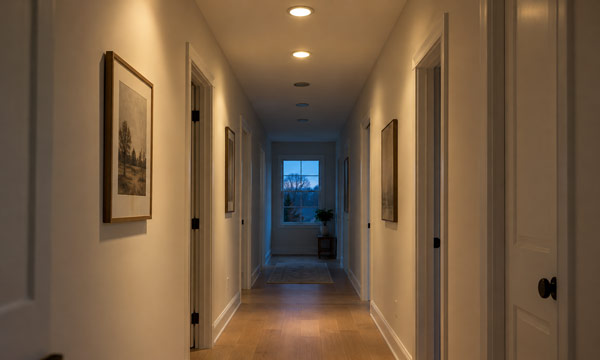
A shared supply fault can leave several recessed lights unlit, even when the fixtures are connected in parallel.
Several fixtures may depend on a connection inside an earlier junction box. If that shared connection opens, fixtures farther along the cable route may lose power together.
Their lamps can still be electrically parallel.
A Fault Operates a Shared Protective Device
A short circuit or another fault may cause a breaker or other protective device to disconnect the shared supply. Every light supplied through that device can go dark, regardless of the individual lamp connections.
These examples suggest a useful troubleshooting principle: the pattern of an outage helps identify shared components, but it does not prove that the lamps are connected in series.
If three adjacent lights stop working together, the useful next step is to have their common supply path investigated. Replacing all three fixtures without examining that shared dependency may leave the underlying problem unresolved.
What About Low-Voltage Garden and Landscape Lights?
Many 12-volt and 24-volt constant-voltage landscape fixtures also connect in parallel. Each compatible fixture receives power across the low-voltage supply conductors.
However, outdoor systems make cable resistance particularly important.
A parallel connection establishes the intended relationship between fixture inputs. The cable still loses some voltage while carrying current. Long runs, insufficient conductor size, and poor connections can therefore reduce the voltage available at individual fixtures.
For perspective, a 1-volt loss represents approximately 8.3% of a 12-volt supply. Whether a fixture continues operating correctly depends on its specified input range.
LED brightness may not decline smoothly as voltage falls. A regulated driver may maintain its output until the input drops below its operating threshold, after which the fixture may become unstable or stop working.
This creates two separate design checks:
- Supply capacity: Can the transformer or power supply support the connected load?
- Voltage delivery: Does every fixture receive an acceptable voltage while the system operates?
A system can pass the first check and fail the second.

Low-voltage landscape lights need adequate transformer capacity and suitable cable sizing to maintain the required voltage at distant fixtures.
Selecting landscape lighting cable size for the load and run length helps address voltage delivery. Grouping fixtures into suitable cable runs can also reduce differences between nearby and distant lights.
Adding another light to an existing run deserves particular attention. The extra load increases current through shared cable sections, which can change the voltage available to lights already installed.
How to Plan a Reliable Household Lighting Circuit
Understanding series and parallel connections is the starting point. A practical lighting plan also needs compatible equipment, appropriate capacity, and a clear understanding of shared connections.
1. Identify the Supply and Fixture Requirements
Record the supply voltage and whether the fixture requires AC, DC, constant voltage, or constant current.
For a driver-powered system, check the specified output current, voltage range, and permitted module arrangement. A matching wattage figure alone does not establish compatibility.
2. Calculate the Actual Connected Load
Use the actual input wattage shown on the fixture or lamp specification.
For example:
8 LED fixtures × 9 watts each = 72 watts of lighting load
A “60-watt equivalent” description indicates an approximate brightness comparison. It does not mean that a 9-watt LED should count as a 60-watt electrical load.
The number of LED lights a 15-amp circuit can support also depends on other connected loads, applicable electrical requirements, and equipment ratings. Parallel wiring does not provide unlimited capacity.
3. Check the Controls as Well as the Circuit
Switches, dimmers, timers, relays, and sensors have their own load limits.
LED drivers can draw a brief startup current that exceeds their normal operating current. A large group switching on simultaneously may therefore place demands on a control that a simple wattage total does not reveal.
Use the control’s LED-specific ratings and compatibility information when determining the supported fixture quantity.
4. Decide Which Lights Should Share Equipment
A single driver or control can simplify an installation, but it also becomes a common dependency.
For example, supplying several pathway lights from one device may be convenient. Supplying every entrance and outdoor step light through that same device creates a larger outage if it fails.
As a design choice, group lights according to how the space will function during a failure, as well as how it should look during normal operation. Separate switching zones improve control, while electrical fault isolation depends on the actual supply and protection arrangement.
Have permanent mains wiring and unexplained group outages assessed by a qualified electrician. Repeated trips, damaged fittings, unusual heat, or a burning smell require prompt investigation.
FAQs
1. Can Different-Wattage LED Bulbs Share the Same Parallel Circuit?
Yes. Parallel-connected bulbs do not need identical wattages. Each bulb must suit the supply voltage and its fixture, and the total load must remain within the relevant circuit and control ratings.
Within an individual fitting, follow the fixture’s actual wattage limit, temperature restrictions, and any enclosed-fixture requirements. Different bulbs used on one dimmer should also have confirmed compatibility.
2. Does Controlling One Light From Two Switches Mean It Is Wired in Series?
Two-location control describes the switching arrangement. A conventional three-way switching system uses two changeover switches and traveler conductors so either switch can change the available current path.
This arrangement does not establish whether multiple lamps supplied through those controls are connected in series or parallel. The lamp connections and the switching mechanism need to be considered separately.
3. Why Does an LED Bulb Glow When the Switch Is Off?
Some electronic controls and illuminated switches allow a small current to pass through the connected lamp. Sensitive LED electronics may produce a faint glow from that current.
A bulb glowing when switched off does not establish that the lamps are wired in series. Persistent or newly appearing glow should be assessed for control compatibility and possible wiring problems.
4. Are Christmas Lights Wired in Series or Parallel?
Both arrangements exist. Many miniature holiday sets contain series-connected groups, with multiple groups connected in parallel. Other decorative strings connect individual lamps in parallel.
That difference helps explain why a loose or failed bulb may affect one section of a set while other sections remain illuminated. Replacement lamps and end-to-end connection limits must match the instructions for the particular set.
5. Why Can Some LED Strips Be Cut Without Turning Off Every LED?
Many cuttable constant-voltage strips contain repeating electrical sections connected across shared supply rails. Cutting at an approved boundary preserves complete circuits in the remaining sections.
The permitted cut lines on outdoor LED strips depend on the product. Only shorten strips specifically designed for cutting, disconnect power first, and follow the instructions for connectors and weather sealing. Addressable strips may have additional restrictions involving their data path.
References & Sources
- All About Circuits. (n.d.). Troubleshooting series and parallel circuits.
- Best Pro Lighting. (2024, October 18). How many LED lights can you run on a 15 amp circuit?.
- Electronic Theatre Controls. (n.d.). Constant current vs constant voltage LED drivers.
- FX Luminaire. (n.d.). DX—Running cable to the fixtures.
- Hershman, S., Miller, N., Yorgey, J., & Willcock, B. (2014, November 12). Specifying LED in a world of continuous change [Conference presentation]. U.S. Department of Energy SSL Market Development Workshop.
- Leviton. (n.d.-a). What is a 3-way switch?.
- Leviton. (n.d.-b). Why do lights stay on or glow when dimmer is off?.
- Lutron Electronics. (n.d.-a). Application note #487: Minimum and maximum loads for LED and CFL lamps/fixtures.
- Lutron Electronics. (n.d.-b). What does the blue wire or blue screw do on Lutron devices?.
- Signify. (2023). LED strips: Design guide.
- Urone, P. P., & Hinrichs, R. (2020a). Parallel circuits. In Physics. OpenStax.
- Urone, P. P., & Hinrichs, R. (2020b). Series circuits. In Physics. OpenStax.
- U.S. Department of Energy. (2015, December 16). How do holiday lights work?.
