

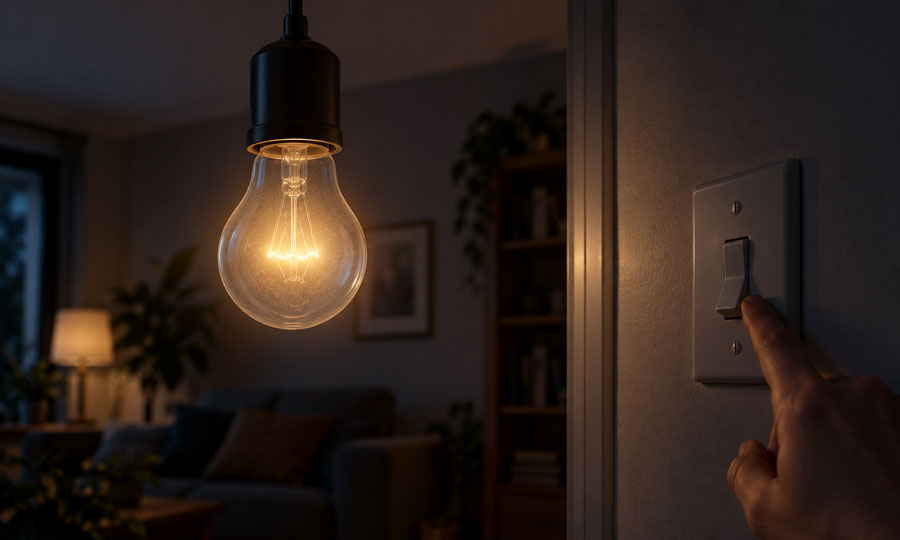
- When Should You Be Concerned?
- Why Does a Light Bulb Glow When Switched Off?
- 1. Stored Energy in the LED Driver
- 2. Small Currents Through Electronic Controls
- 3. An Illuminated Wall Switch
- 4. Capacitive Coupling Between Cables
- 5. A Fault in the Switch or Wiring
- How to Stop a Light Bulb Glowing When Switched Off
- What If an Outdoor Light Glows When Switched Off?
- FAQs
A light bulb that glows after being switched off is often showing an effect called LED ghosting. A very small current can produce visible light in a sensitive LED bulb, even when that current would have no noticeable effect on an incandescent lamp. A faint glow alone does not necessarily indicate a dangerous fault. However, persistent illumination needs a different assessment from a brief glow that fades away.
The important details are how the light behaves, whether the problem is new, and whether other warning signs appear. Burning smells, scorching, crackling, abnormal heat, or repeated breaker trips call for prompt electrical inspection.
When Should You Be Concerned?
Observe the light without touching the bulb, socket, or switch wiring. The following patterns can help you decide what to do next.
| What you notice | Possible explanation | Appropriate next step |
|---|---|---|
| A faint glow gradually fades after switching off | Stored energy discharging from the LED driver | Observe whether it consistently fades and whether any other symptoms occur. |
| A very dim glow remains while the switch is off | Small current through a control device or coupling between cables | Check bulb and control compatibility. Arrange inspection if the cause remains unclear. |
| The bulb remains noticeably bright or the switch no longer controls it reliably | A control fault or unintended power path | Stop using the affected lighting and have it checked. |
| Glowing occurs alongside burning smells, discoloration, unusual noise, or abnormal heat | A possible wiring or component fault | Isolate the circuit if safe and contact a qualified electrician. |
These are clues rather than a diagnosis. Electrical safety guidance identifies flickering or dimming lights, discoloration, buzzing, warm switches or outlets, and burning smells as reasons to have an installation inspected.
If the bulb also flashes, assessing whether flickering LED lights are dangerous depends on the accompanying symptoms and the condition of the circuit.
Why Does a Light Bulb Glow When Switched Off?
Several mechanisms can produce a similar appearance. Distinguishing them helps avoid replacing components that are working correctly.
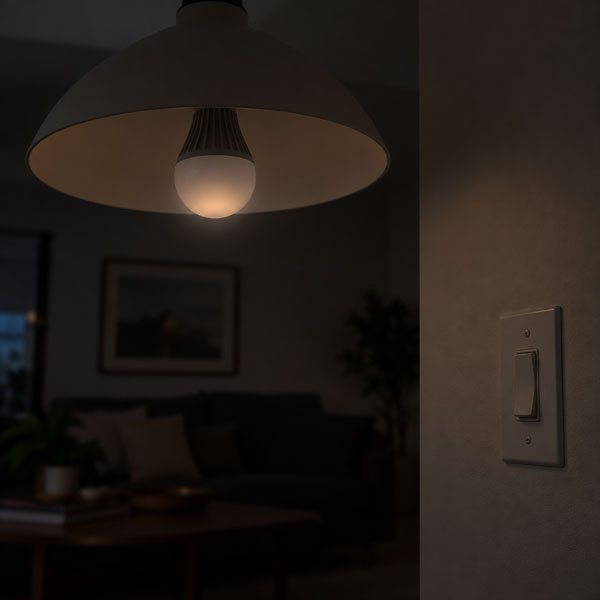
1. Stored Energy in the LED Driver
An LED bulb contains electronic circuitry that controls power to the LEDs. Capacitors within that circuitry can retain a small amount of energy after the supply is interrupted.
As the stored energy discharges, the bulb may continue emitting a weak light before going dark. This can explain a brief, fading glow. Stored energy alone cannot sustain the same level of illumination indefinitely.
A glow that remains throughout the night therefore needs a different explanation from one that fades shortly after switching off.
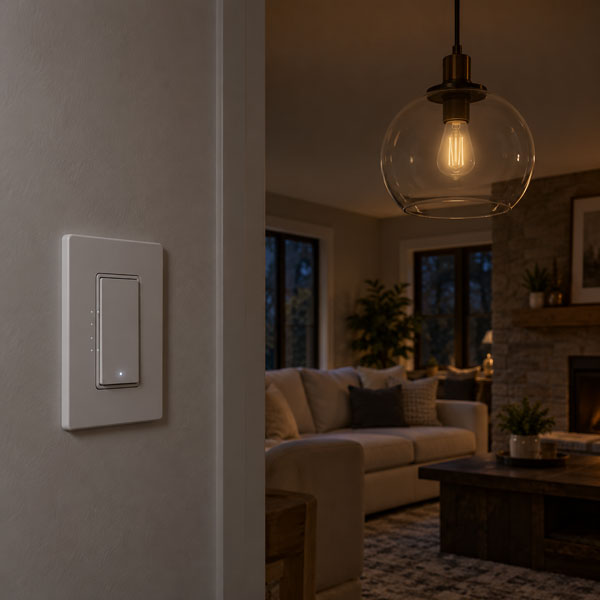
2. Small Currents Through Electronic Controls
Some electronic dimmers and switches need power for their own circuitry. Certain designs without a neutral connection draw that power through the connected lighting load, including while the light is commanded off.
A sensitive LED driver may respond to this small current by producing unwanted illumination. A neutral-connected control can provide a separate supply path for its electronics, where the installation supports that arrangement.
The behavior depends on the combination of the bulb, driver, and control. A bulb working correctly on one switch may behave differently on another.
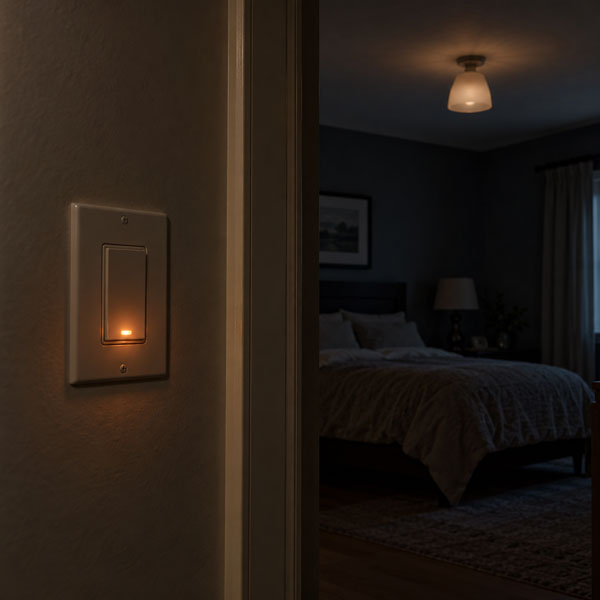
3. An Illuminated Wall Switch
Some switches include a locator light so they are easier to find in the dark. Depending on the design, a small current passes through the lighting load to operate that indicator.
Very sensitive LED bulbs can glow in response. If the switch instructions provide a user-accessible setting to disable the locator light, turning it off may resolve the problem.
Replacing or altering a wired switch should be left to a qualified electrician.
4. Capacitive Coupling Between Cables
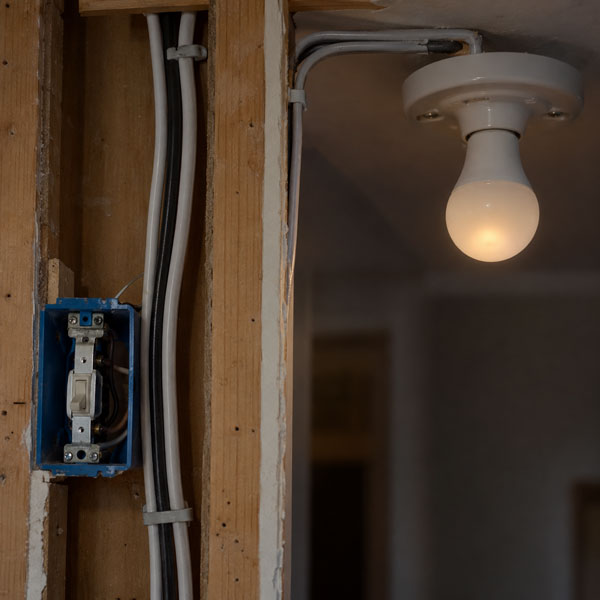
Conductors running close together can behave like a small capacitor. An energized conductor can couple voltage onto an adjacent conductor, even without a direct electrical connection.
This is known as capacitive coupling and can produce what electricians call ghost voltage. It is particularly relevant when evaluating unexpected readings on disconnected or switched wiring.
With a sufficiently sensitive LED driver, this small coupled supply can contribute to faint illumination. However, the appearance of the bulb cannot establish whether coupling or a wiring fault is responsible.
5. A Fault in the Switch or Wiring
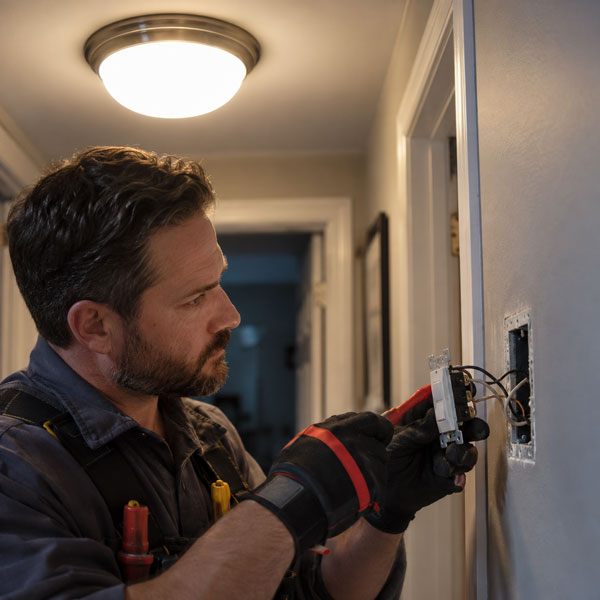
A defective control or unintended electrical connection can also leave a light receiving power when it should be off.
This deserves closer attention when the bulb remains bright, the behavior begins after electrical work, or several lights suddenly behave differently. An electrician can determine whether the control is operating correctly and whether the fitting has an unintended supply.
The position of a wall switch does not prove that equipment is safe to work on. Electrical work requires proper isolation and verification that the relevant parts are dead.
How to Stop a Light Bulb Glowing When Switched Off
The right solution depends on the cause. Start with information you can gather safely, then address compatibility before considering changes to the installation.
Step 1: Record What Happens
Note the following details:
- Whether the glow fades or remains steady.
- Whether one bulb or the entire group is affected.
- Whether the problem began after a bulb or switch replacement.
- Whether the circuit uses a dimmer, illuminated switch, timer, or smart control.
- Whether there are unusual noises, smells, or changes during normal operation.
These observations give an electrician or the equipment supplier a clearer starting point.
Step 2: Check a Suitable Replacement Bulb
If there are no warning signs and the fixture has an accessible, user-replaceable bulb, trying a suitable replacement can help identify a compatibility issue.
Unplug a portable lamp before handling its bulb. For a fixed fitting, isolate the appropriate circuit and allow the bulb to cool. Do not touch socket contacts or attempt to repair a damaged holder.
Check the replacement’s voltage, base, actual wattage, dimming requirements, and suitability for the fixture. When using LED light bulbs in regular fixtures, enclosed fittings also require attention to the bulb’s enclosure rating.
If a different compatible bulb stops glowing, that suggests the original bulb’s electronics were more sensitive to the installation. It does not independently verify the condition of the wiring.
Step 3: Verify Bulb and Control Compatibility
For a dimmed circuit, confirm that the bulb is dimmable and that the exact bulb-and-control combination is supported. A “dimmable” label does not guarantee reliable operation with every dimmer.
Manufacturer compatibility information is more useful than choosing a replacement solely because its packaging says “LED compatible.”
If the same lights also show dimmer-related flickering, that additional symptom can help identify a mismatch between the control and the LED driver.
Have an electrician assess any proposed switch replacement or wiring change.
Step 4: Have Persistent Problems Diagnosed
If suitable bulbs and compatible controls do not resolve the glow, further investigation may be needed.
An electrician can check the control’s off-state behavior, connections, supply arrangements, and possible coupling or leakage paths. This establishes whether the appropriate repair involves the bulb, control, wiring, or another component.
In some installations, a manufacturer-approved bypass or load-correction device can help. Such accessories must match the exact equipment: a device approved for certain electronic switches may be unsuitable for dimmers.
Avoid fitting a generic capacitor or resistor based only on an online suggestion.
What If an Outdoor Light Glows When Switched Off?

Outdoor lighting may include a timer, photocell, transformer, or separate LED driver. Check the operating instructions to establish which part of the system the off command actually controls.
A new problem following rain, irrigation, or damage to the fitting deserves inspection. Moisture, damaged seals, and deteriorating connections need to be considered alongside control compatibility. Do not open a wet fitting while it is energized.
Replacement fixtures and connectors should have an IP rating suited to their exposure. The enclosure rating, condition of the seals, and installation quality all matter.
If the glow persists or the lighting behaves unpredictably, leave the affected equipment off until the cause has been checked.
FAQs
1. Does a Glowing LED Bulb Use Electricity When Switched Off?
A sustained electrically powered glow requires an ongoing energy supply, although the consumption can be much lower than during normal operation. A brief glow caused by stored charge uses energy already held in the bulb’s circuitry.
The bulb’s normal operating wattage does not tell you its off-state consumption. Brightness alone is also insufficient to calculate the cost.
2. Does LED Ghosting Shorten the Bulb’s Lifespan?
Ghosting alone does not establish that a bulb is wearing out or predict how long it will last. LED system reliability also depends on the driver electronics and operating temperature.
A bulb that develops worsening flicker, abnormal heat, or unreliable startup needs investigation rather than an assumption that all off-state glowing is harmless.
3. Why Does Only One Bulb Glow in a Multi-Bulb Fixture?
Bulbs can have different driver designs and sensitivities, even when their wattage and brightness appear similar. Small component variations can also affect how they respond to the same off-state current.
One glowing bulb therefore does not automatically mean its socket is faulty. The bulb model and the shared control should be considered together.
4. What If the Bulb Still Glows After the Circuit Breaker Is Turned Off?
A brief fading glow may come from stored energy. If an ordinary bulb continues glowing after you switch off the breaker you believe supplies it, do not assume the fitting is isolated.
The wrong circuit may have been selected, or another supply path may exist. Have an electrician verify isolation before anyone handles wiring or socket contacts.
5. Is a Smart Bulb Still Powered When It Is Turned Off in an App?
Yes. A smart bulb normally keeps its communication and control electronics powered so it can receive the next command. This involves standby electricity consumption even when it produces no light.
Standby operation does not require a visible glow. If the bulb remains illuminated, check its supported settings and troubleshooting instructions rather than assuming the light output is a necessary part of standby mode.
