Table of Contents
- What Does Bathroom Light Bulb Color Mean?
- Is 3000K or 4000K Better for a Bathroom?
- Are Daylight Bulbs Good for Bathroom Lighting?
- Why Color Rendering Matters for Bathroom Bulbs
- Choose Brightness Separately From Light Color
- Put Light Around the Mirror Where It Helps
- Test the Color in Your Actual Bathroom
- Frequently Asked Questions
A 3000K warm white LED bulb is a practical starting point for a home bathroom. It provides a comfortable white light with a little warmth. If your bathroom is mainly a place for applying makeup, shaving, and detailed grooming, consider 3500K–4000K instead. Whichever color temperature you choose, look for a color rendering index of 90 or higher to help skin tones and cosmetics appear more faithful.
The right choice depends on how you use the room, its finishes, and your preference for warmer or cooler light. Choosing the highest Kelvin number will not automatically give you better bathroom lighting. Color temperature, brightness, and color rendering each affect the result differently.
What Does Bathroom Light Bulb Color Mean?
For everyday bathroom lighting, bulb color usually refers to correlated color temperature, or CCT. This describes whether white light looks warm, neutral, or cool, and it is measured in kelvins, shown as K.
Lower Kelvin numbers produce a warmer appearance with more yellow or amber character. Higher numbers produce a cooler appearance that can look increasingly blue-white.
The descriptions printed on packaging can vary. A bulb labeled “bright white” might have a different color temperature from another bulb with the same description. Check the Kelvin number when comparing products.
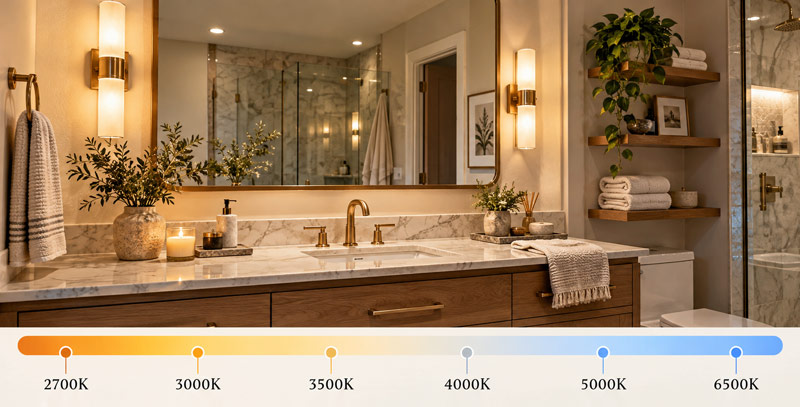
| Color temperature | Typical appearance | Bathroom application |
|---|---|---|
| 2700K | Soft, noticeably warm white | A cozy powder room or bathroom intended mainly for relaxation |
| 3000K | Warm white with a cleaner appearance | A useful starting point for a bathroom serving several purposes |
| 3500K | Balanced white with less warmth | A middle option for homeowners who find 3000K too yellow and 4000K too cool |
| 4000K | Crisp, neutral-to-cool white | Vanity lighting where a less warm appearance is preferred |
| 5000K | Daylight-style white | A dedicated makeup area or an additional setting for checking cosmetics |
| 6500K | Very cool, blue-white light | A specialized preference rather than an essential choice for a home bathroom |
These descriptions indicate appearance. They do not tell you how much light a bulb produces.
Is 3000K or 4000K Better for a Bathroom?
The decision between 3000K and 4000K usually comes down to the balance you want between warmth and a crisp white appearance.

Choose 3000K for a Comfortable Everyday Bathroom
A 3000K bulb is worth trying if your bathroom serves several purposes throughout the day. Its warmth can suit morning routines while maintaining a comfortable atmosphere for an evening bath.
It is also a sensible option to test alongside cream tiles, beige stone, wood cabinets, and warm wall colors. Those finishes may feel more cohesive under slightly warm lighting.
However, 3000K does not have to mean dim or strongly yellow. A high-quality bulb with sufficient light output can provide effective illumination for everyday grooming. Fixture placement and color rendering still matter.
Choose 3500K–4000K for a Less Warm Vanity Area
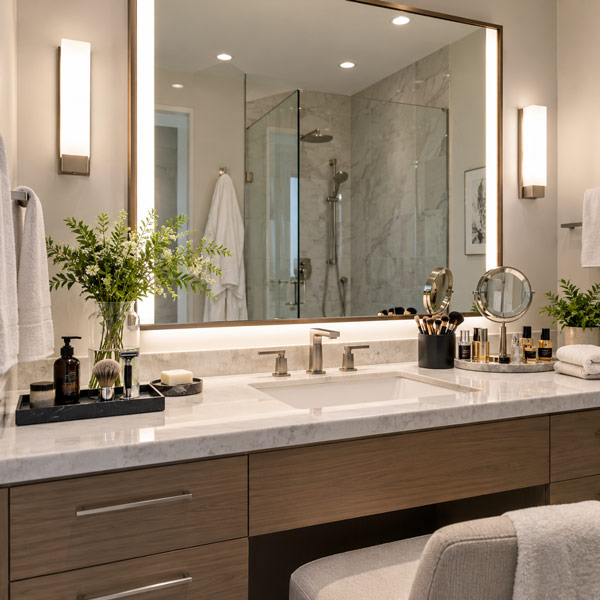
If you dislike the yellow cast of warmer bulbs, 3500K–4000K gives you a less warm alternative.
This range is useful to consider when the mirror is primarily a work area for shaving, styling hair, or applying makeup. A 3500K bulb can provide a comfortable compromise, while 4000K offers a crisper appearance.
Neither setting guarantees accurate colors on its own. A poorly performing 4000K bulb can still make skin and cosmetics look wrong, so check the bulb’s color rendering specifications alongside its Kelvin rating.

Consider How the Bathroom Connects to Other Rooms
The lighting in an adjoining bedroom or hallway also affects your impression of bathroom light. Moving from a warmly lit bedroom into a much cooler bathroom can make the difference feel pronounced.
Before replacing every bulb, try your preferred color temperature in the evening with the adjoining room’s lights on. This helps you judge whether the transition feels comfortable in your home.
Are Daylight Bulbs Good for Bathroom Lighting?
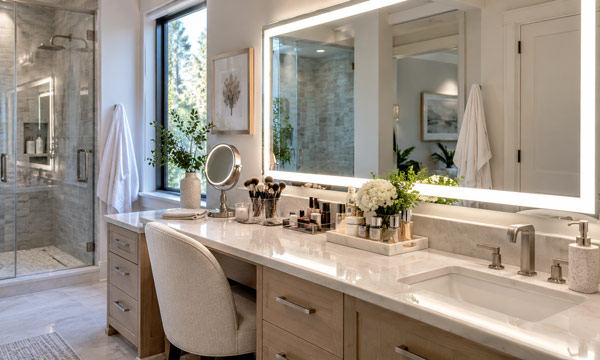
Daylight bulbs can work well in a bathroom, particularly at a dedicated makeup station. Around 5000K, they provide a cooler white appearance that some people prefer for checking cosmetics.
They are an option rather than a requirement. A bathroom used for relaxing may feel more comfortable with warmer general lighting, while a separate makeup light provides a daylight-style setting when needed.
A daylight label also does not guarantee that makeup will look identical outdoors. Natural daylight changes with weather, time of day, and surroundings. If matching cosmetics for daytime wear is important, check the finished result near a window as well.
When choosing between 4000K and 5000K, compare bulbs with similar lumen output. Otherwise, you may prefer one because it produces more light rather than because its color temperature suits you better.
Why Color Rendering Matters for Bathroom Bulbs
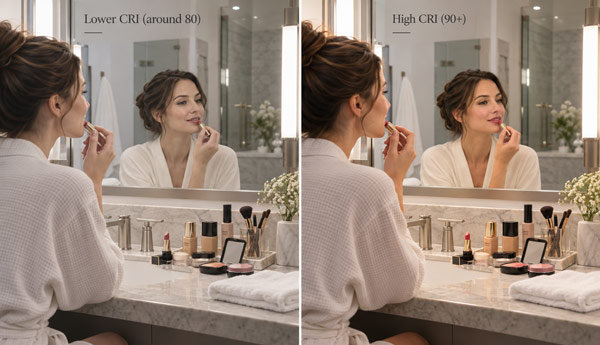
Color temperature describes the appearance of the light itself. The color rendering index, commonly called CRI, describes how faithfully a light source renders object colors compared with a reference source.
For a bathroom vanity, CRI 90 or higher is a useful buying target. It can help you distinguish cosmetic shades, clothing colors, and subtle differences in skin tone more reliably.
CRI has limits, however. The familiar general CRI value averages several test colors and does not include the saturated red test sample known as R9. If a bulb’s specifications include R9, that provides additional information about red color rendering, which is relevant to lipstick, blush, and aspects of skin appearance.
This is why choosing a cooler bulb is not a substitute for choosing a bulb with good color rendering. Check both specifications, particularly if makeup application is a major part of your bathroom routine.
Choose Brightness Separately From Light Color
If your bathroom feels too dark, changing its color temperature may leave the underlying problem unresolved.
A bulb’s lumen output tells you how much visible light it produces. Wattage tells you how much electrical power it uses. Kelvin describes its warm or cool appearance.
For example, a 3000K bulb and a 5000K bulb can each produce 800 lumens. Their light will look different, but both have the same rated light output.
As a familiar reference, an approximately 800-lumen bulb provides light output comparable to a traditional 60-watt incandescent bulb. A three-bulb vanity fitted with 800-lumen bulbs therefore has a combined rated output of about 2,400 lumens, before accounting for light absorbed or redirected by shades and the fixture.
That calculation is a comparison tool, rather than a universal bathroom requirement. The appropriate output depends on the number of fixtures, their position, the size of the room, and how much light reaches your face.
If you already like your bathroom’s brightness, keep a similar lumen rating while comparing color temperatures. If the room feels dark, review light output and placement together.
Put Light Around the Mirror Where It Helps
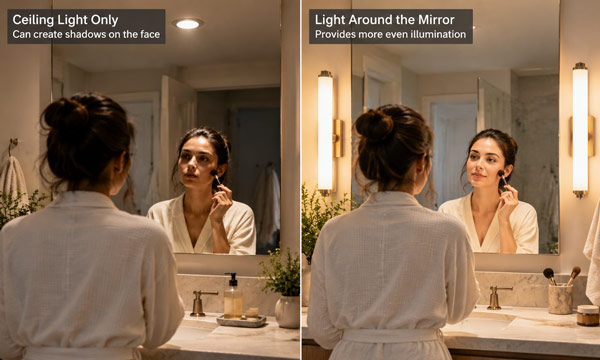
Even the right bulb color can produce an unsatisfactory result when the light comes from an awkward direction.
A ceiling fixture directly above you can leave shadows beneath the eyes, nose, and chin. Adding light beside the mirror helps illuminate the face more evenly. This is especially useful for makeup application and shaving.
Treat the ceiling light as general room illumination and the vanity light as illumination for your face. A bathroom often benefits from both rather than relying on one fixture to perform every task.
When choosing bulbs, think about which lights will operate together. Keeping the main fixtures within the same color temperature family usually creates a more consistent appearance. A large difference between the vanity and ceiling lighting can make one area appear yellow and another blue-white.
Test the Color in Your Actual Bathroom
Your bathroom’s surfaces influence how the lighting looks. A bulb that appears comfortable in a store may feel different beside your mirror, tiles, and wall paint.
Start by testing one candidate bulb in its intended fixture. For a useful comparison:
- Compare similar lumen ratings. This helps you judge color without a large brightness difference influencing the decision.
- Check your reflection. Look at skin, hair, and familiar cosmetic shades.
- Look at the room’s finishes. Notice whether white surfaces look pleasant and whether warmer materials become excessively yellow.
- Evaluate it during the day and after dark. Daylight entering the room can change your impression of the electric lighting.
- Check the bulb’s physical specifications. Match the required base, voltage, dimensions, and actual wattage limits before buying a complete set.
If 3000K feels too warm but 4000K looks too cool, try 3500K where available. A small comparison in the finished room can make the choice much clearer than a packaging label alone.
Frequently Asked Questions
1. Can I Use an Ordinary LED Bulb in an Enclosed Bathroom Fixture?
Only use an LED bulb in a fully enclosed fixture if the bulb is explicitly approved for that application. Heat can accumulate inside a closed globe or housing, affecting the bulb’s electronics and shortening its life.
When choosing LED bulbs for existing fixtures, check the enclosed-fixture suitability alongside the base, voltage, and size. A bulb fitting into the socket does not establish that it is suitable for the enclosure.
2. Do Bathroom Lights Need to Be Damp-Rated or Wet-Rated?
The appropriate rating depends on the fixture’s location and exposure. Damp-location suitability addresses conditions such as moisture condensation. Wet-location suitability addresses exposure where water can drip, splash, or flow against the equipment.
The distinction between damp-rated lighting and shower suitability matters when selecting a shower light. Follow the complete fixture’s markings, installation instructions, and applicable local requirements. A moisture-resistant bulb cannot upgrade an unsuitable fixture.
3. Why Do My Bathroom LED Bulbs Flicker When Dimmed?
Common causes include a non-dimmable bulb, an incompatible dimmer, or operation below the bulb’s stable dimming range.
Check that the bulbs support dimming and that the exact bulb-and-dimmer combination is compatible. If flickering occurs only near minimum brightness, the dimmer’s low-end adjustment may be relevant. Understanding why a dimmer switch causes lights to flicker can help distinguish a compatibility issue from other possible faults.
4. Does Dimming an LED Bathroom Bulb Make Its Color Warmer?
Usually, a fixed-color LED bulb stays approximately the same color temperature as it dims. Lowering its brightness will not necessarily turn a cool white bulb into warm white.
For light that becomes warmer as brightness decreases, choose a product specifically described as “dim-to-warm” or “warm dim.” Tunable-white products offer another approach, allowing color temperature adjustment separately from brightness, depending on their controls.
5. Why Do Two Bulbs With the Same Kelvin Rating Look Different?
Kelvin describes one aspect of white light’s appearance. Two bulbs with the same nominal color temperature can still differ in tint, with one appearing slightly greener and another pinker.
A measurement called Duv helps describe this difference. Light sources with the same CCT and CRI can also render individual colors differently. For a visibly consistent vanity, compare the bulbs together and use matching models where practical.