
1. Define the Lighting Purpose
2. Evaluate the Site’s Solar Exposure
3. Select the Right Brightness and Light Distribution
4. Compare Key Technical Specifications
5. Choose an Appropriate Color Temperature
6. Check Battery Capacity and Runtime
7. Consider Lighting Controls
8. Prioritize Weather and Impact Resistance
9. Reduce Glare and Light Spill
10. Plan Fixture Height and Spacing
11. Evaluate Maintenance Requirements
12. Match the Design to the Public Space
FAQs
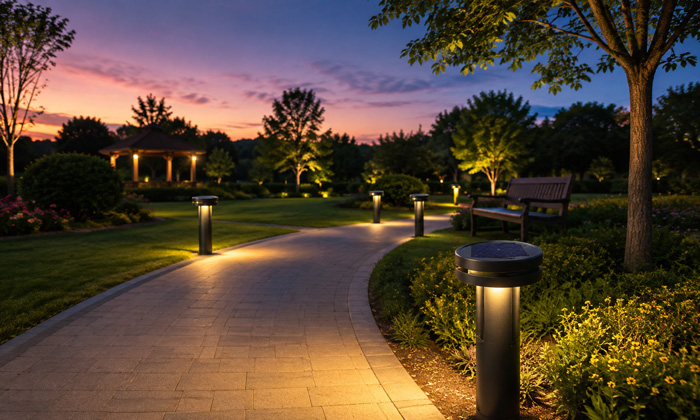
Solar pathway lighting can improve safety, accessibility, and nighttime visibility in parks, plazas, campuses, pedestrian zones, and other public spaces. However, choosing the right system requires more than comparing brightness or fixture appearance. Public lighting must operate reliably in changing weather, withstand frequent use, and provide consistent illumination without creating glare or unnecessary maintenance.
The following factors should guide the selection process.
1. Define the Lighting Purpose
Start by identifying what the lighting needs to achieve. Different areas require different levels of illumination.
Primary pedestrian routes usually need brighter and more uniform lighting because they carry higher foot traffic. Secondary paths, garden trails, and landscape areas may only require low-level guidance lighting. Entrances, intersections, stairs, ramps, and seating areas often need additional visibility for safety.
A clear lighting purpose helps determine the required brightness, spacing, fixture height, and operating mode.
2. Evaluate the Site’s Solar Exposure
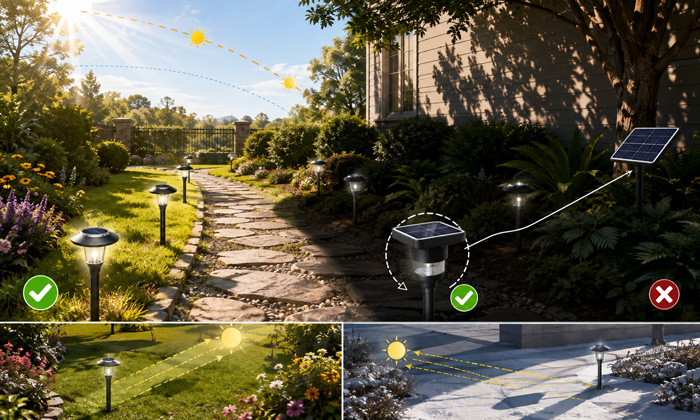
Solar pathway lights depend on sufficient sunlight to recharge their batteries. Before selecting fixtures, assess the installation site throughout the day.
Avoid locations that remain heavily shaded by buildings, trees, shelters, or dense vegetation. Seasonal changes should also be considered because a site with good summer sunlight may receive much less solar exposure during winter.
For partially shaded areas, choose fixtures with high-efficiency solar panels, larger battery capacity, or remote solar panels that can be installed in a sunnier position.
3. Select the Right Brightness and Light Distribution
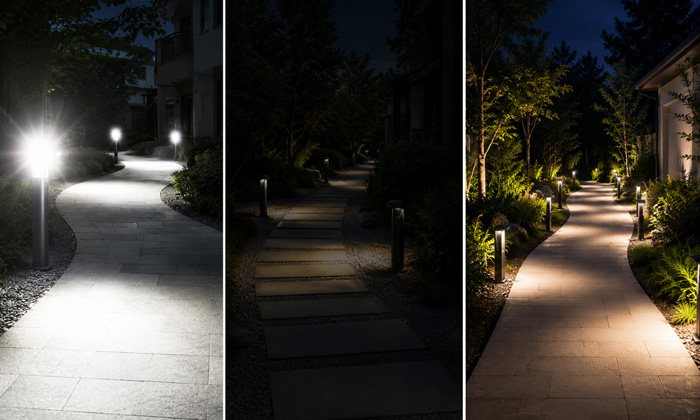
Brightness should match the function of the pathway. Excessive output can cause glare, disturb nearby residents, and waste stored energy. Insufficient output may create dark spots and reduce pedestrian confidence.
Light distribution is just as important as lumen output. Fixtures should direct light toward the walking surface rather than upward or into surrounding properties. Wide, controlled beam patterns generally provide better pathway coverage and allow more consistent spacing between fixtures.
Uniform lighting is preferable to isolated pools of intense light separated by dark areas.
4. Compare Key Technical Specifications
The following table summarizes the main specifications to evaluate.
|
Selection Factor |
Recommended Consideration |
Why It Matters |
|---|---|---|
|
Light output |
Match lumens to pathway type and activity level |
Prevents underlighting and unnecessary glare |
|
Color temperature |
Usually 2700K–4000K |
Provides comfortable visibility and supports the desired atmosphere |
|
Battery type |
High-quality lithium-based battery |
Improves operating time and service life |
|
Operating duration |
Full-night operation or programmed dimming |
Ensures reliable lighting during required hours |
|
Solar panel efficiency |
High-efficiency panel with suitable orientation |
Improves charging performance in limited sunlight |
|
Ingress protection |
IP65 or higher for exposed locations |
Protects against rain, dust, and water jets |
|
Impact resistance |
Strong housing and vandal-resistant construction |
Reduces damage in busy public areas |
|
Control system |
Dusk-to-dawn sensor, motion sensor, or timer |
Balances safety with energy conservation |
|
Fixture materials |
Corrosion-resistant aluminum or durable engineered materials |
Extends service life in outdoor environments |
|
Maintenance access |
Replaceable battery and accessible components |
Reduces long-term maintenance costs |
5. Choose an Appropriate Color Temperature
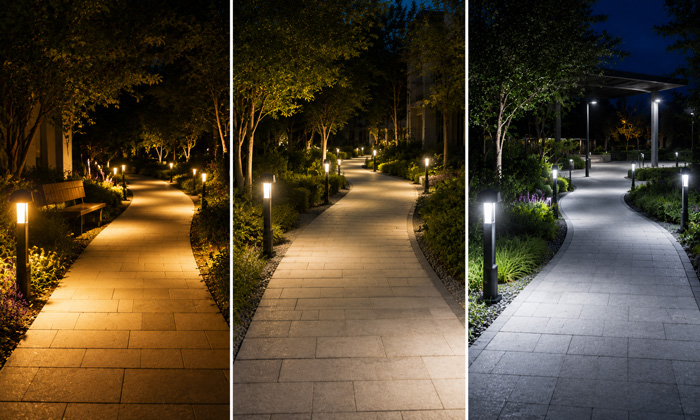
Color temperature affects visibility, comfort, and the character of the space.
Warm white lighting between approximately 2700K and 3000K creates a comfortable atmosphere and is often suitable for parks, gardens, historic areas, and residential surroundings. Neutral white lighting between 3500K and 4000K can provide clearer visibility for busy walkways, transport connections, and public plazas.
Very cool lighting may appear harsh and can increase perceived glare. The selected color temperature should also remain consistent across the site to create a unified visual environment.
6. Check Battery Capacity and Runtime
A solar light must store enough energy to operate through the night, including during periods of cloudy weather. Battery capacity should therefore be evaluated together with fixture wattage, control settings, and local climate.
For public spaces, choose systems designed to provide reliable operation beyond a single ideal charging day. Adaptive controls can extend runtime by reducing brightness during low-traffic periods and increasing output when motion is detected.
Replaceable batteries are usually a better long-term choice than sealed systems because they allow worn components to be serviced without replacing the complete fixture.
See also: Solar Powered Garden Lights Battery Life: How Long Does It Last?
Modern solar pathway lights may include several control options:
- Dusk-to-dawn operation activates the fixture automatically at sunset.
- Timed dimming reduces output during late-night hours.
- Motion sensing increases brightness when pedestrians approach.
- Programmable profiles adjust output according to the expected usage schedule.
For busy public routes, continuous low-level lighting with motion-activated brightness may provide a practical balance between safety and energy efficiency. In remote or low-traffic areas, more aggressive dimming can help preserve battery capacity.
Controls should be simple, reliable, and protected against unauthorized changes.
8. Prioritize Weather and Impact Resistance
Public-space fixtures are exposed to rain, dust, heat, freezing temperatures, irrigation systems, accidental impacts, and possible vandalism.
Choose fixtures with a suitable ingress-protection rating and corrosion-resistant housing. Coastal locations may require additional protection against salt exposure. Areas with severe winters need batteries and electronic components designed for low-temperature operation.
The mounting system should also be secure. Fixtures installed too close to the ground may be damaged by landscaping equipment, bicycles, or maintenance vehicles.
9. Reduce Glare and Light Spill
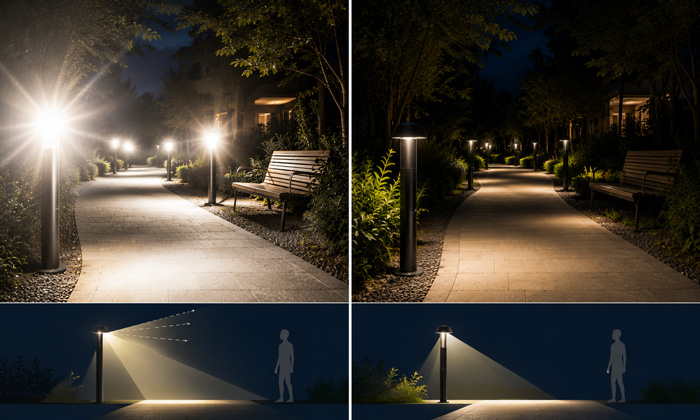
Good pathway lighting should improve visibility without becoming visually intrusive. Shielded fixtures and downward-directed optics help keep light on the path.
Avoid designs that expose the LED source directly at eye level. This is especially important near seating areas, playgrounds, residential boundaries, and routes used by cyclists.
Where ecological sensitivity is a concern, lower color temperatures, reduced operating hours, and carefully controlled beam patterns can limit unnecessary light entering vegetation and surrounding habitats.
10. Plan Fixture Height and Spacing
Fixture spacing should be based on photometric performance rather than appearance alone. Two fixtures with the same lumen rating may produce very different coverage depending on their optics and mounting height.
Bollard-style lights are commonly used along broad pedestrian routes, while lower fixtures may be appropriate for decorative trails or landscaped areas. Fixtures should be placed closely enough to avoid dark gaps but not so closely that they create excessive brightness or visual clutter.
Manufacturers should be able to provide photometric data or recommended spacing information for the selected model.
11. Evaluate Maintenance Requirements
Although solar lighting avoids underground electrical cabling, it is not maintenance-free. Solar panels require occasional cleaning, batteries eventually need replacement, and nearby vegetation may need trimming to prevent shading.
Choose products with accessible components, standard replacement parts, clear warranty terms, and technical support. A modular fixture design can significantly reduce long-term ownership costs.
Maintenance planning should include periodic checks of panel cleanliness, battery condition, fixture alignment, mounting stability, and sensor operation.
12. Match the Design to the Public Space
The fixture should support the visual identity of the site without compromising performance. Contemporary bollards may suit modern plazas and campuses, while simpler or more traditional forms may fit historic parks and landscaped areas.
Consistency is important. Using too many fixture styles can make a public space appear disorganized. The selected product should coordinate with benches, signs, waste bins, railings, and other site furniture.
How much does commercial solar pathway lighting cost?
Commercial solar pathway lights typically cost more upfront than residential products because they use stronger housings, larger batteries, higher-efficiency panels, and professional-grade components.
The total project cost also depends on fixture quantity, foundations, installation labor, smart controls, warranties, and site preparation.
Do solar pathway lights require underground wiring?
Most standalone solar pathway lights do not require underground power cables or connections to the electrical grid.
This can reduce trenching, pavement restoration, and electrical installation costs. However, concrete foundations, anchoring systems, or communication wiring may still be required for certain projects.
What certifications should public-space solar lights have?
Project specifications may require recognized electrical safety certifications, photometric test reports, battery safety documentation, and environmental compliance records.
Buyers should also verify whether the fixtures meet applicable municipal, accessibility, construction, and public procurement standards.
Can solar pathway lighting connect to smart city systems?
Advanced solar lighting systems can support remote monitoring, fault alerts, energy reporting, scheduling, and centralized control.
Connectivity may use cellular networks, LoRaWAN, Zigbee, Bluetooth, or other wireless technologies, depending on the infrastructure and management platform.
Are grants or incentives available for municipal solar lighting projects?
Some local governments, utilities, sustainability programs, and public infrastructure funds offer financial support for renewable-energy or energy-efficiency projects.
Eligibility varies by region, so municipalities should review current funding requirements before approving product specifications or procurement plans.
