
Start With the Architecture, Not the Fixture
What Defines Mid Century Modern Exterior Lighting?
Use Exterior Wall Lighting to Define the House
Build the Lighting Plan From the Garden Toward the House
Keep Pathway Lighting Low and Controlled
Let Landscape Lighting Reveal Shape and Texture
Make the Entrance the Visual Destination
Use Step Lighting as Part of the Architecture
Choose the Right Color Temperature
Pay Attention to Light Quality, Not Only Wattage
Control Glare Carefully
Match Fixture Finish With Architectural Materials
Select Exterior Lights for the Environment
Think About the View From Inside
Avoid Over-Lighting the Garden
Create a Lighting Hierarchy
Balance Upward and Downward Light
Use Repetition Carefully
Consider Fixture Scale
Coordinate Lighting With Planting Design
Integrate Lighting With Hardscape
Frequently Asked Questions About Mid Century Modern Exterior Lighting
Mid-century modern architecture is known for clean horizontal lines, simple geometry, large windows, natural materials, and a strong relationship between indoor and outdoor spaces. Exterior lighting for this type of house should follow the same design philosophy. It should be functional without looking overly decorative, architectural without overpowering the building, and warm enough to make gardens and outdoor spaces feel inviting after dark.
Choosing mid century modern exterior lighting is therefore not simply a matter of finding a fixture with a vintage shape. The better approach is to look at the entire exterior environment: the façade, entrance, garden, pathways, planting beds, steps, walls, and architectural features that connect the house with the landscape.
A successful lighting plan creates layers. Wall lights define the architecture. Pathway lights guide movement. Landscape lights reveal plants and structural features. Step lights improve safety. Entrance lighting establishes a clear destination. Together, these elements reinforce the character of a mid-century modern home while keeping the exterior practical and visually balanced.
Start With the Architecture, Not the Fixture
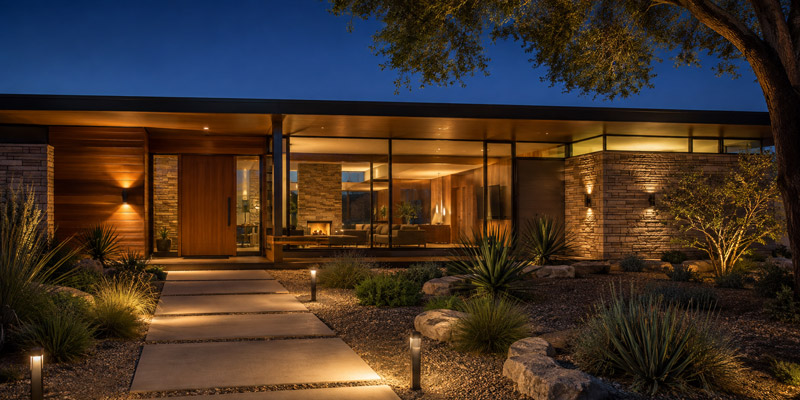
Mid-century modern houses usually rely on strong architectural proportions. Flat or low-pitched roofs, deep eaves, broad façades, exposed brick, timber siding, stone walls, concrete surfaces, and floor-to-ceiling glass are common features.
Exterior lighting should complement these elements rather than compete with them.
Before choosing fixtures, identify the dominant shapes of the house.
If the façade is strongly horizontal, long rectangular wall lights or compact cylindrical fixtures often work well. If the building contains angular rooflines or geometric masonry, square or rectangular fixtures can repeat those forms. For softer modern homes with timber cladding and planted courtyards, simple rounded fixtures can create a useful contrast without breaking the overall aesthetic.
The most important rule is restraint.
Mid-century modern exterior lighting generally looks better when fixtures are visually simple and strategically placed. A small number of well-positioned lights usually produces a stronger result than covering every wall and garden bed with fixtures.
A carefully selected modern wall light, for example, can become part of the architecture instead of appearing as an accessory attached afterward. When the form, finish, light direction, and mounting position relate to the façade, the fixture helps reinforce the architectural composition.
What Defines Mid Century Modern Exterior Lighting?
Although there is no single fixture type that defines the style, several characteristics appear repeatedly.
| Design Element | Mid-Century Modern Approach | Best Exterior Application |
|---|---|---|
| Shape | Clean geometric forms, cylinders, rectangles, squares | Walls, entrances, patios |
| Finish | Black, bronze, dark gray, warm metallic tones | Façades, gates, garden walls |
| Light direction | Downward, upward/downward, concealed illumination | Walls, landscape features |
| Color temperature | Warm to neutral warm light | Gardens, entrances, pathways |
| Fixture scale | Proportional and restrained | Residential façades |
| Decorative detail | Minimal | Modern architecture |
| Landscape integration | Strong emphasis on plants and structural elements | Gardens and courtyards |
| Glare control | High priority | Paths, seating areas, entrances |
The goal is not to reproduce a 1950s exterior exactly. Instead, the lighting should preserve the principles that made mid-century modern design distinctive: simplicity, functionality, geometry, material honesty, and connection with nature.
Use Exterior Wall Lighting to Define the House
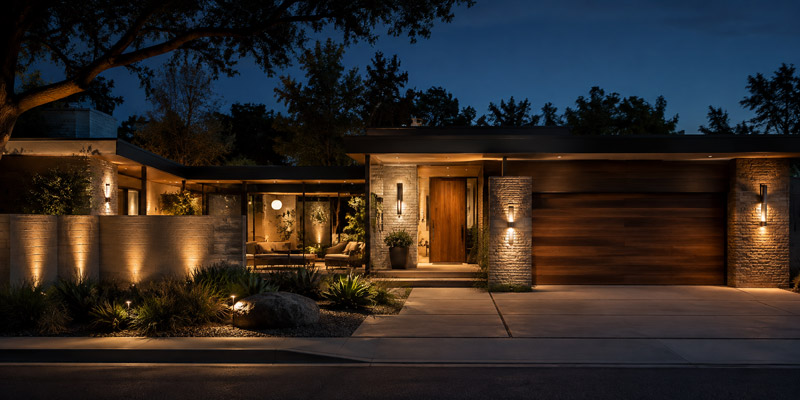
Wall lighting is often the most visible part of an exterior lighting scheme. Because mid-century modern homes frequently have broad, uninterrupted wall surfaces, every wall fixture has a noticeable visual impact during both the day and night.
For this reason, fixture shape matters almost as much as light output.
Choose wall lights with minimal ornamentation. Straight edges, compact cylindrical bodies, architectural boxes, and shallow-profile fixtures are typically easier to integrate into a mid-century façade than lantern-style fixtures with decorative frames.
Consider where the light falls as well.
A downward-facing wall light can emphasize textured brick, stone, or timber. An up-and-down fixture can create vertical columns of light that contrast with the strong horizontal lines of the building. A concealed or recessed source can provide softer illumination where the fixture itself should remain visually quiet.
Avoid placing wall lights at perfectly regular intervals simply because space is available. Instead, connect every fixture to an architectural purpose.
Good locations include:
- beside entrance doors;
- near garage doors;
- along courtyard walls;
- beside outdoor seating areas;
- on architectural columns;
- adjacent to transitions between indoor and outdoor spaces.
The light pattern should reveal the shape of the building after dark without making the entire façade uniformly bright.
Build the Lighting Plan From the Garden Toward the House
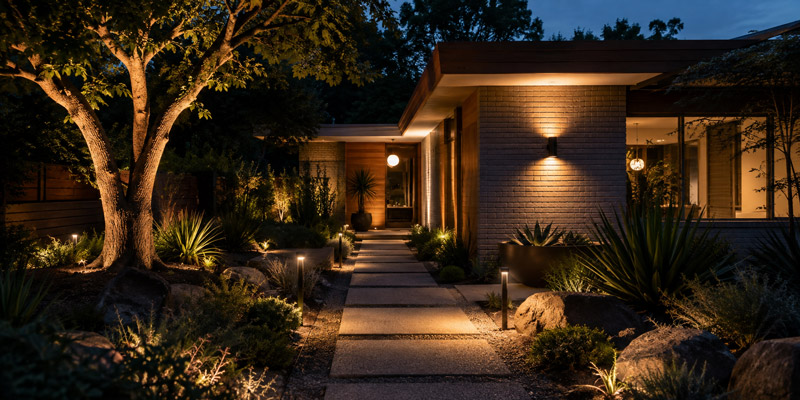
A mid-century modern property should not appear as a brightly lit building surrounded by a completely dark garden. The architecture and landscape should visually support each other.
This is why garden lights should be considered at the same time as wall-mounted exterior fixtures.
Begin by identifying the major visual layers of the garden.
The first layer is circulation: paths, steps, driveways, and entrances.
The second layer is structural landscaping: retaining walls, raised beds, garden walls, fences, large planters, and architectural paving.
The third layer is planting: feature trees, shrubs, ornamental grasses, hedges, and groundcover.
The fourth layer is architectural connection: patios, terraces, courtyards, exterior walls, and glazed areas.
Lighting each layer differently produces depth.
For example, a path may receive low-level downward lighting, while a specimen tree behind it is softly uplighted. A wall beyond the tree might receive a gentle wash. The house entrance can then become slightly brighter than the surrounding garden.
The eye naturally follows these brightness differences through the landscape.
This layered approach is particularly effective for mid-century modern homes because it preserves the architecture's relationship with the surrounding site.
Keep Pathway Lighting Low and Controlled
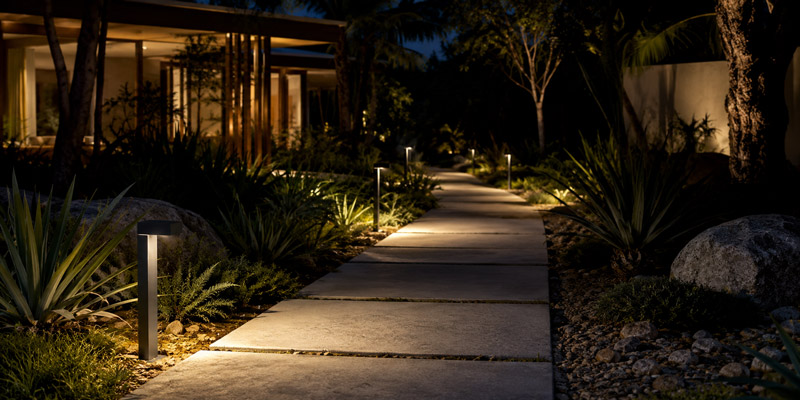
Path lighting has two jobs: make movement safer and create visual rhythm through the landscape.
It should not turn the garden into a brightly illuminated corridor.
Well-designed pathway lights should direct most of their useful light toward the walking surface while minimizing glare at eye level.
For mid-century landscapes, fixtures with simple posts, compact heads, concealed sources, or geometric profiles are usually the most appropriate.
Spacing is important.
Putting pathway lights too close together creates repetitive pools of light and makes the fixtures themselves dominate the garden. Increasing the spacing and allowing the beams to overlap gently often produces a more natural result.
Alternating fixtures from one side of the path to the other can also avoid the visual effect of an airport runway.
On a straight concrete or stone walkway, fewer architectural fixtures may be sufficient. On curved garden paths, small pools of light can subtly reveal direction changes.
The aim is guidance, not maximum brightness.
Let Landscape Lighting Reveal Shape and Texture
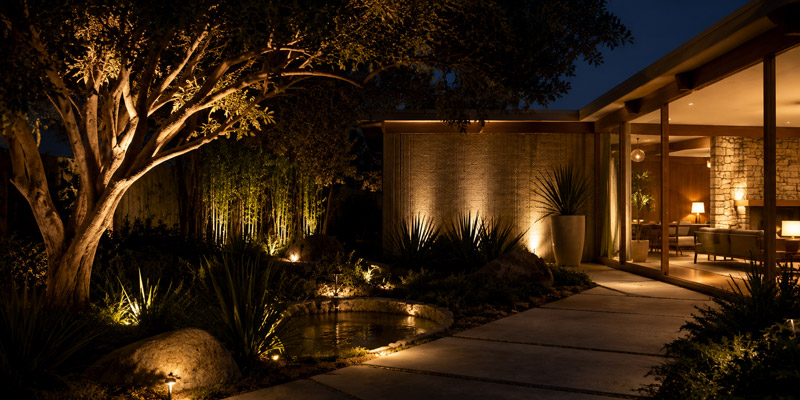
Landscape lighting is one of the best ways to strengthen the indoor-outdoor character associated with mid-century modern architecture.
Large windows often create strong views from the interior toward gardens, courtyards, trees, and exterior walls. During the day, these landscape elements become part of the interior visual experience. At night, however, they disappear unless intentionally illuminated.
This is where carefully positioned landscape lights become important.
Rather than lighting every plant, select a limited number of landscape features with strong shapes.
Good candidates include:
- mature trees with sculptural branching;
- multi-stem trees;
- palms;
- bamboo;
- large architectural shrubs;
- ornamental grasses;
- stone walls;
- textured concrete;
- timber screens;
- large planters;
- water features.
Lighting these elements creates depth beyond the windows and prevents the glass from becoming a dark reflective surface at night.
Uplighting Trees
Uplighting works well when a tree has a strong trunk or interesting canopy.
Place the fixture far enough away from the trunk to reveal both the vertical structure and some of the branching. If the fixture sits directly against the base, the trunk may become excessively bright while the canopy remains dark.
The right fixture also depends on the tree’s height, canopy width, trunk form, and viewing distance. When planning lights for an outdoor tree, consider beam angle and output together so the light reaches the intended branches without creating harsh hotspots.
For broad trees, two lower-output fixtures from different directions often look more natural than one extremely powerful spotlight.
Grazing Textured Surfaces
Brick, stacked stone, rough concrete, and timber can benefit from grazing light.
Positioning the source close to the surface creates shadows that emphasize material texture. This technique works particularly well with mid-century architecture because materials are often intentionally exposed rather than hidden behind ornament.
Washing Walls
If a wall is visually important but relatively smooth, a broader wall wash may be more appropriate.
The objective is not necessarily to produce an evenly illuminated commercial-style façade. A gentle gradient usually looks better in residential landscapes.
Make the Entrance the Visual Destination
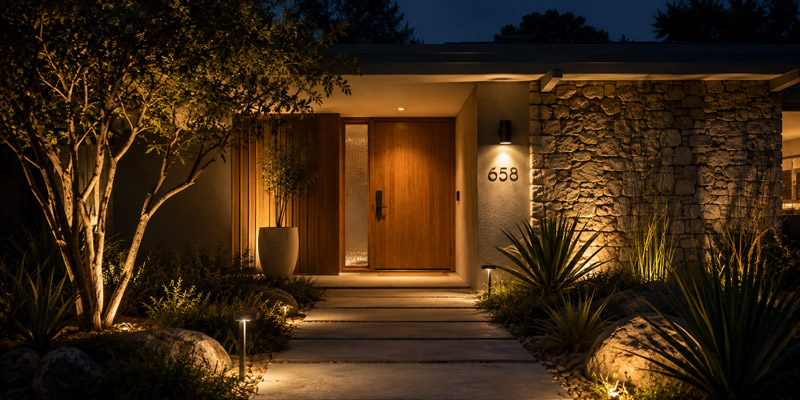
Every exterior lighting plan needs a clear hierarchy, and the main entrance should usually be one of the brightest visual destinations.
That does not mean the doorway needs extremely powerful lighting.
Instead, the entrance should be easy to identify because the surrounding landscape is slightly darker and the light around the door is carefully controlled.
Good entrance lights can highlight the front door, house number, walkway approach, surrounding planting, and architectural surfaces without overwhelming the façade.
For mid-century modern homes, symmetrical lighting can work when the architecture itself is symmetrical, but asymmetrical compositions are equally appropriate.
For example, one strong wall light beside the door may look more authentic than two traditional lanterns on either side.
Another approach is to combine a wall-mounted fixture with indirect landscape illumination. A tree or architectural planter near the entrance can receive soft accent lighting, while the door is illuminated more directly.
This combination makes the entrance feel integrated with the garden rather than separated from it.
Use Step Lighting as Part of the Architecture
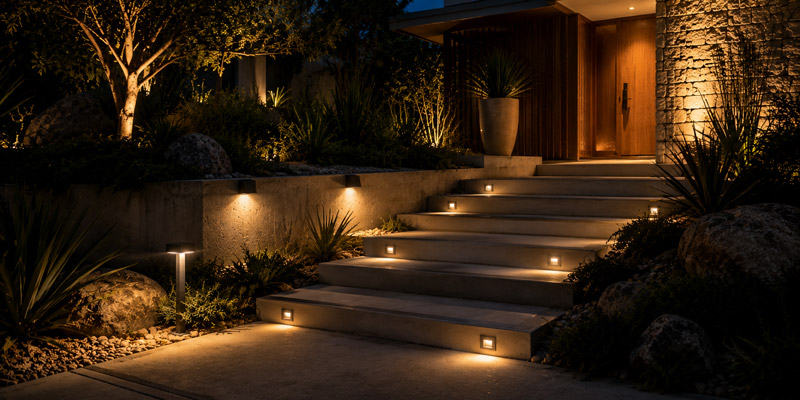
Steps are common around mid-century homes because buildings often follow the natural slope of the site. Changes in elevation may occur between the driveway, front path, garden, terrace, and entrance.
These areas require enough illumination for safe movement.
However, conventional overhead lighting often creates harsh shadows on stairs.
Integrated stair lights provide a better solution because they can illuminate the walking surface directly.
Recessed step lights are especially suitable for modern architecture. They maintain clean lines and avoid introducing unnecessary visual clutter.
A compact fixture such as an LED corner step light can be useful where illumination needs to remain close to the architectural surface while defining edges, corners, and level changes.
The ideal step light should illuminate the tread rather than shining directly into people's eyes.
Spacing depends on the staircase design. Every step does not necessarily need its own fixture. In many residential applications, lighting every second or third step can provide sufficient visual guidance, provided the light distribution overlaps effectively.
For long outdoor stairways, consistent low-level lighting usually creates a more comfortable experience than a few very bright fixtures.
Choose the Right Color Temperature
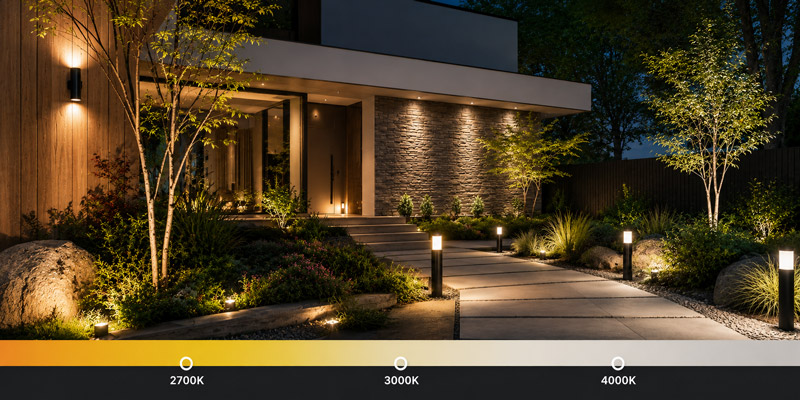
Color temperature has a major influence on how a mid-century modern exterior feels.
For most gardens and residential façades, warm white light is the safest choice. Understanding CCT and CRI in garden lights can help you compare not only the warmth of the light but also how accurately plants, stone, timber, and other exterior materials appear after dark.
Approximately 2700K creates a warm residential atmosphere and works particularly well with timber, brick, warm stone, bronze finishes, and dense planting.
Around 3000K produces a slightly cleaner modern appearance while still feeling comfortable in a garden environment. When deciding between the two, comparing 2700K vs 3000K landscape lighting can help determine which option better suits the architecture, planting palette, and mood of the yard.
Cooler light can work in specific architectural situations, but using very cool white lighting throughout a residential landscape often makes plants and natural materials feel less inviting.
Consistency matters too.
If wall lights are 3000K, pathway lights are 2700K, and landscape spotlights are 4000K, the property can appear visually fragmented.
Keeping most exterior fixtures within a similar color-temperature range creates a more intentional result.
Pay Attention to Light Quality, Not Only Wattage
Wattage is not a useful way to evaluate modern LED exterior lighting by itself.
Instead, consider:
- lumen output;
- beam angle;
- fixture position;
- surface reflectance;
- mounting height;
- glare control;
- optical distribution.
A small fixture positioned close to a light-colored wall may appear surprisingly bright. The same fixture pointed toward dark planting may seem much softer.
Beam angle is especially important in landscape lighting.
A narrow beam is useful for tall trees, columns, and vertical details. A medium beam can illuminate shrubs, planters, and small trees. Wider distributions work better for broader planting areas and wall washing.
Rather than choosing the brightest available fixture, select the beam and output that match the target.
Mid-century modern landscapes usually benefit from contrast between light and shadow. If every surface is equally bright, the architectural forms become less visible rather than more visible.
Control Glare Carefully
Glare is one of the most common problems in exterior lighting.
A landscape can have beautiful fixtures and still feel uncomfortable if the light sources are directly visible.
This problem is particularly noticeable in minimalist gardens because there are fewer decorative elements to distract from poorly controlled light.
Whenever possible, use fixtures with shielding, louvers, recessed light sources, or carefully controlled optics.
For landscape spotlights, aim the beam at the intended object and check the viewing angle from several positions:
- the front door;
- driveway;
- pathway;
- patio;
- major indoor windows;
- neighboring properties.
A spotlight hidden behind a shrub may look fine from one direction while shining directly into the living room from another.
Always evaluate exterior lighting from both outside and inside the house.
This is particularly important for mid-century modern properties with large areas of glass.
Match Fixture Finish With Architectural Materials
Fixture finish is another important part of the design.
Black and charcoal finishes are popular because they create a sharp graphic appearance and work well against timber, concrete, brick, white stucco, and natural stone.
Dark bronze can create a warmer effect, especially when paired with wood siding or earth-toned masonry.
Metallic finishes can also work, but they should usually be used selectively. Highly polished surfaces tend to attract more attention than the restrained finishes associated with classic mid-century architecture.
Consider how the fixture will look during daylight.
Exterior lighting is visible for many more hours during the day than it is illuminated at night. The body of the fixture should therefore relate to window frames, door hardware, roof details, railings, gates, and other architectural materials.
Consistency does not mean everything must match exactly.
A better goal is material harmony.
Select Exterior Lights for the Environment
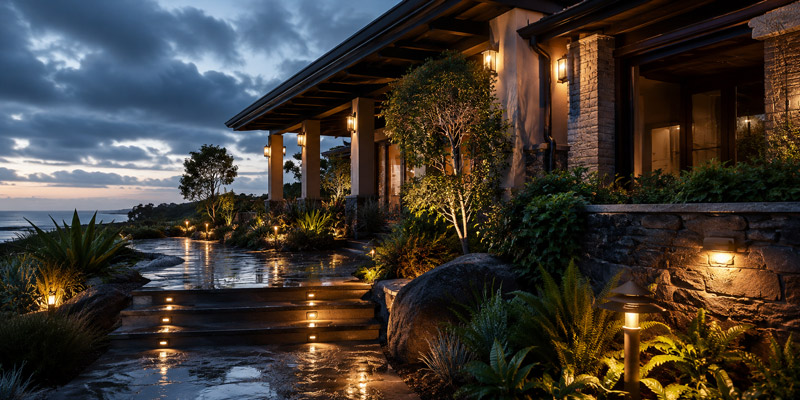
Outdoor fixtures need to withstand weather exposure.
For garden and landscape installations, the level of protection should match the location.
Wall lights beneath deep roof eaves may receive less direct rain than fixtures installed on exposed garden walls. Ground-mounted fixtures are more vulnerable to irrigation, soil moisture, and standing water. Step lights may encounter rainwater and surface runoff.
Check the appropriate ingress protection rating for the installation environment and local conditions. Understanding IP65 waterproof ratings for garden lights can help when comparing fixtures for areas exposed to rain, splashing water, dust, and changing outdoor conditions.
Also consider corrosion.
Properties near the coast or in humid environments may require finishes and materials that tolerate salt and moisture more effectively.
The most beautiful lighting design will not remain attractive if fixture surfaces deteriorate quickly.
Think About the View From Inside
One of the most useful principles in mid-century modern landscape lighting is to design from the interior looking outward.
Large windows create visual connections between living rooms, dining spaces, kitchens, patios, courtyards, and gardens.
At night, exterior lighting can extend the perceived size of the interior.
If only the inside of the house is illuminated, windows become reflective surfaces. When selected landscape features outside are gently illuminated, the eye can see beyond the glass into the garden.
This makes outdoor trees, walls, and planting part of the nighttime interior experience.
Identify the most important windows and stand inside each room after dark.
Ask what you want to see outside.
It may be a sculptural tree, a textured wall, a courtyard planter, a garden path, or a layered composition of several elements.
Then position landscape lighting accordingly.
This inside-out approach is particularly relevant to mid-century modern architecture because visual continuity between interior and exterior spaces is one of its defining characteristics.
Avoid Over-Lighting the Garden
Modern homes can easily become over-lit because LED fixtures are small, efficient, and relatively easy to install.
More fixtures do not necessarily produce a better result.
A successful garden lighting scheme requires darkness.
Dark areas provide contrast. They allow illuminated plants and architectural surfaces to appear more dimensional. They also make pathways and entrances easier to understand because the visual hierarchy is clearer.
Instead of illuminating an entire hedge, consider highlighting one specimen tree in front of it.
Instead of placing lights around every edge of a patio, illuminate the nearby wall and selected planting.
Instead of installing a pathway fixture every meter, allow broader areas of shadow between gentle pools of light.
This restraint is consistent with mid-century modern design itself.
Create a Lighting Hierarchy
Every part of the property should not receive the same amount of light.
A useful hierarchy might look like this:
| Area | Relative Brightness | Primary Purpose |
|---|---|---|
| Main entrance | High | Orientation and welcome |
| Primary pathway | Medium | Safe circulation |
| Steps | Medium | Safety and edge definition |
| Architectural façade | Medium to low | Form and texture |
| Feature trees | Medium | Landscape depth |
| Secondary planting | Low | Background atmosphere |
| Garden boundaries | Low | Depth and enclosure |
| Service areas | Functional | Practical visibility |
This hierarchy helps the eye understand the landscape quickly.
The entrance becomes the destination. Paths lead toward it. Feature planting adds depth. Architectural lighting reveals the house. Background areas remain quieter.
Balance Upward and Downward Light
Mid-century modern exterior lighting often benefits from a mixture of upward and downward illumination.
Downward lighting is useful for entrances, walkways, patios, steps, and exterior walls.
Upward lighting works well for trees, columns, textured surfaces, and selected architectural features.
Using only downlights can make the garden feel flat because most illumination remains close to the ground.
Using only uplights can create a theatrical appearance that may not provide enough practical illumination for movement.
Combining both directions creates visual balance.
For example, a wall-mounted downlight can illuminate a section of path while a nearby landscape spotlight illuminates the canopy of a tree. The eye experiences both the walking surface and the vertical landscape.
Use Repetition Carefully
Repetition is an important principle in mid-century design.
The same fixture family can often be repeated at entrances, courtyard walls, garage areas, and exterior transitions.
However, repetition should reinforce architectural rhythm rather than become monotonous.
If identical wall lights appear every few feet around the building, the façade may begin to resemble a commercial property.
Instead, use repeated fixtures at meaningful architectural points.
Landscape fixtures can be even less visible. Their physical appearance matters less than the consistency of the light they create.
A coherent exterior lighting plan often uses a limited number of fixture types:
- one wall-light family;
- one pathway-light family;
- one step-light type;
- one or two landscape spotlight sizes.
This creates consistency without unnecessary complexity.
Consider Fixture Scale
Exterior fixtures often appear smaller in showrooms or product photographs than they do on the actual building.
Before selecting a wall light, compare its dimensions with the architectural surface where it will be installed.
A very small fixture can look insignificant beside a large front door or broad wall.
An oversized fixture can dominate the façade and disrupt its proportions.
Use nearby architectural elements as references.
Door height, window dimensions, wall panel widths, brick courses, and columns can all help determine whether a fixture is properly scaled.
For pathway lighting, lower and more compact fixtures usually integrate more naturally into a minimalist landscape.
The fixture should support the garden composition, not become the main garden feature.
Coordinate Lighting With Planting Design
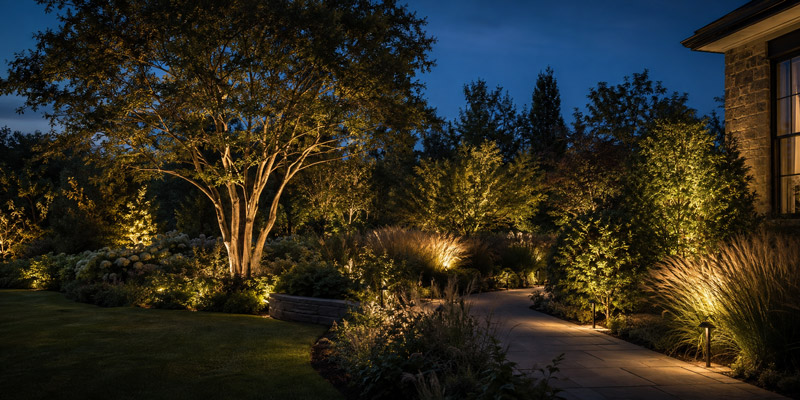
Plants change throughout the year and continue growing after the lighting system is installed, so landscape lighting should account for mature plant size rather than only the appearance of a newly planted garden.
A spotlight aimed perfectly at a young tree may be partially or completely blocked by shrubs as the planting develops. Lighting decisions should also consider the broader impact of garden lights on plants and animals, especially when fixtures are positioned close to dense planting, trees, or areas frequently used by wildlife.
Consider:
- expected plant height;
- canopy spread;
- seasonal foliage;
- pruning requirements;
- irrigation placement;
- root growth;
- future accessibility to fixtures.
Position fixtures where they can be adjusted and maintained without damaging plants. Avoid unnecessary illumination of areas that do not contribute to the landscape composition, and direct light toward specific features rather than allowing it to spill broadly across planting beds.
In gardens with ornamental grasses or low planting, lighting from behind can create attractive silhouettes and reveal movement.
Trees with open branching respond well to uplighting, particularly when the beam is carefully aimed to reveal the trunk and canopy without excessive brightness.
Dense evergreen shrubs usually need broader and softer illumination because narrow beams can create harsh bright spots.
The plant itself should determine the lighting technique, fixture position, beam angle, and intensity.
Integrate Lighting With Hardscape
Mid-century modern landscapes often use strong hardscape geometry.
Concrete slabs, large-format pavers, gravel zones, low retaining walls, timber screens, steel edging, and masonry planters are common.
Lighting can emphasize these structural elements.
Recessed step lights can clarify elevation changes. Low wall lights can reveal horizontal masonry. Path lights can follow geometric paving. Concealed fixtures can wash architectural screens or courtyard walls.
The strongest results usually occur when lighting locations are considered during landscape design rather than added after construction.
If the project is still in the planning stage, coordinate conduits, electrical points, niches, recesses, mounting plates, and drainage requirements before surfaces are finished.
This allows the fixtures to appear genuinely integrated into the architecture.
Frequently Asked Questions About Mid Century Modern Exterior Lighting
Is 12V or 120V better for mid century modern landscape lighting?
For most residential gardens, 12V low-voltage lighting is preferred because it is safer around planting beds and pathways, easier to expand, and well suited to LED landscape fixtures.
A 120V system may be appropriate for certain architectural fixtures or larger properties but usually requires more complex installation and wiring protection.
How many lumens do you need for outdoor landscape lighting?
Most residential landscape lighting does not require extremely high lumen output.
Path and accent lights often work effectively at lower outputs, while taller trees, large façades, and distant landscape features may require more powerful fixtures. The ideal output depends on mounting distance, beam spread, surface color, and the size of the feature being illuminated.
How do you size a transformer for low-voltage garden lights?
Add the wattage of all fixtures connected to the transformer, then choose a transformer with additional capacity rather than operating it at its maximum rating.
Leaving roughly 20–30% spare capacity can accommodate future fixtures and help the system operate reliably. Long cable runs should also be checked for voltage drop.
Are solar lights suitable for a mid century modern landscape?
Solar lights can work for secondary garden areas where wiring is difficult, but they often provide less consistent brightness and runtime than wired LED fixtures.
For entrances, architectural walls, major pathways, and important landscape features, a professionally planned wired system generally provides better control, consistency, and visual quality.
How much does professional landscape lighting cost for a modern house?
Landscape lighting costs vary according to the number and quality of fixtures, wiring distance, transformers, controls, installation conditions, and landscape complexity.
A small entrance or pathway system may require only a limited number of fixtures, while a complete architectural and garden lighting plan can involve multiple circuits and lighting zones across the property.
