
Table of Contents
- What Happens Inside a Dusk to Dawn Light Bulb?
- Why Installation Position Changes When the Bulb Turns On
- Will a Dusk to Dawn Bulb Work in Your Outdoor Fixture?
- How to Install and Test a Dusk to Dawn Light Bulb
- Why Is the Bulb Staying On, Staying Off, or Cycling?
- How Much Electricity Do Dusk to Dawn Bulbs Use?
- When Is Dusk to Dawn Control the Right Choice?
- FAQs
Dusk to dawn light bulbs use a built-in light sensor to turn on automatically as the surroundings darken and turn off when daylight returns. The wall switch stays on, supplying the electricity the bulb needs to monitor light levels and control its illumination.
The most useful detail is where that measurement happens. A bulb responds to light reaching its sensor. A bright garden can still contain a dark corner inside a lantern, and a nearby security light can make a nighttime installation appear bright to the sensor.
That relationship between the bulb and its surroundings explains much of what makes dusk to dawn lighting work well—and why it sometimes behaves unexpectedly.
What Happens Inside a Dusk to Dawn Light Bulb?
A typical dusk to dawn LED bulb combines three functions: detecting light, deciding when to switch, and powering the LEDs.
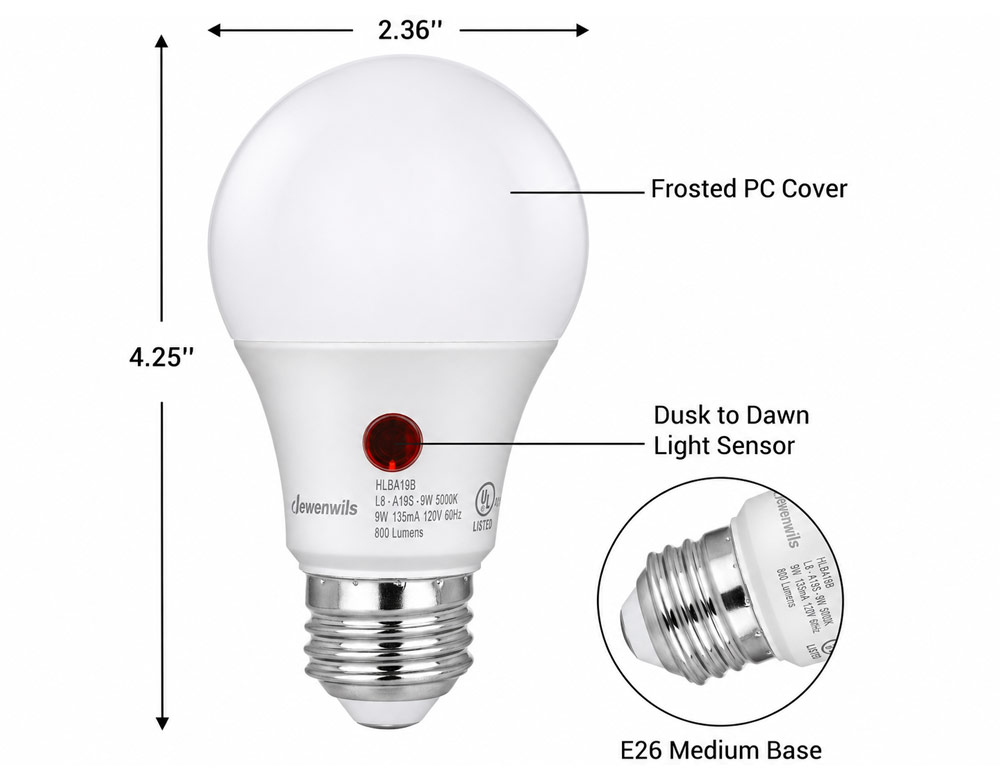
A dusk-to-dawn LED bulb uses a built-in photocell sensor to automatically detect ambient light.
1. The sensor detects the surrounding light
A photosensitive component converts incoming light into an electrical signal. The sensor may be visible near the bulb’s base or incorporated into the bulb’s housing.
“Photocell” is a common name for this sensing function, although the actual component and the wavelengths it detects vary between products.
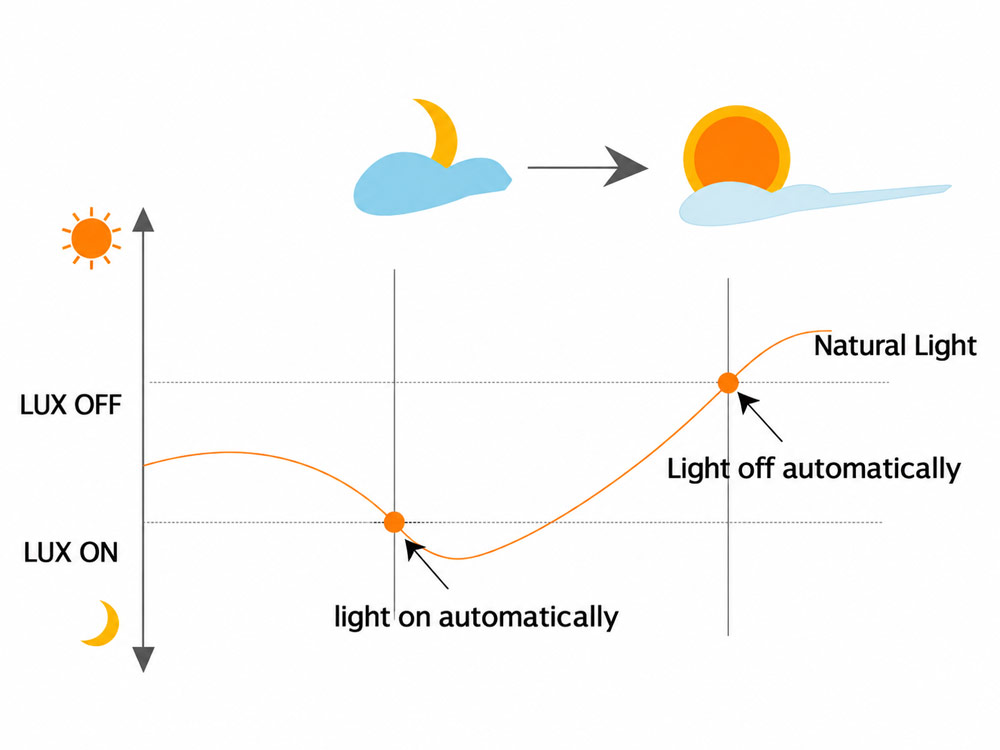
A dusk-to-dawn sensor uses separate LUX ON/OFF thresholds to control lighting and prevent frequent switching.
2. The control circuit decides whether illumination is needed
The circuit uses the sensor’s signal to determine whether the surroundings are sufficiently dark.
Some control designs use separate thresholds for switching on and switching off. The bulb might need a darker environment to activate than the brighter environment required to deactivate it. This separation, called hysteresis, helps prevent repeated switching when light levels hover near a single threshold.
A product may also include a response delay to reduce reactions to brief changes in light. Consequently, covering or uncovering the sensor may not produce an immediate response. Exact thresholds and waiting times depend on the model.
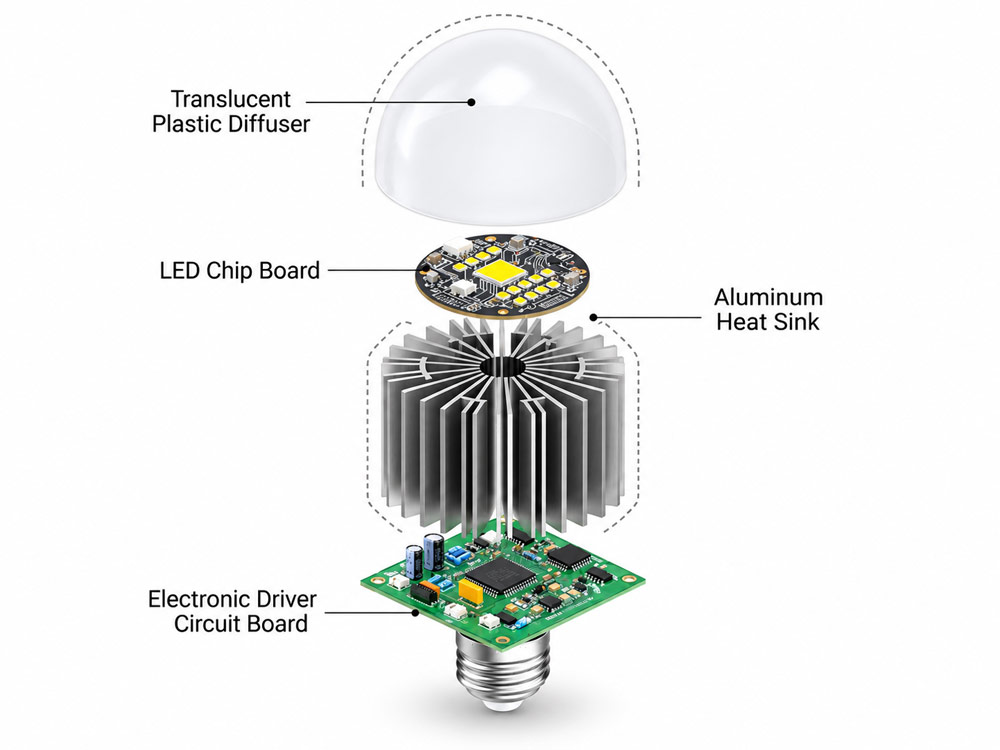
The LED driver regulates power to the chips for efficient, reliable lighting.
3. The LED driver supplies power to the LEDs
Once the control circuit calls for illumination, the driver powers the LEDs. When sufficient daylight returns, the circuit stops the light output.
The wall switch therefore acts as the bulb’s power supply. Turning that switch off prevents automatic operation.
Why Installation Position Changes When the Bulb Turns On
A dusk to dawn bulb does not need to know the sunset time. Its switching point follows the light conditions at its sensor.
This has several practical consequences:
| Conditions around the sensor | Possible behavior |
|---|---|
| Deep shade beneath an overhang | The bulb activates earlier or stays on longer |
| Dirt or an obstructed sensor window | The bulb receives less daylight and may remain on |
| A nearby lamp shining toward the sensor | The bulb may remain off after dark |
| Light reflected back from the fixture | Some designs may repeatedly switch on and off |
Sensor obstruction, reflections, and interference from neighboring lights are recognized causes of unexpected operation. Their effects depend on the sensor design and installation.
A practical implication is that two identical bulbs on opposite sides of a house may switch at different times. One location may lose daylight earlier than the other.
Switching time alone is therefore a poor way to judge whether a bulb is working correctly. A better question is whether its behavior makes sense for the light reaching its sensor.
Also, “dusk to dawn” does not mean the sensor collects solar energy. A standard mains-powered bulb uses incoming light as information; its electrical supply provides the operating power.
Will a Dusk to Dawn Bulb Work in Your Outdoor Fixture?
Physical fit is only the first requirement. The installation also needs suitable electrical, environmental, optical, and thermal conditions.
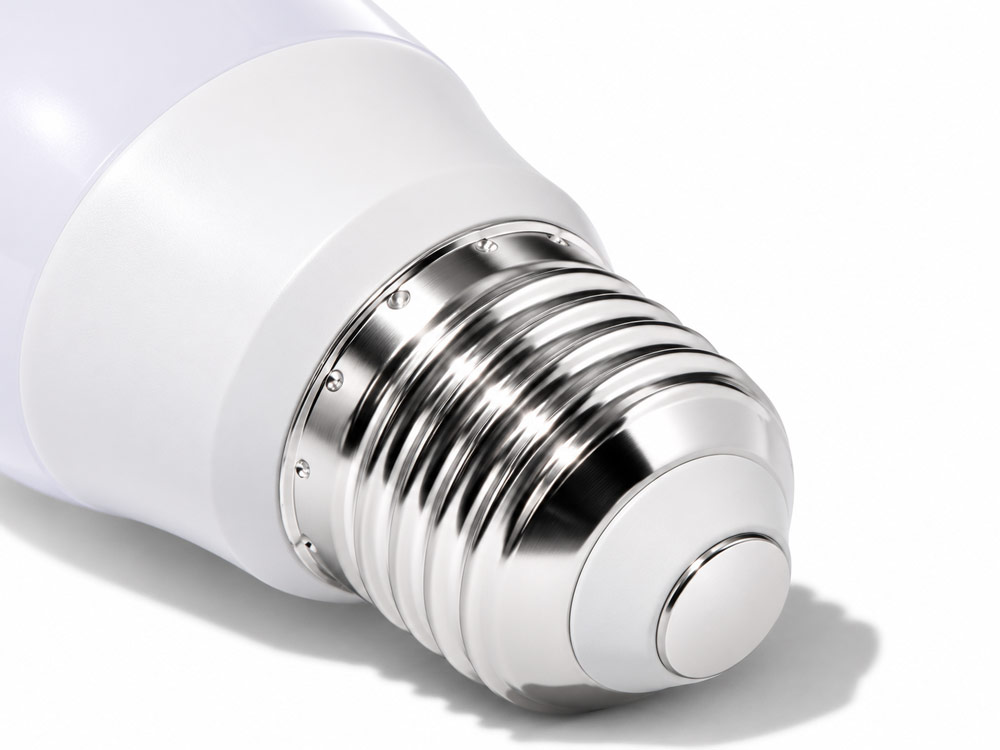
Close-up of an E27 LED light bulb screw base, showing the metal threads and electrical contact point used to connect the bulb to a compatible socket.
Check the base, voltage, and light output
Match the bulb base and supply voltage to the fixture. A screw base that appears to fit does not establish electrical compatibility.
Choose lumens for the amount of light you need, and check actual wattage against the fixture’s limits. An incandescent-equivalent description is a brightness comparison, rather than the bulb’s actual power consumption.
The bulb and fixture must also suit the moisture exposure. Check their outdoor protection ratings, particularly where rain can reach the installation.
Evaluate daylight access and heat separately
A fixture can pass one of these checks and fail the other:
- Daylight access: Can enough of the light the sensor detects reach it through the fixture?
- Heat management: Is the bulb explicitly approved for the enclosure and operating conditions?
A transparent lantern may admit enough daylight while still trapping excessive heat. Conversely, a ventilated fixture may keep the bulb cool while a solid metal section blocks its sensor.
Enclosed-fixture approval matters because elevated operating temperatures can accelerate LED degradation. A successful sensor test does not establish thermal suitability.
Royer, M. P., McCullough, J. J., & Tucker, J. C. (2014). CALiPER retail lamps study RRL3.2: Lumen and chromaticity maintenance of LED A lamps operated in steady-state conditions. Pacific Northwest National Laboratory.
This distinction helps avoid a common purchasing mistake: assuming that a bulb is suitable for a lantern simply because it screws in and switches correctly.
How to Install and Test a Dusk to Dawn Light Bulb
For an accessible fixture designed for replaceable bulbs:
- Check compatibility. Confirm the base, voltage, wattage limits, exposure rating, enclosure approval, and any restrictions involving existing controls.
- Switch off the power and let the old bulb cool.
- Install the replacement according to its instructions. Keep any sensor window unobstructed.
- Restore power and leave the wall switch on.
- Observe operation through dusk and the following morning. Allow for the response delay specified by the manufacturer.
Some products permit a daytime test by temporarily covering the sensor. Follow the stated procedure, keep the cover clear of hot surfaces, and remove it after testing.
The evening-and-morning observation is especially useful because a brief covering test checks the bulb’s response under an artificial condition. Normal operation also depends on the fixture, nearby lighting, and changing daylight.
Why Is the Bulb Staying On, Staying Off, or Cycling?
The pattern helps identify which condition to investigate first.
It stays on during the day
Start with daylight access. Check whether the fixture’s housing, accumulated dirt, vegetation, or deep shade obstructs the sensor.
A bulb that stays on during a particularly dark storm may be responding correctly to low light. Persistent daytime operation in bright conditions deserves a closer inspection.
It stays off at night
Confirm that the circuit has power, then look for light reaching the sensor from another source.
In a fixture containing multiple bulbs, one illuminated bulb can interfere with another bulb’s sensor. Replacing the unlit bulb without considering that interaction may leave the problem unresolved.
It repeatedly switches on and off
Some installations create an optical feedback loop: the bulb turns on, reflected light reaches the sensor, the bulb turns off, and darkness triggers it again.
Check the manufacturer’s placement guidance and nearby reflective surfaces. Avoid permanent modifications to the sensor. If the behavior continues, investigate compatibility, the bulb, and the electrical supply rather than assuming every flicker comes from the photocell.
Switch off power before touching the bulb or adjusting the fixture.
How Much Electricity Do Dusk to Dawn Bulbs Use?
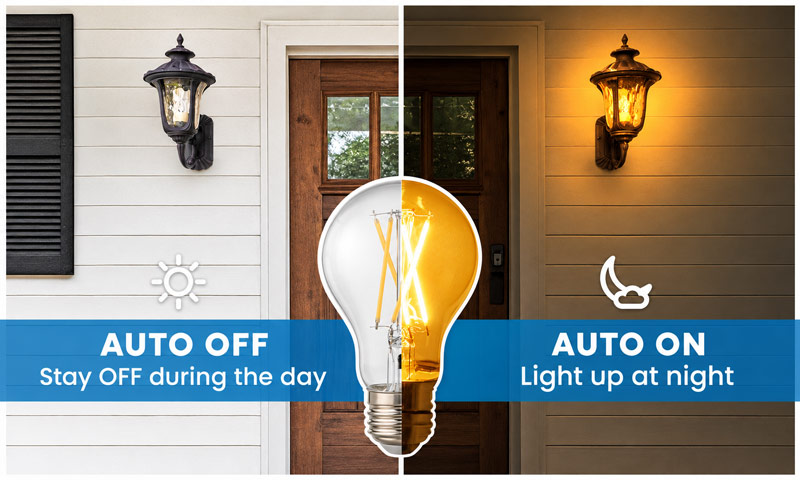
Dusk to dawn LED bulb automatically turns off by day and on at night to save electricity.
Electricity use depends mainly on actual wattage and operating hours.
For the illuminated period:
Annual energy use in kWh = watts × average daily operating hours × 365 ÷ 1,000
Grisso, R., Walker, M. A., & Ignosh, J. (2020, February 26). Energy series: Estimating appliance and home electronic energy use. Virginia Cooperative Extension.
Multiply that result by your electricity rate to estimate operating cost.
For example, consider a 9-watt bulb, an assumed 12 hours of illumination per day, and an illustrative electricity rate of $0.15 per kWh:
| Operating pattern | Annual energy used while illuminated | Annual cost |
|---|---|---|
| Left illuminated continuously | 78.84 kWh | $11.83 |
| Automatically illuminated 12 hours daily | 39.42 kWh | $5.91 |
| Manually illuminated for the same 12 hours | 39.42 kWh | $5.91 |
These figures illustrate the calculation. Actual night length varies by location and season, and any daytime standby consumption must be added separately.
The comparison reveals an important purchasing insight: automatic control saves electricity by preventing unnecessary operating hours. If someone already switches an equally efficient bulb on and off at exactly the right times, automatic control mainly adds convenience.
It can even increase consumption if it replaces a habit of using the light for only a few evening hours. Evaluate the hours your property actually needs illumination before estimating savings.
When Is Dusk to Dawn Control the Right Choice?
Dusk to dawn control suits locations that benefit from dependable illumination throughout the night, such as an entrance used at unpredictable hours.
Other locations may need a different operating pattern:
- A decorative feature used only during the evening may suit a scheduled shutoff.
- An occasionally used side passage may suit a compatible system combining daylight detection with motion sensing.
- Several fixtures that need synchronized operation may suit a shared control rather than separate bulb sensors.
Systems combining photocells and motion detection can prevent daytime activation while limiting nighttime illumination to periods of activity.
Choose the required lighting hours first. Then select a bulb or control system designed to deliver them. This keeps automatic lighting aligned with the purpose of the space.
FAQs
1. Can dusk to dawn light bulbs be used indoors?
Only when the manufacturer permits it and the sensor can respond appropriately to the available light. A windowless room may keep some models illuminated continuously, while another room’s lighting may prevent activation. Some daylight-sensitive designs are intended specifically for outdoor use, so indoor suitability should be checked for the exact bulb.
2. Can you use a dusk to dawn bulb with a dimmer switch?
Only if the bulb explicitly supports dimming and the dimmer is compatible. Many dusk to dawn bulbs are non-dimmable. An unsupported pairing can cause dimmer-related flickering or unreliable operation. Setting an incompatible dimmer to maximum brightness does not establish compatibility.
3. How long do dusk to dawn light bulbs last?
Check the exact product’s rated operating hours and warranty. As a calculation example, 25,000 hours divided by 12 hours of daily illumination equals approximately 5.7 years. That conversion is an estimate, rather than a guaranteed replacement date. LED light maintenance and the reliability of the bulb’s electronics are separate aspects of service life.
4. Can you override a dusk to dawn bulb to keep it on during daylight?
That requires a documented override feature. A basic sensor-controlled bulb may remain off in bright conditions even when the wall switch is on. Some products provide additional modes, but switch-toggle sequences are model-specific. Follow the instructions for the exact bulb rather than assuming a universal override procedure.
5. Do dusk to dawn light bulbs attract bugs?
They can. Automatic switching does not make a bulb insect-resistant. Attraction depends on the emitted spectrum, intensity, surrounding conditions, and insect species. Consider the outdoor bulb color: amber light with reduced short-wavelength output can attract fewer insects in some settings, while a warm-white label alone does not guarantee that result.
Deichmann, J. L., Ampudia Gatty, C., Andía Navarro, J. M., Alonso, A., Linares-Palomino, R., & Longcore, T. (2021). Reducing the blue spectrum of artificial light at night minimises insect attraction in a tropical lowland forest. Insect Conservation and Diversity, 14(2), 247–259.
