
Table of Contents
No. A bigger solar panel can help a solar light stay bright for longer. The LEDs, the circuit that drives them, and the fixture’s optics determine its maximum light output in lumens. A larger panel can support a brighter lamp when the battery and electronics are designed to use the extra energy. Two lights with different-sized panels can also be equally bright when they first switch on.
Consider a light above a garden gate. If you can easily see the latch at dusk but have to reach for your phone when you come home, the light may need more daytime charging, more battery capacity, or a different operating mode. If the latch is hard to see even with a fully charged battery, look first at the lamp’s output and where its beam lands. The time of night when the light disappoints you is a good clue to which specification matters.
What a larger solar panel actually changes
A solar panel converts sunlight into electricity. With the same cell efficiency, orientation, and sunlight, a larger area of active solar cells can produce more electrical power. The outside dimensions of the panel tell you less. A wide frame adds size, and a more efficient cell can produce the same power from a smaller area. Rated panel wattage is a better starting point for comparing charging capability.
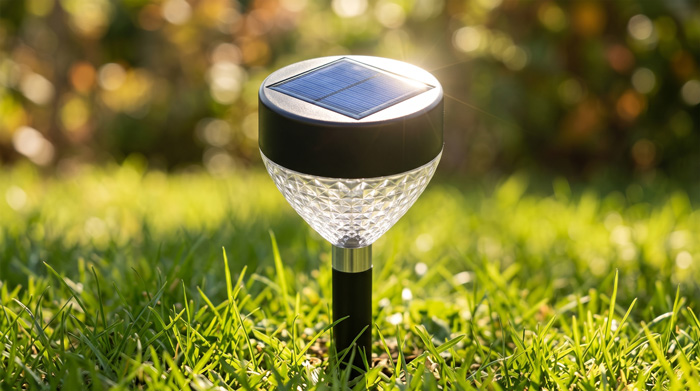
A 4-watt panel earns that rating under standard test conditions, including sunlight at 1,000 watts per square meter and a cell temperature of 25°C. In a garden, the sunlight striking the panel changes throughout the day. A panel facing open sky at noon has a different charging opportunity from one that spends the brightest hours behind a fence. Its wattage describes the power it can produce under the test conditions. The energy it collects over the day is measured in watt-hours.
The battery places a practical limit on the benefit. If it reaches full charge by early afternoon and already runs the light through dawn, a bigger panel has little to add that night. If the battery regularly reaches sunset only partly charged, extra panel capacity can make a visible difference later in the evening.
What determines brightness after sunset?
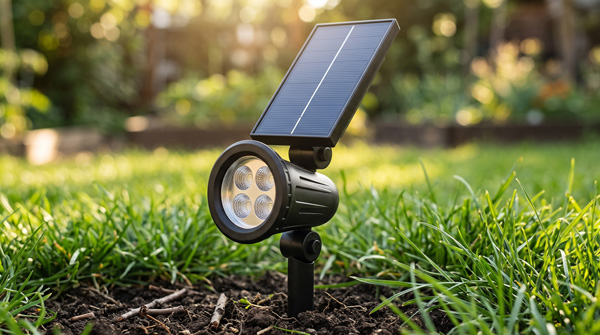
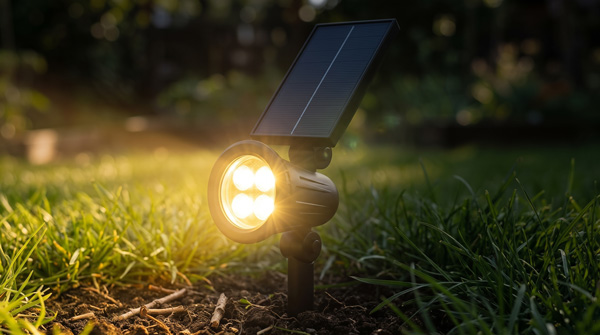
After dark, the battery supplies the lamp. In a regulated fixture, an LED driver controls the current delivered to the LEDs at the selected brightness setting. The LEDs’ efficacy, measured in lumens per watt, affects how much light they produce from that power. The lens, reflector, and cover then shape the beam and affect how much light leaves the housing. When comparing products, look for the lumen output of the complete fixture. A figure quoted for the bare LEDs can be higher than the output delivered through the finished optics.
A solar light can deliver fewer lumens than its bare LEDs because using a lens or reflector to shape the beam “reduces the total amount of emitted light” (U.S. Department of Energy, 2013, p. 3).
The controls also determine what you see as the battery runs down. One light may hold a steady output until it switches off. Another may reduce brightness to conserve its remaining charge. A third may be programmed to dim at a set time every night. Better daytime charging can delay a reduction triggered by low charge. A programmed step-down will still happen on schedule, even after a sunny day.
A 2-watt panel and a 4-watt panel on the same light
Imagine two garden lights with identical optics and a high setting of 200 lumens. Each draws 2 watts from its battery on high, including the driver, and each battery can supply 12 watt-hours of usable energy. The only difference is the panel.
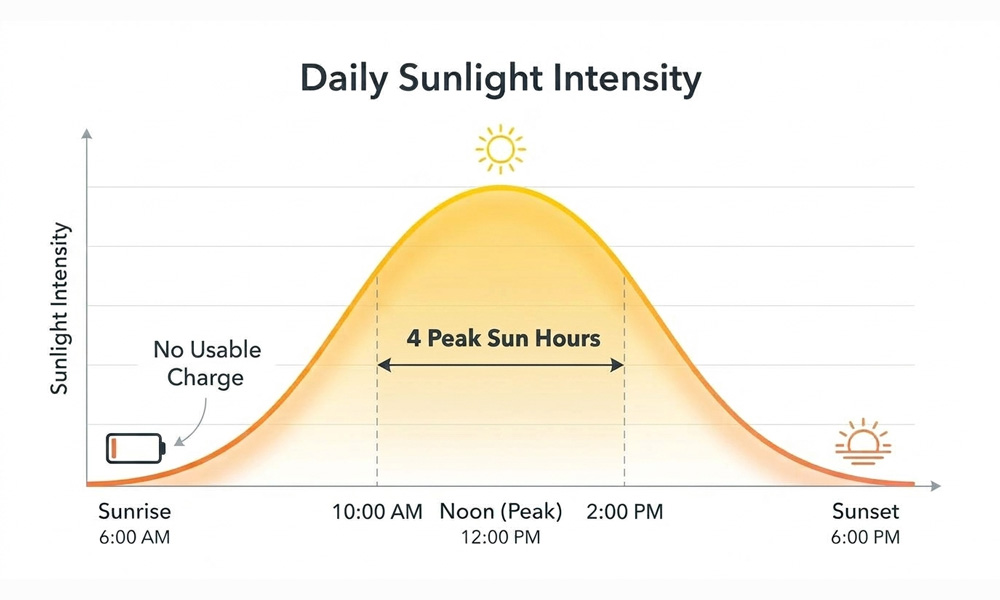
The shaded area represents sunlight accumulated from sunrise to sunset, equivalent to four hours at 1,000 W/m² and yielding an estimated 8 Wh from the 2 W panel or 16 Wh from the 4 W panel before losses.
Suppose both start the morning with no usable charge and receive four peak sun hours. That means the sunlight falling on each panel over the whole day adds up to the energy it would receive in four hours at standard full-sun intensity. Those four hours can accumulate across a much longer period of daylight. For this example, assume 75% of the calculated solar energy becomes usable battery energy. The percentage is an illustration, not a product rating.
| What happens that day and night | Light with a 2 W panel | Light with a 4 W panel |
|---|---|---|
| Usable energy added during the day | 2 W × 4 h × 75% = 6 Wh | 4 W × 4 h × 75% = 12 Wh |
| Light output when switched on high | 200 lumens | 200 lumens |
| Time at 200 lumens from that day’s charge | 3 hours | 6 hours |
| Time at 200 lumens if the battery starts the night full | 6 hours | 6 hours |
At dusk, the two lights cast the same beam. Four hours later, only the one with the larger panel is still lighting the path. If you need eight hours at that setting, the arithmetic changes the buying decision. A 2-watt lamp needs 16 usable watt-hours for eight hours of operation. Even the 4-watt panel in this example is paired with a battery that can supply only 12.
This is also why a battery rating in milliamp-hours needs a voltage alongside it. A 2,000 mAh battery rated at 1.2 volts stores about 2.4 Wh nominally. A 2,000 mAh battery rated at 3.2 volts stores about 6.4 Wh. Multiply amp-hours by nominal voltage to compare stored energy, and use the fixture’s tested runtime to judge how much of that energy is available in practice.
Why equal lumens can look different on a garden path
Lumens measure the total visible light a fixture emits. Lux measures the light reaching a surface. If 60 lumens land on two square meters of paving, the average illuminance is 30 lux. Spread those same 60 lumens over six square meters and the average falls to 10 lux. The center and edges of the beam can differ considerably from either average.
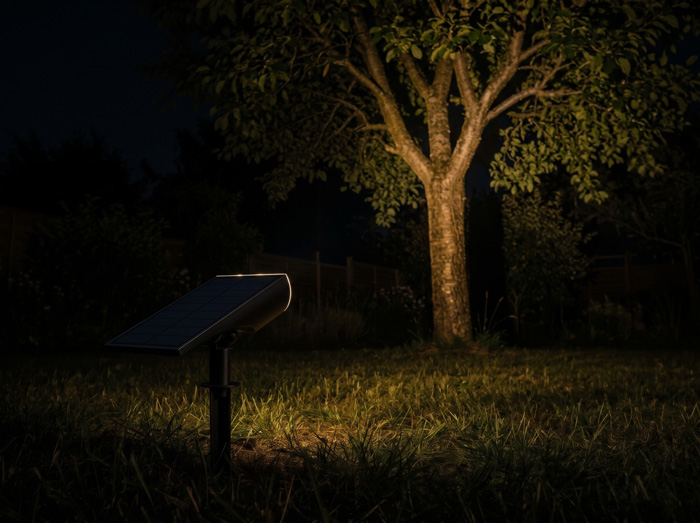
The beam angle of a spotlight helps explain why a compact solar fixture can make a tree trunk stand out while a higher-lumen lantern gives the whole bed a softer glow. The spotlight concentrates its output on a small target. Along a walkway, a broader downward beam may be more useful because it reveals the edges of the paving as well as the patch directly beneath the lamp.
When a product lists a lux figure, look for the measurement distance. A reading taken close to the lens tells you little about the light reaching a gate several feet away. For a path fixture, a diagram showing light levels across the ground at your intended mounting height is more informative than a photograph of the glowing lamp.
When a bigger panel is worth paying for
When the best place for the lamp gets poor sun. A small panel in open sunlight can collect more energy than a larger one charging in partial shade. Before buying, look at the proposed position in the morning, around midday, and in the afternoon. If the lamp belongs under a tree or porch roof, a model with a separate panel lets you light that spot while collecting sunlight beyond the shadow.
When the light needs to work through winter evenings. In places with pronounced seasonal changes, winter brings two demands at once. There is less solar energy available to recharge the battery, and the light may need to run for more hours. A larger panel can collect more during the available daylight. A larger usable battery gives the fixture a reserve through successive poor charging days. For year-round use, compare performance for the season when you rely on the light most.
When you need sustained brightness. A listing that promises “up to 500 lumens” and “up to 12 hours” leaves one question open. How long does it deliver 500 lumens? Brief bursts of high output may suit a side gate that people use a few times each night. A patio where people sit for an entire evening calls for a known continuous output. Compare lumens and runtime on the same setting, and check whether the runtime starts with a full battery or follows one stated day of solar charging. Those measurements answer different questions.
When comparing solar lights, look for “the light output (in lumens) for each setting tested” and check whether the runtime at that setting was measured from a fully charged battery or after one day of solar charging (VeraSol, 2026, pp. 7–8).
For the garden gate, a useful buying requirement might be as simple as “I need to see this latch from dusk until 11 p.m. in winter.” That gives you a target for the beam, a duration to check, and a season against which to judge the panel. It tells you far more about the light you need than panel dimensions alone.
FAQs
Can I replace the solar panel on an existing garden light with a bigger one?
Yes, if the light supports the replacement. When choosing a replacement solar panel for a garden light, check the charge controller’s permitted input voltage and current, along with the connector, polarity, and weather seal. Two plugs can fit together even when their electrical specifications differ. A panel listed for your exact model is the simplest way to confirm compatibility.
Can cleaning a solar garden light make it brighter?
It depends on which surface is dirty. Wiping the clear cover over the LED can improve the beam that same evening. Cleaning the solar panel helps the battery recover charge during the next period of sunlight. Use a soft cloth dampened with water on a cool surface, and loosen gritty dirt before wiping so it does not scratch the cover.
Are cool white solar lights brighter than warm white ones?
A 5,000 K light has a cooler, bluer appearance than a 2,700 K light. If both fixtures deliver 200 lumens, they emit the same measured amount of visible light. On a solar light with selectable white tones, check the lumen rating for the color setting you plan to use. Some fixtures vary in output as the mix of warm and cool LEDs changes.
Why does my solar light stay off when the porch light is on?
The porch light may be shining on the solar fixture’s dusk sensor. To check, switch off the porch light after dark and allow time for the solar light to respond. If it comes on, reposition the sensor or redirect the porch beam so the sensor can detect nightfall. Keep the panel exposed to daylight in its new position.
How far apart should solar path lights be for even coverage?
On a narrow garden walk, try spacing solar path lights about 6 to 8 feet apart, roughly 1.8 to 2.4 meters, as a starting point. Set out two lights first and inspect the paving halfway between them after dark. Move them closer if the path edge disappears into shadow or a bend interrupts the light. That trial accounts for the beam and mounting height of the fixtures you actually own.
